Introduction
Device Certificate Provisioning Tools help organizations securely generate, distribute, install, rotate, and manage digital certificates for connected devices, IoT endpoints, edge systems, industrial hardware, networking equipment, and embedded platforms. These tools are critical for establishing device identity, encrypted communication, secure onboarding, and Zero Trust security across distributed device environments.
As organizations deploy millions of connected devices across industrial systems, healthcare infrastructure, smart buildings, telecom networks, automotive systems, and edge computing environments, managing certificates manually becomes impractical and risky. Device certificates are commonly used for TLS authentication, mutual authentication, secure boot, encrypted communication, VPN access, API trust, and firmware verification.
Real-world use cases include:
- Provisioning certificates for IoT sensors and gateways
- Securing industrial edge device communication
- Managing certificate rotation for connected vehicles
- Enabling mutual TLS for embedded systems
- Automating certificate lifecycle management for smart infrastructure
Buyers evaluating Device Certificate Provisioning Tools should consider:
- Automated certificate enrollment and provisioning
- PKI integration capabilities
- Certificate lifecycle management
- Device identity and authentication support
- Hardware security module compatibility
- Scalability across large device fleets
- Secure manufacturing and onboarding workflows
- Compliance and audit reporting
- API and automation support
- Cloud, hybrid, and edge deployment compatibility
Best for: IoT security teams, PKI architects, embedded systems engineers, telecom providers, industrial operations teams, cloud security teams, automotive technology companies, medical device manufacturers, and enterprises managing connected device identity at scale.
Not ideal for: Small environments with only a few manually managed devices or organizations without any certificate-based authentication or device identity requirements.
Key Trends in Device Certificate Provisioning Tools
- Zero Trust device identity is becoming a major security requirement.
- Automated certificate rotation is replacing manual renewal workflows.
- Hardware-rooted trust and TPM integration are becoming more common.
- Secure manufacturing and factory provisioning workflows are growing rapidly.
- Mutual TLS authentication is increasingly used for IoT and edge systems.
- Device identity management is becoming tightly integrated with OTA update systems.
- Compliance and audit visibility are becoming more important in regulated industries.
- Cloud-native certificate provisioning workflows are expanding.
- Certificate lifecycle automation is reducing operational overhead.
- Edge and intermittent-connectivity certificate provisioning models are improving.
How We Selected These Tools
The tools in this list were selected based on certificate provisioning depth, PKI capabilities, scalability, ecosystem maturity, security controls, and operational practicality.
Selection criteria included:
- Automated certificate provisioning functionality
- Device identity management capabilities
- PKI and CA integration support
- Certificate lifecycle automation
- Security and hardware trust integration
- Scalability across large connected device fleets
- Compliance and audit visibility
- API and automation flexibility
- Cloud and edge deployment compatibility
- Suitability for industrial, enterprise, and IoT environments
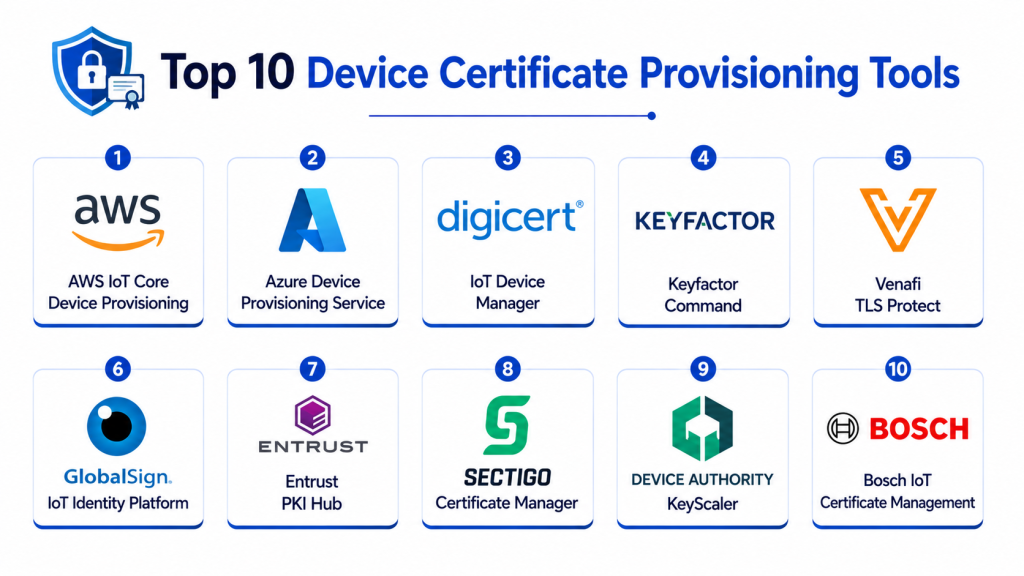
Top 10 Device Certificate Provisioning Tools
1- AWS IoT Core Device Provisioning
Short description: AWS IoT Core Device Provisioning helps organizations securely onboard and provision certificates for IoT devices connected to AWS environments. It supports automated enrollment workflows, policy management, and large-scale device identity operations.
Key Features
- Just-in-time device provisioning
- Certificate-based device authentication
- Automated onboarding workflows
- Fleet provisioning templates
- Device policy management
- Secure IoT onboarding
- Integration with AWS identity systems
Pros
- Strong AWS ecosystem integration
- Highly scalable provisioning workflows
- Good cloud-native automation support
Cons
- Best suited for AWS-centric environments
- Requires AWS architecture knowledge
- Pricing and scaling require planning
Platforms / Deployment
- Embedded devices / Linux / Edge gateways
- Cloud
Security & Compliance
- Device certificates
- Encryption
- IAM integration
- RBAC
- Audit logs
- Mutual TLS support
Integrations & Ecosystem
AWS IoT Core integrates deeply with cloud, security, analytics, and edge services.
- AWS IoT Core
- AWS Lambda
- AWS IoT Greengrass
- Amazon CloudWatch
- AWS IAM
- Security monitoring tools
Support & Community
AWS provides extensive documentation, enterprise support, training resources, and a large cloud developer ecosystem.
2- Azure Device Provisioning Service
Short description: Azure Device Provisioning Service automates secure enrollment and certificate provisioning for IoT devices connected to Microsoft Azure environments. It supports zero-touch onboarding and scalable device identity management.
Key Features
- Zero-touch provisioning
- X.509 certificate support
- TPM-based provisioning support
- Device enrollment groups
- Automated device registration
- Multi-hub assignment
- Secure device onboarding
Pros
- Strong Microsoft ecosystem integration
- Good enterprise identity workflows
- Scalable provisioning automation
Cons
- Best suited for Azure-centric environments
- Requires Azure operational expertise
- Advanced provisioning models can become complex
Platforms / Deployment
- Embedded devices / Linux / Windows / Edge gateways
- Cloud / Hybrid
Security & Compliance
- X.509 authentication
- TPM support
- Encryption
- RBAC
- Audit logs
- Microsoft Entra ID integration
Integrations & Ecosystem
Azure Device Provisioning Service integrates with cloud security, analytics, and edge environments.
- Azure IoT Hub
- Azure IoT Edge
- Microsoft Defender
- Azure Monitor
- Security workflows
- Enterprise applications
Support & Community
Strong Microsoft documentation, enterprise support plans, partner ecosystem, and training resources.
3- DigiCert Device Trust Manager
Short description: DigiCert Device Trust Manager helps organizations manage device identities, certificate provisioning, lifecycle automation, and secure authentication for connected devices and IoT infrastructure.
Key Features
- Automated certificate provisioning
- PKI lifecycle management
- Device identity control
- Certificate renewal automation
- Secure onboarding workflows
- Device trust visibility
- Policy-based certificate management
Pros
- Strong PKI and certificate expertise
- Good enterprise certificate automation
- Useful device trust visibility
Cons
- Enterprise-focused operational model
- Advanced integrations may require planning
- Pricing may not fit smaller deployments
Platforms / Deployment
- Embedded devices / Linux / Windows / IoT systems
- Cloud / Hybrid
Security & Compliance
- PKI integration
- Encryption
- Audit logs
- RBAC
- Device authentication
- Certificate lifecycle governance
Integrations & Ecosystem
DigiCert integrates with enterprise PKI, IoT infrastructure, and device security workflows.
- Enterprise PKI
- IoT platforms
- Edge infrastructure
- Identity systems
- APIs
- Security operations tools
Support & Community
Enterprise support, technical documentation, and certificate management expertise are available.
4- Keyfactor Command
Short description: Keyfactor Command is a PKI and certificate lifecycle automation platform that supports certificate provisioning, device identity management, and large-scale certificate operations across enterprise and IoT environments.
Key Features
- Certificate lifecycle automation
- PKI orchestration
- Device certificate provisioning
- Certificate discovery
- Renewal automation
- Compliance reporting
- API-driven certificate workflows
Pros
- Strong enterprise certificate automation
- Good multi-CA management support
- Useful compliance and governance features
Cons
- Enterprise deployment complexity
- Requires PKI knowledge
- Premium operational model
Platforms / Deployment
- Linux / Windows / Embedded systems
- Cloud / Self-hosted / Hybrid
Security & Compliance
- RBAC
- Audit logs
- Encryption
- PKI governance
- Device authentication
- Certificate policy controls
Integrations & Ecosystem
Keyfactor integrates with enterprise PKI, IoT infrastructure, and security ecosystems.
- Microsoft CA
- AWS environments
- Azure environments
- HSM platforms
- APIs
- Security workflows
Support & Community
Strong enterprise support, training, and certificate management ecosystem resources.
5- Venafi Control Plane
Short description: Venafi Control Plane helps organizations secure machine identities, automate certificate lifecycle management, and provision certificates across IoT, cloud, edge, and enterprise environments.
Key Features
- Machine identity management
- Certificate automation
- Policy enforcement
- Certificate discovery
- Lifecycle governance
- Device trust workflows
- Multi-environment certificate management
Pros
- Strong machine identity governance
- Good enterprise automation workflows
- Useful compliance visibility
Cons
- Enterprise-focused complexity
- Requires certificate management expertise
- Premium pricing model
Platforms / Deployment
- Linux / Windows / IoT systems
- Cloud / Hybrid
Security & Compliance
- RBAC
- Encryption
- Audit logs
- Certificate policy enforcement
- Machine identity governance
- Compliance reporting
Integrations & Ecosystem
Venafi integrates with enterprise security, PKI, and machine identity environments.
- Enterprise PKI
- Cloud platforms
- DevOps pipelines
- Security systems
- APIs
- HSM environments
Support & Community
Enterprise support, implementation guidance, and strong machine identity ecosystem expertise are available.
6- HashiCorp Vault PKI Secrets Engine
Short description: HashiCorp Vault provides dynamic certificate generation, secret management, and PKI automation workflows for cloud-native, edge, and IoT environments.
Key Features
- Dynamic certificate issuance
- PKI secrets engine
- Short-lived certificate support
- Secret management
- API-based certificate workflows
- Identity integration
- Automated certificate rotation
Pros
- Strong cloud-native flexibility
- Good API-driven automation
- Useful dynamic certificate workflows
Cons
- Requires DevOps and security expertise
- Operational complexity at scale
- Not purpose-built solely for IoT provisioning
Platforms / Deployment
- Linux / Kubernetes / Cloud infrastructure
- Cloud / Self-hosted / Hybrid
Security & Compliance
- Encryption
- RBAC
- Audit logs
- Secret management
- Dynamic certificate workflows
- Identity integration
Integrations & Ecosystem
Vault integrates with DevOps, Kubernetes, cloud-native, and infrastructure automation environments.
- Kubernetes
- CI/CD systems
- Cloud providers
- APIs
- Infrastructure automation tools
- Identity systems
Support & Community
Strong open-source community, enterprise support options, and cloud-native ecosystem adoption.
7- Entrust PKI and IoT Identity Platform
Short description: Entrust provides PKI and IoT identity solutions for secure device certificate provisioning, authentication, lifecycle management, and enterprise trust workflows.
Key Features
- PKI certificate management
- Device identity provisioning
- Secure onboarding workflows
- Certificate lifecycle automation
- Hardware trust support
- Compliance reporting
- Multi-environment identity management
Pros
- Strong enterprise PKI expertise
- Good compliance-focused workflows
- Useful hardware-backed trust support
Cons
- Enterprise operational complexity
- Requires PKI management expertise
- Premium enterprise pricing
Platforms / Deployment
- Linux / Windows / Embedded systems
- Cloud / Hybrid
Security & Compliance
- Encryption
- RBAC
- Audit logs
- Hardware trust integration
- Certificate governance
- Device authentication
Integrations & Ecosystem
Entrust integrates with enterprise identity, PKI, and security environments.
- Enterprise PKI
- HSM platforms
- Identity providers
- APIs
- IoT systems
- Security operations tools
Support & Community
Enterprise support, certificate management expertise, and implementation services are available.
8- EJBCA Enterprise
Short description: EJBCA Enterprise is a PKI platform used for certificate issuance, lifecycle management, IoT provisioning, and enterprise device identity workflows.
Key Features
- PKI certificate issuance
- Device identity provisioning
- Certificate lifecycle automation
- Multi-CA management
- Secure enrollment workflows
- Compliance reporting
- Flexible PKI architecture
Pros
- Strong PKI flexibility
- Useful IoT provisioning support
- Good enterprise customization capabilities
Cons
- Requires PKI expertise
- Advanced deployments can be complex
- Enterprise scaling requires planning
Platforms / Deployment
- Linux / Windows / Cloud infrastructure
- Cloud / Self-hosted / Hybrid
Security & Compliance
- Encryption
- RBAC
- Audit logs
- PKI governance
- Certificate policy controls
- Secure enrollment support
Integrations & Ecosystem
EJBCA integrates with enterprise PKI, IoT infrastructure, and security ecosystems.
- HSM systems
- Identity providers
- APIs
- Cloud platforms
- IoT environments
- Security operations workflows
Support & Community
Strong PKI community ecosystem, enterprise support options, and technical documentation.
9- Sectigo Certificate Manager
Short description: Sectigo Certificate Manager helps organizations automate certificate provisioning, lifecycle management, and device trust operations across enterprise and connected environments.
Key Features
- Automated certificate issuance
- Certificate discovery
- Lifecycle management
- Device certificate provisioning
- Renewal automation
- Policy management
- Certificate monitoring
Pros
- Good automation workflows
- Useful enterprise certificate visibility
- Broad certificate management support
Cons
- Enterprise feature complexity
- Advanced workflows may require customization
- PKI expertise recommended
Platforms / Deployment
- Linux / Windows / Embedded systems
- Cloud / Hybrid
Security & Compliance
- Encryption
- RBAC
- Audit logs
- Certificate governance
- Device trust support
- Policy controls
Integrations & Ecosystem
Sectigo integrates with enterprise security, cloud, and PKI ecosystems.
- Cloud platforms
- Enterprise PKI
- APIs
- Security systems
- Device environments
- Automation workflows
Support & Community
Enterprise support, certificate lifecycle expertise, and operational guidance are available.
10- Google Cloud Certificate Authority Service
Short description: Google Cloud Certificate Authority Service provides scalable certificate authority and certificate lifecycle workflows for cloud-native and connected device environments.
Key Features
- Managed certificate authority
- Certificate issuance workflows
- API-based provisioning
- Certificate lifecycle automation
- Scalable PKI operations
- Identity integration
- Cloud-native architecture
Pros
- Strong cloud scalability
- Good API-driven automation
- Useful managed PKI workflows
Cons
- Best suited for Google Cloud environments
- Less focused on complete IoT lifecycle management
- Requires cloud architecture expertise
Platforms / Deployment
- Cloud infrastructure / Embedded systems
- Cloud
Security & Compliance
- Encryption
- IAM integration
- Audit logs
- Managed CA controls
- Certificate governance
- RBAC
Integrations & Ecosystem
Google Cloud Certificate Authority Service integrates with cloud-native security and application ecosystems.
- Google Cloud
- Kubernetes
- APIs
- Cloud-native systems
- Security operations
- Identity workflows
Support & Community
Google Cloud provides enterprise support, technical documentation, and cloud ecosystem resources.
Comparison Table
| Tool Name | Best For | Platforms Supported | Deployment | Standout Feature | Public Rating |
|---|---|---|---|---|---|
| AWS IoT Core Device Provisioning | AWS IoT fleets | Embedded devices / Linux | Cloud | Fleet provisioning automation | N/A |
| Azure Device Provisioning Service | Enterprise IoT onboarding | Embedded devices / Linux / Windows | Cloud / Hybrid | Zero-touch device enrollment | N/A |
| DigiCert Device Trust Manager | Enterprise device trust management | Embedded devices / Linux / Windows | Cloud / Hybrid | PKI-driven device trust automation | N/A |
| Keyfactor Command | Enterprise certificate automation | Linux / Windows / Embedded systems | Cloud / Self-hosted / Hybrid | Multi-CA lifecycle management | N/A |
| Venafi Control Plane | Machine identity governance | Linux / Windows / IoT systems | Cloud / Hybrid | Enterprise machine identity security | N/A |
| HashiCorp Vault PKI Secrets Engine | Cloud-native certificate automation | Linux / Kubernetes | Cloud / Self-hosted / Hybrid | Dynamic certificate workflows | N/A |
| Entrust PKI and IoT Identity Platform | Enterprise PKI and IoT identity | Linux / Windows / Embedded systems | Cloud / Hybrid | Hardware-backed trust integration | N/A |
| EJBCA Enterprise | Flexible enterprise PKI | Linux / Windows / Cloud infrastructure | Cloud / Self-hosted / Hybrid | Customizable PKI architecture | N/A |
| Sectigo Certificate Manager | Automated certificate operations | Linux / Windows / Embedded systems | Cloud / Hybrid | Certificate lifecycle visibility | N/A |
| Google Cloud Certificate Authority Service | Cloud-native certificate operations | Cloud infrastructure / Embedded systems | Cloud | Managed scalable certificate authority | N/A |
Evaluation & Scoring of Device Certificate Provisioning Tools
| Tool Name | Core 25% | Ease 15% | Integrations 15% | Security 10% | Performance 10% | Support 10% | Value 15% | Weighted Total |
|---|---|---|---|---|---|---|---|---|
| AWS IoT Core Device Provisioning | 9.2 | 7.8 | 9.4 | 9.3 | 9.1 | 8.8 | 8.0 | 8.86 |
| Azure Device Provisioning Service | 9.1 | 7.9 | 9.2 | 9.2 | 9.0 | 8.7 | 8.1 | 8.82 |
| DigiCert Device Trust Manager | 8.9 | 7.6 | 8.8 | 9.4 | 8.8 | 8.8 | 7.7 | 8.63 |
| Keyfactor Command | 9.0 | 7.4 | 8.9 | 9.3 | 8.9 | 8.7 | 7.8 | 8.65 |
| Venafi Control Plane | 9.1 | 7.3 | 8.8 | 9.5 | 9.0 | 8.8 | 7.6 | 8.67 |
| HashiCorp Vault PKI Secrets Engine | 8.7 | 7.2 | 9.0 | 9.0 | 8.8 | 8.5 | 8.6 | 8.52 |
| Entrust PKI and IoT Identity Platform | 8.8 | 7.1 | 8.5 | 9.4 | 8.8 | 8.6 | 7.5 | 8.47 |
| EJBCA Enterprise | 8.6 | 7.0 | 8.4 | 9.1 | 8.7 | 8.3 | 8.5 | 8.34 |
| Sectigo Certificate Manager | 8.5 | 7.6 | 8.4 | 8.9 | 8.5 | 8.4 | 8.1 | 8.31 |
| Google Cloud Certificate Authority Service | 8.4 | 7.8 | 8.7 | 8.8 | 8.7 | 8.3 | 8.2 | 8.35 |
These scores are comparative and intended to help organizations evaluate operational fit rather than identify a universal winner. Cloud-native platforms score highly in scalability and automation, while PKI-focused platforms provide deeper governance and certificate lifecycle capabilities. Buyers should align platform selection with existing PKI architecture, IoT scale, compliance requirements, and operational expertise.
Which Device Certificate Provisioning Tool Is Right for You?
Solo / Freelancer
Solo developers and IoT engineers usually prioritize flexibility, APIs, and manageable operational overhead. HashiCorp Vault PKI Secrets Engine and EJBCA Enterprise are useful options for technically skilled teams building custom provisioning workflows.
SMB
SMBs often need automated provisioning, secure onboarding, and manageable certificate operations without excessive enterprise complexity. AWS IoT Core Device Provisioning, Azure Device Provisioning Service, and Sectigo Certificate Manager provide practical automation for growing connected device fleets.
Mid-Market
Mid-market organizations typically require stronger certificate lifecycle visibility, API integration, compliance support, and scalable onboarding workflows. DigiCert Device Trust Manager, Keyfactor Command, and HashiCorp Vault are strong options depending on PKI maturity and cloud strategy.
Enterprise
Large enterprises usually require centralized governance, multi-CA orchestration, audit visibility, hardware-backed trust, compliance reporting, and scalable machine identity management. Venafi Control Plane, Keyfactor Command, DigiCert Device Trust Manager, and Entrust are strong enterprise-focused solutions.
Budget vs Premium
Open-source and API-driven tools such as Vault and EJBCA can reduce licensing costs but require technical expertise. DigiCert, Venafi, Keyfactor, and Entrust are better suited for organizations prioritizing governance, enterprise support, and operational maturity.
Feature Depth vs Ease of Use
AWS and Azure simplify cloud-native IoT onboarding but are most effective within their ecosystems. PKI-focused platforms provide deeper governance but often require certificate management expertise. Vault provides flexibility for DevOps-oriented teams, while Venafi and Keyfactor emphasize enterprise policy control.
Integrations & Scalability
Organizations already invested in AWS, Azure, or Google Cloud should prioritize native provisioning ecosystems for operational simplicity. Enterprises with existing PKI environments may benefit more from DigiCert, Keyfactor, Entrust, Venafi, or EJBCA.
Security & Compliance Needs
Security-focused organizations should prioritize mutual TLS support, audit logging, RBAC, certificate rotation automation, hardware-backed trust, TPM integration, HSM compatibility, and lifecycle governance. Venafi, DigiCert, Entrust, Keyfactor, and AWS or Azure provisioning ecosystems are strong choices for governance-heavy environments.
Frequently Asked Questions
1. What is a Device Certificate Provisioning Tool?
A Device Certificate Provisioning Tool helps organizations securely issue, deploy, install, and manage digital certificates used for authenticating connected devices and encrypting communication.
2. Why are device certificates important?
Device certificates establish trusted device identity, enable encrypted communication, support mutual authentication, and help prevent unauthorized access to connected systems and IoT environments.
3. What is mutual TLS?
Mutual TLS is a security method where both the client device and server authenticate each other using certificates. It is commonly used in IoT, industrial systems, and secure device communication.
4. What is certificate lifecycle management?
Certificate lifecycle management includes issuing, renewing, rotating, revoking, monitoring, and auditing certificates throughout their operational lifespan.
5. Are these tools only for IoT devices?
No. Device certificate provisioning is also used for edge systems, industrial equipment, networking devices, automotive systems, medical devices, and machine identities in enterprise infrastructure.
6. What are common implementation mistakes?
Common mistakes include weak certificate rotation policies, poor inventory tracking, manual renewal processes, insecure onboarding workflows, weak private key protection, and insufficient audit visibility.
7. Can these tools improve security?
Yes. They strengthen device identity verification, enable encrypted communication, automate certificate governance, reduce expired certificate risk, and improve Zero Trust security models.
8. Should organizations choose cloud-native or PKI-focused platforms?
Cloud-native platforms simplify provisioning for devices already integrated into cloud ecosystems, while PKI-focused platforms provide stronger governance, multi-environment support, and advanced lifecycle control.
9. What integrations matter most?
Important integrations include PKI systems, HSMs, cloud platforms, IoT infrastructure, DevOps pipelines, device manufacturing workflows, identity providers, and security monitoring tools.
10. What should buyers evaluate before choosing a platform?
Buyers should evaluate scalability, provisioning automation, certificate lifecycle management, hardware trust integration, compliance support, API flexibility, cloud compatibility, audit visibility, support quality, and operational complexity.
Conclusion
Device Certificate Provisioning Tools are essential for organizations managing secure device identity across IoT, edge computing, industrial automation, networking infrastructure, and connected product environments. The right platform can simplify certificate issuance, automate lifecycle management, strengthen device authentication, improve encrypted communication, and reduce operational risk across distributed device fleets. AWS IoT Core Device Provisioning and Azure Device Provisioning Service are strong cloud-native choices for large-scale IoT environments, while DigiCert, Keyfactor, Venafi, and Entrust provide deeper enterprise PKI governance and machine identity management. HashiCorp Vault and EJBCA offer flexibility for DevOps and technically skilled teams, while Sectigo and Google Cloud Certificate Authority Service provide scalable certificate lifecycle automation. The best choice depends on PKI maturity, device scale, cloud strategy, compliance requirements, and operational expertise. Shortlist two or three platforms, validate provisioning workflows with real devices, test certificate rotation and recovery processes carefully, and ensure the chosen solution can securely scale with your long-term connected device strategy.
I think recovery planning deserves more attention. If a device loses its certificate or becomes inaccessible, organizations need a reliable way to restore trust without manual intervention.