Introduction
OTA Firmware Update Platforms help organizations remotely deploy firmware, software, operating system, and configuration updates to connected devices without requiring physical access. OTA, which stands for Over-the-Air, is widely used across IoT devices, automotive systems, industrial equipment, edge devices, smart appliances, healthcare technology, networking hardware, and embedded systems.
As connected device fleets continue to grow across industries, manual firmware updates become slow, expensive, and risky. Organizations need secure, scalable, and reliable ways to patch vulnerabilities, improve device performance, release new features, and maintain operational consistency across distributed environments. OTA platforms help reduce downtime, strengthen security, and simplify lifecycle management for millions of connected endpoints.
Real-world use cases include:
- Updating firmware on industrial IoT gateways
- Deploying security patches to connected medical devices
- Managing automotive software updates remotely
- Rolling out new features to smart consumer devices
- Updating Linux-based edge systems in remote environments
Buyers evaluating OTA Firmware Update Platforms should consider:
- Secure firmware delivery capabilities
- Rollback and recovery support
- Device authentication and encryption
- Fleet segmentation and staged rollouts
- Update monitoring and reporting
- Edge and offline update support
- Scalability across large device fleets
- Integration with IoT and cloud ecosystems
- Linux, RTOS, and embedded OS compatibility
- Compliance and audit visibility
Best for: IoT product teams, embedded systems engineers, automotive technology companies, industrial operations teams, medical device manufacturers, telecom providers, smart appliance vendors, edge computing teams, and enterprises managing large connected device fleets.
Not ideal for: Organizations with only a few manually updated devices or environments where firmware updates are performed physically without any requirement for centralized lifecycle management.
Key Trends in OTA Firmware Update Platforms
- Secure OTA update delivery is becoming a core cybersecurity requirement.
- Delta updates are reducing bandwidth usage for remote device fleets.
- Edge and intermittent-connectivity update workflows are becoming more important.
- Automotive and industrial OTA deployments are growing rapidly.
- Container-based edge application updates are increasingly integrated with firmware management.
- Rollback and recovery mechanisms are becoming mandatory for mission-critical systems.
- Device identity and certificate management are becoming tightly integrated with OTA workflows.
- Fleet-wide staged rollout strategies are reducing update-related operational risk.
- Compliance and software bill of materials visibility are becoming more important.
- AI-assisted monitoring is helping organizations detect failed updates and device anomalies faster.
How We Selected These Tools
The tools in this list were selected based on OTA deployment depth, scalability, security capabilities, ecosystem maturity, and operational flexibility.
Selection criteria included:
- Secure firmware deployment functionality
- Rollback and recovery support
- Device authentication and encryption features
- Fleet segmentation and staged rollout capabilities
- Scalability across large device environments
- Embedded and edge system compatibility
- Integration with cloud and IoT ecosystems
- Monitoring and reporting visibility
- Ease of deployment and administration
- Suitability for industrial, enterprise, automotive, and consumer IoT use cases
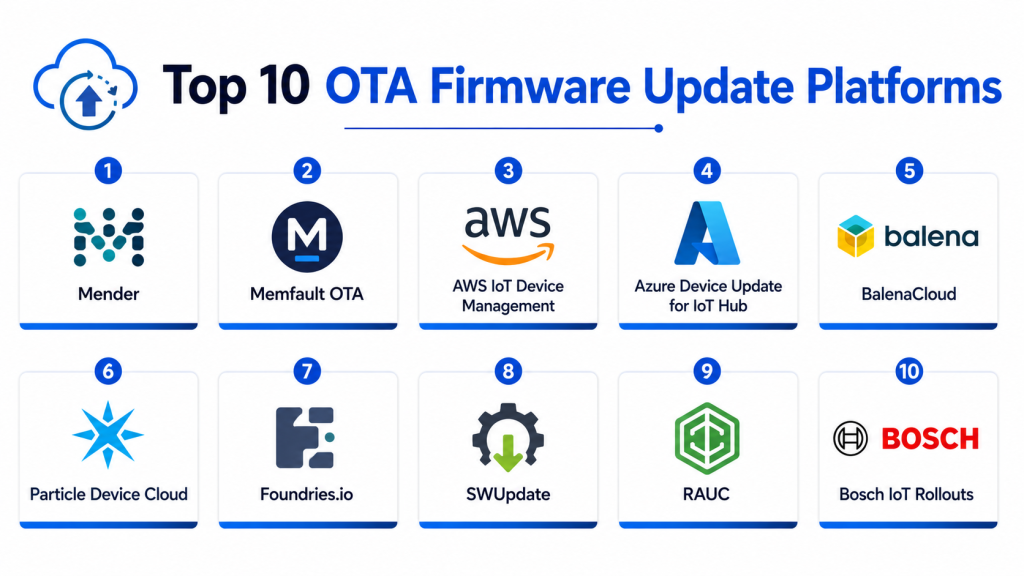
Top 10 OTA Firmware Update Platforms
1- Mender
Short description: Mender is a widely used open-source OTA update platform for embedded Linux and IoT devices. It helps organizations securely deploy firmware and software updates, monitor deployments, and manage rollback workflows across distributed edge fleets.
Key Features
- Secure OTA firmware deployment
- Automatic rollback support
- Staged update rollouts
- Device inventory tracking
- Delta update support
- Multi-device fleet management
- Embedded Linux compatibility
Pros
- Strong open-source ecosystem
- Reliable rollback mechanisms
- Good Linux edge device support
Cons
- Best suited for Linux-based environments
- Advanced customization may require expertise
- Enterprise scaling requires careful planning
Platforms / Deployment
- Linux / Embedded devices / Edge gateways
- Cloud / Self-hosted / Hybrid
Security & Compliance
- RBAC
- Encryption
- Device authentication
- Audit logs
- Secure update signing
- TLS communication support
Integrations & Ecosystem
Mender integrates with embedded Linux workflows, edge systems, and DevOps environments.
- Yocto Project
- Docker
- Kubernetes
- CI/CD platforms
- Edge gateways
- Cloud APIs
Support & Community
Strong open-source community, technical documentation, enterprise support options, and embedded systems ecosystem presence.
2- Balena
Short description: Balena provides remote management and OTA update capabilities for Linux-based IoT and edge devices. It simplifies containerized application deployment and remote lifecycle management for distributed device fleets.
Key Features
- Container-based OTA updates
- Fleet monitoring
- Remote diagnostics
- Secure device management
- CI/CD integration
- Device grouping
- Remote application deployment
Pros
- Excellent developer experience
- Strong container deployment workflows
- Good for distributed Linux edge fleets
Cons
- Best suited for Linux devices
- Requires container knowledge
- Less focused on non-Linux embedded systems
Platforms / Deployment
- Linux / Raspberry Pi / Embedded devices
- Cloud / Self-hosted options vary
Security & Compliance
- Encryption
- Device authentication
- Access controls
- Secure update workflows
- Audit visibility varies by plan
Integrations & Ecosystem
Balena integrates with edge development workflows and Linux application environments.
- Docker
- Git workflows
- Cloud APIs
- Edge gateways
- CI/CD systems
- Custom applications
Support & Community
Strong developer community, practical documentation, and support resources for edge and IoT teams.
3- AWS IoT Device Management Jobs
Short description: AWS IoT Device Management Jobs enables organizations to remotely deploy updates, configurations, and maintenance actions across connected IoT devices managed through AWS cloud services.
Key Features
- Remote firmware deployment
- Device grouping and targeting
- Fleet-wide update orchestration
- Secure update workflows
- Monitoring and status tracking
- Job scheduling
- Cloud-scale fleet support
Pros
- Strong AWS ecosystem integration
- Highly scalable cloud infrastructure
- Good enterprise fleet visibility
Cons
- Best suited for AWS environments
- Requires AWS operational expertise
- Pricing can become complex at scale
Platforms / Deployment
- Embedded devices / Linux / Edge gateways
- Cloud
Security & Compliance
- IAM integration
- Device certificates
- Encryption
- RBAC
- Audit logs
- Secure communication channels
Integrations & Ecosystem
AWS IoT Jobs integrates deeply with AWS cloud and IoT infrastructure services.
- AWS IoT Core
- AWS Lambda
- CloudWatch
- S3
- IoT Greengrass
- Analytics services
Support & Community
AWS provides extensive technical documentation, training resources, enterprise support, and cloud developer ecosystem access.
4- Azure Device Update for IoT Hub
Short description: Azure Device Update for IoT Hub provides secure OTA update management for IoT and edge devices connected through Microsoft Azure environments. It supports staged rollouts, compliance visibility, and device update orchestration.
Key Features
- Secure OTA update delivery
- Device grouping and segmentation
- Staged deployment workflows
- Compliance visibility
- Update reporting dashboards
- Rollback support
- Cloud-integrated device management
Pros
- Strong Microsoft ecosystem integration
- Good update compliance visibility
- Useful enterprise cloud scalability
Cons
- Best suited for Azure-centric environments
- Requires Azure architecture knowledge
- Advanced deployments may become complex
Platforms / Deployment
- Linux / Embedded devices / Edge gateways
- Cloud / Hybrid
Security & Compliance
- Encryption
- RBAC
- Audit logs
- Device authentication
- Microsoft Entra ID integration
- Secure update verification
Integrations & Ecosystem
Azure Device Update integrates with Microsoft cloud, security, and IoT ecosystems.
- Azure IoT Hub
- Azure IoT Edge
- Microsoft Defender
- Azure Monitor
- Power BI
- Cloud automation services
Support & Community
Strong Microsoft enterprise documentation, support plans, training, and partner ecosystem availability.
5- SWUpdate
Short description: SWUpdate is an open-source software update framework for embedded systems and Linux devices. It helps organizations implement secure and customizable OTA update workflows for connected devices.
Key Features
- Embedded firmware updates
- Rollback support
- Delta update options
- Signed update packages
- Flexible update scripting
- Linux system compatibility
- Custom deployment workflows
Pros
- Open-source flexibility
- Strong embedded Linux support
- Highly customizable update workflows
Cons
- Requires embedded systems expertise
- Less turnkey than commercial platforms
- Enterprise support depends on implementation model
Platforms / Deployment
- Linux / Embedded systems
- Self-hosted / Hybrid
Security & Compliance
- Signed update verification
- Encryption support
- Secure update delivery
- Audit visibility varies by setup
- Compliance features depend on implementation
Integrations & Ecosystem
SWUpdate integrates with embedded Linux ecosystems and custom OTA workflows.
- Yocto Project
- Buildroot
- Embedded Linux systems
- CI/CD pipelines
- Edge gateways
- Custom deployment systems
Support & Community
Strong technical documentation and open-source community support for embedded Linux developers.
6- RAUC
Short description: RAUC is an open-source OTA update framework focused on robust embedded Linux system updates. It is designed for secure and reliable firmware delivery with rollback and redundancy support.
Key Features
- Redundant update partitions
- Secure firmware updates
- Rollback support
- Signed bundle verification
- Embedded Linux integration
- Atomic update workflows
- System integrity validation
Pros
- Strong reliability and rollback design
- Good secure update workflows
- Useful for embedded Linux systems
Cons
- Requires Linux and embedded expertise
- Less complete as a full device management platform
- Enterprise support depends on ecosystem vendors
Platforms / Deployment
- Linux / Embedded systems
- Self-hosted / Hybrid
Security & Compliance
- Signed bundles
- Encryption support
- Secure update verification
- Device integrity validation
- Audit features vary by deployment
Integrations & Ecosystem
RAUC integrates with embedded Linux workflows and secure device environments.
- Yocto Project
- Buildroot
- Embedded Linux
- CI/CD systems
- Edge gateways
- Custom deployment workflows
Support & Community
Active open-source community, technical documentation, and embedded systems ecosystem resources.
7- Particle
Short description: Particle provides OTA firmware updates, fleet monitoring, and cloud-connected lifecycle management for connected product teams building IoT devices and smart products.
Key Features
- OTA firmware deployment
- Device fleet management
- Cloud APIs
- Device monitoring
- Connectivity management
- Remote diagnostics
- Product lifecycle support
Pros
- Strong connected product workflows
- Good hardware-to-cloud integration
- Useful developer ecosystem
Cons
- Best value comes with Particle hardware ecosystem
- Less suited for industrial-scale infrastructure
- Advanced enterprise integrations may require customization
Platforms / Deployment
- Embedded devices / Web
- Cloud
Security & Compliance
- Device authentication
- Encryption
- Access controls
- Secure firmware delivery
- Compliance details not publicly stated
Integrations & Ecosystem
Particle integrates hardware, connectivity, cloud APIs, and application environments.
- Particle hardware
- Cloud APIs
- Webhooks
- Mobile applications
- Backend systems
- Analytics workflows
Support & Community
Strong developer documentation, active product development community, and support resources.
8- FoundriesFactory
Short description: FoundriesFactory is a secure Linux device lifecycle platform focused on OTA updates, fleet security, and embedded edge management for connected Linux systems.
Key Features
- Secure OTA updates
- Linux edge lifecycle management
- Device provisioning
- Secure boot support
- Fleet monitoring
- Container deployment support
- CI/CD integration
Pros
- Strong Linux security focus
- Useful secure update mechanisms
- Good embedded edge lifecycle management
Cons
- Linux-focused deployment model
- Requires embedded systems expertise
- Smaller ecosystem than hyperscale cloud vendors
Platforms / Deployment
- Linux / Embedded devices
- Cloud / Hybrid
Security & Compliance
- Secure boot
- Encryption
- Device authentication
- RBAC
- Audit logging support
Integrations & Ecosystem
FoundriesFactory integrates with Linux edge, embedded security, and CI/CD workflows.
- Linux distributions
- Embedded hardware
- CI/CD systems
- Containers
- APIs
- Secure hardware workflows
Support & Community
Technical documentation, embedded Linux guidance, and support services are available.
9- Memfault
Short description: Memfault combines OTA firmware management with device observability, crash reporting, diagnostics, and embedded system monitoring for connected devices and edge products.
Key Features
- OTA firmware deployment
- Device diagnostics
- Crash reporting
- Performance monitoring
- Fleet observability
- Remote debugging support
- Embedded telemetry collection
Pros
- Strong device diagnostics visibility
- Good developer-focused tooling
- Useful embedded monitoring workflows
Cons
- More focused on observability than complete device lifecycle management
- Requires engineering expertise
- Enterprise-scale orchestration may require integrations
Platforms / Deployment
- Embedded devices / Linux / RTOS
- Cloud
Security & Compliance
- Encryption
- Access controls
- Device authentication support
- Audit visibility varies by deployment
- Compliance details not publicly stated
Integrations & Ecosystem
Memfault integrates with embedded systems development and monitoring workflows.
- Embedded operating systems
- CI/CD systems
- Cloud analytics
- Mobile applications
- Device telemetry systems
- APIs
Support & Community
Strong embedded developer resources, documentation, and modern device engineering ecosystem support.
10- Resin.io Legacy Ecosystem and OpenBalena
Short description: OpenBalena extends the Balena ecosystem for self-hosted OTA and edge device management environments. It allows organizations to manage Linux edge devices with greater deployment flexibility and operational control.
Key Features
- Self-hosted OTA updates
- Linux device fleet management
- Containerized application deployment
- Remote diagnostics
- Device grouping
- Edge application lifecycle management
- Secure update workflows
Pros
- Open-source deployment flexibility
- Good Linux edge management support
- Useful for self-hosted environments
Cons
- Requires DevOps and container expertise
- Less turnkey than fully managed platforms
- Enterprise governance requires planning
Platforms / Deployment
- Linux / Embedded devices
- Self-hosted / Hybrid
Security & Compliance
- Encryption
- Device authentication
- Access controls
- Secure update support
- Audit visibility varies by setup
Integrations & Ecosystem
OpenBalena integrates with Linux edge, containerized applications, and DevOps environments.
- Docker
- Git workflows
- Edge gateways
- APIs
- CI/CD systems
- Linux edge devices
Support & Community
Community-driven support, technical documentation, and open-source ecosystem resources are available.
Comparison Table
| Tool Name | Best For | Platforms Supported | Deployment | Standout Feature | Public Rating |
|---|---|---|---|---|---|
| Mender | Linux IoT fleets | Linux / Embedded devices | Cloud / Self-hosted / Hybrid | Reliable rollback support | N/A |
| Balena | Containerized edge fleets | Linux / Embedded devices | Cloud / Self-hosted options vary | Container-based OTA workflows | N/A |
| AWS IoT Device Management Jobs | Cloud-scale IoT fleets | Embedded devices / Linux | Cloud | Cloud-native fleet orchestration | N/A |
| Azure Device Update for IoT Hub | Enterprise IoT updates | Linux / Embedded devices | Cloud / Hybrid | Compliance-focused staged rollouts | N/A |
| SWUpdate | Embedded Linux customization | Linux / Embedded systems | Self-hosted / Hybrid | Flexible update scripting | N/A |
| RAUC | Secure embedded Linux updates | Linux / Embedded systems | Self-hosted / Hybrid | Atomic update reliability | N/A |
| Particle | Connected product teams | Embedded devices / Web | Cloud | Hardware-to-cloud lifecycle workflows | N/A |
| FoundriesFactory | Secure Linux edge management | Linux / Embedded devices | Cloud / Hybrid | Secure OTA lifecycle security | N/A |
| Memfault | Embedded observability and updates | Embedded devices / Linux / RTOS | Cloud | Firmware diagnostics visibility | N/A |
| OpenBalena | Self-hosted Linux edge updates | Linux / Embedded devices | Self-hosted / Hybrid | Open-source edge deployment flexibility | N/A |
Evaluation & Scoring of OTA Firmware Update Platforms
| Tool Name | Core 25% | Ease 15% | Integrations 15% | Security 10% | Performance 10% | Support 10% | Value 15% | Weighted Total |
|---|---|---|---|---|---|---|---|---|
| Mender | 9.1 | 8.0 | 8.6 | 9.0 | 8.8 | 8.5 | 8.9 | 8.74 |
| Balena | 8.8 | 8.7 | 8.3 | 8.4 | 8.6 | 8.3 | 8.8 | 8.60 |
| AWS IoT Device Management Jobs | 9.3 | 7.6 | 9.4 | 9.2 | 9.2 | 8.8 | 8.0 | 8.86 |
| Azure Device Update for IoT Hub | 9.1 | 7.8 | 9.2 | 9.1 | 9.0 | 8.7 | 8.1 | 8.79 |
| SWUpdate | 8.4 | 7.1 | 7.8 | 8.6 | 8.5 | 7.8 | 9.0 | 8.15 |
| RAUC | 8.5 | 7.2 | 7.7 | 8.9 | 8.7 | 7.9 | 8.8 | 8.24 |
| Particle | 8.3 | 8.6 | 8.1 | 8.0 | 8.2 | 8.2 | 8.7 | 8.32 |
| FoundriesFactory | 8.6 | 7.5 | 7.9 | 9.0 | 8.6 | 8.0 | 8.4 | 8.30 |
| Memfault | 8.1 | 8.2 | 7.8 | 8.1 | 8.5 | 8.3 | 8.5 | 8.16 |
| OpenBalena | 8.0 | 7.4 | 7.9 | 8.3 | 8.3 | 7.7 | 8.9 | 8.08 |
These scores are comparative and intended to help organizations evaluate operational fit rather than identify a universal winner. Enterprise cloud platforms score highly in scalability and ecosystem integrations, while open-source and Linux-focused platforms often provide stronger flexibility and cost efficiency. Buyers should align platform selection with operating systems, update reliability requirements, security expectations, and internal engineering maturity.
Which OTA Firmware Update Platform Is Right for You?
Solo / Freelancer
Solo developers and embedded engineers often prioritize flexibility, affordability, and Linux compatibility. Mender, SWUpdate, RAUC, and OpenBalena are practical choices for small-scale embedded and edge device projects.
SMB
SMBs typically need reliable remote updates, monitoring visibility, and manageable operational workflows without excessive complexity. Balena, Particle, Mender, and Memfault provide strong value for connected product and edge environments.
Mid-Market
Mid-market organizations often require stronger security controls, staged deployments, cloud integrations, and fleet visibility. AWS IoT Device Management Jobs, Azure Device Update, Balena, and FoundriesFactory are good options depending on infrastructure strategy.
Enterprise
Large enterprises usually need high-scale rollout orchestration, compliance reporting, rollback safety, audit visibility, and integration with cloud or industrial ecosystems. AWS IoT Device Management Jobs, Azure Device Update, Mender Enterprise, and FoundriesFactory are strong enterprise-focused options.
Budget vs Premium
Open-source tools such as SWUpdate, RAUC, and OpenBalena may appeal to budget-conscious teams with strong embedded expertise. AWS, Azure, Mender Enterprise, and FoundriesFactory are better suited for organizations prioritizing governance, support, and large-scale operational reliability.
Feature Depth vs Ease of Use
AWS and Azure provide broad ecosystem integration but require cloud architecture knowledge. Mender balances usability with enterprise-grade OTA reliability, while Balena is highly developer-friendly for Linux edge deployments. SWUpdate and RAUC offer deep customization but require embedded Linux expertise.
Integrations & Scalability
Organizations already using AWS or Azure should prioritize their native OTA ecosystems. Linux-focused edge teams may prefer Mender, Balena, FoundriesFactory, or OpenBalena, while embedded engineering teams requiring secure redundancy may benefit from RAUC.
Security & Compliance Needs
Security-focused organizations should prioritize signed firmware verification, encrypted delivery, rollback support, audit logging, secure boot compatibility, certificate-based device authentication, and staged deployment controls. AWS, Azure, Mender, FoundriesFactory, and RAUC are strong choices for governance-heavy environments.
Frequently Asked Questions
1. What is an OTA Firmware Update Platform?
An OTA Firmware Update Platform allows organizations to remotely deploy firmware, software, operating system, and configuration updates to connected devices without requiring physical access.
2. Why are OTA updates important?
OTA updates help organizations fix security vulnerabilities, improve functionality, deploy new features, reduce operational costs, and maintain device consistency across distributed fleets.
3. What is rollback support in OTA systems?
Rollback support allows devices to automatically revert to a previous working firmware version if an update fails. This helps reduce downtime and prevents devices from becoming unusable.
4. What are staged rollouts?
Staged rollouts allow updates to be deployed gradually across groups of devices instead of all at once. This reduces operational risk and helps detect issues before large-scale deployment.
5. Are OTA platforms only for IoT devices?
No. OTA updates are also used in automotive systems, industrial equipment, edge servers, networking devices, medical systems, and connected consumer electronics.
6. What operating systems are commonly supported?
Many OTA platforms support embedded Linux, Ubuntu Core, Yocto-based systems, RTOS environments, and containerized edge operating systems. Compatibility varies by platform.
7. What are common implementation mistakes?
Common mistakes include skipping rollback testing, weak device authentication, poor fleet segmentation, insufficient monitoring, insecure firmware signing, and deploying updates too broadly without validation.
8. Can OTA platforms improve security?
Yes. They help organizations quickly patch vulnerabilities, enforce signed updates, secure firmware delivery, manage device identities, and maintain operational consistency across device fleets.
9. Should organizations choose open-source or managed OTA platforms?
Open-source tools provide flexibility and customization but require engineering expertise. Managed platforms simplify operations, scaling, monitoring, and support for enterprise environments.
10. What should buyers evaluate before selecting an OTA platform?
Buyers should evaluate rollback reliability, update security, scalability, operating system support, connectivity requirements, monitoring visibility, staged deployment controls, cloud integrations, support quality, and operational complexity.
Conclusion
OTA Firmware Update Platforms are essential for organizations managing connected devices, embedded systems, industrial infrastructure, edge computing environments, and smart products at scale. The right platform can simplify remote updates, improve security patching, reduce operational downtime, strengthen device lifecycle management, and improve overall fleet reliability. AWS IoT Device Management Jobs and Azure Device Update are strong enterprise cloud-native choices, while Mender provides excellent Linux-focused OTA workflows with reliable rollback support. Balena and OpenBalena are highly useful for containerized edge environments, while SWUpdate and RAUC offer strong flexibility for embedded Linux engineering teams. Particle supports connected product development, FoundriesFactory focuses on secure Linux edge lifecycle management, and Memfault adds strong firmware observability capabilities. The best choice depends on operating system compatibility, device scale, security requirements, engineering maturity, and cloud strategy. Shortlist two or three platforms, validate update reliability on real hardware, test rollback and recovery workflows carefully, and ensure the chosen solution can scale securely with your future connected device roadmap.
I think bandwidth optimization deserves more discussion. Incremental updates can make a significant difference when managing devices across multiple locations.