Introduction
Edge Device Management Tools help organizations deploy, monitor, update, secure, and manage devices operating at the edge of networks, closer to where data is generated and processed. These tools are used to manage gateways, industrial computers, IoT appliances, retail systems, smart cameras, edge servers, AI devices, remote sensors, and embedded systems distributed across factories, stores, hospitals, vehicles, branch offices, and field locations.
As businesses increasingly adopt edge computing for real-time analytics, AI inference, automation, and low-latency applications, managing distributed edge infrastructure has become a major operational challenge. Organizations need centralized visibility into device health, application versions, connectivity, security posture, firmware updates, and operational performance across thousands of remote endpoints.
Real-world use cases include:
- Managing edge AI devices in manufacturing environments
- Updating remote retail and branch office systems
- Monitoring edge gateways in logistics and transportation
- Running remote diagnostics on industrial edge hardware
- Deploying containerized applications to distributed edge fleets
Buyers evaluating Edge Device Management Tools should consider:
- Remote device monitoring capabilities
- Firmware and software update management
- Container and application deployment support
- Security and identity controls
- Edge analytics and telemetry visibility
- Connectivity and offline operation support
- Multi-cloud and hybrid deployment compatibility
- Scalability across distributed environments
- API and automation support
- Compliance and audit reporting
Best for: Edge computing teams, IoT architects, DevOps teams, industrial operations teams, telecom providers, retailers, healthcare organizations, logistics companies, smart city operators, and enterprises managing distributed edge infrastructure.
Not ideal for: Small businesses with only a few unmanaged edge systems or organizations that rely entirely on centralized cloud processing without distributed edge infrastructure.
Key Trends in Edge Device Management Tools
- Edge AI and real-time analytics are increasing demand for scalable edge management platforms.
- Containerized edge application deployment is becoming standard across distributed environments.
- Secure remote updates are now critical for edge infrastructure operations.
- Zero Trust security models are being applied to edge devices and gateways.
- Offline and intermittent connectivity support is becoming increasingly important.
- Edge observability and telemetry integration are improving operational visibility.
- Fleet-wide automation is reducing manual maintenance for remote sites.
- Hybrid cloud and edge orchestration platforms are gaining popularity.
- Industrial and ruggedized edge deployments are expanding rapidly.
- Sustainability and remote lifecycle management are extending device operational lifespan.
How We Selected These Tools
The tools in this list were selected based on edge device management depth, scalability, operational maturity, ecosystem support, and practical deployment value.
Selection criteria included:
- Remote device management functionality
- Firmware and application deployment capabilities
- Container and edge orchestration support
- Security and identity management features
- Telemetry and monitoring visibility
- Multi-platform and hardware compatibility
- Scalability across distributed edge fleets
- Integration with cloud and IoT ecosystems
- Ease of deployment and administration
- Suitability for industrial, enterprise, and IoT environments
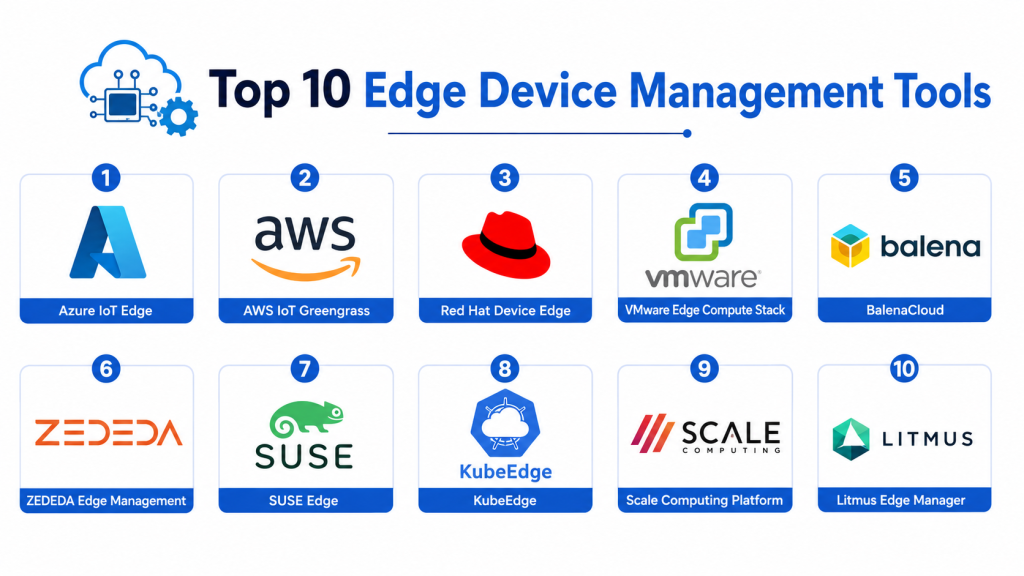
Top 10 Edge Device Management Tools
1- Azure IoT Edge
Short description: Azure IoT Edge extends Azure cloud capabilities to edge devices, allowing organizations to deploy workloads, analytics, AI models, and services directly onto distributed edge infrastructure. It is commonly used in industrial and enterprise IoT environments.
Key Features
- Edge application deployment
- Container orchestration support
- AI and analytics at the edge
- Remote monitoring and diagnostics
- Device provisioning workflows
- Secure communication channels
- Integration with Azure cloud services
Pros
- Strong Microsoft ecosystem integration
- Good AI and analytics support
- Enterprise-grade scalability
Cons
- Best suited for Azure-centric environments
- Requires cloud and edge expertise
- Advanced deployments can become complex
Platforms / Deployment
- Linux / Windows / Edge gateways
- Cloud / Hybrid
Security & Compliance
- RBAC
- Encryption
- Audit logs
- Device authentication
- Microsoft Entra ID integration
- Secure edge runtime support
Integrations & Ecosystem
Azure IoT Edge integrates deeply with cloud analytics, AI, security, and operational systems.
- Azure IoT Hub
- Azure AI services
- Azure Functions
- Power BI
- Microsoft Defender
- Industrial systems
Support & Community
Microsoft provides enterprise documentation, training, support plans, and strong developer resources.
2- AWS IoT Greengrass
Short description: AWS IoT Greengrass enables organizations to run cloud capabilities, local messaging, machine learning inference, and edge applications directly on connected edge devices.
Key Features
- Local edge processing
- Edge application deployment
- Device shadow functionality
- Machine learning inference
- Secure messaging
- Fleet management support
- Lambda integration
Pros
- Strong cloud-to-edge integration
- Good edge AI support
- Highly scalable architecture
Cons
- Best suited for AWS-centric organizations
- Pricing can become complex
- Requires AWS operational knowledge
Platforms / Deployment
- Linux / Embedded devices / Edge gateways
- Cloud / Hybrid
Security & Compliance
- Encryption
- Device certificates
- IAM integration
- RBAC
- Audit logging
- Secure device communication
Integrations & Ecosystem
Greengrass integrates deeply with AWS cloud, analytics, security, and automation services.
- AWS IoT Core
- AWS Lambda
- Amazon S3
- CloudWatch
- SageMaker
- Kinesis
Support & Community
AWS provides extensive technical documentation, training resources, enterprise support, and developer community access.
3- Balena
Short description: Balena is an edge device management platform focused on Linux-based IoT and edge systems. It simplifies container deployment, remote updates, diagnostics, and lifecycle management across distributed device fleets.
Key Features
- Containerized edge deployment
- Remote OS updates
- Fleet monitoring
- Secure remote access
- Device health monitoring
- CI/CD support for edge devices
- Device grouping and tagging
Pros
- Excellent developer experience
- Strong container management workflows
- Good for distributed Linux edge fleets
Cons
- Best suited for Linux environments
- Requires container knowledge
- Less focused on industrial protocol management
Platforms / Deployment
- Linux / Embedded devices / Raspberry Pi
- Cloud / Self-hosted options vary
Security & Compliance
- Device authentication
- Encryption
- Access controls
- Secure update mechanisms
- Audit visibility varies by plan
Integrations & Ecosystem
Balena integrates with DevOps workflows, edge hardware, and cloud application environments.
- Docker
- Git workflows
- Raspberry Pi
- Edge gateways
- APIs
- Custom applications
Support & Community
Strong developer documentation, active community ecosystem, and practical support resources.
4- Portainer
Short description: Portainer is a lightweight container management platform widely used for edge container administration. It supports Kubernetes, Docker, and edge deployment workflows across distributed infrastructure.
Key Features
- Edge container management
- Kubernetes support
- Docker management
- Remote endpoint administration
- Role-based access control
- Cluster monitoring
- Edge deployment management
Pros
- Simple and user-friendly interface
- Strong container ecosystem support
- Good for distributed container fleets
Cons
- Focused primarily on containers
- Less complete as a full IoT lifecycle platform
- Advanced industrial workflows require integrations
Platforms / Deployment
- Linux / Windows / Kubernetes / Docker
- Cloud / Self-hosted / Hybrid
Security & Compliance
- RBAC
- Encryption
- Audit logs
- Authentication support
- SSO integration varies by edition
Integrations & Ecosystem
Portainer integrates with container orchestration and cloud-native edge environments.
- Docker
- Kubernetes
- K3s
- Edge clusters
- CI/CD tools
- APIs
Support & Community
Large open-source community, strong documentation, and commercial support options are available.
5- VMware Edge Compute Stack
Short description: VMware Edge Compute Stack provides enterprise-grade edge infrastructure management, virtualization, orchestration, and application deployment for distributed edge computing environments.
Key Features
- Edge virtualization
- Kubernetes orchestration
- Centralized edge management
- Secure edge operations
- AI and analytics support
- Multi-site administration
- Infrastructure automation
Pros
- Strong enterprise virtualization support
- Good hybrid cloud integration
- Useful for large-scale edge deployments
Cons
- Enterprise-focused complexity
- Premium pricing
- Requires VMware ecosystem knowledge
Platforms / Deployment
- Linux / Edge servers / Virtualized infrastructure
- Cloud / Hybrid
Security & Compliance
- RBAC
- Encryption
- Audit logs
- Secure access controls
- Compliance visibility
Integrations & Ecosystem
VMware Edge Compute Stack integrates with virtualization, networking, and cloud management ecosystems.
- VMware Tanzu
- VMware vSphere
- Kubernetes
- Cloud platforms
- SD-WAN environments
- Enterprise operations tools
Support & Community
VMware provides enterprise support, training resources, partner ecosystem, and infrastructure expertise.
6- KubeEdge
Short description: KubeEdge is an open-source edge computing platform extending Kubernetes to edge environments. It enables container orchestration, device communication, and cloud-edge coordination for distributed infrastructure.
Key Features
- Kubernetes-based edge orchestration
- Cloud-edge synchronization
- Offline edge support
- Device communication management
- Edge node management
- Container deployment
- Event-driven architecture
Pros
- Strong Kubernetes alignment
- Open-source flexibility
- Good offline operation support
Cons
- Requires Kubernetes expertise
- Enterprise support depends on ecosystem vendors
- Advanced production deployments require planning
Platforms / Deployment
- Linux / Kubernetes / Edge nodes
- Cloud / Self-hosted / Hybrid
Security & Compliance
- Encryption
- Authentication support
- RBAC through Kubernetes
- Audit logging varies by configuration
Integrations & Ecosystem
KubeEdge integrates with Kubernetes ecosystems, cloud-native tools, and edge infrastructure workflows.
- Kubernetes
- CNCF ecosystem
- Edge gateways
- Cloud platforms
- APIs
- DevOps workflows
Support & Community
Strong open-source community support, technical documentation, and growing enterprise adoption.
7- EdgeIQ
Short description: EdgeIQ is an IoT and edge operations platform focused on device orchestration, telemetry monitoring, edge visibility, and operational automation for distributed connected systems.
Key Features
- Device provisioning
- Remote diagnostics
- Telemetry monitoring
- Edge orchestration
- OTA update management
- Fleet visibility
- Device lifecycle tracking
Pros
- Strong operational visibility
- Good edge telemetry workflows
- Useful fleet management features
Cons
- Smaller ecosystem than hyperscale cloud providers
- Enterprise integrations may vary
- Advanced customization may require services
Platforms / Deployment
- Web / Edge devices / Gateways
- Cloud / Hybrid
Security & Compliance
- Encryption
- RBAC
- Audit logs
- Secure communication support
- Compliance details not publicly stated
Integrations & Ecosystem
EdgeIQ integrates with connected device, cloud, and analytics workflows.
- Cloud environments
- APIs
- Edge gateways
- Monitoring systems
- Analytics platforms
- Enterprise workflows
Support & Community
EdgeIQ provides implementation support, documentation, and operational guidance for edge deployments.
8- FoundriesFactory
Short description: FoundriesFactory is an edge and IoT platform focused on secure Linux device lifecycle management, OTA updates, application deployment, and fleet security.
Key Features
- Secure Linux edge management
- OTA firmware updates
- Device security lifecycle
- Container deployment
- Fleet monitoring
- Device provisioning
- Secure boot workflows
Pros
- Strong Linux security focus
- Good secure update mechanisms
- Useful for embedded edge systems
Cons
- Linux-focused deployment model
- Requires embedded systems expertise
- Smaller ecosystem than hyperscale platforms
Platforms / Deployment
- Linux / Embedded devices
- Cloud / Hybrid
Security & Compliance
- Secure boot
- Encryption
- Device authentication
- RBAC
- Audit logging support
Integrations & Ecosystem
FoundriesFactory integrates with Linux edge workflows and embedded systems environments.
- Linux distributions
- Container runtimes
- CI/CD systems
- Secure hardware
- Embedded gateways
- APIs
Support & Community
Technical documentation, support services, and embedded Linux operational resources are available.
9- ZEDEDA
Short description: ZEDEDA is an edge orchestration and management platform designed to simplify distributed edge infrastructure operations, application deployment, and edge security management.
Key Features
- Edge orchestration
- Remote infrastructure management
- Zero Trust edge security
- Application lifecycle management
- Fleet visibility
- Distributed policy management
- Edge analytics integration
Pros
- Strong Zero Trust edge approach
- Good multi-site management
- Useful operational visibility
Cons
- Enterprise deployment complexity
- Requires edge infrastructure planning
- Premium operational model
Platforms / Deployment
- Linux / Edge infrastructure
- Cloud / Hybrid
Security & Compliance
- RBAC
- Encryption
- Zero Trust controls
- Audit logging
- Device identity management
Integrations & Ecosystem
ZEDEDA integrates with virtualization, cloud, edge analytics, and orchestration ecosystems.
- Kubernetes
- VMware
- Edge hardware
- Cloud environments
- APIs
- Industrial systems
Support & Community
Enterprise support, operational guidance, and partner ecosystem resources are available.
10- Canonical Ubuntu Core and Landscape
Short description: Ubuntu Core combined with Canonical Landscape provides secure Linux edge management, remote updates, monitoring, and fleet administration for IoT and edge computing environments.
Key Features
- Secure Linux edge OS
- OTA update management
- Device inventory
- Remote administration
- Compliance visibility
- Application packaging support
- Fleet monitoring
Pros
- Strong Ubuntu ecosystem support
- Good Linux security model
- Useful for distributed edge fleets
Cons
- Best suited for Ubuntu-centric environments
- Advanced edge orchestration may require integrations
- Enterprise customization may need expertise
Platforms / Deployment
- Linux / Embedded devices / Edge gateways
- Cloud / Self-hosted
Security & Compliance
- Encryption
- RBAC
- Audit logs
- Secure package management
- Device authentication
Integrations & Ecosystem
Ubuntu Core and Landscape integrate with Linux, cloud, and IoT operational ecosystems.
- Ubuntu environments
- Cloud platforms
- Snap package ecosystem
- Embedded hardware
- APIs
- Automation workflows
Support & Community
Canonical provides enterprise support, Ubuntu documentation, training resources, and Linux community access.
Comparison Table
| Tool Name | Best For | Platforms Supported | Deployment | Standout Feature | Public Rating |
|---|---|---|---|---|---|
| Azure IoT Edge | Enterprise edge AI and analytics | Linux / Windows / Edge gateways | Cloud / Hybrid | AI workloads at the edge | N/A |
| AWS IoT Greengrass | Cloud-native edge deployments | Linux / Embedded devices | Cloud / Hybrid | Local edge processing and ML | N/A |
| Balena | Linux edge fleets | Linux / Raspberry Pi | Cloud / Self-hosted options vary | Containerized edge deployment | N/A |
| Portainer | Edge container management | Linux / Windows / Kubernetes | Cloud / Self-hosted / Hybrid | Lightweight container administration | N/A |
| VMware Edge Compute Stack | Enterprise edge virtualization | Linux / Edge servers | Cloud / Hybrid | Enterprise edge orchestration | N/A |
| KubeEdge | Kubernetes edge operations | Linux / Kubernetes | Cloud / Self-hosted / Hybrid | Cloud-edge Kubernetes integration | N/A |
| EdgeIQ | Edge telemetry and orchestration | Web / Edge devices | Cloud / Hybrid | Device lifecycle visibility | N/A |
| FoundriesFactory | Secure Linux edge systems | Linux / Embedded devices | Cloud / Hybrid | Secure OTA lifecycle management | N/A |
| ZEDEDA | Zero Trust edge infrastructure | Linux / Edge infrastructure | Cloud / Hybrid | Distributed edge orchestration | N/A |
| Ubuntu Core and Landscape | Ubuntu edge management | Linux / Embedded devices | Cloud / Self-hosted | Secure Linux edge administration | N/A |
Evaluation & Scoring of Edge Device Management Tools
| Tool Name | Core 25% | Ease 15% | Integrations 15% | Security 10% | Performance 10% | Support 10% | Value 15% | Weighted Total |
|---|---|---|---|---|---|---|---|---|
| Azure IoT Edge | 9.3 | 7.8 | 9.4 | 9.2 | 9.2 | 8.9 | 8.0 | 8.88 |
| AWS IoT Greengrass | 9.2 | 7.7 | 9.3 | 9.1 | 9.3 | 8.8 | 8.0 | 8.86 |
| Balena | 8.5 | 8.7 | 8.1 | 8.3 | 8.6 | 8.2 | 8.8 | 8.47 |
| Portainer | 8.4 | 9.0 | 8.5 | 8.4 | 8.5 | 8.4 | 8.9 | 8.61 |
| VMware Edge Compute Stack | 9.0 | 7.2 | 8.9 | 9.0 | 9.1 | 8.8 | 7.5 | 8.51 |
| KubeEdge | 8.7 | 7.3 | 8.8 | 8.5 | 8.9 | 8.1 | 8.6 | 8.44 |
| EdgeIQ | 8.2 | 8.0 | 7.9 | 8.1 | 8.4 | 8.0 | 8.3 | 8.12 |
| FoundriesFactory | 8.3 | 7.5 | 7.8 | 8.8 | 8.5 | 7.9 | 8.2 | 8.14 |
| ZEDEDA | 8.8 | 7.4 | 8.4 | 9.0 | 8.8 | 8.2 | 7.8 | 8.34 |
| Ubuntu Core and Landscape | 8.1 | 8.0 | 7.9 | 8.6 | 8.3 | 8.4 | 8.5 | 8.18 |
These scores are comparative and intended to help organizations evaluate operational fit rather than identify a universal winner. Cloud-native platforms score highly in scalability and integrations, while Linux-focused and open-source tools often provide stronger flexibility and cost efficiency. Buyers should align platform selection with edge architecture, security requirements, hardware diversity, and operational maturity.
Which Edge Device Management Tool Is Right for You?
Solo / Freelancer
Solo developers and edge computing enthusiasts usually prioritize flexibility, affordability, and ease of deployment. Balena, Portainer, and Ubuntu Core with Landscape are practical options for small Linux edge projects and containerized environments.
SMB
SMBs often need manageable edge monitoring, secure updates, and straightforward deployment workflows without heavy enterprise complexity. Portainer, Balena, EdgeIQ, and Ubuntu Core with Landscape provide good operational value for smaller distributed edge fleets.
Mid-Market
Mid-market organizations typically require stronger orchestration, monitoring, hybrid deployment support, and scalability. Azure IoT Edge, AWS IoT Greengrass, KubeEdge, and ZEDEDA are good fits depending on cloud strategy and infrastructure maturity.
Enterprise
Large enterprises usually require advanced edge orchestration, Zero Trust security, telemetry visibility, distributed automation, and strong ecosystem integrations. VMware Edge Compute Stack, Azure IoT Edge, AWS IoT Greengrass, and ZEDEDA are strong enterprise-focused choices.
Budget vs Premium
Portainer, Balena, Ubuntu Core with Landscape, and KubeEdge may appeal to budget-conscious teams that want flexibility and open-source alignment. Azure, AWS, VMware, and ZEDEDA are better suited for organizations prioritizing enterprise support, governance, and large-scale infrastructure control.
Feature Depth vs Ease of Use
AWS IoT Greengrass and Azure IoT Edge provide broad edge functionality but require cloud architecture expertise. Portainer and Balena are easier for container-focused edge environments, while VMware and ZEDEDA provide deeper enterprise orchestration and infrastructure control.
Integrations & Scalability
Organizations deeply invested in AWS or Microsoft cloud ecosystems should prioritize Greengrass or Azure IoT Edge. Kubernetes-centric teams may prefer KubeEdge or Portainer, while virtualization-heavy enterprises may benefit from VMware Edge Compute Stack.
Security & Compliance Needs
Security-focused organizations should prioritize secure OTA updates, RBAC, audit logs, Zero Trust access, encryption, device identity management, and compliance visibility. Azure IoT Edge, AWS IoT Greengrass, VMware Edge Compute Stack, FoundriesFactory, and ZEDEDA are strong options for governance-heavy environments.
Frequently Asked Questions
1. What is an Edge Device Management Tool?
An Edge Device Management Tool helps organizations remotely manage, monitor, update, secure, and troubleshoot distributed edge devices and infrastructure. These platforms support edge computing environments where data processing occurs closer to devices and users.
2. Why is edge device management important?
Edge environments are often distributed across remote locations, making manual administration difficult. Centralized management helps improve uptime, security, scalability, operational consistency, and remote troubleshooting capabilities.
3. What is edge computing?
Edge computing processes data closer to where it is generated instead of sending all data to centralized cloud systems. This improves latency, bandwidth efficiency, and real-time operational responsiveness.
4. Can edge management tools deploy applications remotely?
Yes. Many platforms support remote deployment of applications, containers, firmware updates, AI models, and configuration changes across distributed edge fleets.
5. Are these tools only for industrial IoT environments?
No. Edge device management is also used in retail, healthcare, transportation, telecommunications, branch offices, smart buildings, video analytics, and AI inference environments.
6. What integrations are most important?
Important integrations include cloud platforms, Kubernetes, container runtimes, analytics systems, AI services, monitoring tools, identity providers, and IoT infrastructure services.
7. What are common implementation mistakes?
Common mistakes include weak network planning, poor security controls, ignoring offline operation requirements, insufficient update testing, incomplete device inventory tracking, and choosing platforms before defining edge workloads.
8. Can Edge Device Management Tools improve security?
Yes. They help enforce secure updates, centralized policy control, encrypted communication, access management, audit logging, device authentication, and remote remediation workflows.
9. Should organizations choose cloud-managed or self-hosted platforms?
Cloud-managed platforms simplify scalability and centralized administration, while self-hosted options may suit regulated, latency-sensitive, or highly customized edge environments. The right choice depends on governance and operational needs.
10. What should buyers evaluate before selecting a platform?
Buyers should evaluate hardware compatibility, edge workload requirements, security controls, connectivity models, orchestration capabilities, offline support, integration flexibility, scalability, support quality, and total operational cost.
Conclusion
Edge Device Management Tools are becoming essential as organizations deploy more distributed computing infrastructure across factories, stores, hospitals, vehicles, industrial environments, and smart operational systems. The right platform can simplify remote updates, edge application deployment, telemetry monitoring, security governance, device orchestration, and lifecycle management while reducing manual operational effort. Azure IoT Edge and AWS IoT Greengrass are strong choices for cloud-native enterprise edge environments, while VMware Edge Compute Stack and ZEDEDA provide deeper infrastructure orchestration for large-scale distributed operations. Balena, Portainer, KubeEdge, and Ubuntu Core with Landscape offer strong flexibility for Linux and container-based edge deployments, while FoundriesFactory focuses heavily on secure embedded lifecycle management. The best choice depends on your edge architecture, cloud strategy, device diversity, security requirements, and operational maturity. Shortlist two or three platforms, validate deployment and update workflows on real edge hardware, test monitoring and security controls, and confirm that the solution can scale with your long-term edge computing strategy.
In many deployments, connectivity is not always stable. Tools that can continue managing devices effectively during network disruptions have a clear advantage.