Introduction
Telemedicine Platforms are digital healthcare systems that enable remote medical consultations using video, audio, messaging, and connected technologies. These platforms allow patients and healthcare providers to interact virtually, reducing the need for in-person visits while improving access to care.
Telemedicine has rapidly become a core part of healthcare delivery, especially for primary care, mental health, and chronic disease management. It removes geographic barriers, reduces waiting times, and enables continuous care through digital channels. Telemedicine is essentially the practice of medicine via remote electronic interfaces, supported by secure communication technologies and data systems.
Common use cases include:
- Virtual doctor consultations and follow-ups
- Mental health therapy sessions
- Chronic disease monitoring and care
- Prescription management and refills
- Remote diagnostics and triage
What buyers should evaluate:
- Video consultation quality and reliability
- Integration with EHR/EMR systems
- Security and compliance (encryption, access control)
- Scheduling and workflow automation
- Patient experience and mobile accessibility
- Scalability across patient populations
- Multi-channel communication (chat, video, voice)
- Billing and reimbursement capabilities
Best for: Hospitals, clinics, telehealth providers, and healthcare startups looking to deliver remote care and expand access to patients.
Not ideal for: Healthcare providers requiring complex physical examinations or procedures that cannot be conducted remotely.
Key Trends in Telemedicine Platforms
- AI-powered virtual assistants and symptom checkers
- Integration with wearable devices and remote monitoring
- Expansion of direct-to-consumer telehealth services
- Cloud-native telemedicine platforms
- Multi-channel patient communication (video, chat, voice)
- Growth of mental health and specialty telehealth services
- API-driven integration with healthcare ecosystems
- Increased focus on cybersecurity and compliance
- Hybrid care models combining virtual and in-person visits
- Automation of scheduling, reminders, and follow-ups
How We Selected These Tools (Methodology)
- Evaluated adoption across healthcare providers and telehealth companies
- Assessed feature completeness for virtual care workflows
- Reviewed scalability and performance
- Analyzed integration with EHR/EMR and healthcare systems
- Considered usability for patients and clinicians
- Evaluated security and compliance capabilities
- Included both enterprise and SMB platforms
- Reviewed ecosystem strength and vendor support
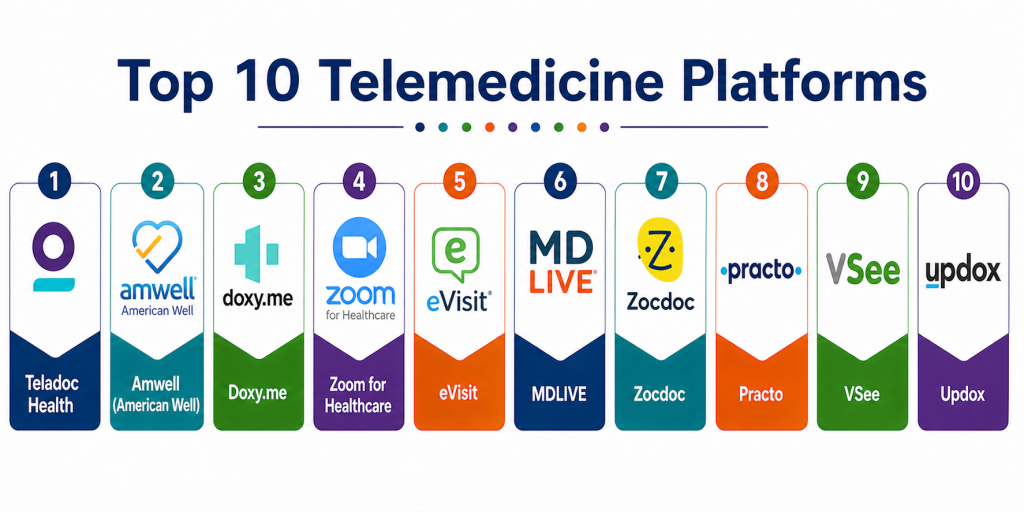
Top 10 Telemedicine Platforms
#1 — Teladoc Health
Short description: A leading global telemedicine platform offering virtual care services across primary care, mental health, and chronic condition management.
Key Features
- Video and audio consultations
- Mental health services
- Chronic care management
- Mobile app access
- Global provider network
Pros
- Large provider network
- Comprehensive services
Cons
- Pricing variability
- Limited customization
Platforms / Deployment
Web / iOS / Android / Cloud
Security & Compliance
Varies / N/A
Integrations & Ecosystem
Integrates with healthcare systems and insurers
- API ecosystem
- Device integrations
Support & Community
Strong enterprise support
#2 — Amwell (American Well)
Short description: A telehealth platform designed for hospitals and health systems, offering scalable virtual care solutions.
Key Features
- Video consultations
- Telehealth workflows
- Patient engagement tools
- Analytics dashboards
- Integration capabilities
Pros
- Enterprise-ready
- Strong scalability
Cons
- Complex implementation
- Cost considerations
Platforms / Deployment
Web / Mobile / Cloud
Security & Compliance
Varies / N/A
Integrations & Ecosystem
Supports integration with healthcare systems
- API support
Support & Community
Enterprise-level support
#3 — Doxy.me
Short description: A simple and accessible telemedicine platform focused on ease of use for providers and patients.
Key Features
- Browser-based video calls
- No downloads required
- Waiting room feature
- Secure communication
- Free tier availability
Pros
- Easy to use
- Quick setup
Cons
- Limited advanced features
- Basic analytics
Platforms / Deployment
Web / Cloud
Security & Compliance
Not publicly stated
Integrations & Ecosystem
Integrates with scheduling tools
- Basic API support
Support & Community
Strong SMB adoption
#4 — Zoom for Healthcare
Short description: A healthcare-focused version of Zoom offering secure video consultations and telehealth capabilities.
Key Features
- HD video conferencing
- Scheduling integration
- Secure communication
- Multi-user sessions
- Recording capabilities
Pros
- Familiar interface
- Reliable performance
Cons
- Not healthcare-specific by design
- Requires integration
Platforms / Deployment
Web / Desktop / Mobile / Cloud
Security & Compliance
Varies / N/A
Integrations & Ecosystem
Integrates with healthcare systems
- API ecosystem
Support & Community
Large global user base
#5 — eVisit
Short description: A telemedicine platform designed for healthcare providers to deliver virtual care with integrated workflows.
Key Features
- Video consultations
- Patient engagement tools
- Workflow automation
- Reporting dashboards
- EHR integration
Pros
- Healthcare-focused
- Strong workflow tools
Cons
- Cost considerations
- Setup complexity
Platforms / Deployment
Web / Cloud
Security & Compliance
Not publicly stated
Integrations & Ecosystem
Supports EHR integration
- API support
Support & Community
Enterprise support
#6 — MDLIVE
Short description: A telehealth platform providing virtual care services including urgent care, dermatology, and mental health.
Key Features
- Virtual consultations
- Specialty care services
- Prescription management
- Mobile access
- Patient engagement
Pros
- Wide range of services
- Easy access
Cons
- Limited provider customization
- Pricing variability
Platforms / Deployment
Web / Mobile / Cloud
Security & Compliance
Varies / N/A
Integrations & Ecosystem
Integrates with healthcare systems
- API support
Support & Community
Strong support network
#7 — Zocdoc
Short description: A healthcare marketplace and telemedicine platform enabling patients to book appointments and access virtual consultations.
Key Features
- Appointment booking
- Telehealth consultations
- Provider discovery
- Patient reviews
- Scheduling tools
Pros
- Strong patient reach
- Easy scheduling
Cons
- Not a full clinical platform
- Limited workflow features
Platforms / Deployment
Web / Mobile / Cloud
Security & Compliance
Varies / N/A
Integrations & Ecosystem
Supports integration with healthcare systems
- API ecosystem
Support & Community
Large user base
#8 — Practo
Short description: A widely used telemedicine platform offering online consultations, appointment booking, and digital health services.
Key Features
- Video consultations
- Appointment scheduling
- E-prescriptions
- Health records
- Multi-language support
Pros
- Strong presence in emerging markets
- Easy to use
Cons
- Limited enterprise features
- Regional focus
Platforms / Deployment
Web / Mobile / Cloud
Security & Compliance
Varies / N/A
Integrations & Ecosystem
Supports healthcare integrations
- API support
Support & Community
Large user base
#9 — VSee
Short description: A telemedicine platform focused on secure video communication and remote patient care workflows.
Key Features
- Secure video conferencing
- Patient management tools
- Workflow automation
- Mobile support
- Data security features
Pros
- Strong security focus
- Reliable performance
Cons
- Limited UI modernity
- Requires setup
Platforms / Deployment
Web / Desktop / Mobile / Cloud
Security & Compliance
Not publicly stated
Integrations & Ecosystem
Supports healthcare integrations
- API ecosystem
Support & Community
Moderate support
#10 — Updox
Short description: A telehealth platform offering communication, messaging, and workflow automation for healthcare providers.
Key Features
- Secure messaging
- Video consultations
- File sharing
- Workflow automation
- Reporting tools
Pros
- Strong communication features
- Easy integration
Cons
- Limited advanced analytics
- Not full clinical system
Platforms / Deployment
Web / Mobile / Cloud
Security & Compliance
Includes encryption and authentication features
Integrations & Ecosystem
Integrates with EHR systems
- API support
Support & Community
Good SMB support
Comparison Table
| Tool Name | Best For | Platform(s) Supported | Deployment | Standout Feature | Public Rating |
|---|---|---|---|---|---|
| Teladoc Health | Global telehealth | Web/Mobile | Cloud | Full virtual care | N/A |
| Amwell | Enterprise hospitals | Web/Mobile | Cloud | Scalability | N/A |
| Doxy.me | Small practices | Web | Cloud | No-download video | N/A |
| Zoom Healthcare | Video consultations | Cross-platform | Cloud | Reliability | N/A |
| eVisit | Clinical workflows | Web | Cloud | Workflow automation | N/A |
| MDLIVE | Specialty care | Web/Mobile | Cloud | Multi-specialty | N/A |
| Zocdoc | Patient marketplace | Web/Mobile | Cloud | Booking + telehealth | N/A |
| Practo | Emerging markets | Web/Mobile | Cloud | All-in-one platform | N/A |
| VSee | Secure telehealth | Cross-platform | Cloud | Security | N/A |
| Updox | Communication | Web/Mobile | Cloud | Messaging + video | N/A |
Evaluation & Scoring of Telemedicine Platforms
| Tool Name | Core (25%) | Ease (15%) | Integrations (15%) | Security (10%) | Performance (10%) | Support (10%) | Value (15%) | Weighted Total |
|---|---|---|---|---|---|---|---|---|
| Teladoc | 10 | 8 | 9 | 9 | 9 | 9 | 7 | 8.9 |
| Amwell | 9 | 7 | 9 | 9 | 8 | 9 | 7 | 8.5 |
| Doxy.me | 7 | 9 | 7 | 7 | 7 | 7 | 9 | 7.8 |
| Zoom | 8 | 9 | 8 | 8 | 9 | 8 | 8 | 8.4 |
| eVisit | 8 | 7 | 8 | 8 | 8 | 8 | 7 | 8.0 |
| MDLIVE | 8 | 8 | 7 | 8 | 8 | 8 | 7 | 8.0 |
| Zocdoc | 7 | 9 | 7 | 7 | 7 | 7 | 8 | 7.6 |
| Practo | 8 | 8 | 7 | 7 | 7 | 7 | 8 | 7.7 |
| VSee | 7 | 7 | 7 | 9 | 8 | 7 | 7 | 7.6 |
| Updox | 7 | 8 | 8 | 8 | 7 | 7 | 8 | 7.8 |
How to interpret scores:
These scores reflect relative strengths across telemedicine capabilities. Higher scores indicate enterprise-grade platforms with broad functionality, while mid-range scores highlight tools suited for SMBs or specific use cases.
Which Telemedicine Platform Is Right for You?
Solo / Freelancer
- Doxy.me, Updox
- Easy setup and affordable
SMB
- eVisit, Practo
- Balanced features and usability
Mid-Market
- MDLIVE, Zoom Healthcare
- Strong performance and scalability
Enterprise
- Teladoc, Amwell
- Advanced capabilities and integrations
Budget vs Premium
- Budget: Doxy.me, Updox
- Premium: Teladoc, Amwell
Feature Depth vs Ease of Use
- Deep features: Teladoc, Amwell
- Easy to use: Doxy.me, Zoom
Integrations & Scalability
- Enterprise tools offer better integration
- SMB tools focus on simplicity
Security & Compliance Needs
- Enterprise platforms better suited for regulated healthcare environments
Frequently Asked Questions (FAQs)
1. What is a telemedicine platform?
A telemedicine platform enables remote medical consultations using video, audio, and digital communication tools.
2. How does telemedicine work?
It connects patients and providers via secure digital systems, allowing consultations without physical visits.
3. Are telemedicine platforms secure?
Most platforms include encryption and secure access controls to protect patient data.
4. What devices are needed?
A smartphone, tablet, or computer with internet access is typically sufficient.
5. Can telemedicine replace in-person visits?
It can handle many cases but not all, especially those requiring physical exams.
6. Do telemedicine platforms support prescriptions?
Yes, many platforms allow e-prescriptions after consultations.
7. What industries use telemedicine?
Hospitals, clinics, telehealth providers, and digital health startups.
8. Are telemedicine platforms cloud-based?
Most modern platforms are cloud-based for scalability.
9. What are common challenges?
Connectivity issues, regulatory requirements, and integration complexity.
10. How do I choose the right platform?
Evaluate based on features, integrations, scalability, and patient experience.
Conclusion
Telemedicine platforms are transforming healthcare by making medical services more accessible, efficient, and patient-centric. They reduce barriers to care, improve convenience, and enable continuous engagement between patients and providers. The right platform depends on your organization’s size, use cases, and technical requirements. Enterprise solutions offer comprehensive features and scalability, while smaller tools focus on simplicity and affordability. Before selecting a platform, organizations should carefully evaluate integration capabilities, user experience, and security features. Telemedicine should also align with existing clinical workflows and patient expectations. Instead of choosing a single platform immediately, shortlist a few options and conduct pilot implementations. This helps validate real-world performance and usability. Ultimately, the best telemedicine platform is the one that enhances care delivery, improves patient access, and fits seamlessly into your healthcare ecosystem.
Really helpful breakdown of telemedicine software with clear explanations about automation, communication, and patient management features.