Introduction
Remote Patient Monitoring (RPM) Platforms are healthcare technologies that allow providers to track patient health data—such as blood pressure, glucose levels, oxygen saturation, and heart rate—outside traditional clinical settings. These platforms collect real-time data from connected devices and transmit it to clinicians for continuous monitoring and proactive care.
RPM has become a critical part of modern healthcare delivery, enabling providers to manage chronic conditions, reduce hospital readmissions, and improve patient outcomes. By enabling continuous data collection and automated alerts, RPM platforms help clinicians intervene early when patient conditions change.
Common use cases include:
- Chronic disease management (diabetes, hypertension, COPD)
- Post-discharge patient monitoring
- Elderly and home healthcare
- Cardiac and respiratory monitoring
- Preventive and population health management
What buyers should evaluate:
- Device compatibility and data accuracy
- Real-time monitoring and alert capabilities
- Integration with EHR/EMR systems
- Scalability across patient populations
- Ease of use for patients and clinicians
- Automation and workflow management
- Security and compliance features
- Billing and reimbursement support
Best for: Hospitals, clinics, telehealth providers, and healthcare organizations managing chronic care and remote patient populations.
Not ideal for: Practices without digital infrastructure or those managing very small patient populations where manual monitoring may suffice.
Key Trends in Remote Patient Monitoring Platforms
- AI-driven predictive analytics for early intervention
- Cloud-native RPM platforms for scalability
- Integration with wearable devices and IoT sensors
- Automated alerts and real-time clinical monitoring
- Expansion of chronic disease management programs
- Multi-device data aggregation platforms
- API-driven integration with healthcare systems
- Growth of reimbursement-driven RPM programs
- Remote care combined with telehealth services
- Increased focus on patient engagement and adherence
How We Selected These Tools (Methodology)
- Evaluated adoption across healthcare providers and systems
- Assessed feature completeness for RPM workflows
- Reviewed scalability and performance capabilities
- Analyzed integration with EHR and medical devices
- Considered usability for patients and clinicians
- Evaluated automation and alerting capabilities
- Included both enterprise and SMB solutions
- Reviewed vendor ecosystem and support
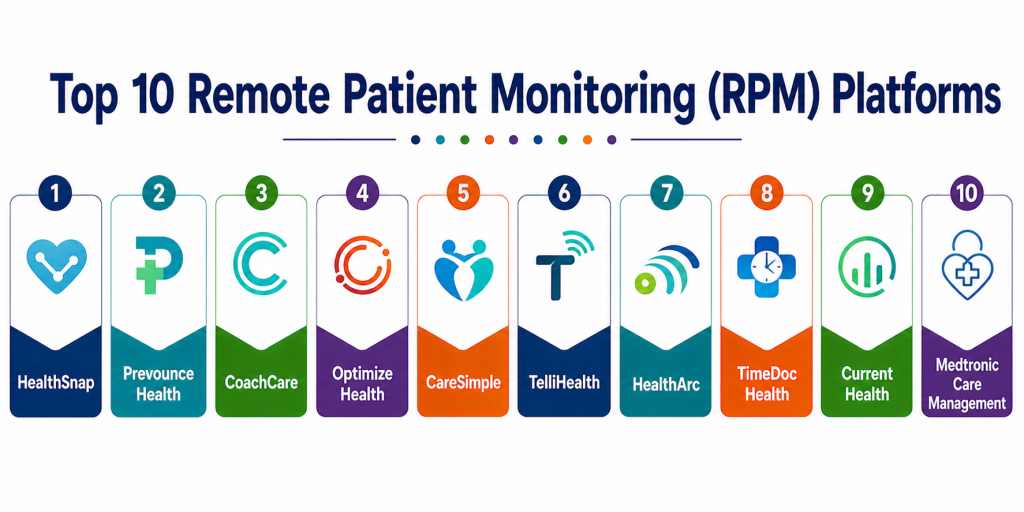
Top 10 Remote Patient Monitoring (RPM) Platforms
#1 — HealthSnap
Short description: A scalable RPM platform focused on chronic disease management with real-time patient monitoring and analytics.
Key Features
- Real-time vitals tracking
- Chronic disease protocols
- Patient engagement tools
- Data analytics dashboards
- EHR integration
Pros
- Strong population health features
- Scalable platform
Cons
- Requires onboarding effort
- Pricing varies
Platforms / Deployment
Web / Cloud
Security & Compliance
Not publicly stated
Integrations & Ecosystem
Integrates with EHR systems and devices
- API support
- Device integrations
Support & Community
Enterprise-level support
#2 — Prevounce Health
Short description: A user-friendly RPM platform designed for both small practices and large health systems with strong compliance support.
Key Features
- Plug-and-play RPM setup
- Automated patient reminders
- Device integration
- Billing support
- Workflow automation
Pros
- Easy implementation
- Strong compliance support
Cons
- Limited advanced analytics
- Customization constraints
Platforms / Deployment
Web / Cloud
Security & Compliance
Not publicly stated
Integrations & Ecosystem
Supports multiple device integrations
- API connectivity
Support & Community
Strong support ecosystem
#3 — CoachCare
Short description: A patient engagement and RPM platform combining monitoring with wellness and chronic care programs.
Key Features
- Mobile app integration
- Custom care plans
- Real-time monitoring
- Patient engagement tools
- Device connectivity
Pros
- Strong engagement features
- Flexible workflows
Cons
- Limited enterprise features
- Learning curve
Platforms / Deployment
Web / Mobile / Cloud
Security & Compliance
Not publicly stated
Integrations & Ecosystem
Supports device and app integrations
- API ecosystem
Support & Community
Growing support
#4 — Optimize Health
Short description: A turnkey RPM solution offering monitoring, billing, and clinical support services.
Key Features
- Automated alerts
- Billing workflows
- Patient monitoring dashboards
- Device integration
- Care team support
Pros
- Easy to deploy
- Strong billing integration
Cons
- Cost considerations
- Limited customization
Platforms / Deployment
Web / Cloud
Security & Compliance
Not publicly stated
Integrations & Ecosystem
Integrates with healthcare systems
- API support
Support & Community
Dedicated support teams
#5 — CareSimple
Short description: A comprehensive RPM platform offering device integration, onboarding, and clinical monitoring tools.
Key Features
- Device management
- Patient onboarding
- Real-time alerts
- Reporting dashboards
- Workflow automation
Pros
- End-to-end solution
- Strong scalability
Cons
- Complex setup
- Pricing varies
Platforms / Deployment
Web / Cloud
Security & Compliance
Not publicly stated
Integrations & Ecosystem
Supports EHR integration
- API ecosystem
Support & Community
Enterprise support
#6 — TelliHealth
Short description: A connected health platform combining RPM devices with analytics and patient engagement tools.
Key Features
- Device integration
- Data analytics
- Real-time monitoring
- Patient engagement tools
- Alerts and notifications
Pros
- Integrated ecosystem
- Easy to use
Cons
- Limited enterprise adoption
- Feature limitations
Platforms / Deployment
Web / Cloud
Security & Compliance
Not publicly stated
Integrations & Ecosystem
Supports device integrations
- API support
Support & Community
Moderate support
#7 — HealthArc
Short description: An enterprise-grade RPM platform designed for large healthcare systems with advanced analytics and compliance features.
Key Features
- Multi-program monitoring (RPM, CCM, etc.)
- AI-powered analytics
- Billing support
- Device integration
- Workflow automation
Pros
- Enterprise-ready
- Advanced analytics
Cons
- Complex implementation
- Costly
Platforms / Deployment
Web / Cloud
Security & Compliance
Varies / N/A
Integrations & Ecosystem
Supports multiple integrations
- API ecosystem
Support & Community
Enterprise support
#8 — TimeDoc Health
Short description: A remote care platform focused on RPM and chronic care management with strong workflow automation.
Key Features
- Chronic care management
- Real-time monitoring
- Patient engagement tools
- Billing integration
- Reporting dashboards
Pros
- Strong automation
- Good scalability
Cons
- Limited customization
- Learning curve
Platforms / Deployment
Web / Cloud
Security & Compliance
Not publicly stated
Integrations & Ecosystem
Integrates with healthcare systems
- API support
Support & Community
Strong support
#9 — Current Health
Short description: A comprehensive RPM platform combining wearable devices, analytics, and clinical monitoring tools.
Key Features
- Continuous patient monitoring
- Wearable device integration
- Data analytics
- Alerts and notifications
- Clinical dashboards
Pros
- Advanced monitoring capabilities
- Strong analytics
Cons
- Expensive
- Complex deployment
Platforms / Deployment
Web / Cloud
Security & Compliance
Varies / N/A
Integrations & Ecosystem
Supports integration with healthcare systems
- API support
Support & Community
Enterprise-level support
#10 — Medtronic Care Management
Short description: A medical-grade RPM platform focused on chronic disease management with integrated devices and analytics.
Key Features
- Device-based monitoring
- Chronic disease management
- Data analytics
- Alerts and notifications
- Reporting tools
Pros
- Trusted medical-grade solution
- Strong clinical focus
Cons
- Limited flexibility
- High cost
Platforms / Deployment
Web / Cloud
Security & Compliance
Varies / N/A
Integrations & Ecosystem
Supports healthcare integrations
- Device ecosystem
Support & Community
Strong enterprise support
Comparison Table
| Tool Name | Best For | Platform(s) Supported | Deployment | Standout Feature | Public Rating |
|---|---|---|---|---|---|
| HealthSnap | Chronic care | Web | Cloud | Population health | N/A |
| Prevounce | Easy deployment | Web | Cloud | Plug-and-play RPM | N/A |
| CoachCare | Engagement | Web/Mobile | Cloud | Care plans | N/A |
| Optimize Health | Billing-focused RPM | Web | Cloud | Turnkey solution | N/A |
| CareSimple | Full-service RPM | Web | Cloud | End-to-end solution | N/A |
| TelliHealth | Device integration | Web | Cloud | Connected ecosystem | N/A |
| HealthArc | Enterprise RPM | Web | Cloud | AI analytics | N/A |
| TimeDoc Health | Chronic care | Web | Cloud | Automation | N/A |
| Current Health | Advanced monitoring | Web | Cloud | Wearables | N/A |
| Medtronic | Clinical-grade RPM | Web | Cloud | Device ecosystem | N/A |
Evaluation & Scoring of Remote Patient Monitoring Platforms
| Tool Name | Core (25%) | Ease (15%) | Integrations (15%) | Security (10%) | Performance (10%) | Support (10%) | Value (15%) | Weighted Total |
|---|---|---|---|---|---|---|---|---|
| HealthSnap | 9 | 7 | 8 | 7 | 8 | 8 | 7 | 8.0 |
| Prevounce | 8 | 9 | 7 | 7 | 7 | 8 | 8 | 8.0 |
| CoachCare | 8 | 8 | 7 | 7 | 7 | 7 | 8 | 7.8 |
| Optimize Health | 8 | 8 | 8 | 7 | 8 | 8 | 7 | 8.0 |
| CareSimple | 9 | 7 | 8 | 7 | 8 | 8 | 7 | 8.1 |
| TelliHealth | 7 | 8 | 7 | 7 | 7 | 7 | 8 | 7.5 |
| HealthArc | 9 | 7 | 8 | 8 | 8 | 8 | 6 | 8.1 |
| TimeDoc | 8 | 7 | 8 | 7 | 8 | 8 | 7 | 8.0 |
| Current Health | 9 | 6 | 8 | 8 | 9 | 8 | 6 | 8.2 |
| Medtronic | 9 | 6 | 7 | 8 | 9 | 8 | 6 | 8.1 |
How to interpret scores:
These scores are comparative and reflect real-world capabilities across RPM platforms. Higher scores indicate enterprise readiness and advanced monitoring capabilities, while mid-range scores highlight tools suitable for SMBs or specific use cases.
Which Remote Patient Monitoring Platform Is Right for You?
Solo / Freelancer
- CoachCare, Prevounce
- Easy setup and affordable
SMB
- Optimize Health, TelliHealth
- Balanced features and scalability
Mid-Market
- CareSimple, TimeDoc Health
- Strong automation and integration
Enterprise
- HealthArc, Current Health, Medtronic
- Advanced analytics and large-scale monitoring
Budget vs Premium
- Budget: Prevounce, CoachCare
- Premium: Medtronic, Current Health
Feature Depth vs Ease of Use
- Deep features: HealthArc, Current Health
- Easy to use: Prevounce
Integrations & Scalability
- Enterprise platforms offer deeper integrations
- SMB tools focus on ease of deployment
Security & Compliance Needs
- Enterprise platforms better suited for regulated environments
Frequently Asked Questions (FAQs)
1. What is Remote Patient Monitoring (RPM)?
RPM is a technology that allows healthcare providers to monitor patients remotely using connected devices and software platforms.
2. What devices are used in RPM?
Common devices include blood pressure monitors, glucometers, pulse oximeters, and wearable sensors.
3. How does RPM improve healthcare?
It enables early intervention, reduces hospital visits, and improves patient outcomes.
4. Is RPM secure?
Security varies by platform, but most include encryption and access controls.
5. Can RPM integrate with EHR systems?
Yes, integration with EHR/EMR systems is a core capability.
6. What industries use RPM?
Hospitals, clinics, telehealth providers, and home healthcare services.
7. Are RPM platforms cloud-based?
Most modern RPM platforms are cloud-based for scalability.
8. What are common challenges?
Device integration, patient adherence, and workflow complexity.
9. Do RPM platforms support billing?
Many platforms include billing support and reimbursement workflows.
10. How do I choose the right RPM platform?
Evaluate based on scalability, integrations, ease of use, and clinical needs.
Conclusion
Remote Patient Monitoring platforms are transforming healthcare by enabling continuous, data-driven care outside traditional clinical settings. They help providers monitor chronic conditions, detect early warning signs, and improve patient outcomes while reducing operational costs. The right platform depends on your organization’s size, patient population, and technical infrastructure. SMB-focused tools prioritize ease of use and quick deployment, while enterprise solutions offer advanced analytics, scalability, and integration capabilities. Healthcare organizations should carefully evaluate device compatibility, workflow automation, and integration with existing systems before making a decision. Security and compliance are also critical considerations. Instead of choosing a single solution immediately, it is recommended to shortlist a few platforms and run pilot programs. This helps validate performance and workflow alignment in real-world scenarios.