Introduction
The journey toward mastering modern IT operations is often complex, yet the path is made clearer through specialized education. In the current landscape of enterprise technology, the integration of artificial intelligence into operational workflows is no longer a luxury but a necessity. The Certified AIOps Professional program is designed to bridge the gap between traditional management and intelligent automation.
What is Certified AIOps Professional?
The Certified AIOps Professional designation is recognized as a high-tier credential for individuals who aim to master the intersection of Artificial Intelligence and IT Operations. It is structured to provide a deep understanding of how machine learning algorithms and big data analytics can be applied to automate and enhance system monitoring, event correlation, and incident response. This certification is sought after by those who wish to transform reactive IT environments into proactive, self-healing systems.
By completing this program, a comprehensive grasp of the AIOps lifecycle is gained. This includes data ingestion from diverse sources, the application of various analytical patterns, and the eventual automation of remedial actions. It is not merely a theoretical exercise; rather, it is a practical framework that is used to manage the increasing complexity of modern cloud-native and hybrid infrastructures.
Why it matters today?
In an era where data is generated at an unprecedented scale, manual monitoring is found to be insufficient. System outages and performance bottlenecks can lead to significant financial losses if they are not addressed with speed and precision. AIOps matters today because it allows for the processing of vast amounts of telemetry data that would be impossible for human operators to analyze in real-time.
Furthermore, the shift toward microservices and distributed architectures has made troubleshooting much more difficult. Through the implementation of AIOps, patterns are identified within the noise of thousands of alerts, allowing engineers to focus on root causes rather than symptoms. It is observed that organizations adopting these intelligent practices experience a marked reduction in Mean Time to Repair (MTTR) and a boost in overall system reliability.
Why Certified AIOps Professional certifications are important?
Validation of skills through a formal certification is viewed as a critical step for career progression in the technical domain. The Certified AIOps Professional certification is considered important because it provides a standardized benchmark for expertise in a rapidly evolving field. It ensures that a professional is not only familiar with the tools but also understands the underlying methodologies required to build robust AI-driven operational frameworks.
Moreover, having this credential is often used by hiring managers and stakeholders to identify individuals who are capable of leading digital transformation initiatives. It provides a level of confidence that the certified individual can navigate the complexities of data science within an operational context. In a competitive job market, this specialization is recognized as a significant differentiator that highlights a commitment to staying at the forefront of technological innovation.
Why choose AIOps School?
When looking for a platform to master intelligent operations, AIOps School is frequently selected as the preferred choice. It is known for offering a curriculum that is deeply rooted in practical application and real-world scenarios. The learning materials provided are curated by experts who have spent decades navigating the challenges of large-scale system management.
AIOps School is also chosen because of its focus on the entire ecosystem of AI and operations. Unlike general courses, the training here is specifically tailored to the needs of DevOps and SRE professionals. The support provided during the certification journey is found to be highly effective, ensuring that every candidate is well-prepared to apply their knowledge in a professional setting.
Certification Deep-Dive
What is this certification?
The Certified AIOps Professional is a specialized program focused on using AI and Machine Learning to automate IT operations. It is designed to help professionals manage complex environments through data-driven insights and automated workflows.
Who should take this certification?
This program is ideally suited for DevOps engineers, Site Reliability Engineers, and IT managers who are responsible for maintaining system uptime. It is also beneficial for data engineers who wish to move into the operational side of technology.
Certification Overview Table
| Track | Level | Who it’s for | Prerequisites | Skills Covered | Recommended Order |
| AIOps/MLOps | Professional | Engineers & Managers | Basic DevOps Knowledge | Data Analysis, ML Models, Automation | 1st in AIOps Track |
| DevOps | Expert | Senior Engineers | 3+ Years Experience | CI/CD, Infrastructure as Code | After Professional |
| SRE | Intermediate | Operations Staff | Linux & Scripting | Error Budgets, SLIs/SLOs | 2nd in SRE Track |
| FinOps | Associate | Finance & Tech Ops | Cloud Basics | Cloud Cost Optimization | Post AIOps |
Skills you will gain
- Proficiency in identifying noise reduction patterns within system alerts.
- The ability to implement automated root cause analysis using ML models.
- Expertise in managing large-scale data lakes for operational telemetry.
- Skill in developing self-healing scripts for common infrastructure issues.
- Competence in integrating AI tools into existing DevOps pipelines.
Real-world projects you should be able to do after this certification
- Building an automated alert suppression system to reduce “pager fatigue.”
- Developing a predictive scaling model for cloud resources based on traffic patterns.
- Implementing a centralized dashboard that correlates logs, metrics, and traces using AI.
- Creating a self-remediation workflow for disk space management on production servers.
Preparation plan
7–14 days plan
- Intensive review of the core AIOps terminology and concepts.
- Completion of all practice exams provided by the official provider.
- Quick walkthrough of the primary automation tools mentioned in the syllabus.
30 days plan
- Two weeks of focused study on data ingestion and event correlation logic.
- One week dedicated to hands-on labs involving machine learning model deployment.
- Final week spent on revision and mock testing to build confidence.
60 days plan
- First month used for a deep dive into the theoretical foundations of AI in operations.
- Second month focused on implementing real-world projects in a sandbox environment.
- Bi-weekly check-ins with study groups or mentors to clarify difficult topics.
Common mistakes to avoid
- Ignoring the importance of clean data ingestion before applying ML models.
- Focusing solely on the tools while neglecting the underlying operational principles.
- Rushing through the practice labs without understanding the “why” behind each step.
Best next certification after this
- Same track: Certified MLOps Professional.
- Cross-track: Certified SRE Professional.
- Leadership / management: Certified Engineering Manager.
Choose Your Learning Path
DevOps Path
This path is intended for those who wish to focus on the speed and quality of software delivery. It is best for software developers and system administrators who want to master the bridge between code and deployment.
DevSecOps Path
Security is integrated into every stage of the lifecycle here. It is most suitable for security analysts and engineers who believe that protection should be built-in rather than bolted-on.
Site Reliability Engineering (SRE) Path
The focus is placed on system availability and reliability. This is the ideal choice for those who enjoy solving complex scaling problems and ensuring that services remain operational under heavy load.
AIOps / MLOps Path
This is best for professionals who want to leverage data science to improve operations. It is designed for those looking to automate the detection and resolution of system issues through intelligent algorithms.
DataOps Path
For those managing the flow of data within an organization, this path provides the necessary tools. It is recommended for data engineers and architects who want to ensure data quality and accessibility.
FinOps Path
This path is dedicated to cloud financial management. It is best for individuals who need to balance technical requirements with budget constraints and cloud cost transparency.
Role → Recommended Certifications Mapping
| Role | Primary Certification | Secondary Certification | Leadership Track |
| DevOps Engineer | Certified DevOps Pro | Certified AIOps Pro | Engineering Manager |
| SRE | Certified SRE Pro | Certified AIOps Pro | SRE Director |
| Platform Engineer | Certified Kubernetes Admin | Certified AIOps Pro | Platform Lead |
| Cloud Engineer | AWS/Azure Solutions Architect | Certified AIOps Pro | Cloud Architect |
| Security Engineer | Certified DevSecOps Pro | Certified AIOps Pro | CISO |
| Data Engineer | Certified DataOps Pro | Certified MLOps Pro | Data Director |
| FinOps Practitioner | Certified FinOps Pro | Certified AIOps Pro | FinOps Lead |
| Engineering Manager | Certified Engineering Manager | Certified AIOps Pro | CTO |
Next Certifications to Take
One same-track certification
The Certified MLOps Professional is recommended as a natural progression from AIOps. It allows for a deeper exploration of the lifecycle of machine learning models in a production environment.
One cross-track certification
The Certified SRE Professional is often pursued to complement AIOps skills. It provides the operational rigor and reliability frameworks that benefit from AI-driven automation.
One leadership-focused certification
The Certified Engineering Manager program is suggested for those looking to transition into senior roles. It focuses on the people and process management skills needed to lead technical teams effectively.
Training & Certification Support Institutions
DevOpsSchool
This institution is widely recognized for its extensive range of DevOps and SRE training programs. It provides a blend of theoretical knowledge and hands-on laboratory exercises to ensure students are job-ready. A strong emphasis is placed on mastering the latest industry tools.
Cotocus
Cotocus is known for offering specialized consultancy and training in cloud-native technologies. Their programs are designed to help organizations and individuals navigate the complexities of digital transformation. They provide tailored support for various professional certifications.
ScmGalaxy
This platform is considered a major hub for community-driven learning in the software configuration management and DevOps space. It offers a wealth of resources, including blogs, videos, and tutorials, to support engineers in their career growth.
BestDevOps
BestDevOps focuses on providing high-quality educational content for aspiring and experienced engineers. Their training modules are structured to be easy to follow and highly practical. They are frequently used by professionals seeking to upgrade their skill sets quickly.
devsecopsschool.com
This portal is dedicated specifically to the integration of security into the DevOps workflow. It offers deep-dive courses on security automation and compliance. It is the go-to resource for those wishing to specialize in the DevSecOps domain.
sreschool.com
The focus here is entirely on Site Reliability Engineering principles and practices. The curriculum is designed to teach the skills necessary to maintain high-availability systems. It is highly regarded for its practical approach to error budgets and incident management.
aiopsschool.com
This is the primary institution for AIOps and MLOps certification and training. It provides a comprehensive learning path for those wishing to master intelligent operations. The school is known for its expert instructors and industry-aligned curriculum.
dataopsschool.com
DataOpsSchool offers specialized training for data professionals who want to improve the speed and quality of data delivery. Their courses cover the entire data lifecycle from ingestion to visualization. It is an essential resource for modern data engineers.
finopsschool.com
This institution focuses on the emerging field of cloud financial management. It provides the training needed to manage and optimize cloud spending across large organizations. It is ideal for those balancing technical operations with financial accountability.
FAQs Section
- What is the difficulty level of this certification?
It is generally considered to be of a professional or intermediate level, requiring a good understanding of both IT operations and basic data concepts. - How much time is required to prepare for the exam?
A period of 30 to 60 days is usually sufficient for most candidates, depending on their existing experience with automation and AI tools. - Are there any specific prerequisites for taking the course?
While there are no strict barriers, a foundational knowledge of DevOps practices and basic scripting is highly recommended for success. - What is the recommended certification sequence?
It is often suggested that a general DevOps certification be completed before specializing in AIOps to ensure a strong operational foundation. - What is the career value of becoming a Certified AIOps Professional?
This credential is known to significantly increase employability and salary potential by validating expertise in a high-demand, specialized field. - What job roles can be pursued after getting certified?
Professionals often move into roles such as AIOps Engineer, SRE, Automation Architect, or Senior DevOps Consultant after obtaining this certification. - Is there growth potential in the AIOps field?
The field is experiencing rapid growth as more companies look to automate their operations, ensuring long-term career stability for certified individuals. - Is the exam conducted online or at a center?
The examination is typically offered in an online proctored format, allowing candidates to take it from the comfort of their own location. - How long does the certification remain valid?
Most professional certifications in this track are valid for two to three years, after which renewal or advanced certification is encouraged. - Does the program include hands-on labs?
Yes, a significant portion of the training is dedicated to practical exercises that simulate real-world IT operational challenges. - Are study materials provided by the institution?
Comprehensive study guides, video lectures, and practice tests are included as part of the enrollment in the official certification program. - Can this certification help in transitioning from a developer role?
It is an excellent way for developers to gain the operational and AI skills needed to move into more senior architectural or SRE positions.
Certified AIOps Professional FAQs
- How does AIOps differ from standard DevOps?
AIOps specifically utilizes machine learning and big data to enhance the automation and monitoring tasks that are foundational to DevOps. - Is a background in data science required?
A deep degree in data science is not necessary, but an understanding of how models are used to analyze operational data is taught within the course. - What specific tools are covered in the AIOps curriculum?
The program covers a variety of open-source and enterprise tools used for log aggregation, event correlation, and automated remediation. - How is “noise reduction” achieved in AIOps?
Noise reduction is achieved through intelligent algorithms that group related alerts and filter out redundant information, allowing for faster response times. - Will this certification help me manage cloud costs?
While primarily focused on operations, the efficiency gained through AIOps often leads to better resource utilization and indirect cost savings. - Can AIOps be applied to legacy on-premise systems?
Yes, the principles of AIOps are found to be highly effective in hybrid environments that combine legacy hardware with modern cloud services. - What is the format of the Certified AIOps Professional exam?
The exam usually consists of multiple-choice questions and scenario-based problems that test both theoretical knowledge and practical application. - Is there a community for AIOps professionals?
Enrollment in the program often provides access to exclusive forums and groups where professionals can share insights and best practices.
Testimonials
Anjali R.
The transition into a more senior role was made much easier after completing this program. The ability to handle complex system alerts with intelligent automation has provided a new level of confidence in daily operations.
Sandeep M.
It was found that the practical labs were the most valuable part of the training. Real-world scenarios were replicated effectively, allowing for the immediate application of skills in a production environment.
Kavita P.
A clear path for career growth was established through this certification. The noise reduction techniques learned have significantly decreased the time spent on troubleshooting routine issues.
Vikram S.
The mastery of data-driven insights has changed the way infrastructure is managed. Decisions are now based on predictive patterns rather than reactive measures, leading to much higher system stability.
Rohan B.
Leading a technical team requires a deep understanding of modern automation. This certification provided the necessary expertise to guide the organization through a successful AIOps implementation.
Conclusion
The pursuit of the Certified AIOps Professional designation is a strategic move for any technology professional aiming for long-term career success. It is clear that the future of IT operations lies in the intelligent integration of data and automation. By obtaining this certification, individuals are equipped with the skills necessary to navigate and manage the most complex digital environments.
The benefits of this learning path extend far beyond the credential itself; it fosters a mindset of continuous improvement and proactive management. It is highly encouraged that engineers and managers alike plan their certification journey carefully to remain relevant in an industry that never stops evolving. Embracing these advanced methodologies today will ensure a position at the forefront of tomorrow’s technological breakthroughs.
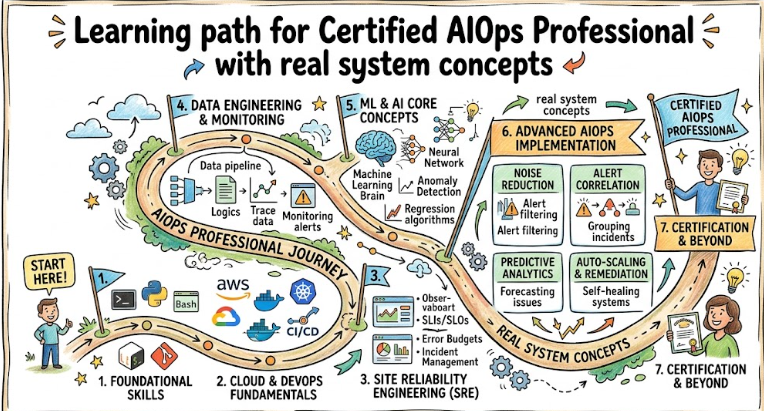
This learning path gives a clear roadmap for mastering AIOps concepts with practical real world system understanding.
This learning path gives a clear roadmap for mastering AIOps concepts with practical real world system understanding.
Very detailed learning roadmap. It clearly explains how AIOps skills connect with real-world IT operations and automation 👍