Introduction
Credential Issuance Platforms are specialized systems that enable organizations to create, issue, manage, and verify digital credentials such as certificates, IDs, licenses, and verifiable credentials. These platforms are a core component of modern digital identity ecosystems, supporting secure and tamper-proof credential distribution.
They are becoming critical because organizations are shifting toward digital-first identity and trust frameworks, reducing reliance on paper-based or centralized verification systems. These platforms are widely used in education, workforce certification, government identity programs, and enterprise access control.
Common use cases include digital certificates for education, employee credentials, government-issued IDs, professional licensing, and decentralized identity verification.
Buyers should evaluate support for verifiable credential standards, security and cryptography, issuance workflows, integration APIs, scalability, interoperability, revocation mechanisms, compliance readiness, and ecosystem maturity.
Best for: Governments, educational institutions, enterprises, and fintech platforms implementing digital identity or certification systems.
Not ideal for: Small teams needing simple document issuance without verification or compliance requirements.
Key Trends in Credential Issuance Platforms
- Adoption of W3C Verifiable Credentials standards
- Rise of decentralized identity (SSI) ecosystems
- Blockchain-based credential verification
- Integration with digital identity wallets
- Automation of credential issuance workflows
- Real-time credential verification and revocation
- API-first platforms for developer integration
- Expansion into workforce and education credentials
- Privacy-first identity systems with selective disclosure
- Cross-platform interoperability and global identity frameworks
How We Selected These Tools (Methodology)
- Adoption across digital identity, education, and enterprise ecosystems
- Support for verifiable credentials and identity standards
- Security features including cryptographic verification
- Integration capabilities with wallets, APIs, and platforms
- Scalability for large credential issuance programs
- Automation and workflow capabilities
- Vendor ecosystem and innovation in identity technologies
- Compliance readiness and standards alignment
- Ease of implementation and usability
- Fit across SMB, mid-market, and enterprise use cases
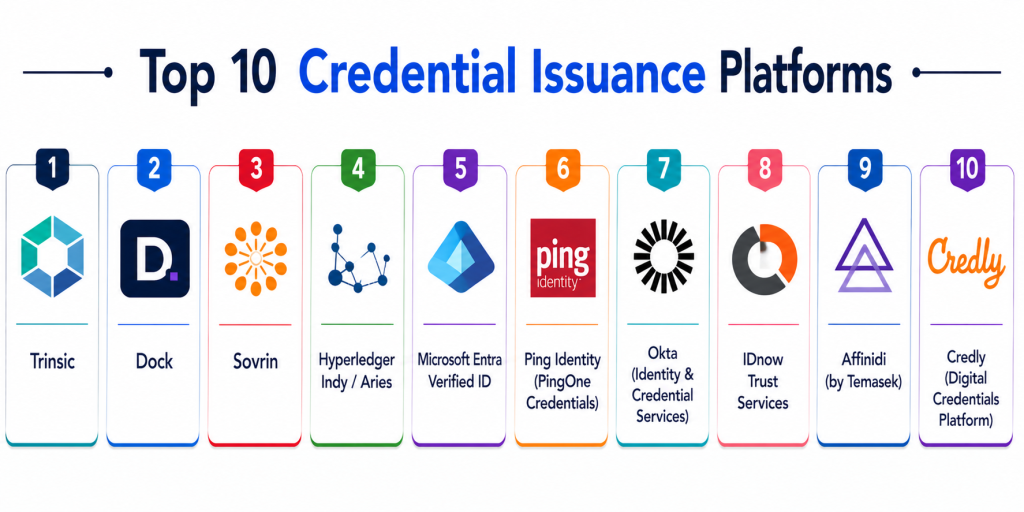
Top 10 Credential Issuance Platforms
#1 — Trinsic
Short description: Trinsic provides a developer-friendly platform for issuing and managing verifiable credentials in decentralized identity ecosystems.
Key Features
- Verifiable credential issuance
- API-first platform
- Decentralized identity support
- Secure credential storage
- Integration with identity wallets
Pros
- Developer-friendly
- Scalable
- Flexible
- Strong SSI support
Cons
- Requires technical expertise
- Limited non-technical UI
- Integration effort
- Setup complexity
Platforms / Deployment
Web
Cloud
Security & Compliance
Cryptographic verification
Integrations & Ecosystem
Integrates with identity wallets and decentralized identity frameworks
- APIs
- Blockchain systems
- Identity platforms
Support & Community
Developer-focused support
#2 — Dock
Short description: Dock enables organizations to issue blockchain-based verifiable credentials securely and at scale.
Key Features
- Credential issuance
- Blockchain verification
- API integration
- Secure credential sharing
- Revocation support
Pros
- Strong security
- Scalable
- Decentralized approach
- Flexible
Cons
- Requires technical expertise
- Limited enterprise UI
- Integration complexity
- Setup effort
Platforms / Deployment
Web
Cloud
Security & Compliance
Cryptographic verification
Integrations & Ecosystem
- Blockchain platforms
- Identity wallets
- APIs
Support & Community
Developer community support
#3 — Sovrin
Short description: Sovrin provides a decentralized identity network for issuing and verifying trusted credentials.
Key Features
- SSI-based credential issuance
- Trust frameworks
- Secure identity verification
- Decentralized infrastructure
- Verifiable credentials
Pros
- Strong privacy focus
- Decentralized trust model
- Scalable
- Open ecosystem
Cons
- Technical complexity
- Limited enterprise adoption
- Integration required
- Setup effort
Platforms / Deployment
Web
Cloud
Security & Compliance
Cryptographic identity verification
Integrations & Ecosystem
- SSI frameworks
- Identity platforms
- APIs
Support & Community
Open-source community
#4 — Hyperledger Indy / Aries
Short description: Hyperledger provides open-source frameworks for building credential issuance and decentralized identity systems.
Key Features
- Verifiable credentials
- Decentralized identity frameworks
- Secure communication
- API integration
- Developer tools
Pros
- Open-source
- Highly flexible
- Scalable
- Strong developer ecosystem
Cons
- Requires development effort
- Not plug-and-play
- Technical complexity
- Setup required
Platforms / Deployment
Varies / N/A
Security & Compliance
Cryptographic security
Integrations & Ecosystem
- Blockchain systems
- Identity frameworks
- APIs
Support & Community
Strong open-source community
#5 — Microsoft Entra Verified ID
Short description: Microsoft provides a credential issuance platform integrated with enterprise identity and access management.
Key Features
- Verifiable credential issuance
- Integration with Microsoft ecosystem
- Identity verification
- API integration
- Secure credential sharing
Pros
- Enterprise-grade
- Strong integration
- Scalable
- Easy adoption for Microsoft users
Cons
- Ecosystem dependency
- Limited customization
- Pricing varies
- Enterprise focus
Platforms / Deployment
Web
Cloud
Security & Compliance
Encryption, identity verification
Integrations & Ecosystem
- Microsoft services
- Enterprise systems
- APIs
Support & Community
Enterprise support available
#6 — PingOne Credentials (Ping Identity)
Short description: PingOne provides verifiable credential issuance with strong identity and authentication integration.
Key Features
- Credential issuance
- Identity verification
- Secure sharing
- API integration
- Workflow automation
Pros
- Enterprise-grade
- Strong identity integration
- Scalable
- Secure
Cons
- Pricing varies
- Enterprise focus
- Integration required
- Setup complexity
Platforms / Deployment
Web
Cloud
Security & Compliance
Encryption, identity verification
Integrations & Ecosystem
- Identity platforms
- APIs
- Enterprise systems
Support & Community
Enterprise support available
#7 — Okta Identity Platform
Short description: Okta provides identity services including credential issuance and authentication workflows.
Key Features
- Identity and credential management
- Authentication workflows
- API integration
- Secure access control
- Identity verification
Pros
- Strong identity platform
- Scalable
- Easy integration
- Enterprise adoption
Cons
- Not dedicated credential issuance tool
- Pricing varies
- Enterprise focus
- Limited SSI features
Platforms / Deployment
Web
Cloud
Security & Compliance
MFA, encryption
Integrations & Ecosystem
- Enterprise apps
- APIs
- Cloud platforms
Support & Community
Enterprise support available
#8 — IDnow Trust Services
Short description: IDnow provides identity verification and credential issuance for regulated industries.
Key Features
- Credential issuance
- Identity verification
- Compliance workflows
- Risk scoring
- API integration
Pros
- Strong compliance focus
- Scalable
- Secure
- Enterprise-ready
Cons
- Pricing varies
- Integration effort
- Limited customization
- Setup required
Platforms / Deployment
Web
Cloud
Security & Compliance
Not publicly stated
Integrations & Ecosystem
- Banking systems
- Compliance tools
- APIs
Support & Community
Professional support available
#9 — Affinidi
Short description: Affinidi provides decentralized identity and credential issuance solutions with privacy-first design.
Key Features
- Verifiable credentials
- Privacy-first identity
- API integration
- Secure sharing
- Identity verification
Pros
- Strong privacy focus
- Flexible
- Scalable
- Developer-friendly
Cons
- Technical complexity
- Limited enterprise adoption
- Integration required
- Setup effort
Platforms / Deployment
Web
Cloud
Security & Compliance
Cryptographic verification
Integrations & Ecosystem
- Identity platforms
- APIs
- Blockchain systems
Support & Community
Developer support available
#10 — Credly
Short description: Credly provides digital credential issuance for education and workforce certifications.
Key Features
- Digital badge issuance
- Credential management
- Verification tools
- Analytics dashboards
- Integration APIs
Pros
- Easy to use
- Strong education focus
- Scalable
- Widely adopted
Cons
- Limited SSI features
- Focused on certifications
- Pricing varies
- Less flexible
Platforms / Deployment
Web
Cloud
Security & Compliance
Not publicly stated
Integrations & Ecosystem
- Learning platforms
- HR systems
- APIs
Support & Community
Professional support available
Comparison Table
| Tool Name | Best For | Platform(s) Supported | Deployment | Standout Feature | Public Rating |
|---|---|---|---|---|---|
| Trinsic | SSI developers | Web | Cloud | API-first VC issuance | N/A |
| Dock | Blockchain credentials | Web | Cloud | Decentralized identity | N/A |
| Sovrin | SSI ecosystem | Web | Cloud | Trust framework | N/A |
| Hyperledger | Developers | Varies | Varies | Open-source framework | N/A |
| Microsoft Entra | Enterprise identity | Web | Cloud | Enterprise integration | N/A |
| PingOne | Enterprise credentials | Web | Cloud | Identity integration | N/A |
| Okta | Identity management | Web | Cloud | Auth workflows | N/A |
| IDnow | Regulated industries | Web | Cloud | Compliance workflows | N/A |
| Affinidi | Privacy-first identity | Web | Cloud | Decentralized VC | N/A |
| Credly | Education credentials | Web | Cloud | Digital badges | N/A |
Evaluation & Scoring of Credential Issuance Platforms
| Tool | Core | Ease | Integrations | Security | Performance | Support | Value | Weighted Total |
|---|---|---|---|---|---|---|---|---|
| Trinsic | 9 | 7.5 | 9 | 9 | 8.5 | 8 | 8 | 8.6 |
| Dock | 8.5 | 7 | 8.5 | 9 | 8 | 7.5 | 8 | 8.3 |
| Sovrin | 8.5 | 7 | 8 | 9 | 8 | 7.5 | 8 | 8.2 |
| Hyperledger | 9 | 6.5 | 9 | 9 | 8.5 | 7.5 | 8 | 8.4 |
| Microsoft Entra | 8.5 | 8.5 | 8.5 | 9 | 8.5 | 8 | 8 | 8.5 |
| PingOne | 8.5 | 8 | 8.5 | 9 | 8.5 | 8 | 8 | 8.4 |
| Okta | 8 | 8.5 | 9 | 9 | 8.5 | 8 | 8 | 8.4 |
| IDnow | 8 | 8 | 8 | 8.5 | 8 | 7.5 | 8 | 8.1 |
| Affinidi | 8.5 | 7.5 | 8.5 | 9 | 8 | 7.5 | 8 | 8.3 |
| Credly | 8 | 9 | 7.5 | 8 | 8 | 8 | 8.5 | 8.2 |
How to interpret:
- SSI platforms score higher on security and flexibility
- Enterprise platforms balance integration and usability
- Education tools prioritize ease of use
- Scores are comparative, not absolute benchmarks
Which Credential Issuance Platform Is Right for You?
Solo / Freelancer
Use Credly for certifications and simple credential needs.
SMB
Choose Credly or IDnow for easy onboarding and compliance.
Mid-Market
Consider Trinsic, Dock, or Affinidi for scalable identity solutions.
Enterprise
Use Microsoft Entra, PingOne, or Okta for full identity infrastructure.
Budget vs Premium
Open-source tools are flexible; enterprise platforms offer managed services.
Feature Depth vs Ease of Use
SSI platforms offer depth; enterprise tools offer ease and integration.
Integrations & Scalability
Ensure compatibility with identity wallets and enterprise systems.
Security & Compliance Needs
Critical—ensure cryptographic verification and compliance readiness.
Frequently Asked Questions (numbring)
1. What is a credential issuance platform?
It is software used to create, issue, and verify digital credentials securely.
2. Why are they important?
They enable secure, scalable, and verifiable digital identity systems.
3. Who uses these platforms?
Governments, enterprises, educational institutions, and fintechs.
4. What credentials can be issued?
IDs, certificates, licenses, and digital badges.
5. Are they secure?
Yes, they use cryptographic verification and secure storage.
6. What is SSI?
Self-sovereign identity allows users to control their credentials.
7. Do they integrate with wallets?
Yes, most platforms integrate with digital identity wallets.
8. Are they cloud-based?
Many are cloud-native, though some support hybrid models.
9. How long does implementation take?
It varies from days to months depending on complexity.
10. What are alternatives?
Paper-based certificates or centralized identity systems.
Conclusion
Credential Issuance Platforms are foundational to modern digital identity ecosystems.
They enable secure, verifiable, and scalable credential management across industries.
SSI platforms like Trinsic and Dock provide flexibility and decentralization.
Enterprise platforms like Microsoft Entra and PingOne offer strong integration and scalability.
Education-focused tools like Credly simplify credential distribution.
The right platform depends on use case, scale, and technical capabilities.
Organizations should prioritize interoperability, security, and automation.
Pilot implementations can validate integration and user experience.
Ultimately, the best platform aligns with your identity strategy and digital transformation goals.
Very informative comparison showing how credential issuance tools improve digital certification and reduce manual verification challenges efficiently.