Introduction
Crisis Management Platforms are software solutions designed to help organizations prepare for, respond to, and recover from critical events such as natural disasters, cyber incidents, operational failures, or reputational crises. These platforms centralize communication, coordination, and decision-making so teams can act quickly and effectively under pressure.
In today’s complex business environment, crises can escalate rapidly. Organizations need structured workflows, real-time visibility, and reliable communication tools to minimize impact and maintain continuity. Modern platforms go beyond basic alerting by combining incident response, collaboration, analytics, and compliance in a single system.
Real-world use cases:
- Enterprises managing cybersecurity incidents and outages
- Government agencies coordinating emergency response
- Healthcare organizations handling critical patient or operational disruptions
- Financial institutions managing risk and compliance events
- Logistics companies responding to supply chain disruptions
What buyers should evaluate:
- Real-time communication and alerting capabilities
- Incident response workflows and automation
- Integration with existing systems (IT, HR, security tools)
- Scalability and performance under pressure
- Data security and access control
- Reporting and analytics
- Ease of use and onboarding
- Customization and flexibility
- Mobile accessibility
Best for: Operations teams, IT leaders, risk managers, compliance officers, and large organizations that require structured crisis response and coordination.
Not ideal for: Small teams with minimal risk exposure or those needing only simple communication tools.
Key Trends in Crisis Management Platforms
- AI-driven incident detection and response recommendations
- Unified platforms combining alerting, collaboration, and analytics
- Mobile-first crisis management for remote teams
- Integration with monitoring and security systems
- Real-time dashboards and situational awareness tools
- Automation of escalation workflows
- Increased focus on resilience and business continuity
- API-first architecture for integrations
- Cloud-based scalability
- Enhanced compliance and audit tracking
How We Selected These Tools (Methodology)
- Evaluated market presence and adoption
- Assessed feature completeness and innovation
- Reviewed usability and interface design
- Considered scalability across industries
- Analyzed integration capabilities
- Evaluated security and compliance readiness
- Reviewed customer support and onboarding
- Balanced enterprise and flexible solutions
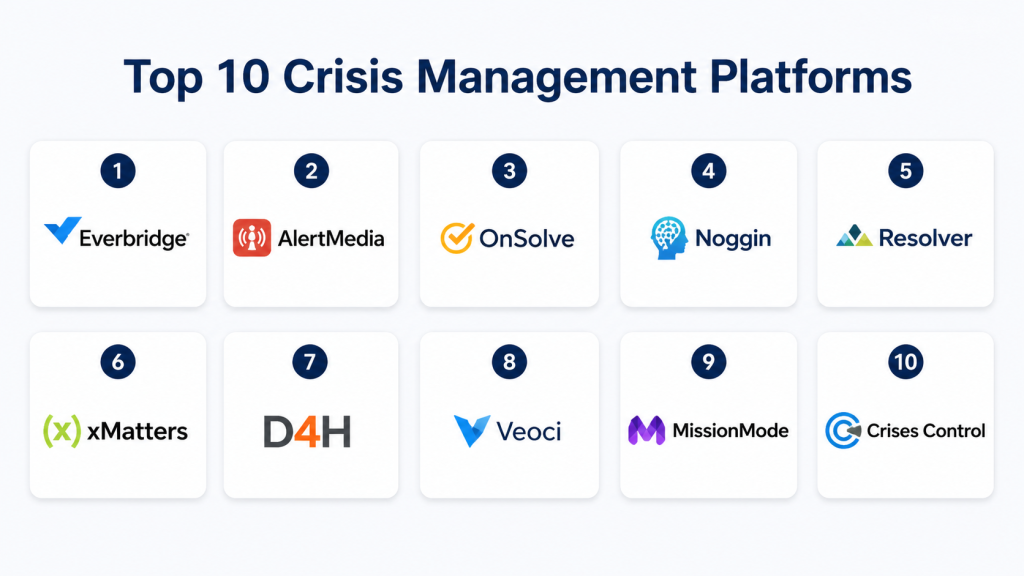
Top 10 Crisis Management Platforms
#1 — Everbridge
Short description:
A leading platform for critical event management, offering end-to-end crisis response, communication, and risk intelligence.
Key Features
- Mass notification and alerting
- Incident management workflows
- Risk intelligence feeds
- Real-time dashboards
- Automation and escalation
- Crisis collaboration tools
Pros
- Comprehensive platform
- Highly scalable
- Strong analytics and reporting
Cons
- Complex implementation
- Higher cost
- Requires training
Platforms / Deployment
Web / iOS / Android
Cloud
Security & Compliance
SSO/SAML, MFA, RBAC, audit logs
Not publicly stated
Integrations & Ecosystem
Supports integrations with enterprise systems and monitoring tools.
- APIs
- Security systems
- IT monitoring tools
Support & Community
Enterprise-level support and onboarding.
#2 — AlertMedia
Short description:
A modern crisis communication platform focused on workforce safety and fast emergency alerts.
Key Features
- Emergency alerts
- Two-way communication
- Threat intelligence
- Geo-targeting
- Mobile notifications
Pros
- Easy to use
- Fast deployment
- Strong mobile experience
Cons
- Limited deep customization
- Pricing not transparent
- Some advanced features limited
Platforms / Deployment
Web / iOS / Android
Cloud
Security & Compliance
SSO, encryption
Not publicly stated
Integrations & Ecosystem
Supports integrations with business tools.
- APIs
- HR systems
- Communication tools
Support & Community
Strong customer support.
#3 — OnSolve
Short description:
A platform designed for critical communications and public safety alerts with strong crisis response capabilities.
Key Features
- Mass notification
- Geo-targeting
- Incident workflows
- Analytics
- Automation
Pros
- Reliable communication
- Scalable
- Strong public safety use cases
Cons
- Complex interface
- Higher cost
- Setup effort required
Platforms / Deployment
Web
Cloud
Security & Compliance
Not publicly stated
Integrations & Ecosystem
Supports integrations.
- APIs
- Government systems
Support & Community
Enterprise support available.
#4 — Noggin
Short description:
A crisis management and resilience platform focused on operational risk and incident response.
Key Features
- Incident management
- Risk and resilience tracking
- Workflow automation
- Reporting dashboards
- Compliance tools
Pros
- Strong risk management features
- Flexible workflows
- Good analytics
Cons
- Learning curve
- Pricing not transparent
- Setup complexity
Platforms / Deployment
Web
Cloud
Security & Compliance
Not publicly stated
Integrations & Ecosystem
Supports integrations.
- APIs
- Business systems
Support & Community
Professional support.
#5 — Resolver
Short description:
A risk and incident management platform that helps organizations investigate and respond to crises effectively.
Key Features
- Incident tracking
- Risk management
- Investigation workflows
- Analytics
- Reporting
Pros
- Strong investigation tools
- Enterprise-ready
- Detailed insights
Cons
- Complex interface
- Higher cost
- Implementation effort
Platforms / Deployment
Web
Cloud
Security & Compliance
Not publicly stated
Integrations & Ecosystem
Supports integrations.
- APIs
- Enterprise systems
Support & Community
Enterprise support.
#6 — xMatters
Short description:
A platform focused on incident response and communication for IT and DevOps teams.
Key Features
- Automated alerting
- Incident workflows
- On-call management
- Integrations with monitoring tools
- Analytics
Pros
- Strong automation
- Deep integrations
- Ideal for IT teams
Cons
- Not focused on general crisis scenarios
- Learning curve
- Pricing varies
Platforms / Deployment
Web / Mobile
Cloud
Security & Compliance
SSO, RBAC
Not publicly stated
Integrations & Ecosystem
Extensive integrations.
- Monitoring tools
- IT systems
- APIs
Support & Community
Strong support.
#7 — D4H
Short description:
A crisis and emergency management platform designed for teams handling real-world incident response.
Key Features
- Incident logging
- Resource management
- Team coordination
- Reporting
- Mobile support
Pros
- Easy to use
- Good for emergency teams
- Flexible
Cons
- Limited enterprise features
- Basic analytics
- Smaller ecosystem
Platforms / Deployment
Web / Mobile
Cloud
Security & Compliance
Not publicly stated
Integrations & Ecosystem
Basic integrations.
- APIs
- Data export
Support & Community
Growing community support.
#8 — Veoci
Short description:
A crisis management platform offering workflow automation and incident response coordination.
Key Features
- Incident management
- Workflow automation
- Reporting dashboards
- Collaboration tools
- Mobile support
Pros
- Flexible workflows
- Strong customization
- Scalable
Cons
- Interface may feel complex
- Setup required
- Pricing varies
Platforms / Deployment
Web / Mobile
Cloud
Security & Compliance
Not publicly stated
Integrations & Ecosystem
Supports integrations.
- APIs
- Enterprise tools
Support & Community
Professional support.
#9 — MissionMode
Short description:
A platform focused on incident management and operational resilience.
Key Features
- Incident workflows
- Communication tools
- Reporting
- Automation
- Dashboards
Pros
- Strong incident workflows
- Good usability
- Scalable
Cons
- Limited brand recognition
- Smaller ecosystem
- Pricing not transparent
Platforms / Deployment
Web
Cloud
Security & Compliance
Not publicly stated
Integrations & Ecosystem
Supports integrations.
- APIs
- Business systems
Support & Community
Standard support.
#10 — Crises Control
Short description:
A crisis communication platform focused on alerting and team coordination.
Key Features
- Mass alerts
- Incident management
- Communication tools
- Reporting
- Automation
Pros
- Easy to use
- Good alerting features
- Quick deployment
Cons
- Limited advanced analytics
- Smaller ecosystem
- Pricing varies
Platforms / Deployment
Web / Mobile
Cloud
Security & Compliance
Not publicly stated
Integrations & Ecosystem
Supports integrations.
- APIs
- Communication tools
Support & Community
Good customer support.
Comparison Table
| Tool Name | Best For | Platform(s) Supported | Deployment | Standout Feature | Public Rating |
|---|---|---|---|---|---|
| Everbridge | Enterprise crisis management | Web, Mobile | Cloud | End-to-end platform | N/A |
| AlertMedia | Workforce safety | Web, Mobile | Cloud | Easy alerts | N/A |
| OnSolve | Public safety alerts | Web | Cloud | Geo-targeting | N/A |
| Noggin | Risk & resilience | Web | Cloud | Risk tracking | N/A |
| Resolver | Enterprise risk | Web | Cloud | Investigation tools | N/A |
| xMatters | IT incident response | Web, Mobile | Cloud | Automation workflows | N/A |
| D4H | Emergency teams | Web, Mobile | Cloud | Resource coordination | N/A |
| Veoci | Workflow automation | Web, Mobile | Cloud | Custom workflows | N/A |
| MissionMode | Incident workflows | Web | Cloud | Operational resilience | N/A |
| Crises Control | Communication | Web, Mobile | Cloud | Fast alerts | N/A |
Evaluation & Scoring of Crisis Management Platforms
| Tool Name | Core (25%) | Ease (15%) | Integrations (15%) | Security (10%) | Performance (10%) | Support (10%) | Value (15%) | Weighted Total |
|---|---|---|---|---|---|---|---|---|
| Everbridge | 9 | 6 | 8 | 8 | 9 | 8 | 6 | 7.9 |
| AlertMedia | 8 | 9 | 7 | 7 | 8 | 8 | 8 | 8.1 |
| OnSolve | 8 | 6 | 7 | 7 | 8 | 7 | 6 | 7.2 |
| Noggin | 8 | 7 | 7 | 7 | 8 | 7 | 7 | 7.5 |
| Resolver | 8 | 6 | 7 | 7 | 8 | 7 | 6 | 7.2 |
| xMatters | 8 | 7 | 9 | 7 | 8 | 8 | 7 | 7.8 |
| D4H | 7 | 8 | 6 | 6 | 7 | 7 | 8 | 7.3 |
| Veoci | 7 | 7 | 7 | 6 | 7 | 7 | 7 | 7.0 |
| MissionMode | 7 | 7 | 6 | 6 | 7 | 7 | 7 | 6.9 |
| Crises Control | 7 | 8 | 6 | 6 | 7 | 7 | 8 | 7.2 |
How to interpret scores:
- Scores are comparative, not absolute
- Higher scores indicate stronger overall performance
- Ease is more important for smaller teams
- Feature depth matters more for enterprises
Which Crisis Management Platform Is Right for You?
Solo / Freelancer
- Basic tools are usually sufficient
SMB
- AlertMedia or Crises Control
- Focus on ease of use and fast setup
Mid-Market
- Noggin or Veoci
- Balance features and flexibility
Enterprise
- Everbridge or Resolver
- Focus on scalability and integrations
Budget vs Premium
- Budget: D4H, Crises Control
- Premium: Everbridge, Noggin
Feature Depth vs Ease of Use
- Advanced: Everbridge, Resolver
- Easy: AlertMedia, D4H
Integrations & Scalability
- High: xMatters, Everbridge
- Moderate: Veoci
Security & Compliance Needs
- High: Everbridge
- Moderate: AlertMedia
Frequently Asked Questions (FAQs) (numbring )
Q1: What is a crisis management platform?
It is software that helps organizations manage and respond to critical events efficiently.
Q2: Who uses these platforms?
Enterprises, governments, healthcare, and logistics organizations commonly use them.
Q3: Are these tools scalable?
Yes, most platforms are designed to scale with organizational needs.
Q4: Do they support mobile devices?
Yes, most include mobile apps for real-time communication.
Q5: Can they integrate with other systems?
Yes, APIs and integrations are widely supported.
Q6: Are these tools secure?
Most include security features, though specifics vary.
Q7: How long does implementation take?
It depends on complexity, ranging from quick setup to longer deployments.
Q8: Do they support automation?
Yes, automation is a key feature.
Q9: Are there budget-friendly options?
Yes, some tools offer flexible pricing for smaller teams.
Q10: Can they handle large-scale crises?
Yes, enterprise tools are built for large-scale scenarios.
Conclusion
Crisis Management Platforms play a vital role in helping organizations respond effectively to unexpected events. They provide structured workflows, real-time communication, and centralized visibility that improve decision-making during critical situations. Different platforms serve different needs, from simple communication tools to advanced enterprise systems with automation and analytics. The right choice depends on your organization’s size, complexity, and risk exposure. It is important to focus on usability, scalability, and integration capabilities when selecting a platform. Testing shortlisted tools in real-world scenarios can provide better insights. There is no single best solution. The most effective approach is to evaluate your needs, compare options carefully, and select a platform that aligns with your operational goals.