Introduction
Rail Operations Management Software is a specialized system that helps railway operators plan, monitor, and control train operations across complex rail networks. In simple terms, it acts as the “brain” behind railway systems, coordinating schedules, traffic, crew, and infrastructure in real time.
With increasing passenger demand, tighter schedules, and growing safety requirements, modern railways need intelligent, automated systems to manage operations efficiently. These platforms bring together real-time data from trains, tracks, and control centers to improve punctuality, reduce delays, and optimize resource usage.
Common use cases include:
- Train scheduling and dispatching
- Traffic control and network monitoring
- Crew and asset management
- Incident and disruption handling
- Performance analytics and reporting
What buyers should evaluate:
- Real-time monitoring and control capabilities
- Scheduling and optimization features
- Integration with signaling and infrastructure systems
- Scalability for large rail networks
- Ease of use for control room operators
- Automation and AI-driven insights
- Reporting and analytics tools
- Security and compliance features
- Integration with ERP and maintenance systems
Best for: National rail operators, metro systems, freight rail companies, and urban transit authorities managing complex rail networks.
Not ideal for: Small transport businesses without large-scale rail infrastructure or operational complexity.
Key Trends in Rail Operations Management Software
- AI-driven train scheduling and predictive analytics
- Real-time traffic control with automated dispatching
- Integration with IoT and smart rail infrastructure
- Cloud-based platforms for centralized control
- Digital twins for rail network simulation
- Automation of disruption and incident management
- Energy optimization and sustainability tracking
- API-first systems for interoperability
- Mobile tools for field staff and engineers
- Cybersecurity enhancements for rail networks
How We Selected These Tools (Methodology)
- Evaluated adoption across global rail operators
- Assessed scheduling, dispatching, and control capabilities
- Compared real-time monitoring and analytics features
- Reviewed integration with signaling and infrastructure systems
- Considered scalability and performance
- Evaluated usability for operators and planners
- Assessed vendor reliability and industry presence
- Reviewed reporting and decision-support tools
- Balanced enterprise and mid-market solutions
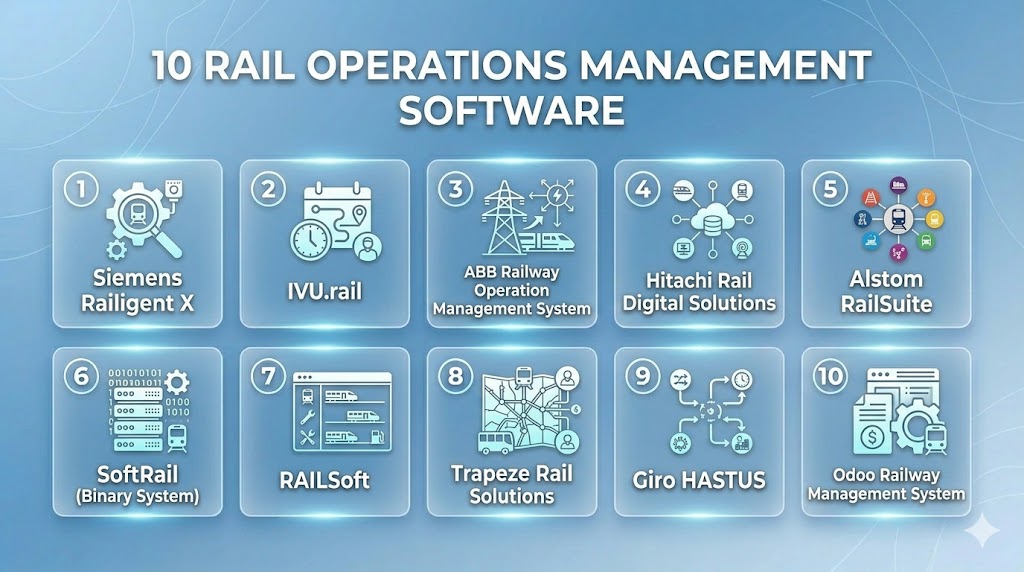
Top 10 Rail Operations Management Software Tools
#1 — Siemens Railigent X
Short description: A comprehensive rail platform that combines operations, maintenance, and analytics into one ecosystem. It is designed for large rail networks and focuses on predictive insights and automation. It supports data-driven decision-making across operations.
Key Features
- Integrated operations and asset management
- Predictive maintenance analytics
- Real-time monitoring dashboards
- Energy optimization tools
- Cloud-based architecture
- Passenger information systems
Pros
- Strong integration with rail infrastructure
- Advanced analytics capabilities
Cons
- Complex implementation
- Enterprise-focused
Platforms / Deployment
Web
Cloud
Security & Compliance
Not publicly stated
Integrations & Ecosystem
Integrates with rail infrastructure systems.
- Signaling systems
- IoT devices
- APIs
Support & Community
Enterprise-level support.
#2 — IVU.rail
Short description: IVU.rail is a modular platform designed for planning, scheduling, and dispatching rail operations. It is widely used in public transport and railway systems. It focuses on efficiency and operational transparency.
Key Features
- Timetable planning
- Crew scheduling
- Vehicle management
- Real-time dispatching
- Optimization algorithms
Pros
- Modular and flexible
- Strong planning tools
Cons
- Requires customization
- Learning curve
Platforms / Deployment
Web
Cloud
Security & Compliance
Not publicly stated
Integrations & Ecosystem
Supports integrations.
- ERP systems
- APIs
Support & Community
Strong enterprise support.
#3 — ABB Railway Operation Management System
Short description: ABB’s solution focuses on optimizing train operations through real-time monitoring and automation. It integrates infrastructure and rolling stock data for better decision-making.
Key Features
- Train scheduling and dispatching
- Real-time monitoring
- Incident management
- Capacity planning
- Performance analytics
Pros
- Reliable and scalable
- Strong operational visibility
Cons
- Enterprise-focused
- Implementation complexity
Platforms / Deployment
Web
Cloud
Security & Compliance
Not publicly stated
Integrations & Ecosystem
Integrates with rail systems.
- Signaling systems
- Control systems
- APIs
Support & Community
Enterprise support.
#4 — Hitachi Rail Digital Solutions
Short description: A digital platform designed to enhance rail operations through automation and analytics. It supports traffic management, maintenance, and operational efficiency.
Key Features
- Traffic management
- Predictive analytics
- Asset monitoring
- Real-time data integration
- Reporting tools
Pros
- Strong analytics
- Scalable platform
Cons
- Complex setup
- Enterprise-oriented
Platforms / Deployment
Web
Cloud
Security & Compliance
Not publicly stated
Integrations & Ecosystem
Supports integrations.
- Rail infrastructure systems
- APIs
Support & Community
Enterprise-level support.
#5 — Alstom RailSuite
Short description: RailSuite provides a unified platform for managing rail operations, assets, and maintenance. It is designed for large rail operators and metro systems.
Key Features
- Operations management
- Asset tracking
- Maintenance planning
- Analytics dashboards
- Integration tools
Pros
- Comprehensive platform
- Strong industry presence
Cons
- High implementation effort
- Cost may vary
Platforms / Deployment
Web
Cloud
Security & Compliance
Not publicly stated
Integrations & Ecosystem
Enterprise integrations.
- Maintenance systems
- APIs
Support & Community
Enterprise support.
#6 — CloudMoyo Rail Operations Management
Short description: A cloud-based platform that helps rail operators manage scheduling, assets, and operations efficiently. It focuses on automation and real-time visibility.
Key Features
- Train scheduling
- Asset and equipment tracking
- Real-time monitoring
- Work order management
- Compliance support
Pros
- Cloud-native architecture
- Strong visibility tools
Cons
- Adoption still growing
- Customization required
Platforms / Deployment
Web
Cloud
Security & Compliance
Not publicly stated
Integrations & Ecosystem
API-based integrations.
- Enterprise systems
- APIs
Support & Community
Standard enterprise support.
#7 — Indra Rail Operation Management System
Short description: Indra provides a system for managing rail traffic, scheduling, and operations. It focuses on improving efficiency and reducing delays.
Key Features
- Traffic control
- Scheduling tools
- Real-time monitoring
- Incident management
- KPI tracking
Pros
- Strong traffic management
- Good analytics
Cons
- Requires integration effort
- Enterprise-focused
Platforms / Deployment
Web
Cloud
Security & Compliance
Not publicly stated
Integrations & Ecosystem
Supports integrations.
- Signaling systems
- APIs
Support & Community
Enterprise support.
#8 — Trapeze Rail Solutions
Short description: Trapeze provides rail and transit management tools focused on scheduling, dispatching, and operations. It is widely used in public transport systems.
Key Features
- Scheduling tools
- Dispatch management
- Real-time tracking
- Reporting
- Integration support
Pros
- Proven solution
- Reliable performance
Cons
- Interface may feel dated
- Customization needed
Platforms / Deployment
Web
Cloud
Security & Compliance
Not publicly stated
Integrations & Ecosystem
Supports integrations.
- Transit systems
- APIs
Support & Community
Strong support network.
#9 — Giro HASTUS
Short description: HASTUS is a scheduling and planning system used in public transport and rail operations. It focuses on optimizing workforce and vehicle usage.
Key Features
- Scheduling optimization
- Crew management
- Resource planning
- Analytics tools
- Integration support
Pros
- Strong optimization algorithms
- Widely adopted
Cons
- Learning curve
- Complex setup
Platforms / Deployment
Web
Cloud
Security & Compliance
Not publicly stated
Integrations & Ecosystem
Supports integrations.
- ERP systems
- APIs
Support & Community
Enterprise support.
#10 — RAILSoft
Short description: RAILSoft is a comprehensive railway management system designed to manage operations, planning, and resources. It supports real-time data collection and analysis.
Key Features
- Route planning
- Fleet management
- HR management
- Real-time data collection
- Reporting tools
Pros
- Comprehensive functionality
- Supports multiple rail use cases
Cons
- Limited global presence
- Customization required
Platforms / Deployment
Web
Cloud / On-premise
Security & Compliance
Not publicly stated
Integrations & Ecosystem
Supports integrations.
- Operational systems
- APIs
Support & Community
Standard support.
Comparison Table (Top 10)
| Tool Name | Best For | Platform(s) Supported | Deployment | Standout Feature | Public Rating |
|---|---|---|---|---|---|
| Siemens Railigent X | Enterprise | Web | Cloud | Predictive analytics | N/A |
| IVU.rail | Transit systems | Web | Cloud | Modular planning | N/A |
| ABB ROMS | Large networks | Web | Cloud | Real-time control | N/A |
| Hitachi Rail | Enterprise | Web | Cloud | Data integration | N/A |
| Alstom RailSuite | Metro systems | Web | Cloud | Unified platform | N/A |
| CloudMoyo | Modern rail ops | Web | Cloud | Cloud-native | N/A |
| Indra | Traffic control | Web | Cloud | KPI tracking | N/A |
| Trapeze | Public transport | Web | Cloud | Dispatch tools | N/A |
| HASTUS | Workforce planning | Web | Cloud | Optimization | N/A |
| RAILSoft | Multi-use rail | Web | Hybrid | End-to-end system | N/A |
Evaluation & Scoring of Rail Operations Management Software
| Tool Name | Core (25%) | Ease (15%) | Integrations (15%) | Security (10%) | Performance (10%) | Support (10%) | Value (15%) | Weighted Total |
|---|---|---|---|---|---|---|---|---|
| Siemens | 10 | 6 | 9 | 8 | 9 | 9 | 6 | 8.4 |
| IVU | 9 | 7 | 8 | 7 | 8 | 8 | 7 | 7.9 |
| ABB | 9 | 7 | 8 | 8 | 9 | 8 | 7 | 8.1 |
| Hitachi | 9 | 6 | 8 | 7 | 8 | 8 | 6 | 7.8 |
| Alstom | 9 | 6 | 8 | 7 | 8 | 8 | 6 | 7.8 |
| CloudMoyo | 8 | 8 | 7 | 7 | 8 | 7 | 8 | 7.8 |
| Indra | 8 | 7 | 8 | 7 | 8 | 7 | 7 | 7.6 |
| Trapeze | 8 | 7 | 7 | 6 | 7 | 7 | 7 | 7.3 |
| HASTUS | 8 | 7 | 7 | 7 | 8 | 7 | 7 | 7.5 |
| RAILSoft | 7 | 7 | 6 | 6 | 7 | 7 | 8 | 7.1 |
How to interpret scores:
- Higher scores indicate stronger overall capability
- Enterprise tools score higher in features and integrations
- Mid-market tools balance usability and value
- Choose based on operational complexity and scale
Which Rail Operations Management Software Is Right for You?
Solo / Freelancer
Not applicable.
SMB
RAILSoft, CloudMoyo.
Mid-Market
IVU.rail, Indra, HASTUS.
Enterprise
Siemens Railigent X, ABB, Hitachi, Alstom.
Budget vs Premium
- Budget: RAILSoft
- Premium: Siemens, ABB
Feature Depth vs Ease of Use
- Feature-rich: Siemens
- Easier tools: CloudMoyo
Integrations & Scalability
- Strong: ABB, Siemens
Security & Compliance Needs
- Enterprise-grade tools recommended
Frequently Asked Questions (FAQs)
Q1: What is rail operations management software?
It is software used to plan, monitor, and control railway operations.
Q2: Who uses these tools?
Railway operators, metro systems, and freight companies.
Q3: Do these tools support real-time monitoring?
Yes, real-time tracking is a core feature.
Q4: Are they cloud-based?
Many modern solutions are cloud-based.
Q5: Do they help reduce delays?
Yes, they improve scheduling and coordination.
Q6: Can they integrate with signaling systems?
Yes, integration is a key capability.
Q7: Are they secure?
Security features vary by platform.
Q8: How long does implementation take?
It can take months depending on complexity.
Q9: Are they customizable?
Some tools offer customization options.
Q10: What are common challenges?
Integration complexity and training requirements.
Conclusion
Rail Operations Management Software plays a crucial role in modern railway systems by ensuring efficient, safe, and reliable operations. These platforms bring together scheduling, monitoring, and analytics into a unified system that helps operators manage complex rail networks. The best solution depends on the scale and complexity of your operations. Enterprise systems offer deep integration and advanced features, while mid-market tools provide flexibility and ease of use. With advancements in automation, AI, and real-time data processing, these platforms are evolving rapidly to meet the demands of modern transportation systems.