Introduction
Asset Tracking (RFID) Software enables organizations to monitor and manage physical assets using Radio Frequency Identification (RFID) technology. It combines RFID tags, readers, and software platforms to automatically track asset location, movement, and usage in real time.
Unlike traditional barcode systems, RFID allows scanning multiple assets without direct line-of-sight, improving efficiency and accuracy. Businesses using RFID systems often achieve significantly higher inventory accuracy and faster tracking operations .
In modern operations, RFID-based asset tracking is critical for industries like logistics, manufacturing, healthcare, and IT infrastructure management.
Real-world use cases
- Inventory and warehouse tracking – Real-time visibility of stock movement
- IT asset management – Track laptops, servers, and devices
- Equipment tracking – Monitor tools and machinery usage
- Supply chain automation – Reduce manual errors and delays
- Compliance and audit tracking – Maintain accurate asset records
What buyers should evaluate
- RFID hardware compatibility (tags, readers)
- Real-time tracking capabilities
- Accuracy and scanning range
- Integration with ERP and CMMS systems
- Reporting and analytics features
- Scalability across locations
- Data security and privacy controls
- Ease of deployment
- Total cost (hardware + software)
Best for: Enterprises, warehouses, logistics companies, manufacturing units, hospitals, and IT asset managers.
Not ideal for: Very small businesses or environments where manual tracking is sufficient.
Key Trends in Asset Tracking (RFID) Software
- AI-powered asset tracking insights
- IoT integration for real-time monitoring
- Cloud-based RFID platforms replacing legacy systems
- Mobile RFID scanning using handheld devices
- Integration with ERP and supply chain systems
- Predictive maintenance using asset data
- Hybrid tracking (RFID + GPS + IoT sensors)
- Automation in inventory audits and stock counting
- Improved privacy and compliance controls
- Edge computing for faster RFID processing
How We Selected These Tools (Methodology)
- Market adoption and industry recognition
- RFID-specific capabilities and hardware support
- Performance and real-time tracking accuracy
- Security and compliance features
- Integration ecosystem strength
- Fit across SMB, mid-market, and enterprise
- Ease of implementation and usability
- Value for cost and scalability
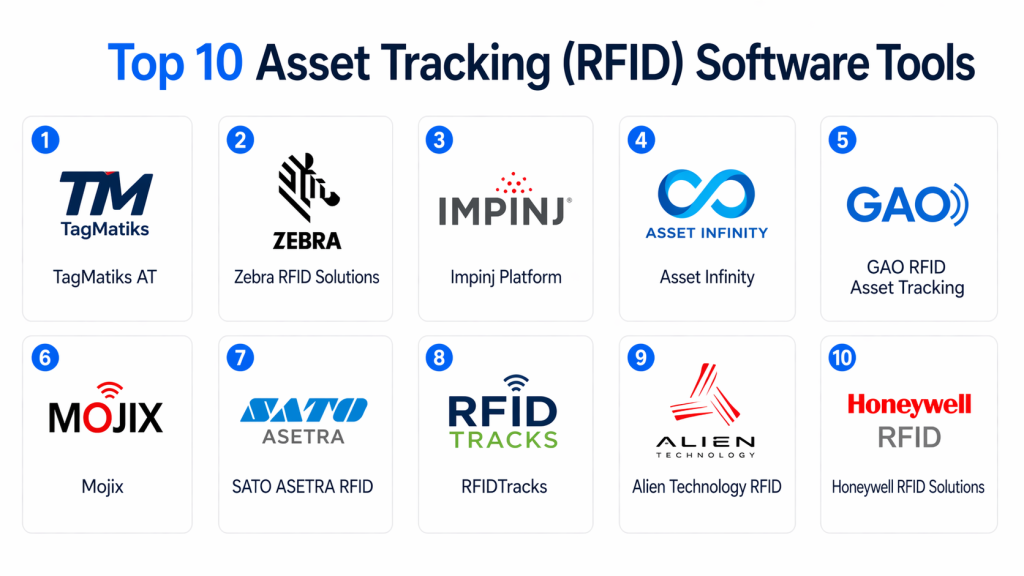
Top 10 Asset Tracking (RFID) Software Tools
#1 — TagMatiks AT
Short description: TagMatiks AT is a cloud-based RFID asset tracking platform that supports RFID and barcode technologies for complete lifecycle tracking of assets from acquisition to disposal .
Key Features
- RFID and barcode tracking
- Asset lifecycle management
- Real-time visibility
- Mobile applications
- Reporting dashboards
- Workflow automation
Pros
- Supports multiple tracking technologies
- Strong analytics features
Cons
- Requires RFID hardware setup
- Learning curve for new users
Platforms / Deployment
Cloud
Security & Compliance
Not publicly stated
Integrations & Ecosystem
- APIs
- ERP systems
- Inventory platforms
Support & Community
Good documentation and enterprise support.
#2 — Zebra RFID Software Solutions
Short description: Zebra provides enterprise-grade RFID asset tracking solutions integrated with hardware and analytics platforms.
Key Features
- Real-time asset tracking
- RFID hardware integration
- Advanced analytics
- Inventory automation
- Mobile scanning
Pros
- Industry-leading hardware ecosystem
- High accuracy
Cons
- Higher cost
- Requires hardware investment
Platforms / Deployment
Cloud / Hybrid
Security & Compliance
Not publicly stated
Integrations & Ecosystem
- ERP systems
- Warehouse systems
- APIs
Support & Community
Strong enterprise support.
#3 — Impinj Platform
Short description: Impinj offers RFID solutions focused on real-time tracking and IoT connectivity for asset visibility.
Key Features
- RFID tracking infrastructure
- Real-time monitoring
- IoT connectivity
- Data analytics
- Scalable architecture
Pros
- High-performance platform
- Strong IoT integration
Cons
- Complex setup
- Hardware dependency
Platforms / Deployment
Cloud / Hybrid
Security & Compliance
Not publicly stated
Integrations & Ecosystem
- IoT platforms
- APIs
- Enterprise systems
Support & Community
Enterprise-level support.
#4 — Asset Infinity RFID
Short description: Asset Infinity provides RFID-enabled asset tracking with a focus on automation and inventory accuracy.
Key Features
- RFID asset tracking
- Inventory management
- Maintenance tracking
- Reporting tools
- Mobile support
Pros
- Easy to use
- Good for mid-market
Cons
- Limited advanced features
- Customization limitations
Platforms / Deployment
Cloud
Security & Compliance
Not publicly stated
Integrations & Ecosystem
- APIs
- Business systems
Support & Community
Reliable support and onboarding.
#5 — GAO RFID Asset Tracking System
Short description: GAO RFID provides asset tracking systems with real-time monitoring and location tracking capabilities.
Key Features
- Real-time tracking
- RFID tags and readers
- Asset visibility
- Reporting dashboards
- Automation
Pros
- Strong tracking accuracy
- Comprehensive solution
Cons
- Hardware dependency
- Setup complexity
Platforms / Deployment
Cloud / Hybrid
Security & Compliance
Not publicly stated
Integrations & Ecosystem
- ERP systems
- APIs
Support & Community
Enterprise support available.
#6 — Mojix RFID Platform
Short description: Mojix provides cloud-based RFID tracking with real-time visibility across supply chains and enterprise operations.
Key Features
- Real-time asset tracking
- Cloud analytics
- Supply chain visibility
- IoT integration
- Data dashboards
Pros
- Strong supply chain capabilities
- Scalable
Cons
- Complex implementation
- Enterprise-focused
Platforms / Deployment
Cloud
Security & Compliance
Not publicly stated
Integrations & Ecosystem
- ERP systems
- APIs
- Supply chain tools
Support & Community
Enterprise support and documentation.
#7 — SATO ASETRA RFID
Short description: ASETRA is an RFID asset tracking system that enables fast inventory scanning and asset tracking with improved efficiency .
Key Features
- Bulk asset scanning
- Real-time tracking
- Inventory management
- Asset search
- Reporting
Pros
- Fast scanning capability
- Improves efficiency
Cons
- Requires RFID hardware
- Limited customization
Platforms / Deployment
Cloud
Security & Compliance
Not publicly stated
Integrations & Ecosystem
- APIs
- Inventory systems
Support & Community
Standard support services.
#8 — RFIDTracks
Short description: RFIDTracks offers asset tracking with maintenance tracking and mapping capabilities for improved asset visibility.
Key Features
- Asset mapping
- Maintenance tracking
- Work order integration
- Real-time tracking
- Reporting tools
Pros
- Easy to use
- Good for maintenance workflows
Cons
- Limited enterprise features
- UI improvements needed
Platforms / Deployment
Cloud
Security & Compliance
Not publicly stated
Integrations & Ecosystem
- APIs
- Maintenance tools
Support & Community
Good customer feedback and support .
#9 — Alien Technology RFID Software
Short description: Alien Technology provides RFID solutions focused on high-performance tracking and supply chain optimization.
Key Features
- RFID tracking
- Inventory automation
- Real-time monitoring
- Data analytics
- Scalable infrastructure
Pros
- Strong performance
- Enterprise scalability
Cons
- Hardware dependency
- Complex setup
Platforms / Deployment
Cloud / Hybrid
Security & Compliance
Not publicly stated
Integrations & Ecosystem
- ERP systems
- APIs
Support & Community
Enterprise-level support.
#10 — Honeywell RFID Solutions
Short description: Honeywell offers RFID tracking solutions integrated with industrial hardware for asset and inventory tracking.
Key Features
- RFID tracking
- Industrial-grade hardware integration
- Real-time data
- Reporting dashboards
- Automation
Pros
- Reliable hardware ecosystem
- Strong enterprise support
Cons
- Higher cost
- Hardware dependency
Platforms / Deployment
Cloud / Hybrid
Security & Compliance
Not publicly stated
Integrations & Ecosystem
- ERP systems
- Warehouse tools
- APIs
Support & Community
Strong enterprise support.
Comparison Table (Top 10)
| Tool Name | Best For | Platform(s) Supported | Deployment | Standout Feature | Public Rating |
|---|---|---|---|---|---|
| TagMatiks AT | RFID lifecycle tracking | Web | Cloud | Multi-tech tracking | N/A |
| Zebra RFID | Enterprise tracking | Web | Hybrid | Hardware ecosystem | N/A |
| Impinj | IoT tracking | Web | Hybrid | Real-time connectivity | N/A |
| Asset Infinity | Mid-market | Web | Cloud | Easy deployment | N/A |
| GAO RFID | Real-time tracking | Web | Hybrid | High accuracy | N/A |
| Mojix | Supply chain | Web | Cloud | Cloud analytics | N/A |
| SATO ASETRA | Fast inventory | Web | Cloud | Bulk scanning | N/A |
| RFIDTracks | Maintenance tracking | Web | Cloud | Asset mapping | N/A |
| Alien RFID | Enterprise | Web | Hybrid | Performance | N/A |
| Honeywell RFID | Industrial use | Web | Hybrid | Hardware integration | N/A |
Evaluation & Scoring of Asset Tracking (RFID) Software
| Tool Name | Core (25%) | Ease (15%) | Integrations (15%) | Security (10%) | Performance (10%) | Support (10%) | Value (15%) | Weighted Total |
|---|---|---|---|---|---|---|---|---|
| TagMatiks | 8 | 7 | 8 | 6 | 8 | 7 | 8 | 7.7 |
| Zebra | 9 | 6 | 9 | 7 | 9 | 9 | 6 | 8.2 |
| Impinj | 9 | 6 | 9 | 7 | 9 | 9 | 6 | 8.2 |
| Asset Infinity | 7 | 8 | 7 | 6 | 7 | 7 | 8 | 7.4 |
| GAO RFID | 8 | 6 | 7 | 6 | 8 | 7 | 7 | 7.3 |
| Mojix | 9 | 6 | 8 | 7 | 9 | 8 | 6 | 7.9 |
| SATO ASETRA | 7 | 7 | 7 | 6 | 8 | 7 | 7 | 7.3 |
| RFIDTracks | 7 | 8 | 6 | 6 | 7 | 7 | 8 | 7.2 |
| Alien RFID | 9 | 6 | 8 | 7 | 9 | 8 | 6 | 7.9 |
| Honeywell | 9 | 6 | 8 | 7 | 9 | 9 | 6 | 8.0 |
How to interpret scores:
These scores compare tools across key criteria like features, ease of use, and performance. Higher scores indicate stronger capabilities, but the best tool depends on your use case. Enterprise tools excel in performance, while mid-market tools focus on usability and cost efficiency.
Which Asset Tracking (RFID) Software Is Right for You?
Solo / Freelancer
Not required unless tracking high-value equipment.
SMB
Asset Infinity and RFIDTracks are easy to deploy and affordable.
Mid-Market
TagMatiks and SATO ASETRA provide balanced features.
Enterprise
Zebra, Impinj, Mojix, and Honeywell are best for large-scale deployments.
Budget vs Premium
- Budget: Asset Infinity
- Premium: Zebra, Impinj
Feature Depth vs Ease of Use
- Advanced: Impinj, Mojix
- Easy: RFIDTracks
Integrations & Scalability
Choose platforms with strong APIs like Zebra or Impinj.
Security & Compliance Needs
Enterprise tools provide better compliance and security features.
Frequently Asked Questions (FAQs)
1. What is RFID asset tracking software?
RFID asset tracking software uses RFID tags and readers to automatically track physical assets in real time, improving accuracy and efficiency.
2. How does RFID tracking work?
RFID tags store data about assets, which is read by RFID readers and processed by software to monitor location and usage .
3. What are the benefits of RFID over barcodes?
RFID allows scanning without direct line-of-sight and can track multiple items simultaneously, making it faster and more efficient .
4. Which industries use RFID asset tracking?
Industries like logistics, manufacturing, healthcare, and retail use RFID for tracking assets and inventory.
5. Does RFID require special hardware?
Yes, RFID systems require tags and readers along with software to function properly.
6. Is RFID tracking accurate?
RFID tracking is highly accurate and significantly reduces manual errors compared to traditional methods.
7. Can RFID integrate with ERP systems?
Most modern RFID systems integrate with ERP and inventory management platforms.
8. How much does RFID tracking cost?
Costs vary depending on hardware, software, and deployment scale.
9. Is RFID secure?
Most systems include encryption and access controls, but security features vary by vendor.
10. Can small businesses use RFID?
Yes, but cost and complexity should be carefully evaluated before implementation.
Conclusion
Asset Tracking (RFID) Software has become a powerful solution for organizations looking to improve visibility, efficiency, and control over their physical assets. By automating tracking processes and eliminating manual errors, RFID systems enable faster operations and more accurate data-driven decisions. However, selecting the right solution depends on your business size, infrastructure, and operational needs. Enterprise platforms offer advanced scalability and performance, while mid-market tools provide a balance between cost and usability. Before implementing an RFID solution, it is essential to evaluate hardware requirements, integration capabilities, and long-term ROI. Running a pilot project can help validate performance and usability. Ultimately, the value of RFID asset tracking lies in its ability to provide real-time insights and operational efficiency. When implemented effectively, it can significantly improve asset management, reduce losses, and enhance overall productivity.