Introduction
Brand Monitoring Tools help businesses track what people are saying about their brand, products, executives, competitors, campaigns, and industry topics across online channels. These tools monitor mentions from social media, news sites, blogs, forums, review platforms, podcasts, videos, and other digital sources so teams can understand public perception and respond quickly.
Brand monitoring is important because customer opinions, complaints, praise, and viral discussions can affect trust, reputation, sales, and customer loyalty. A strong platform helps teams detect positive and negative mentions, measure sentiment, identify influencers, track competitor activity, and create reports for marketing, PR, customer support, and leadership teams.
Real-world use cases include:
- Tracking brand mentions across social media and online news
- Detecting customer complaints and reputation risks early
- Monitoring competitor mentions and campaign performance
- Measuring sentiment around product launches or announcements
- Finding influencers, journalists, and advocates talking about the brand
- Reporting share of voice, reach, engagement, and brand health
Buyer evaluation criteria should include:
- Source coverage across web, social, news, blogs, forums, and reviews
- Real-time alerts and notification speed
- Sentiment analysis accuracy
- Competitor tracking and share-of-voice reporting
- Influencer and author identification
- Dashboard and reporting quality
- Team collaboration and workflow features
- Integrations with social, PR, CRM, and support tools
- Security and access controls
- Pricing, scalability, and customer support
Best for: Marketing teams, PR teams, communications teams, brand managers, agencies, customer experience teams, ecommerce brands, SaaS companies, enterprises, and businesses that need visibility into reputation, customer sentiment, and online brand conversations.
Not ideal for: Very small teams that only need occasional manual searches, businesses with no active online presence, or users who only need social media scheduling without deeper mention tracking, sentiment analysis, alerts, or reputation reporting.
Key Trends in Brand Monitoring Tools
- AI-powered sentiment analysis: Brand monitoring platforms increasingly use AI to classify positive, negative, neutral, urgent, and emotional mentions.
- Real-time reputation alerts: Teams want fast notifications when negative reviews, viral posts, or crisis signals appear.
- Social listening and media monitoring are merging: Buyers prefer platforms that cover social media, news, blogs, forums, podcasts, and online discussions together.
- Customer support teams are using monitoring data: Brand mentions are now routed to support teams when customers complain publicly.
- Competitor benchmarking is becoming essential: Teams want share-of-voice comparisons, sentiment trends, campaign comparisons, and category-level visibility.
- Influencer and advocate discovery is growing: Brands want to identify people who influence conversations and customer trust.
- Review monitoring is more important: Businesses increasingly track ratings, feedback, and review trends across customer review platforms.
- Executive reputation monitoring is expanding: Companies monitor founders, leaders, spokespeople, and public-facing executives.
- Global and multilingual tracking matters: Brands operating in multiple regions need language, location, and local source coverage.
- Actionable reporting is replacing vanity metrics: Teams want insights that guide response, messaging, product improvement, and campaign decisions.
How We Selected These Tools
The tools in this list were selected using practical buyer-focused evaluation logic:
- Strong recognition in brand monitoring, social listening, media monitoring, reputation management, or customer intelligence
- Ability to track brand mentions across multiple online and media sources
- Fit across SMBs, agencies, mid-market teams, enterprises, PR teams, and marketing departments
- Practical capabilities for alerts, sentiment analysis, competitor tracking, and reporting
- Support for social listening, review monitoring, news monitoring, or online conversation tracking
- Ease of use for marketers, PR teams, support teams, and brand managers
- Reporting quality for sentiment, reach, share of voice, engagement, and trend analysis
- Team collaboration features for response workflows and escalation
- Security and administration controls suitable for business use
- Overall value based on coverage, usability, insights, integrations, scalability, and support
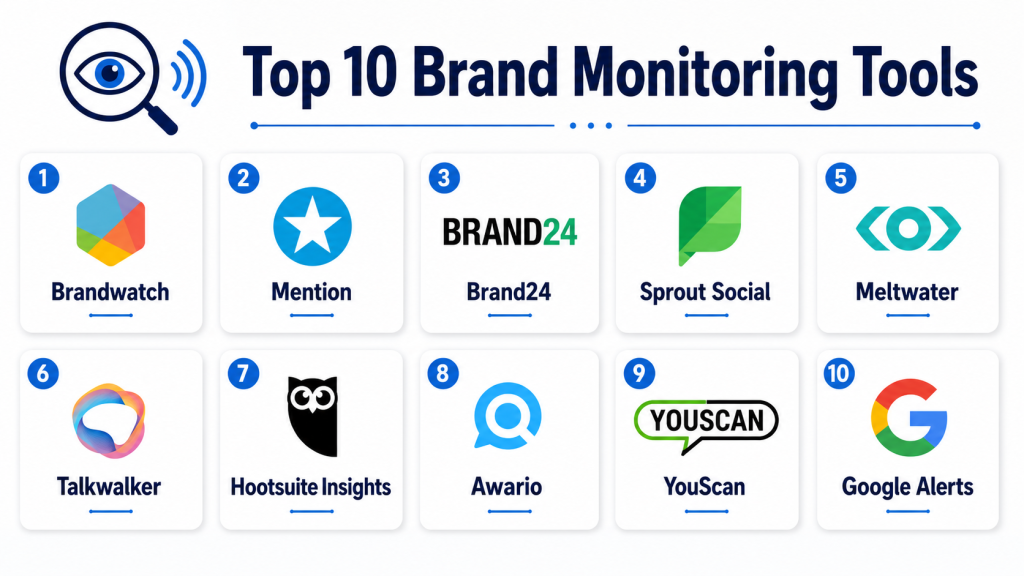
Top 10 Brand Monitoring Tools
#1 — Brandwatch
Short description: Brandwatch is a social listening and consumer intelligence platform that helps teams monitor online conversations, analyze sentiment, track trends, and understand audience behavior. It is useful for large brands, agencies, marketing teams, and insights teams that need deep analytics. Brandwatch is especially strong for organizations that want advanced conversation analysis and trend discovery.
Key Features
- Social listening and online conversation monitoring
- Sentiment and emotion analysis
- Trend and topic discovery
- Competitor and campaign tracking
- Audience intelligence and segmentation
- Dashboards and reporting
- Brand reputation monitoring
Pros
- Strong analytics depth for online conversations
- Useful for brand, marketing, and consumer insight teams
- Good fit for enterprise and agency use cases
Cons
- May feel complex for small teams
- Requires careful query setup for accurate insights
- Pricing may be higher than lightweight tools
Platforms / Deployment
Cloud
Web-based platform
Security & Compliance
Enterprise security controls may be available. Buyers should validate SSO, role-based access, permissions, encryption, audit logs, retention, and compliance needs directly.
Integrations & Ecosystem
Brandwatch fits into brand intelligence, campaign analysis, consumer research, PR reporting, and social listening workflows. It is especially useful for teams that need detailed online conversation insights.
- Social media workflows
- Consumer research processes
- Campaign reporting
- Marketing intelligence dashboards
- Data export workflows
- Brand strategy workflows
Support & Community
Brandwatch provides documentation, onboarding, customer support, training resources, and customer success assistance. Support depth may vary by package and business size.
#2 — Mention
Short description: Mention is a brand monitoring and social listening tool that helps teams track brand mentions, competitor mentions, keywords, and online conversations. It is practical for SMBs, agencies, marketers, and PR teams that need accessible monitoring without heavy enterprise complexity. Mention works well for quick alerts and simple online reputation tracking.
Key Features
- Brand and keyword monitoring
- Social media and web mention tracking
- Alerts and notifications
- Competitor monitoring
- Sentiment and engagement insights
- Reporting dashboards
- Team collaboration support
Pros
- Easy to use for small and mid-sized teams
- Good for online brand mention tracking
- Practical for agencies and marketers
Cons
- May not match enterprise tools in coverage depth
- Advanced reporting needs should be validated
- Broadcast monitoring may require other tools
Platforms / Deployment
Cloud
Web-based platform
Security & Compliance
Security and compliance details should be verified directly. Buyers should review permissions, data handling, account security, retention, and privacy requirements.
Integrations & Ecosystem
Mention supports everyday brand tracking, competitor monitoring, social listening, and reporting workflows. It is useful for teams that want fast alerts and straightforward dashboards.
- Social media workflows
- Brand tracking dashboards
- Competitor monitoring
- Marketing reporting
- Agency workflows
- Collaboration tools
Support & Community
Mention provides documentation, help resources, support options, and product guidance. Support level may vary by plan.
#3 — Brand24
Short description: Brand24 is a brand monitoring and social listening platform that helps teams track mentions, sentiment, reach, influencers, hashtags, and online discussions. It is popular with SMBs, agencies, marketers, and PR teams that want accessible monitoring and clear dashboards. Brand24 is especially useful for tracking online reputation and campaign conversations.
Key Features
- Online mention tracking
- Sentiment analysis
- Influencer and reach metrics
- Alerts and spike detection
- Hashtag and keyword tracking
- Competitor monitoring
- Reporting dashboards
Pros
- Practical for SMBs and agencies
- Easy to use for online reputation tracking
- Good value for digital mention monitoring
Cons
- May not provide deep enterprise PR database workflows
- Sentiment accuracy should be tested for niche topics
- Broadcast monitoring depth may be limited
Platforms / Deployment
Cloud
Web-based platform
Mobile access may vary
Security & Compliance
Security and compliance details should be verified directly. Buyers should validate access controls, permissions, data handling, retention, and privacy requirements.
Integrations & Ecosystem
Brand24 fits marketing, PR, reputation management, campaign tracking, and competitor monitoring workflows. It is useful for teams that want quick visibility into online conversations.
- Social media workflows
- Reputation tracking
- Influencer monitoring
- Competitor analysis
- Reporting dashboards
- Campaign measurement
Support & Community
Brand24 provides documentation, onboarding resources, support options, product education, and monitoring guidance. Support level may vary by plan.
#4 — Sprout Social
Short description: Sprout Social is a social media management and listening platform that helps teams monitor brand mentions, manage engagement, analyze conversations, and report on social performance. It is useful for brands where social media is a major customer communication and reputation channel. Sprout Social is especially strong when monitoring must connect with social publishing and customer care workflows.
Key Features
- Social media monitoring and listening
- Brand mention and keyword tracking
- Unified social inbox
- Social engagement and response workflows
- Sentiment and trend insights
- Analytics and reporting
- Team collaboration tools
Pros
- Strong for social media monitoring and engagement
- Useful for marketing, support, and brand teams
- Good reporting and workflow collaboration features
Cons
- Not a full traditional media monitoring platform
- News and broadcast coverage may require another tool
- Pricing should be evaluated for larger teams
Platforms / Deployment
Cloud
Web-based platform
Mobile apps available
Security & Compliance
Business and enterprise security features may be available. Buyers should validate SSO, permissions, role-based access, audit logs, retention, and compliance requirements directly.
Integrations & Ecosystem
Sprout Social connects brand monitoring with social publishing, engagement, analytics, and customer care workflows. It is strongest when social channels are central to brand reputation.
- Social media platforms
- Customer care workflows
- Analytics dashboards
- Team collaboration tools
- Marketing reporting
- Social engagement workflows
Support & Community
Sprout Social provides documentation, onboarding resources, training, customer support, and a large user community. Support level may vary by plan.
#5 — Meltwater
Short description: Meltwater is a media intelligence and brand monitoring platform used by PR, communications, marketing, and enterprise reputation teams. It helps organizations track news, social conversations, brand mentions, competitors, sentiment, and campaign performance. Meltwater is especially useful for teams that need broad monitoring coverage and executive reporting.
Key Features
- Online news and social media monitoring
- Brand mention tracking and alerts
- Sentiment analysis and trend detection
- Share-of-voice and competitor benchmarking
- PR and brand reporting dashboards
- Influencer and media intelligence support
- Global monitoring capabilities
Pros
- Strong fit for enterprise and global teams
- Broad media monitoring and analytics capabilities
- Useful for brand reputation and executive reporting
Cons
- May be more advanced than small teams need
- Pricing can vary by package and coverage
- Setup requires clear keyword and reporting strategy
Platforms / Deployment
Cloud
Web-based platform
Mobile access may vary by package
Security & Compliance
Enterprise security and administration controls may be available. Buyers should validate SSO, role-based access, encryption, audit logs, retention, and compliance requirements directly.
Integrations & Ecosystem
Meltwater connects brand monitoring with PR, social listening, influencer analysis, reporting, and communications workflows. It is useful for brands that need broad visibility across media channels.
- PR reporting workflows
- Social media workflows
- Analytics dashboards
- Influencer marketing workflows
- Executive reporting
- Communications workflows
Support & Community
Meltwater provides onboarding, documentation, customer success resources, training, and enterprise support options. Support depth may vary by package and region.
#6 — Talkwalker
Short description: Talkwalker is a social listening, consumer intelligence, and media monitoring platform used by brands and agencies to track online conversations, sentiment, campaigns, and reputation signals. It supports broad digital monitoring and multilingual analysis. Talkwalker is especially useful for global brands that need deeper social and media intelligence.
Key Features
- Social listening and media monitoring
- Sentiment analysis and trend tracking
- Brand and competitor tracking
- Visual and image recognition support
- Campaign performance reporting
- Real-time alerts
- Global and multilingual monitoring support
Pros
- Strong for global brand monitoring
- Useful analytics for social and digital conversations
- Good fit for agencies and enterprise marketing teams
Cons
- Advanced setup may require training
- Smaller teams may not need full platform depth
- Pricing may be enterprise-oriented
Platforms / Deployment
Cloud
Web-based platform
Security & Compliance
Security and compliance capabilities should be verified directly. Buyers should validate SSO, permissions, encryption, audit logs, retention, and privacy requirements.
Integrations & Ecosystem
Talkwalker supports brand intelligence, PR reporting, campaign measurement, and consumer insight workflows. It works well when teams need broad monitoring across languages and regions.
- Social analytics workflows
- PR reporting
- Campaign measurement
- Executive dashboards
- Brand intelligence workflows
- Data export systems
Support & Community
Talkwalker provides onboarding, documentation, training, support, and analytics guidance. Support level may vary by package and region.
#7 — Hootsuite Insights
Short description: Hootsuite Insights supports social listening and brand monitoring workflows inside the broader Hootsuite social media management ecosystem. It helps teams track conversations, monitor keywords, understand sentiment, and connect insights with social media activity. It is useful for teams already using Hootsuite for publishing and engagement.
Key Features
- Social listening and keyword tracking
- Brand mention monitoring
- Sentiment and conversation insights
- Social media engagement workflows
- Dashboards and analytics
- Competitor tracking support
- Team collaboration features
Pros
- Strong fit for Hootsuite users
- Useful when monitoring must connect with social management
- Practical for marketing and social teams
Cons
- May not replace dedicated enterprise media monitoring platforms
- Full capabilities may depend on selected plan or add-ons
- Source coverage should be validated for each use case
Platforms / Deployment
Cloud
Web-based platform
Mobile apps available through Hootsuite ecosystem
Security & Compliance
Security features may include user permissions, team access controls, authentication, and administrative settings. Buyers should validate SSO, data handling, retention, and compliance needs directly.
Integrations & Ecosystem
Hootsuite Insights works best inside social media management workflows where monitoring, publishing, engagement, and reporting need to connect.
- Social media platforms
- Publishing workflows
- Engagement workflows
- Analytics dashboards
- Team collaboration
- Marketing reporting
Support & Community
Hootsuite provides documentation, training resources, product support, onboarding options, and a large user community. Support level may vary by plan.
#8 — Awario
Short description: Awario is a social listening and web monitoring tool that helps teams track brand mentions, keywords, competitors, and industry conversations. It is useful for small businesses, agencies, founders, and marketers that want affordable brand monitoring and mention alerts. Awario is especially practical for users who need simple online conversation tracking.
Key Features
- Brand mention tracking
- Social media and web monitoring
- Keyword and competitor monitoring
- Sentiment analysis
- Influencer discovery support
- Real-time alerts
- Reporting dashboards
Pros
- Practical for small teams and agencies
- Affordable option for online monitoring
- Easy to use for basic brand tracking
Cons
- Enterprise governance features may be limited
- Source coverage should be validated for specific markets
- Advanced analytics may not match larger platforms
Platforms / Deployment
Cloud
Web-based platform
Security & Compliance
Security and compliance details should be verified directly. Buyers should validate access controls, data handling, permissions, account security, and privacy requirements.
Integrations & Ecosystem
Awario fits brand tracking, social listening, competitor monitoring, and simple reporting workflows. It is useful for teams that need accessible monitoring without heavy complexity.
- Social media workflows
- Web mention tracking
- Competitor monitoring
- Influencer discovery
- Reporting dashboards
- Agency workflows
Support & Community
Awario provides documentation, product resources, support options, and monitoring guidance. Support depth may vary by plan.
#9 — YouScan
Short description: YouScan is a social listening and brand monitoring platform with strengths in visual analytics, social media monitoring, sentiment analysis, and consumer insight workflows. It helps brands track mentions, images, trends, and audience conversations. YouScan is especially useful for teams that care about visual brand mentions and social media intelligence.
Key Features
- Social media monitoring
- Brand mention and keyword tracking
- Visual recognition and image monitoring
- Sentiment analysis
- Trend and topic discovery
- Audience and consumer insights
- Reporting dashboards
Pros
- Strong for visual and social media monitoring
- Useful for consumer brands and agencies
- Helps identify image-based brand mentions
Cons
- May not be the best standalone PR media database
- Enterprise fit should be validated by region and source coverage
- Advanced setup may require training
Platforms / Deployment
Cloud
Web-based platform
Security & Compliance
Security and compliance details should be verified directly. Buyers should validate user permissions, data handling, authentication, retention, and compliance requirements.
Integrations & Ecosystem
YouScan fits social intelligence, visual monitoring, brand tracking, campaign analysis, and consumer research workflows. It is useful for brands where images and visual content matter.
- Social media workflows
- Visual brand monitoring
- Consumer research
- Campaign reporting
- Competitor tracking
- Analytics dashboards
Support & Community
YouScan provides documentation, onboarding resources, customer support, training, and analytics guidance. Support depth may vary by package.
#10 — Google Alerts
Short description: Google Alerts is a simple free monitoring tool that sends notifications when new web results match selected keywords. It is not a full brand monitoring platform, but it can be useful for individuals, small businesses, and early-stage teams that need basic web mention alerts. It works best as a lightweight starting point, not as a full reputation management solution.
Key Features
- Basic keyword alerts
- Web mention notifications
- Simple setup
- Email-based updates
- Topic and brand tracking
- Basic competitor mention tracking
- Useful for low-cost monitoring
Pros
- Free and simple to use
- Good for basic web mention tracking
- Useful as an entry-level monitoring option
Cons
- Limited source coverage and analytics
- No advanced sentiment, dashboards, or workflow tools
- Not suitable for serious brand reputation management at scale
Platforms / Deployment
Cloud
Web-based tool
Email alerts
Security & Compliance
Google account security controls apply. Buyers should not treat it as an enterprise brand monitoring or compliance platform without reviewing organizational requirements.
Integrations & Ecosystem
Google Alerts is mainly used as a simple standalone alerting tool. It can support basic brand, competitor, and topic tracking for individuals and small teams.
- Email notification workflows
- Manual brand tracking
- Simple competitor monitoring
- Topic tracking
- Personal research workflows
- Lightweight PR monitoring
Support & Community
Google Alerts has basic help resources and general Google account support options. It does not offer the structured onboarding or reporting support expected from dedicated brand monitoring platforms.
Comparison Table
| Tool Name | Best For | Platform(s) Supported | Deployment | Standout Feature | Public Rating |
|---|---|---|---|---|---|
| Brandwatch | Enterprise social and consumer intelligence | Web-based | Cloud | Deep online conversation analytics | N/A |
| Mention | SMB and agency brand monitoring | Web-based | Cloud | Simple online mention tracking | N/A |
| Brand24 | Digital reputation and campaign tracking | Web-based, mobile access varies | Cloud | Mentions, sentiment, and reach metrics | N/A |
| Sprout Social | Social monitoring and engagement teams | Web-based, mobile apps | Cloud | Social listening plus response workflows | N/A |
| Meltwater | Enterprise media and brand intelligence | Web-based, mobile access varies | Cloud | Broad media monitoring and reporting | N/A |
| Talkwalker | Global brand monitoring | Web-based | Cloud | Multilingual social and media intelligence | N/A |
| Hootsuite Insights | Hootsuite social media teams | Web-based, mobile apps | Cloud | Monitoring connected with social management | N/A |
| Awario | Affordable online brand tracking | Web-based | Cloud | Simple web and social monitoring | N/A |
| YouScan | Visual and social brand monitoring | Web-based | Cloud | Image and visual mention tracking | N/A |
| Google Alerts | Basic web mention alerts | Web-based, email alerts | Cloud | Free keyword-based web alerts | N/A |
Evaluation & Scoring of Brand Monitoring Tools
| Tool Name | Core (25%) | Ease (15%) | Integrations (15%) | Security (10%) | Performance (10%) | Support (10%) | Value (15%) | Weighted Total (0–10) |
|---|---|---|---|---|---|---|---|---|
| Brandwatch | 10 | 7 | 8 | 8 | 9 | 8 | 7 | 8.25 |
| Mention | 8 | 9 | 7 | 7 | 8 | 8 | 8 | 7.85 |
| Brand24 | 8 | 9 | 7 | 7 | 8 | 8 | 9 | 8.10 |
| Sprout Social | 8 | 9 | 9 | 8 | 8 | 8 | 8 | 8.30 |
| Meltwater | 10 | 7 | 9 | 9 | 9 | 8 | 7 | 8.55 |
| Talkwalker | 9 | 7 | 8 | 8 | 9 | 8 | 7 | 8.10 |
| Hootsuite Insights | 8 | 8 | 8 | 8 | 8 | 8 | 8 | 8.00 |
| Awario | 7 | 9 | 7 | 7 | 8 | 7 | 9 | 7.75 |
| YouScan | 8 | 8 | 7 | 7 | 8 | 8 | 8 | 7.75 |
| Google Alerts | 5 | 10 | 5 | 7 | 6 | 5 | 10 | 6.65 |
These scores are comparative and should be used as a shortlist guide. Enterprise platforms usually score higher for coverage, analytics, security, and reporting depth. SMB-focused tools often score higher for ease of use and value. Social-first platforms are stronger for engagement workflows, while media intelligence platforms are stronger for broader coverage and executive reporting. The best tool depends on your monitoring goals, channel mix, team size, and budget.
Which Brand Monitoring Tool Is Right for You?
Solo / Freelancer
Solo users should keep monitoring simple and affordable. Google Alerts, Awario, Mention, or Brand24 can be practical starting points depending on the need. If you only need basic brand or name tracking, Google Alerts may be enough. If you need dashboards, sentiment, competitor monitoring, and social mentions, Brand24 or Mention will be more useful.
SMB
SMBs should prioritize ease of use, alerts, sentiment tracking, competitor monitoring, and clear reporting. Brand24, Mention, Awario, Sprout Social, and Hootsuite Insights are strong candidates depending on whether the business needs web monitoring, social engagement, or both. SMBs should define keywords carefully and monitor customer complaints, review trends, and competitor activity.
Mid-Market
Mid-market teams usually need stronger dashboards, team workflows, share-of-voice reporting, alerts, and social engagement integrations. Sprout Social, Brand24, Mention, Hootsuite Insights, Talkwalker, YouScan, and Meltwater are useful options depending on channel coverage. If the brand receives many social mentions, Sprout Social may be strong. If broader media intelligence is needed, Meltwater or Talkwalker may fit better.
Enterprise
Enterprises should prioritize global coverage, multilingual monitoring, governance, real-time alerts, reporting, sentiment analysis, and security. Meltwater, Brandwatch, Talkwalker, Sprout Social, and YouScan are strong enterprise candidates depending on whether the focus is media intelligence, social listening, visual monitoring, or customer care. Enterprises should validate region coverage, data access, workflow routing, permissions, and reporting exports before rollout.
Budget vs Premium
Budget-focused teams should consider Google Alerts, Awario, Brand24, or Mention for basic to mid-level monitoring. These tools can provide alerts and useful brand tracking without high complexity. Premium buyers should evaluate Meltwater, Brandwatch, Talkwalker, Sprout Social, Hootsuite Insights, or YouScan when they need broader coverage, analytics, social engagement, visual monitoring, or global reporting.
Feature Depth vs Ease of Use
If ease of use matters most, Google Alerts, Mention, Brand24, Awario, and Sprout Social are practical choices. If feature depth matters more, Meltwater, Brandwatch, Talkwalker, Hootsuite Insights, and YouScan provide stronger analytics, broader monitoring, or specialized capabilities. The best decision depends on whether your team needs simple alerts, social engagement, media intelligence, visual monitoring, or executive dashboards.
Integrations & Scalability
Brand Monitoring Tools should connect with social media tools, PR workflows, customer support systems, CRM platforms, analytics dashboards, and team collaboration systems. As monitoring grows, teams should evaluate permissions, alert routing, exports, API access, workflow assignments, and report sharing. Agencies should also consider multi-client management, saved dashboards, and repeatable reporting templates.
Security & Compliance Needs
Brand monitoring data can include customer complaints, private workflow notes, executive reputation data, crisis alerts, and internal response plans. Buyers should validate authentication, role-based access, user permissions, data retention, report sharing controls, audit logs, and privacy requirements. Larger organizations should involve PR, marketing, support, legal, security, and IT teams before full rollout.
Frequently Asked Questions
1. What are Brand Monitoring Tools?
Brand Monitoring Tools track mentions of a brand, product, executive, competitor, or keyword across online channels.
They help teams understand reputation, sentiment, customer feedback, and public conversation trends.
These tools are used by marketing, PR, support, communications, and brand teams.
2. Why are Brand Monitoring Tools important?
They help businesses detect positive mentions, negative feedback, customer complaints, competitor activity, and reputation risks early.
Without monitoring, teams may miss important conversations that affect trust and customer perception.
Strong monitoring helps brands respond faster and make better communication decisions.
3. What features should buyers prioritize?
Buyers should prioritize source coverage, real-time alerts, sentiment analysis, competitor tracking, reporting, and workflow collaboration.
Social-heavy brands should also look for engagement and response management features.
Enterprise teams should evaluate security, permissions, exports, multilingual monitoring, and dashboard quality.
4. Are Brand Monitoring Tools useful for small businesses?
Yes, small businesses can use brand monitoring tools to track reviews, mentions, social posts, and competitor activity.
Simple tools like Mention, Brand24, Awario, or Google Alerts can be enough for basic needs.
Small teams should choose tools that are easy to set up and affordable to maintain.
5. How much do Brand Monitoring Tools cost?
Pricing varies based on users, keywords, mentions, source coverage, historical data, alerts, reporting, and enterprise features.
Basic tools may be affordable, while advanced media intelligence platforms can cost more.
Buyers should compare price against monitoring volume, reporting needs, and team workflow requirements.
6. Can Brand Monitoring Tools track competitors?
Yes, most brand monitoring tools can track competitor names, product names, campaigns, hashtags, and industry keywords.
Competitor tracking helps teams compare share of voice, sentiment, visibility, and campaign performance.
Teams should set up competitor keywords carefully to avoid irrelevant results.
7. Do Brand Monitoring Tools include sentiment analysis?
Many tools include sentiment analysis to classify mentions as positive, negative, or neutral.
Some platforms also detect emotion, urgency, themes, or topic trends.
Sentiment analysis should be reviewed manually for important mentions because context can be difficult for automation.
8. What mistakes should buyers avoid?
A common mistake is tracking broad keywords that create too much irrelevant noise.
Another mistake is relying only on automated sentiment without reviewing context.
Teams should also avoid tools that do not cover the channels where their customers actually talk.
9. Are Brand Monitoring Tools secure?
Many reputable platforms provide permissions, user controls, authentication, and data handling settings.
However, security depth varies by vendor and package.
Buyers should validate role-based access, retention, report sharing, encryption, and compliance needs before rollout.
10. What are alternatives to dedicated Brand Monitoring Tools?
Alternatives include manual searches, search engine alerts, social media searches, review platform notifications, spreadsheets, and basic analytics tools.
These may work for very small teams or low monitoring needs.
Dedicated tools are better when teams need real-time alerts, sentiment analysis, competitor tracking, reporting, and scalable workflows.
Conclusion
Brand Monitoring Tools help businesses understand how customers, media outlets, competitors, and online communities talk about their brand.
They support reputation management, social listening, campaign analysis, customer response, competitor tracking, and executive reporting.
Brandwatch, Meltwater, and Talkwalker are strong choices for larger teams that need advanced analytics, media intelligence, and global monitoring.
Mention, Brand24, and Awario are practical options for SMBs, agencies, and teams that need accessible online mention tracking.
Sprout Social and Hootsuite Insights are useful when brand monitoring must connect with social media publishing, engagement, and customer care.
YouScan is valuable for brands that need visual and image-based monitoring, while Google Alerts can be a basic starting point for lightweight tracking.
The best tool depends on your monitoring scope, audience channels, team size, alert needs, reporting expectations, and budget.
Before choosing, shortlist two or three platforms, test keyword accuracy, compare source coverage, review sentiment quality, and validate reporting workflows.
A strong Brand Monitoring Tool should help your team detect issues early, understand public perception, and respond with confidence.
Easy to understand guide showing how businesses can monitor mentions, sentiment, and competitor activity online.