Introduction
Press Release Distribution Tools help businesses, PR teams, agencies, startups, public companies, nonprofits, and communications teams publish official announcements to media outlets, journalists, investors, search engines, online newsrooms, and targeted industry audiences. These platforms are used to distribute company news, product launches, funding updates, partnerships, executive appointments, event announcements, financial disclosures, and crisis communication statements.
A strong press release distribution tool does more than send a release. It helps teams reach the right media audience, format announcements professionally, include multimedia assets, manage approvals, track pickup, measure visibility, and report campaign performance. For PR teams, these tools can support brand awareness, earned media visibility, investor communication, and stakeholder trust.
Real-world use cases include:
- Distributing company announcements to media outlets
- Sharing product launches and partnership news
- Publishing investor or corporate updates
- Supporting crisis communication and official statements
- Reaching journalists, bloggers, analysts, and trade publications
- Measuring release pickup, visibility, and engagement
Buyer evaluation criteria should include:
- Distribution network reach
- Targeting by industry, region, or media type
- Editorial review and release formatting support
- Multimedia support for images, videos, and documents
- Reporting and analytics quality
- Investor relations and disclosure support
- Ease of submission and approval workflow
- Newsroom and archive features
- Security, permissions, and account controls
- Pricing, scalability, and customer support
Best for: PR teams, communications departments, agencies, investor relations teams, startups, public companies, nonprofits, B2B brands, product marketing teams, and enterprises that need structured announcement distribution.
Not ideal for: Teams that only need informal social media announcements, businesses without newsworthy updates, users expecting guaranteed media coverage, or companies that need journalist relationship management more than formal release distribution.
Key Trends in Press Release Distribution Tools
- Targeted distribution is becoming more important: Teams want releases sent to relevant industries, regions, journalist groups, investor audiences, and niche publications instead of broad generic lists.
- Multimedia releases are more common: Images, videos, infographics, executive quotes, product visuals, and downloadable assets help releases stand out.
- Analytics expectations are increasing: PR teams want pickup reports, views, engagement, referral signals, geographic reach, and coverage summaries.
- Investor relations workflows matter: Public companies and financial teams need controlled release processes, disclosure support, approval workflows, and consistent distribution.
- Owned newsroom integration is growing: Brands want distributed releases connected with online newsrooms, media kits, and corporate announcement archives.
- PR and SEO expectations are more realistic: Buyers understand that distribution can support visibility, but it should not be treated as a replacement for strong media outreach or quality content.
- Compliance and approval controls are becoming important: Enterprises need secure workflows for embargoed news, executive announcements, legal review, and sensitive updates.
- Niche and industry distribution is gaining value: Companies want to reach trade publications, industry analysts, local media, and targeted business audiences.
- AI-assisted drafting is emerging: Some teams use AI to draft summaries, headlines, quotes, and variations, while still relying on human review for accuracy and tone.
- Measurement is becoming outcome-focused: PR teams increasingly evaluate distribution by relevance, pickup quality, audience fit, and follow-up opportunities, not only raw publication count.
How We Selected These Tools
The tools in this list were selected using practical buyer-focused evaluation logic:
- Strong recognition in press release distribution, corporate communications, PR workflows, or media announcement services
- Ability to distribute press releases to media outlets, journalists, investors, trade publications, or online news platforms
- Fit across startups, agencies, SMBs, enterprises, public companies, and nonprofit organizations
- Practical support for targeting, formatting, editorial review, multimedia assets, and approval workflows
- Reporting depth for release pickup, visibility, engagement, and campaign measurement
- Ease of use for PR managers, founders, communications teams, and agency account managers
- Support for corporate, product, event, financial, and crisis-related announcements
- Security and administration controls for sensitive or embargoed communications
- Customer support quality, editorial assistance, and submission guidance
- Overall value based on reach, targeting, usability, reporting, credibility, and workflow fit
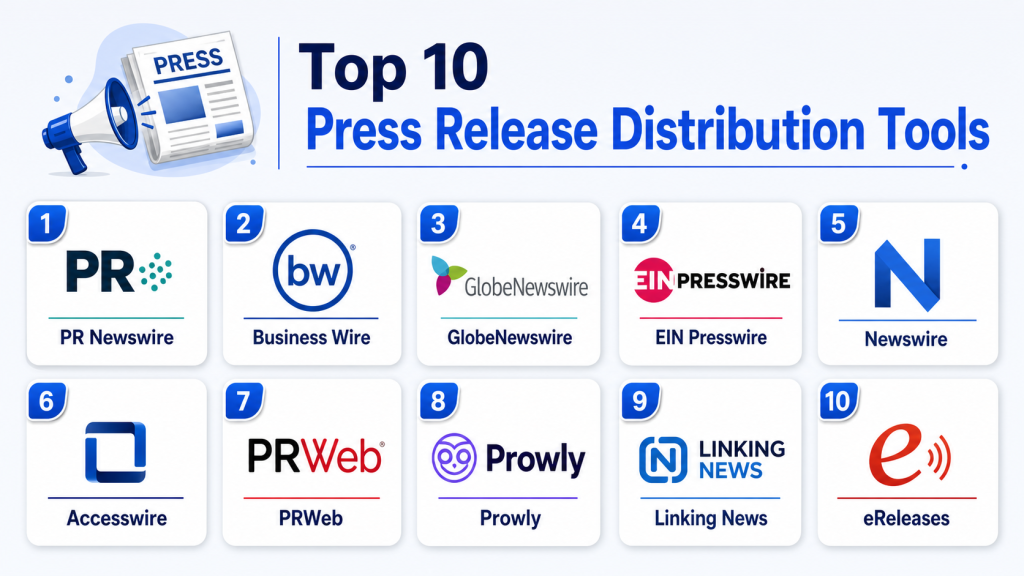
Top 10 Press Release Distribution Tools
#1 — PR Newswire
Short description: PR Newswire is a press release distribution service used by companies, agencies, public companies, nonprofits, and communications teams to distribute official announcements. It supports corporate news, product updates, financial announcements, multimedia releases, and targeted distribution. It is especially useful for organizations that need broad visibility and established distribution workflows.
Key Features
- Press release distribution to media and online outlets
- Industry and geographic targeting options
- Multimedia release support
- Corporate and investor communications workflows
- Editorial review and formatting support
- Release performance reporting
- Newsroom and announcement support
Pros
- Strong recognition in corporate press release distribution
- Suitable for formal business and investor announcements
- Useful for broad release visibility and structured workflows
Cons
- Can be expensive for smaller teams
- Not a replacement for personalized journalist outreach
- Distribution results depend on news quality and audience relevance
Platforms / Deployment
Cloud
Web-based submission and service-based distribution
Security & Compliance
Security and compliance details should be verified directly. Buyers should validate account permissions, approval workflows, release controls, embargo handling, data handling, and publication requirements.
Integrations & Ecosystem
PR Newswire fits corporate communications, public relations, investor relations, and official announcement workflows. It is often used alongside PR platforms, newsroom tools, media monitoring systems, and executive reporting processes.
- Corporate communications workflows
- Investor relations announcements
- Media distribution processes
- Online newsroom workflows
- Multimedia release workflows
- PR reporting processes
Support & Community
PR Newswire provides editorial assistance, distribution support, customer service, reporting resources, and guidance for formal announcements. Support depth may vary by package and release scope.
#2 — Business Wire
Short description: Business Wire is a press release distribution and corporate disclosure service used by businesses, public companies, agencies, and investor relations teams. It helps organizations distribute official news, financial updates, regulatory-style announcements, and multimedia content. It is especially useful for corporate and financial communications.
Key Features
- Press release distribution
- Corporate and financial disclosure support
- Targeted industry and regional distribution
- Multimedia news release options
- Editorial and formatting assistance
- Reporting on release distribution
- Investor and stakeholder communication workflows
Pros
- Strong for corporate and investor communications
- Useful for official announcement distribution
- Recognized for formal business news workflows
Cons
- Not a complete PR CRM or journalist relationship tool
- Pricing depends on release length, scope, and services
- Best results still require newsworthiness and follow-up outreach
Platforms / Deployment
Cloud
Web-based submission and service-based distribution
Security & Compliance
Security and compliance details should be verified directly. Buyers should validate account access, approval workflows, disclosure requirements, embargo handling, data controls, and release review processes.
Integrations & Ecosystem
Business Wire supports corporate communications, investor relations, financial announcements, and PR distribution workflows. It is commonly used with monitoring, newsroom, and reporting tools.
- Corporate announcement workflows
- Investor relations workflows
- Financial disclosure processes
- Multimedia release support
- News distribution
- PR reporting workflows
Support & Community
Business Wire provides editorial support, release guidance, customer service, and reporting assistance. Support level may vary by release type and service package.
#3 — GlobeNewswire
Short description: GlobeNewswire is a press release distribution service used by companies, agencies, investor relations teams, and communications professionals to publish announcements across media, financial, and online channels. It supports corporate news, financial updates, product announcements, and targeted distribution. It is especially useful for companies that need business news distribution and investor-focused reach.
Key Features
- Press release distribution
- Financial and corporate announcement support
- Multimedia release options
- Regional and industry targeting
- Investor relations communication workflows
- Editorial support
- Release reporting and analytics
Pros
- Strong fit for corporate and financial announcements
- Useful for investor relations and public company communications
- Supports targeted business news distribution
Cons
- Not a full PR outreach or media relations platform
- Distribution performance depends on announcement quality
- Buyers should validate reach and reporting needs by region
Platforms / Deployment
Cloud
Web-based submission and service-based distribution
Security & Compliance
Security and compliance details should be verified directly. Buyers should validate account controls, approval workflows, embargo handling, data retention, and disclosure requirements.
Integrations & Ecosystem
GlobeNewswire fits corporate communications, investor relations, product announcements, and public company news workflows. It is often paired with media monitoring and PR reporting platforms.
- Press release workflows
- Investor relations workflows
- Corporate communications
- Newsroom publishing
- Multimedia announcement workflows
- Reporting processes
Support & Community
GlobeNewswire provides editorial assistance, distribution support, reporting resources, and customer service. Support depth may vary by plan and distribution need.
#4 — EIN Presswire
Short description: EIN Presswire is a press release distribution platform used by startups, small businesses, agencies, nonprofits, and organizations that want accessible news distribution. It supports online release publishing, targeted distribution, and press release visibility across multiple channels. It is practical for teams that need a cost-conscious distribution option.
Key Features
- Press release distribution
- Online publishing and visibility support
- Industry and regional targeting
- Release scheduling
- Basic analytics and reporting
- Multimedia support may vary by package
- Agency-friendly workflows
Pros
- Practical for startups, SMBs, and agencies
- Generally easier to access than some premium distribution services
- Useful for regular announcement distribution
Cons
- May not provide the same premium reach as top-tier wire services
- Reporting depth should be validated
- Not a replacement for targeted journalist outreach
Platforms / Deployment
Cloud
Web-based platform
Security & Compliance
Security and compliance details should be verified directly. Buyers should validate account controls, data handling, release approval processes, payment security, and publication policies.
Integrations & Ecosystem
EIN Presswire fits small business, startup, nonprofit, and agency PR workflows. It is useful for teams that need press release publishing without complex enterprise communications infrastructure.
- Small business announcements
- Agency release workflows
- Online news distribution
- Industry targeting
- Regional outreach support
- Basic reporting workflows
Support & Community
EIN Presswire provides customer support, submission guidance, publishing assistance, and release management resources. Support level may vary by package.
#5 — Newswire
Short description: Newswire is a press release distribution and media outreach platform that helps businesses publish announcements, target media audiences, and measure campaign results. It is used by startups, agencies, SMBs, and larger organizations that want a mix of press release distribution and PR support. It is especially useful for teams looking for guided distribution and campaign visibility.
Key Features
- Press release distribution
- Targeted media outreach support
- Editorial review and release optimization
- Multimedia release options
- Campaign reporting and analytics
- Industry and geographic targeting
- PR campaign support services
Pros
- Useful for businesses needing distribution plus PR guidance
- Good fit for startups, SMBs, and agencies
- Supports targeted release campaigns
Cons
- Advanced PR relationship management may require other tools
- Pricing depends on distribution scope and services
- Buyers should validate outlet reach and reporting depth
Platforms / Deployment
Cloud
Web-based platform and service-supported distribution
Security & Compliance
Security and compliance details should be verified directly. Buyers should validate user access, release approval workflow, content review process, data handling, and account controls.
Integrations & Ecosystem
Newswire fits businesses that need structured release distribution, campaign reporting, and PR service support. It can work alongside media monitoring, journalist outreach, and newsroom tools.
- Press release workflows
- Media outreach support
- Campaign reporting
- Startup announcements
- Agency PR workflows
- Corporate news publishing
Support & Community
Newswire provides editorial review, customer support, campaign assistance, and distribution guidance. Support depth may vary by package and service level.
#6 — Accesswire
Short description: Accesswire is a press release and disclosure distribution platform used by public companies, investor relations teams, agencies, and corporate communications professionals. It supports news distribution, financial announcements, regulatory-style communications, and investor-focused messaging. It is especially relevant for organizations that need public market and investor communication workflows.
Key Features
- Press release distribution
- Investor relations communication support
- Corporate disclosure workflows
- Financial announcement distribution
- Multimedia release support
- Reporting and analytics
- Targeted distribution options
Pros
- Strong for investor relations and public company news
- Useful for corporate disclosure-style announcements
- Supports formal communications workflows
Cons
- Not a complete PR CRM or outreach platform
- Best fit depends on investor and corporate communication needs
- Buyers should validate distribution network and reporting requirements
Platforms / Deployment
Cloud
Web-based submission and service-based distribution
Security & Compliance
Security and compliance details should be validated directly. Buyers should review account permissions, release approval controls, disclosure workflows, embargo handling, data security, and retention needs.
Integrations & Ecosystem
Accesswire fits investor relations, corporate news, public company announcements, and formal release workflows. It is typically used alongside PR monitoring, IR websites, and corporate reporting tools.
- Investor relations workflows
- Financial announcements
- Corporate communications
- Press release distribution
- Newsroom publishing
- Reporting workflows
Support & Community
Accesswire provides customer support, editorial guidance, distribution assistance, and reporting resources. Support level may vary by plan and release needs.
#7 — PRWeb
Short description: PRWeb is a press release distribution service used by small businesses, startups, agencies, and marketers for online announcement publishing and distribution. It is often used for product launches, company updates, event announcements, and general business news. It is practical for teams that want online visibility and basic distribution without complex enterprise workflows.
Key Features
- Online press release distribution
- Search and web visibility support
- Industry and topic targeting options
- Release submission workflow
- Basic reporting
- Multimedia support may vary by package
- Small business PR workflows
Pros
- Practical for small businesses and simple announcements
- Easy to use for online press release publishing
- Useful for general visibility campaigns
Cons
- Not ideal for complex corporate disclosure needs
- Premium media pickup is not guaranteed
- Reporting and targeting depth should be validated
Platforms / Deployment
Cloud
Web-based submission workflow
Security & Compliance
Security and compliance details should be verified directly. Buyers should validate account access, payment security, release review, data handling, and publication controls.
Integrations & Ecosystem
PRWeb fits small business PR, product announcements, local news visibility, and online release publishing. It is often used alongside basic media outreach and content marketing workflows.
- Startup announcements
- Small business updates
- Product launch releases
- Event announcements
- Online publishing workflows
- Basic PR reporting
Support & Community
PRWeb provides release submission guidance, customer support, help resources, and publishing assistance. Support level may vary by package.
#8 — Prowly
Short description: Prowly is a PR platform that includes press release creation, online newsroom management, journalist outreach, media database access, and PR reporting. While it is broader than distribution alone, it is useful for teams that want to create and share press releases from a branded newsroom. It is especially practical for startups, agencies, and growing PR teams.
Key Features
- Press release creation tools
- Online newsroom builder
- Media database and journalist search
- Pitching and outreach workflows
- Contact management
- PR reporting and analytics
- Branded media content publishing
Pros
- Strong for PR teams that need newsroom plus outreach workflows
- Easy to use for agencies, startups, and SMBs
- Helps manage press materials and journalist communication
Cons
- Not the same as a premium newswire distribution service
- Broad distribution may require additional services
- Advanced enterprise monitoring should be validated
Platforms / Deployment
Cloud
Web-based platform
Security & Compliance
Security and compliance details should be verified directly. Buyers should validate access controls, permissions, authentication, data handling, retention, and privacy requirements.
Integrations & Ecosystem
Prowly fits PR workflows where teams create releases, maintain newsrooms, build media lists, and contact journalists. It can complement formal distribution tools.
- Online newsroom workflows
- Press release creation
- Journalist outreach
- Media list management
- Agency PR workflows
- PR reporting
Support & Community
Prowly provides documentation, onboarding resources, templates, customer support, and PR workflow guidance. Support level may vary by package.
#9 — Linking News
Short description: Linking News is a press release distribution service used by businesses, startups, agencies, and marketers that want online release visibility and distribution packages. It supports business announcements, brand updates, product launches, and digital PR campaigns. It is useful for teams seeking accessible release distribution options.
Key Features
- Press release distribution
- Online publishing support
- Business announcement distribution
- Digital PR visibility workflows
- Package-based distribution options
- Basic reporting support
- Multimedia support may vary
Pros
- Accessible for startups, agencies, and small businesses
- Useful for online announcement visibility
- Practical for digital PR campaigns
Cons
- Buyers should validate outlet quality and reporting depth
- Not a full PR relationship management platform
- Not suitable for every formal investor or regulatory communication need
Platforms / Deployment
Cloud
Web-based submission and service-based distribution
Security & Compliance
Security and compliance details should be verified directly. Buyers should review account security, content approval, data handling, publication controls, and payment security.
Integrations & Ecosystem
Linking News fits digital PR and online announcement workflows. It is commonly used for business news visibility, product announcements, and agency-managed release campaigns.
- Online press release workflows
- Digital PR campaigns
- Startup announcements
- Agency workflows
- Product launch announcements
- Basic reporting processes
Support & Community
Linking News provides submission support, publishing guidance, customer assistance, and release package support. Support level may vary by package.
#10 — eReleases
Short description: eReleases is a press release writing and distribution service focused on helping small businesses, startups, authors, nonprofits, and agencies reach journalists and media outlets. It supports professionally prepared releases and distribution to media audiences. It is especially useful for teams that need writing assistance along with distribution.
Key Features
- Press release writing support
- Press release distribution
- Editorial review and formatting guidance
- Targeted media reach
- Small business announcement support
- Campaign reporting
- PR service assistance
Pros
- Useful for teams needing writing help
- Practical for small businesses and startups
- Combines release preparation with distribution support
Cons
- Not a full media monitoring or PR CRM platform
- Distribution results depend on news quality and targeting
- Buyers should validate package scope and reporting expectations
Platforms / Deployment
Cloud
Service-supported distribution workflow
Security & Compliance
Security and compliance details should be verified directly. Buyers should validate content approval workflows, account security, data handling, payment processing, and publication policies.
Integrations & Ecosystem
eReleases fits teams that need help preparing and distributing announcements. It is especially useful for small organizations without dedicated PR writing or communications staff.
- Small business announcements
- Startup PR workflows
- Nonprofit updates
- Author and book announcements
- Product launch releases
- PR writing and distribution support
Support & Community
eReleases provides writing assistance, editorial support, customer service, distribution guidance, and reporting resources. Support level may vary by selected package.
Comparison Table
| Tool Name | Best For | Platform(s) Supported | Deployment | Standout Feature | Public Rating |
|---|---|---|---|---|---|
| PR Newswire | Corporate and broad press release distribution | Web-based workflows | Cloud | Established business news distribution | N/A |
| Business Wire | Corporate and investor announcements | Web-based workflows | Cloud | Financial and formal disclosure distribution | N/A |
| GlobeNewswire | Public company and business news distribution | Web-based workflows | Cloud | Corporate and investor-focused release reach | N/A |
| EIN Presswire | Startups, SMBs, and agencies | Web-based | Cloud | Accessible press release distribution | N/A |
| Newswire | Businesses needing distribution plus PR support | Web-based | Cloud | Guided release distribution and reporting | N/A |
| Accesswire | Investor relations and corporate news | Web-based workflows | Cloud | Public company communication workflows | N/A |
| PRWeb | Small business online press releases | Web-based | Cloud | Simple online release visibility | N/A |
| Prowly | PR teams needing newsrooms and outreach | Web-based | Cloud | Press release creation plus newsroom tools | N/A |
| Linking News | Digital PR and online announcements | Web-based workflows | Cloud | Package-based online distribution | N/A |
| eReleases | Small teams needing writing plus distribution | Service-supported workflow | Cloud | Press release writing and distribution support | N/A |
Evaluation & Scoring of Press Release Distribution Tools
| Tool Name | Core (25%) | Ease (15%) | Integrations (15%) | Security (10%) | Performance (10%) | Support (10%) | Value (15%) | Weighted Total (0–10) |
|---|---|---|---|---|---|---|---|---|
| PR Newswire | 10 | 8 | 8 | 8 | 9 | 9 | 7 | 8.50 |
| Business Wire | 10 | 8 | 8 | 9 | 9 | 9 | 7 | 8.60 |
| GlobeNewswire | 9 | 8 | 8 | 8 | 9 | 8 | 7 | 8.25 |
| EIN Presswire | 8 | 9 | 7 | 7 | 8 | 8 | 9 | 8.10 |
| Newswire | 8 | 8 | 7 | 7 | 8 | 8 | 8 | 7.75 |
| Accesswire | 9 | 8 | 7 | 8 | 9 | 8 | 7 | 8.10 |
| PRWeb | 7 | 9 | 7 | 7 | 8 | 8 | 8 | 7.70 |
| Prowly | 8 | 9 | 8 | 7 | 8 | 8 | 8 | 8.00 |
| Linking News | 7 | 8 | 6 | 7 | 7 | 7 | 8 | 7.10 |
| eReleases | 8 | 8 | 6 | 7 | 8 | 9 | 8 | 7.75 |
These scores are comparative and should be used as a shortlist guide. Premium wire services score higher for formal distribution, corporate communications, investor relations, and established workflows. SMB-focused platforms may score higher in ease of use and value. PR platforms like Prowly are stronger when release creation, newsroom management, and journalist outreach matter more than wire-style distribution alone. The best tool depends on announcement type, audience, budget, reporting needs, and distribution goals.
Which Press Release Distribution Tool Is Right for You?
Solo / Freelancer
Solo founders, consultants, authors, and independent professionals should focus on ease of use, affordability, and practical support. EIN Presswire, PRWeb, Linking News, and eReleases can be suitable depending on whether you need simple distribution, online visibility, or writing assistance. If you also need to manage media contacts and newsrooms, Prowly may be useful. Solo users should avoid premium distribution unless the announcement has strong business value or investor relevance.
SMB
SMBs should prioritize simple submission, targeted distribution, clear pricing, basic analytics, and helpful support. EIN Presswire, Newswire, PRWeb, Prowly, and eReleases are practical choices. For local launches, product announcements, partnerships, and event news, these tools may be enough. SMBs should remember that distribution works best when paired with direct journalist outreach and a genuinely newsworthy story.
Mid-Market
Mid-market teams usually need better reporting, targeting, editorial review, brand control, newsroom support, and campaign coordination. Newswire, GlobeNewswire, Accesswire, PR Newswire, Business Wire, and Prowly are strong candidates depending on announcement type. Companies with investor or corporate communication needs should evaluate more formal distribution services. Teams focused on PR relationship management should consider Prowly alongside distribution tools.
Enterprise
Enterprises should prioritize governance, approval workflows, global reach, investor relations support, editorial review, security, and reporting. PR Newswire, Business Wire, GlobeNewswire, Accesswire, and Newswire are strong candidates for formal announcement distribution. Prowly may support newsroom and media outreach workflows but may not replace enterprise wire distribution for sensitive corporate announcements. Large teams should involve PR, legal, investor relations, compliance, and executive communications stakeholders.
Budget vs Premium
Budget-focused users should consider EIN Presswire, PRWeb, Linking News, eReleases, or Prowly depending on the workflow. These tools can support smaller announcements and accessible online distribution. Premium buyers should evaluate PR Newswire, Business Wire, GlobeNewswire, Accesswire, and Newswire when reach, corporate credibility, investor communications, editorial review, and reporting depth matter more than low cost.
Feature Depth vs Ease of Use
If ease of use matters most, EIN Presswire, PRWeb, eReleases, and Linking News are practical options. If feature depth matters more, PR Newswire, Business Wire, GlobeNewswire, Accesswire, Newswire, and Prowly provide stronger workflows for formal distribution, support, targeting, reporting, or newsroom management. Teams should choose based on whether they need simple publishing, official distribution, PR support, or full newsroom workflows.
Integrations & Scalability
Press Release Distribution Tools should fit into PR planning, newsroom publishing, media monitoring, reporting, social promotion, investor relations, and internal approval workflows. As teams scale, they should evaluate user permissions, release history, approval controls, reporting exports, newsroom archives, multimedia handling, and distribution targeting. Agencies should also consider multi-client management and repeatable reporting workflows.
Security & Compliance Needs
Press releases may contain sensitive company information, financial updates, executive announcements, product news, acquisition details, or embargoed content. Buyers should validate access permissions, approval workflows, embargo controls, account security, editorial review processes, report sharing, and data handling. Public companies and regulated organizations should involve legal, investor relations, compliance, and executive stakeholders before publication.
Frequently Asked Questions
1. What are Press Release Distribution Tools?
Press Release Distribution Tools help companies publish official announcements to media outlets, journalists, investors, and online news platforms.
They support release submission, formatting, targeting, distribution, and reporting.
These tools are commonly used by PR, communications, investor relations, and marketing teams.
2. How are press release distribution tools different from PR platforms?
Press release distribution tools focus mainly on publishing and distributing announcements.
PR platforms often include media databases, journalist outreach, newsroom management, monitoring, and reporting workflows.
Some tools overlap, but many teams use both distribution and PR management tools together.
3. What features should buyers prioritize?
Buyers should prioritize distribution reach, targeting options, editorial support, multimedia handling, analytics, and release approval workflows.
Corporate teams may also need investor relations support and secure release controls.
Small teams may prioritize affordability, ease of use, and basic reporting.
4. Are Press Release Distribution Tools useful for small businesses?
Yes, small businesses can use these tools for product launches, partnerships, events, awards, funding news, and company updates.
However, distribution works best when the announcement is genuinely newsworthy.
Small businesses should combine distribution with direct outreach to relevant journalists and local media.
5. How much do Press Release Distribution Tools cost?
Pricing varies by release length, distribution region, industry targeting, multimedia assets, reporting, and support services.
Some tools offer affordable packages, while premium wire services may cost more.
Buyers should compare total cost based on announcement importance, audience needs, and reporting expectations.
6. Do press release tools guarantee media coverage?
No tool can guarantee meaningful media coverage from journalists or publications.
Distribution can improve visibility and make an announcement easier to discover.
Strong media pickup still depends on news value, timing, relevance, headline quality, and follow-up outreach.
7. Can these tools help with investor relations?
Yes, some distribution tools support investor relations, financial announcements, disclosure workflows, and corporate communications.
PR Newswire, Business Wire, GlobeNewswire, and Accesswire are commonly evaluated for formal business and investor communication needs.
Companies should confirm legal, disclosure, and approval requirements before selecting a tool.
8. What mistakes should buyers avoid?
A common mistake is distributing weak or promotional content that lacks real news value.
Another mistake is relying only on distribution without targeted journalist outreach.
Teams should also avoid choosing a tool without checking targeting, reporting, approval workflows, and total cost.
9. Are Press Release Distribution Tools secure?
Many reputable services provide account controls, release approval workflows, editorial review, and secure submission processes.
However, security depth varies by vendor and package.
Buyers should validate permissions, embargo controls, data handling, release review, and access management before publishing sensitive news.
10. What are alternatives to dedicated Press Release Distribution Tools?
Alternatives include direct journalist outreach, company blog posts, online newsrooms, social media announcements, email newsletters, and PR agency outreach.
These methods can work well for smaller announcements or targeted campaigns.
Dedicated distribution tools are better when teams need structured reach, formal publishing, reporting, and broader media visibility.
Conclusion
Press Release Distribution Tools help organizations publish official announcements with structure, visibility, and reporting support.
They are useful for product launches, funding updates, corporate news, investor communications, event announcements, partnerships, and crisis statements.
PR Newswire, Business Wire, GlobeNewswire, and Accesswire are strong options for formal corporate, financial, and investor-focused distribution.
EIN Presswire, PRWeb, Linking News, Newswire, and eReleases are practical choices for startups, SMBs, agencies, and teams seeking accessible distribution support.
Prowly is useful when teams need press release creation, online newsroom management, journalist outreach, and PR workflow support together.
The best tool depends on your announcement type, target audience, budget, reporting needs, and approval requirements.
Before choosing, shortlist two or three services, compare distribution targeting, review reporting samples, confirm support options, and validate security controls.
Great explanation of how distribution platforms help companies share updates with journalists and industry audiences efficiently.