Introduction
Configuration Management Tools are software solutions used to automate the setup, configuration, and maintenance of systems, servers, and applications. In simple terms, they ensure that infrastructure stays consistent, repeatable, and controlled across environments.
As organizations adopt cloud computing, DevOps practices, and infrastructure automation, configuration management has become essential. Manual configuration is error-prone and difficult to scale, while automated tools help maintain consistency, reduce downtime, and improve deployment speed.
Common use cases include:
- Automating server provisioning and configuration
- Managing infrastructure across cloud and on-prem environments
- Enforcing system consistency and compliance
- Supporting DevOps and CI/CD pipelines
- Managing updates, patches, and system states
What buyers should evaluate:
- Automation capabilities and scripting approach
- Agent-based vs agentless architecture
- Scalability and performance
- Ease of use and learning curve
- Integration with cloud and DevOps tools
- Security and compliance features
- Infrastructure as Code support
- Community and vendor support
Best for: DevOps engineers, system administrators, cloud architects, and enterprises managing large-scale infrastructure.
Not ideal for: Small environments with minimal infrastructure or teams that do not require automation.
Key Trends in Configuration Management Tools
- Infrastructure as Code adoption: Declarative configuration becoming standard
- Agentless tools gaining popularity: Simpler deployment and maintenance
- Cloud-native automation: Deep integration with cloud platforms
- Security and compliance enforcement: Policy-driven configuration management
- Automation-first DevOps workflows: Integration into CI/CD pipelines
- Hybrid and multi-cloud support: Managing diverse environments
- Self-healing infrastructure: Automatic remediation of configuration drift
- Integration with containers: Managing Kubernetes and container environments
- Scalable orchestration: Managing thousands of nodes efficiently
How We Selected These Tools (Methodology)
- Evaluated industry adoption and enterprise usage
- Assessed automation and configuration capabilities
- Reviewed scalability and performance features
- Considered security and compliance capabilities
- Analyzed integration ecosystem with cloud platforms
- Included tools for different deployment models
- Balanced open-source and enterprise solutions
- Evaluated ease of use and learning curve
- Considered community and vendor support
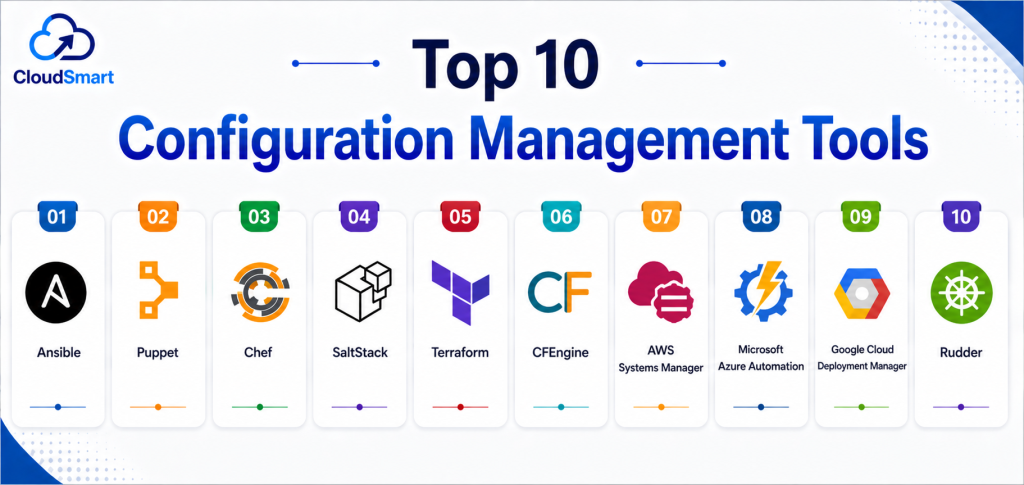
Top 10 Configuration Management Tools
#1 — Ansible
Short description: A popular agentless configuration management tool that uses simple YAML-based playbooks for automation.
Key Features
- Agentless architecture
- YAML-based automation
- Configuration and orchestration
- Cloud integration
- Idempotent execution
Pros
- Easy to learn and use
- No agent installation required
Cons
- Slower for very large environments
- Limited advanced orchestration
Platforms / Deployment
Linux / Windows
Self-hosted
Security & Compliance
SSH-based security, RBAC
Not publicly stated certifications
Integrations & Ecosystem
Ansible integrates widely with cloud platforms and DevOps tools.
- AWS
- Azure
- Kubernetes
- CI/CD tools
Support & Community
Large community with extensive documentation.
#2 — Puppet
Short description: A mature configuration management tool that uses a declarative language to manage infrastructure.
Key Features
- Declarative configuration
- Agent-based architecture
- Compliance enforcement
- Reporting and analytics
- Role-based access control
Pros
- Strong compliance features
- Scalable for enterprise
Cons
- Complex setup
- Requires learning DSL
Platforms / Deployment
Linux / Windows
Cloud / Self-hosted
Security & Compliance
RBAC, encryption
Not publicly stated certifications
Integrations & Ecosystem
- Cloud platforms
- DevOps tools
Support & Community
Strong enterprise support.
#3 — Chef
Short description: A configuration management tool using code-based automation for infrastructure management.
Key Features
- Infrastructure as Code
- Policy-based configuration
- Automation workflows
- Compliance tools
- Scalable architecture
Pros
- Highly flexible
- Strong automation capabilities
Cons
- Steep learning curve
- Requires coding
Platforms / Deployment
Cross-platform
Cloud / Self-hosted
Security & Compliance
Policy enforcement
Not publicly stated certifications
Integrations & Ecosystem
- AWS
- Azure
- DevOps tools
Support & Community
Active community and enterprise support.
#4 — SaltStack
Short description: A fast configuration management and automation tool designed for large-scale infrastructure.
Key Features
- Remote execution
- Configuration management
- Event-driven automation
- High scalability
- Real-time updates
Pros
- Very fast performance
- Scales well
Cons
- Complex setup
- Smaller community
Platforms / Deployment
Cross-platform
Cloud / Self-hosted
Security & Compliance
Encryption support
Not publicly stated certifications
Integrations & Ecosystem
- Cloud platforms
- Monitoring tools
Support & Community
Moderate community support.
#5 — Terraform
Short description: An Infrastructure as Code tool focused on provisioning infrastructure across multiple platforms.
Key Features
- Declarative configuration
- Multi-cloud support
- Infrastructure provisioning
- State management
- Modular architecture
Pros
- Strong multi-cloud support
- Widely adopted
Cons
- Not a full configuration tool
- State management complexity
Platforms / Deployment
Cross-platform
Cloud / Self-hosted
Security & Compliance
Encryption support
Not publicly stated certifications
Integrations & Ecosystem
- AWS
- Azure
- Google Cloud
Support & Community
Large global community.
#6 — CFEngine
Short description: One of the oldest configuration management tools, designed for high scalability and performance.
Key Features
- Policy-based automation
- Lightweight agents
- High scalability
- Configuration enforcement
Pros
- Efficient and fast
- Proven reliability
Cons
- Less modern features
- Smaller community
Platforms / Deployment
Cross-platform
Self-hosted
Security & Compliance
Policy enforcement
Not publicly stated certifications
Integrations & Ecosystem
- Enterprise systems
Support & Community
Limited but stable support.
#7 — AWS Systems Manager
Short description: A managed service for automating configuration and management of AWS resources.
Key Features
- Configuration management
- Patch management
- Automation workflows
- Inventory tracking
- Cloud integration
Pros
- Fully managed
- Deep AWS integration
Cons
- Limited outside AWS
- Vendor lock-in
Platforms / Deployment
Cloud
Cloud-managed
Security & Compliance
IAM integration, encryption
Not publicly stated certifications
Integrations & Ecosystem
- EC2
- AWS services
Support & Community
Enterprise support available.
#8 — Azure Automation
Short description: A cloud-based automation service for managing configuration and deployments in Azure environments.
Key Features
- Automation workflows
- Configuration management
- Patch management
- Integration with Azure services
Pros
- Strong Azure integration
- Managed service
Cons
- Limited multi-cloud support
- Requires Azure expertise
Platforms / Deployment
Cloud
Cloud-managed
Security & Compliance
Azure security controls
Not publicly stated certifications
Integrations & Ecosystem
- Azure services
- DevOps tools
Support & Community
Strong enterprise support.
#9 — Google Cloud Deployment Manager
Short description: A configuration management and deployment tool for Google Cloud infrastructure.
Key Features
- Infrastructure as Code
- Template-based deployment
- Cloud integration
- Resource management
Pros
- Native Google Cloud integration
- Declarative configuration
Cons
- Limited outside Google Cloud
- Less feature-rich
Platforms / Deployment
Cloud
Cloud-managed
Security & Compliance
Cloud security controls
Not publicly stated certifications
Integrations & Ecosystem
- Google Cloud services
Support & Community
Enterprise support available.
#10 — Rudder
Short description: An open-source configuration management tool focused on compliance and automation.
Key Features
- Policy-based configuration
- Compliance management
- Automation workflows
- Reporting
Pros
- Strong compliance focus
- Open-source flexibility
Cons
- Smaller ecosystem
- Limited advanced features
Platforms / Deployment
Cross-platform
Self-hosted
Security & Compliance
Compliance tracking
Not publicly stated certifications
Integrations & Ecosystem
- IT infrastructure tools
Support & Community
Growing community support.
Comparison Table
| Tool Name | Best For | Platform(s) Supported | Deployment | Standout Feature | Public Rating |
|---|---|---|---|---|---|
| Ansible | Beginners | Cross-platform | Self-hosted | Agentless | N/A |
| Puppet | Enterprise | Cross-platform | Hybrid | Compliance | N/A |
| Chef | DevOps teams | Cross-platform | Hybrid | Code-based | N/A |
| SaltStack | Large scale | Cross-platform | Hybrid | Speed | N/A |
| Terraform | Multi-cloud | Cross-platform | Hybrid | IaC | N/A |
| CFEngine | Large infra | Cross-platform | Self-hosted | Efficiency | N/A |
| AWS SSM | AWS users | Cloud | Cloud | Managed | N/A |
| Azure Automation | Azure users | Cloud | Cloud | Integration | N/A |
| Google CDM | GCP users | Cloud | Cloud | Templates | N/A |
| Rudder | Compliance | Cross-platform | Self-hosted | Policy-based | N/A |
Evaluation & Scoring of Configuration Management Tools
| Tool Name | Core (25%) | Ease (15%) | Integrations (15%) | Security (10%) | Performance (10%) | Support (10%) | Value (15%) | Weighted Total |
|---|---|---|---|---|---|---|---|---|
| Ansible | 9 | 9 | 9 | 8 | 8 | 9 | 9 | 8.9 |
| Puppet | 9 | 6 | 8 | 9 | 9 | 9 | 7 | 8.4 |
| Chef | 9 | 6 | 9 | 8 | 9 | 8 | 7 | 8.3 |
| SaltStack | 8 | 6 | 8 | 8 | 9 | 7 | 8 | 8.0 |
| Terraform | 8 | 7 | 10 | 8 | 8 | 9 | 9 | 8.5 |
| CFEngine | 7 | 6 | 7 | 7 | 9 | 7 | 8 | 7.5 |
| AWS SSM | 8 | 8 | 9 | 9 | 8 | 9 | 7 | 8.3 |
| Azure Automation | 8 | 8 | 9 | 9 | 8 | 9 | 7 | 8.3 |
| Google CDM | 7 | 7 | 8 | 8 | 7 | 8 | 7 | 7.5 |
| Rudder | 7 | 7 | 7 | 8 | 7 | 7 | 8 | 7.4 |
How to interpret the scores:
These scores are comparative and reflect typical enterprise and DevOps use cases. Higher scores indicate stronger capabilities across multiple areas, but the best tool depends on your specific needs. Open-source tools often provide flexibility and cost advantages, while managed services simplify operations. Ease of use and scalability should be balanced based on team expertise. Always validate tools with real-world testing before making a final decision.
Which Configuration Management Tool Is Right for You?
Solo / Freelancer
Ansible is ideal due to simplicity and agentless setup.
SMB
SaltStack or Rudder provide automation with manageable complexity.
Mid-Market
Chef and Terraform offer scalability and flexibility.
Enterprise
Puppet and cloud-native tools provide compliance and advanced features.
Budget vs Premium
Open-source tools are cost-effective, while managed services reduce overhead.
Feature Depth vs Ease of Use
Ansible offers ease of use, while Chef and Puppet offer deeper control.
Integrations & Scalability
Terraform and cloud-native tools excel in multi-cloud environments.
Security & Compliance Needs
Puppet and Rudder are strong in compliance-focused environments.
Frequently Asked Questions (FAQs)
1. What are configuration management tools?
They automate the setup and maintenance of systems. They ensure consistency across environments. This reduces manual errors.
2. Why are they important?
They improve efficiency and scalability. They also ensure systems remain consistent. This is critical for DevOps practices.
3. What is Infrastructure as Code?
It is the practice of managing infrastructure using code. Tools like Terraform enable this. It allows repeatable deployments.
4. Are agentless tools better?
Agentless tools are easier to deploy. However, agent-based tools offer more control. The choice depends on use case.
5. Can these tools manage cloud infrastructure?
Yes, most tools integrate with cloud platforms. They support hybrid and multi-cloud environments.
6. Are configuration management tools secure?
They include security features like encryption and access control. Enterprise tools provide stronger compliance features.
7. What is configuration drift?
It occurs when systems deviate from their intended state. These tools help detect and fix drift automatically.
8. Do they support automation?
Yes, automation is their core function. They enable repeatable and consistent processes.
9. What are common mistakes?
Poor configuration design and lack of testing are common issues. Not monitoring systems can also cause problems.
10. Which tool is best?
There is no single best tool. The choice depends on requirements, scale, and team expertise.
Conclusion
Configuration Management Tools are essential for modern IT operations, enabling automation, consistency, and scalability across infrastructure environments. As organizations adopt cloud computing and DevOps practices, these tools help eliminate manual errors and ensure reliable system configurations. Solutions like Ansible and Terraform provide simplicity and flexibility, while Puppet and Chef offer enterprise-grade capabilities with strong compliance features. Cloud-native tools from major providers simplify management within their ecosystems but may introduce vendor dependency. Open-source tools offer cost efficiency and customization, while managed services reduce operational overhead. The best choice depends on factors such as infrastructure complexity, team expertise, and integration needs. Smaller teams may prioritize ease of use, while enterprises focus on scalability, governance, and compliance. No single tool fits all scenarios, making it important to evaluate options carefully. A practical approach is to shortlist a few tools, test them in real environments, and validate their fit. This ensures a scalable and future-ready configuration management strategy.