Introduction
Marketing automation platforms are software systems that automate, manage, and optimize marketing activities across multiple channels—including email, social media, websites, ads, and messaging apps. They allow businesses to trigger personalized campaigns based on user behavior, segment audiences, and track performance automatically.
In today’s digital landscape, where customers interact across dozens of touchpoints, manual marketing simply doesn’t scale. Marketing automation platforms help teams deliver timely, relevant, and consistent experiences while reducing repetitive work and improving ROI.
Common Use Cases
- Lead nurturing and lifecycle marketing
- Email and SMS campaign automation
- Customer segmentation and targeting
- Campaign orchestration across channels
- Analytics and performance tracking
What Buyers Should Evaluate
- Workflow automation flexibility (visual builders, triggers)
- Omnichannel capabilities (email, SMS, push, ads)
- CRM and CDP integrations
- Personalization and segmentation depth
- AI-driven optimization (send time, content)
- Scalability and performance
- Reporting and attribution capabilities
- Ease of use vs technical complexity
- Pricing model (contacts, usage, features)
Best for: Marketing teams, growth teams, SaaS companies, e-commerce businesses, and enterprises managing multi-channel campaigns.
Not ideal for: Very small businesses with minimal campaigns or teams that only need basic email tools.
Key Trends in Marketing Automation Platforms
- AI-driven automation and campaign optimization
- Omnichannel orchestration (email, SMS, push, ads, web)
- Customer journey automation (visual workflow builders)
- Predictive analytics and lead scoring
- Integration with CDPs and data warehouses
- Real-time behavioral triggers and personalization
- Privacy-first marketing (first-party data focus)
- Composable marketing stacks (API-first platforms)
- Generative AI for content creation and campaigns
- No-code/low-code automation builders for marketers
How We Selected These Tools (Methodology)
The tools were selected based on:
- Market adoption and brand recognition
- Depth of automation and personalization features
- Integration ecosystem (CRM, analytics, ads platforms)
- Ease of use for marketers and developers
- Scalability for SMB to enterprise
- Performance and reliability
- Security and governance capabilities
- Innovation in AI and automation workflows
- Deployment flexibility (cloud-first, API-driven)
- Customer fit across industries and use cases
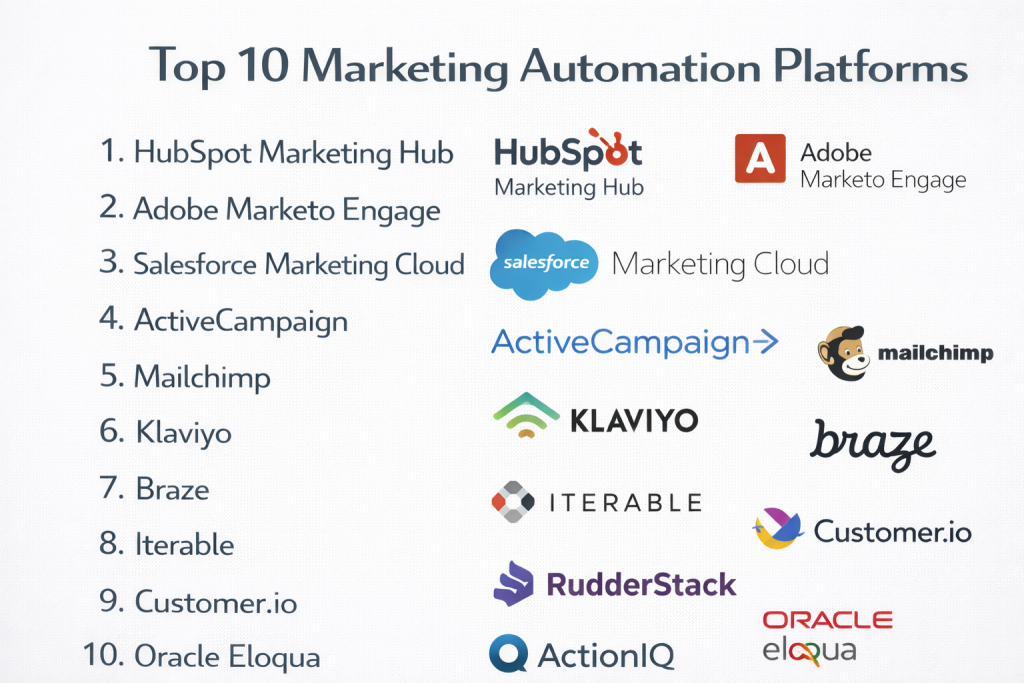
Top 10 Marketing Automation Platforms
#1 — HubSpot Marketing Hub
Short description: An all-in-one marketing automation platform combining CRM, content, and automation tools for growing businesses.
Key Features
- Visual workflow automation builder
- Email marketing and lead nurturing
- Built-in CRM integration
- Landing pages and forms
- Social media scheduling
- Analytics and reporting
Pros
- Easy to use and beginner-friendly
- All-in-one platform
Cons
- Pricing increases with scale
- Advanced features require higher tiers
Platforms / Deployment
Web
Cloud
Security & Compliance
- SSO, encryption, access controls
- Additional certifications: Not publicly stated
Integrations & Ecosystem
Extensive ecosystem across marketing tools.
- CRM systems
- Analytics tools
- Ad platforms
- APIs
Support & Community
Strong documentation, academy, and large community.
#2 — Adobe Marketo Engage
Short description: A powerful enterprise-grade platform designed for complex B2B marketing operations.
Key Features
- Advanced lead management
- Account-based marketing (ABM)
- Multi-channel campaign orchestration
- Personalization and segmentation
- Analytics and attribution
- CRM integration
Pros
- Highly scalable
- Strong B2B capabilities
Cons
- Complex setup
- Expensive
Platforms / Deployment
Web
Cloud
Security & Compliance
Not publicly stated
Integrations & Ecosystem
Deep enterprise integrations.
- CRM tools
- Analytics platforms
- APIs
Support & Community
Enterprise-level support.
#3 — Salesforce Marketing Cloud
Short description: A comprehensive marketing platform with strong CRM integration and omnichannel automation.
Key Features
- Email, SMS, and push automation
- Journey builder
- Customer segmentation
- AI-driven insights
- CRM integration
- Analytics
Pros
- Strong CRM integration
- Enterprise scalability
Cons
- Complex ecosystem
- High cost
Platforms / Deployment
Web
Cloud
Security & Compliance
Not publicly stated
Integrations & Ecosystem
Extensive Salesforce ecosystem.
- CRM
- Data platforms
- APIs
Support & Community
Enterprise-grade support.
#4 — ActiveCampaign
Short description: A popular SMB-focused platform combining email marketing, automation, and CRM features.
Key Features
- Email automation workflows
- CRM and sales automation
- Behavioral tracking
- Segmentation
- SMS marketing
- Reporting
Pros
- Affordable and powerful
- Easy automation setup
Cons
- Limited enterprise features
- UI can feel cluttered
Platforms / Deployment
Web
Cloud
Security & Compliance
Not publicly stated
Integrations & Ecosystem
Wide integrations.
- CRM
- E-commerce platforms
- APIs
Support & Community
Strong SMB support and documentation.
#5 — Mailchimp
Short description: A widely used marketing automation platform focused on email campaigns and SMB growth.
Key Features
- Email automation
- Audience segmentation
- Campaign builder
- AI content suggestions
- Analytics
- Landing pages
Pros
- Very user-friendly
- Strong email capabilities
Cons
- Limited advanced automation
- Pricing increases with contacts
Platforms / Deployment
Web / Mobile
Cloud
Security & Compliance
Not publicly stated
Integrations & Ecosystem
Broad integrations.
- E-commerce platforms
- CRM tools
- APIs
Support & Community
Strong community and onboarding resources.
#6 — Klaviyo
Short description: A marketing automation platform focused on e-commerce personalization and lifecycle marketing.
Key Features
- Email and SMS automation
- Customer segmentation
- Predictive analytics
- E-commerce integrations
- Real-time triggers
- Reporting
Pros
- Strong for e-commerce
- Advanced segmentation
Cons
- Limited outside e-commerce
- Pricing scales with usage
Platforms / Deployment
Web
Cloud
Security & Compliance
Not publicly stated
Integrations & Ecosystem
E-commerce-focused integrations.
- Shopify
- APIs
- Analytics tools
Support & Community
Strong documentation and community.
#7 — Braze
Short description: A customer engagement platform with strong real-time messaging and automation capabilities.
Key Features
- Cross-channel messaging
- Real-time personalization
- Campaign automation
- Segmentation
- Analytics
- Customer journey orchestration
Pros
- Strong real-time capabilities
- Omnichannel messaging
Cons
- Enterprise-focused
- Complex setup
Platforms / Deployment
Web / Mobile
Cloud
Security & Compliance
Not publicly stated
Integrations & Ecosystem
Strong integrations.
- APIs
- Messaging platforms
- CRM
Support & Community
Enterprise support.
#8 — Iterable
Short description: A growth marketing platform designed for cross-channel customer engagement.
Key Features
- Cross-channel automation
- Personalization
- Journey orchestration
- A/B testing
- Segmentation
- Analytics
Pros
- Strong omnichannel support
- Flexible workflows
Cons
- Learning curve
- Enterprise pricing
Platforms / Deployment
Web
Cloud
Security & Compliance
Not publicly stated
Integrations & Ecosystem
Wide integrations.
- APIs
- CRM
- Analytics tools
Support & Community
Enterprise support.
#9 — Customer.io
Short description: A developer-friendly automation platform focused on messaging and lifecycle marketing.
Key Features
- Behavioral messaging
- Email, SMS, push notifications
- Workflow automation
- Segmentation
- API-first design
- Real-time triggers
Pros
- Flexible and developer-friendly
- Strong automation
Cons
- Requires technical setup
- Limited out-of-the-box UI
Platforms / Deployment
Web
Cloud
Security & Compliance
Not publicly stated
Integrations & Ecosystem
API-driven integrations.
- Data platforms
- APIs
- Messaging tools
Support & Community
Good documentation and developer community.
#10 — Oracle Eloqua
Short description: An enterprise marketing automation platform designed for large-scale B2B marketing.
Key Features
- Campaign orchestration
- Lead management
- Segmentation
- Analytics
- CRM integration
- Personalization
Pros
- Strong enterprise capabilities
- Advanced lead management
Cons
- Complex interface
- High cost
Platforms / Deployment
Web
Cloud
Security & Compliance
Not publicly stated
Integrations & Ecosystem
Enterprise integrations.
- CRM
- APIs
- Data platforms
Support & Community
Enterprise support.
Comparison Table (Top 10)
| Tool Name | Best For | Platform(s) Supported | Deployment | Standout Feature | Public Rating |
|---|---|---|---|---|---|
| HubSpot | SMB & mid-market | Web | Cloud | All-in-one platform | N/A |
| Marketo | Enterprise B2B | Web | Cloud | Lead management | N/A |
| Salesforce | Enterprise | Web | Cloud | CRM integration | N/A |
| ActiveCampaign | SMB | Web | Cloud | Easy automation | N/A |
| Mailchimp | Beginners | Web, Mobile | Cloud | Email marketing | N/A |
| Klaviyo | E-commerce | Web | Cloud | Predictive segmentation | N/A |
| Braze | Customer engagement | Web, Mobile | Cloud | Real-time messaging | N/A |
| Iterable | Growth teams | Web | Cloud | Omnichannel automation | N/A |
| Customer.io | Developers | Web | Cloud | API-first automation | N/A |
| Oracle Eloqua | Enterprise B2B | Web | Cloud | Advanced campaigns | N/A |
Evaluation & Scoring of Marketing Automation Platforms
| Tool Name | Core (25%) | Ease (15%) | Integrations (15%) | Security (10%) | Performance (10%) | Support (10%) | Value (15%) | Weighted Total |
|---|---|---|---|---|---|---|---|---|
| HubSpot | 9 | 9 | 9 | 8 | 9 | 9 | 7 | 8.7 |
| Marketo | 10 | 6 | 10 | 8 | 9 | 9 | 6 | 8.5 |
| Salesforce | 10 | 6 | 10 | 8 | 9 | 9 | 6 | 8.5 |
| ActiveCampaign | 8 | 8 | 8 | 7 | 8 | 8 | 9 | 8.1 |
| Mailchimp | 7 | 9 | 8 | 7 | 8 | 8 | 8 | 8.0 |
| Klaviyo | 8 | 8 | 8 | 7 | 8 | 8 | 8 | 8.0 |
| Braze | 9 | 7 | 9 | 7 | 9 | 8 | 7 | 8.1 |
| Iterable | 9 | 7 | 9 | 7 | 8 | 8 | 7 | 8.0 |
| Customer.io | 8 | 6 | 8 | 7 | 8 | 7 | 8 | 7.7 |
| Eloqua | 9 | 5 | 9 | 8 | 9 | 8 | 6 | 8.0 |
How to interpret scores:
- Higher scores indicate stronger overall marketing automation capabilities
- Enterprise tools excel in integrations and scalability
- SMB tools score higher in ease of use and value
- Developer-focused tools offer flexibility but require setup
- Choose based on your team size, complexity, and channels
Which Marketing Automation Platform Is Right for You?
Solo / Freelancer
- Best options: Mailchimp
- Focus on simplicity and low cost
SMB
- Best options: HubSpot, ActiveCampaign
- Balance ease of use and automation power
Mid-Market
- Best options: Klaviyo, Iterable
- Focus on personalization and scalability
Enterprise
- Best options: Marketo, Salesforce, Eloqua
- Focus on scale, governance, and integrations
Budget vs Premium
- Budget: Mailchimp, ActiveCampaign
- Premium: Salesforce, Marketo
Feature Depth vs Ease of Use
- Advanced: Marketo, Eloqua
- Easy: HubSpot, Mailchimp
Integrations & Scalability
- Strong integrations: Salesforce, HubSpot
- Lightweight: Customer.io
Security & Compliance Needs
- High compliance: Enterprise platforms
- Basic needs: SMB tools
Frequently Asked Questions (FAQs)
What is a marketing automation platform?
A system that automates marketing tasks like email campaigns, segmentation, and customer journeys.
How does marketing automation work?
It uses triggers, workflows, and customer data to send personalized messages automatically.
Are marketing automation tools only for large companies?
No, many tools are designed for SMBs and startups.
What channels can be automated?
Email, SMS, push notifications, social media, ads, and websites.
Do I need a CRM?
Not always, but integration with CRM improves effectiveness.
Can marketing automation improve ROI?
Yes, it increases efficiency, personalization, and conversion rates.
Is AI used in marketing automation?
Yes, for segmentation, predictions, and campaign optimization.
How long does implementation take?
From a few days to several months depending on complexity.
What are common mistakes?
Over-automation, poor segmentation, and lack of strategy.
Which platform is best overall?
There’s no single best—choose based on your business size and needs.
Conclusion
Marketing automation platforms are essential for scaling campaigns, improving personalization, and driving measurable growth.