Introduction
Email marketing software is a platform that helps businesses create, send, automate, and analyze email campaigns at scale. It goes far beyond basic email sending by enabling segmentation, personalization, automation workflows, and performance tracking—all from a single system.
In today’s marketing landscape, email remains one of the most reliable and high-ROI channels because it allows direct communication with customers without relying on third-party platforms or algorithms. Modern tools now integrate AI, automation, and omnichannel capabilities, making them central to growth strategies.
Common Use Cases
- Lead nurturing and onboarding sequences
- Promotional and newsletter campaigns
- Transactional and lifecycle emails
- Customer retention and re-engagement
- Product updates and announcements
What Buyers Should Evaluate
- Automation workflows (drip campaigns, triggers)
- Segmentation and personalization depth
- Deliverability and inbox placement
- Template and design flexibility
- Analytics and reporting capabilities
- Integration with CRM/CDP tools
- Scalability and pricing model
- AI features (content generation, optimization)
- Ease of use vs technical complexity
Best for: Marketing teams, SaaS companies, e-commerce businesses, agencies, and enterprises managing customer communication at scale.
Not ideal for: Very small businesses with minimal outreach needs or teams that only require basic email sending without automation.
Key Trends in Email Marketing Software
- AI-generated email content and subject lines improving productivity
- Predictive send-time optimization for better engagement
- Omnichannel marketing (email + SMS + push + WhatsApp)
- Privacy-first marketing with first-party data strategies
- Advanced segmentation based on behavior and lifecycle stages
- Interactive emails (AMP emails with embedded actions)
- Real-time automation triggers based on user actions
- Integration with CDPs and data warehouses
- Deliverability-focused infrastructure and compliance tools
- Low-code/no-code automation builders for marketers
How We Selected These Tools (Methodology)
The tools were selected based on:
- Market adoption and brand recognition
- Core email automation and campaign capabilities
- Ease of use for marketers and non-technical users
- Integration ecosystem (CRM, analytics, e-commerce)
- Scalability across SMB, mid-market, and enterprise
- Deliverability infrastructure and reliability
- AI and automation innovation
- Pricing flexibility and value
- Deployment model (cloud-first platforms)
- Suitability across industries and use cases
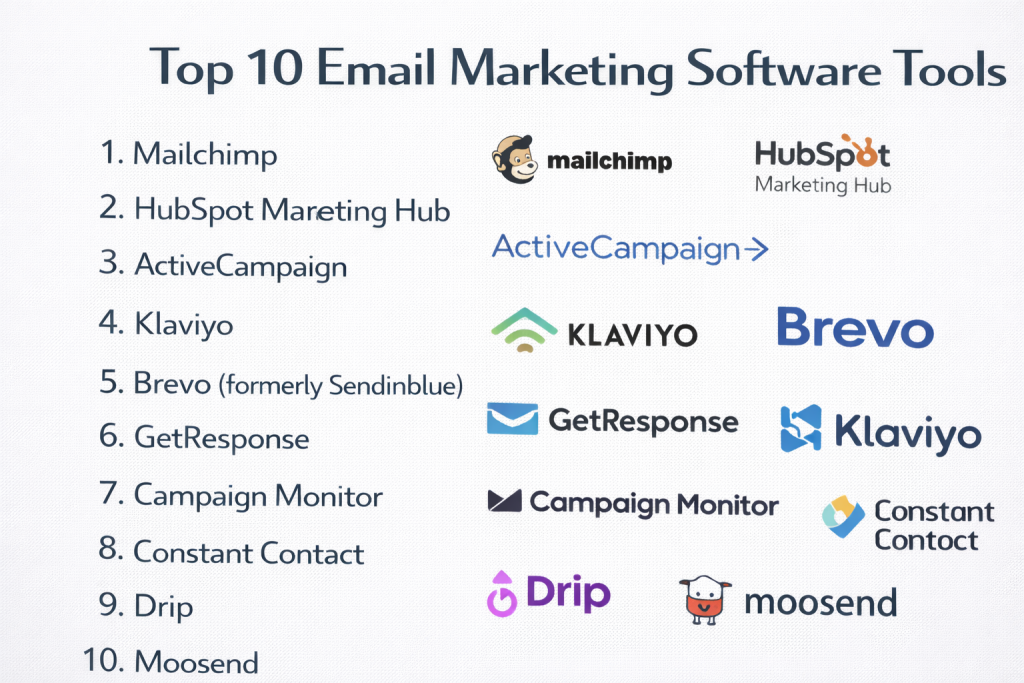
Top 10 Email Marketing Software Tools
#1 — Mailchimp
Short description: A widely used email marketing platform known for ease of use and strong SMB capabilities.
Key Features
- Drag-and-drop email builder
- Automation workflows
- Audience segmentation
- AI content suggestions
- Campaign analytics
- Landing pages
Pros
- Beginner-friendly
- Strong template library
Cons
- Limited advanced automation
- Pricing increases with contacts
Platforms / Deployment
Web / Mobile
Cloud
Security & Compliance
Not publicly stated
Integrations & Ecosystem
Broad integrations with marketing tools.
- E-commerce platforms
- CRM tools
- APIs
Support & Community
Large community and strong onboarding resources.
#2 — HubSpot Marketing Hub
Short description: An all-in-one marketing platform combining email marketing with CRM and automation.
Key Features
- Email automation workflows
- Built-in CRM
- Personalization
- Analytics and reporting
- Landing pages
- AI tools
Pros
- Unified platform
- Excellent user experience
Cons
- Expensive at scale
- Advanced features gated
Platforms / Deployment
Web
Cloud
Security & Compliance
- SSO, encryption, access control
Integrations & Ecosystem
Extensive ecosystem.
- CRM
- Analytics tools
- APIs
Support & Community
Strong documentation and training resources.
#3 — ActiveCampaign
Short description: A powerful SMB-focused platform combining email automation with CRM capabilities.
Key Features
- Visual automation builder
- Behavioral targeting
- Email campaigns
- CRM integration
- Segmentation
- Reporting
Pros
- Strong automation
- Good value
Cons
- UI complexity
- Limited enterprise features
Platforms / Deployment
Web
Cloud
Security & Compliance
Not publicly stated
Integrations & Ecosystem
Wide integrations.
- E-commerce platforms
- APIs
- CRM tools
Support & Community
Good SMB support.
#4 — Klaviyo
Short description: A leading platform for e-commerce email and SMS marketing.
Key Features
- Email + SMS automation
- Predictive analytics
- Customer segmentation
- Real-time triggers
- E-commerce integrations
- Reporting
Pros
- Strong for e-commerce
- Advanced segmentation
Cons
- Pricing scales with usage
- Limited outside e-commerce
Platforms / Deployment
Web
Cloud
Security & Compliance
Not publicly stated
Integrations & Ecosystem
Commerce-focused integrations.
- Shopify
- APIs
- Analytics tools
Support & Community
Strong documentation.
#5 — Brevo (formerly Sendinblue)
Short description: A cost-effective platform offering email, SMS, and CRM capabilities.
Key Features
- Email campaigns
- Automation workflows
- CRM integration
- SMS marketing
- AI tools
- Analytics
Pros
- Affordable
- Multi-channel support
Cons
- Limited advanced features
- UI performance issues
Platforms / Deployment
Web
Cloud
Security & Compliance
Not publicly stated
Integrations & Ecosystem
Wide integrations.
- CRM
- APIs
- Marketing tools
Support & Community
Moderate support.
#6 — GetResponse
Short description: A marketing automation platform with strong email and funnel-building capabilities.
Key Features
- Email marketing
- Automation workflows
- Landing pages
- Webinar tools
- Segmentation
- Analytics
Pros
- All-in-one marketing suite
- Good automation
Cons
- UI can feel outdated
- Pricing tiers vary
Platforms / Deployment
Web
Cloud
Security & Compliance
Not publicly stated
Integrations & Ecosystem
Supports integrations.
- CRM
- APIs
- Marketing tools
Support & Community
Good documentation.
#7 — Campaign Monitor
Short description: A platform focused on beautifully designed email campaigns and ease of use.
Key Features
- Email templates
- Automation
- Segmentation
- Personalization
- Analytics
- Drag-and-drop editor
Pros
- Excellent design tools
- Easy to use
Cons
- Limited advanced automation
- Pricing varies
Platforms / Deployment
Web
Cloud
Security & Compliance
Not publicly stated
Integrations & Ecosystem
Marketing integrations.
- CRM
- APIs
Support & Community
Moderate support.
#8 — Constant Contact
Short description: A beginner-friendly email marketing platform with strong support and templates.
Key Features
- Email campaigns
- Templates
- Contact management
- Automation
- Reporting
- Event marketing tools
Pros
- Easy setup
- Strong support
Cons
- Limited advanced features
- Higher cost for features
Platforms / Deployment
Web
Cloud
Security & Compliance
Not publicly stated
Integrations & Ecosystem
Wide integrations.
- CRM
- E-commerce tools
Support & Community
Strong customer support.
#9 — Drip
Short description: An e-commerce-focused email automation platform with advanced personalization.
Key Features
- Email automation
- Customer segmentation
- Personalization
- Workflow builder
- Analytics
- E-commerce integrations
Pros
- Strong personalization
- Good for online stores
Cons
- Limited outside e-commerce
- Pricing varies
Platforms / Deployment
Web
Cloud
Security & Compliance
Not publicly stated
Integrations & Ecosystem
Commerce integrations.
- Shopify
- APIs
Support & Community
Good support.
#10 — Moosend
Short description: A budget-friendly email marketing platform with solid automation features.
Key Features
- Email campaigns
- Automation workflows
- Segmentation
- Templates
- Analytics
- Reporting
Pros
- Affordable
- Easy to use
Cons
- Limited enterprise features
- Smaller ecosystem
Platforms / Deployment
Web
Cloud
Security & Compliance
Not publicly stated
Integrations & Ecosystem
Basic integrations.
- APIs
- CRM tools
Support & Community
Moderate support.
Comparison Table (Top 10)
| Tool Name | Best For | Platform(s) Supported | Deployment | Standout Feature | Public Rating |
|---|---|---|---|---|---|
| Mailchimp | SMB beginners | Web, Mobile | Cloud | Ease of use | N/A |
| HubSpot | All-in-one marketing | Web | Cloud | CRM integration | N/A |
| ActiveCampaign | Automation | Web | Cloud | Workflow builder | N/A |
| Klaviyo | E-commerce | Web | Cloud | Predictive analytics | N/A |
| Brevo | Budget-friendly | Web | Cloud | Multi-channel marketing | N/A |
| GetResponse | Funnels | Web | Cloud | Webinar tools | N/A |
| Campaign Monitor | Design-focused | Web | Cloud | Email templates | N/A |
| Constant Contact | Beginners | Web | Cloud | Customer support | N/A |
| Drip | E-commerce | Web | Cloud | Personalization | N/A |
| Moosend | Budget users | Web | Cloud | Affordable automation | N/A |
Evaluation & Scoring of Email Marketing Software
| Tool Name | Core (25%) | Ease (15%) | Integrations (15%) | Security (10%) | Performance (10%) | Support (10%) | Value (15%) | Weighted Total |
|---|---|---|---|---|---|---|---|---|
| Mailchimp | 8 | 9 | 8 | 7 | 8 | 8 | 8 | 8.1 |
| HubSpot | 9 | 9 | 10 | 8 | 9 | 9 | 7 | 8.9 |
| ActiveCampaign | 9 | 8 | 8 | 7 | 8 | 8 | 9 | 8.4 |
| Klaviyo | 9 | 8 | 8 | 7 | 8 | 8 | 8 | 8.3 |
| Brevo | 8 | 8 | 8 | 7 | 8 | 7 | 9 | 8.2 |
| GetResponse | 8 | 7 | 8 | 7 | 8 | 7 | 8 | 7.9 |
| Campaign Monitor | 7 | 9 | 7 | 7 | 8 | 7 | 7 | 7.8 |
| Constant Contact | 7 | 9 | 7 | 7 | 8 | 9 | 7 | 8.0 |
| Drip | 8 | 7 | 7 | 7 | 8 | 7 | 7 | 7.7 |
| Moosend | 7 | 8 | 6 | 6 | 7 | 7 | 9 | 7.5 |
How to interpret scores:
- Higher scores indicate better overall marketing capabilities
- Enterprise tools score higher in integrations and scalability
- SMB tools rank higher in ease of use and value
- E-commerce tools excel in personalization
- Choose based on your use case, not just total score
Which Email Marketing Software Is Right for You?
Solo / Freelancer
- Best options: Mailchimp, Moosend
- Focus on simplicity and affordability
SMB
- Best options: ActiveCampaign, Brevo
- Balance automation and cost
Mid-Market
- Best options: Klaviyo, GetResponse
- Focus on personalization and growth
Enterprise
- Best options: HubSpot
- Focus on integrations, scale, and analytics
Budget vs Premium
- Budget: Moosend, Brevo
- Premium: HubSpot
Feature Depth vs Ease of Use
- Advanced: ActiveCampaign, HubSpot
- Easy: Mailchimp, Constant Contact
Integrations & Scalability
- Strong integrations: HubSpot
- Lightweight: Moosend
Security & Compliance Needs
- High compliance: Enterprise tools
- Basic needs: SMB tools
Frequently Asked Questions (FAQs)
What is email marketing software?
It is a tool that helps businesses create, send, and track email campaigns.
What features should I look for?
Automation, segmentation, templates, analytics, and deliverability tools.
Is email marketing still effective?
Yes, it remains one of the highest ROI marketing channels.
Can I automate campaigns?
Yes, modern tools support automated workflows and triggers.
Do I need coding skills?
No, most tools offer drag-and-drop builders.
How much does it cost?
Pricing varies from free plans to enterprise-level subscriptions.
What is deliverability?
It’s the ability of emails to reach inboxes instead of spam folders.
Can I integrate with CRM?
Yes, most tools support CRM and analytics integrations.
What industries use email marketing?
E-commerce, SaaS, media, education, and more.
Which tool is best overall?
It depends on your budget, scale, and marketing needs.
Conclusion
Email marketing software remains a core pillar of digital marketing, enabling businesses to communicate directly with customers and drive measurable results.