Introduction
Digital Twin platforms are software systems that create virtual replicas of physical assets, processes, or systems. These digital models are continuously updated using real-world data from sensors, IoT devices, and enterprise systems, allowing organizations to simulate, monitor, and optimize performance in real time.
As industries move toward smarter operations and predictive intelligence, Digital Twin platforms have become essential for improving efficiency, reducing downtime, and enabling data-driven decision-making. They are widely used in manufacturing, smart cities, energy, healthcare, and logistics.
Common use cases include:
- Predictive maintenance of industrial equipment
- Smart factory and production optimization
- Asset performance monitoring
- Infrastructure and smart city modeling
- Product lifecycle simulation and testing
Key evaluation criteria:
- Real-time data integration and IoT connectivity
- Simulation and modeling capabilities
- Scalability across assets and systems
- AI/ML-driven insights and predictions
- Visualization and dashboard capabilities
- Integration with enterprise systems (ERP, PLM, MES)
- Security and data governance
- Deployment flexibility (cloud, edge, hybrid)
- Ease of use and customization
Best for: Manufacturing companies, industrial enterprises, energy providers, smart city planners, and engineering teams.
Not ideal for: Small teams without connected assets or organizations that do not rely on real-time operational data.
Key Trends in Digital Twin Platforms
- AI-powered predictive analytics: Increasing use of machine learning for forecasting failures and optimizing systems
- Edge computing integration: Processing data closer to physical assets for real-time responsiveness
- Cloud-native platforms: Scalable infrastructure for managing large digital twin environments
- Interoperability standards: Improved integration across IoT, PLM, and ERP systems
- 3D and immersive visualization: Use of AR/VR for enhanced monitoring and simulation
- Sustainability tracking: Monitoring energy usage and carbon footprint
- Digital thread integration: Connecting data across the entire product lifecycle
- Low-code/no-code tools: Enabling faster deployment and customization
- Cybersecurity focus: Protecting connected industrial systems
- Industry-specific solutions: Tailored platforms for manufacturing, healthcare, and smart cities
How We Selected These Tools (Methodology)
- Evaluated market adoption and enterprise usage
- Assessed real-time data processing capabilities
- Reviewed simulation and modeling depth
- Analyzed AI and predictive analytics features
- Considered integration with IoT and enterprise systems
- Evaluated deployment flexibility (cloud, edge, hybrid)
- Reviewed visualization and user interface quality
- Considered support, training, and ecosystem strength
- Included platforms for different industries and scales
- Ensured balance between enterprise and flexible solutions
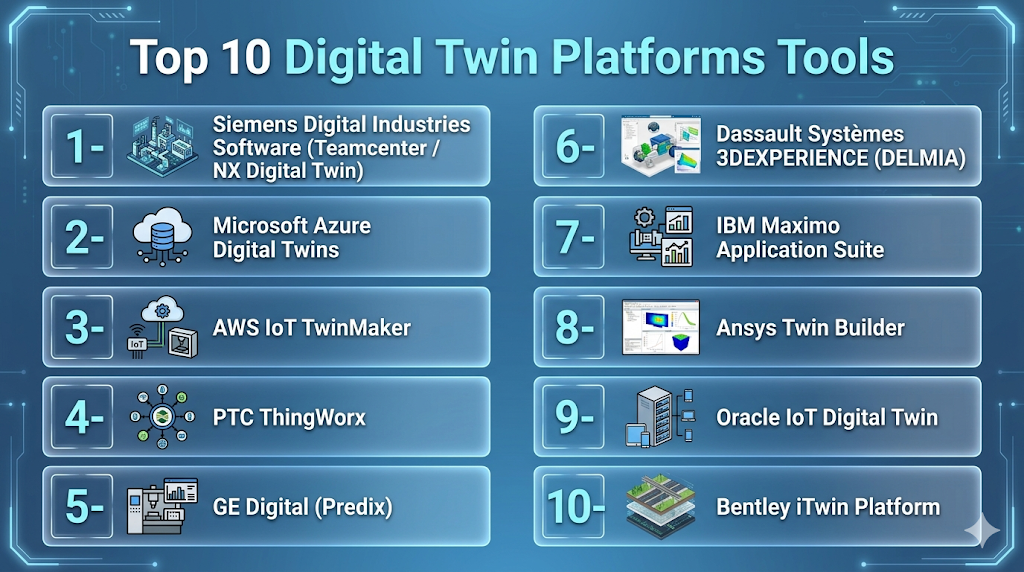
Top 10 Digital Twin Platforms Tools
#1 — Siemens Digital Industries Software (Teamcenter / NX Digital Twin)
Short description: A comprehensive enterprise platform for product lifecycle management and digital twin simulation across industries.
Key Features
- End-to-end digital twin lifecycle management
- Advanced simulation and modeling
- Integration with PLM and CAD tools
- Real-time data synchronization
- Multi-domain simulation
- Industry-specific solutions
Pros
- Strong enterprise capabilities
- Deep integration with engineering workflows
Cons
- Expensive
- Complex implementation
Platforms / Deployment
- Windows / Web
- Cloud / Hybrid
Security & Compliance
- Not publicly stated
Integrations & Ecosystem
Extensive enterprise ecosystem.
- PLM systems
- CAD tools
- IoT platforms
- APIs
Support & Community
Strong enterprise support and training resources.
#2 — Microsoft Azure Digital Twins
Short description: A cloud-based platform for modeling and managing digital representations of physical environments.
Key Features
- IoT data integration
- Graph-based modeling
- Real-time data processing
- AI and analytics integration
- Scalable cloud infrastructure
Pros
- Highly scalable
- Strong cloud ecosystem
Cons
- Requires cloud expertise
- Ongoing costs
Platforms / Deployment
- Web
- Cloud
Security & Compliance
- SSO, RBAC, encryption (part of Azure ecosystem)
Integrations & Ecosystem
Deep integration with Microsoft services.
- IoT Hub
- Power BI
- Azure AI
- APIs
Support & Community
Strong documentation and developer community.
#3 — AWS IoT TwinMaker
Short description: A cloud service for building digital twins using IoT data and visualization tools.
Key Features
- Real-time IoT data ingestion
- 3D visualization
- Integration with AWS services
- Data modeling
- Scalable architecture
Pros
- Flexible and scalable
- Strong cloud integration
Cons
- Complex setup
- AWS dependency
Platforms / Deployment
- Web
- Cloud
Security & Compliance
- IAM, encryption, access controls (AWS ecosystem)
Integrations & Ecosystem
Part of AWS ecosystem.
- IoT Core
- S3
- Lambda
- APIs
Support & Community
Strong cloud documentation and support.
#4 — PTC ThingWorx
Short description: An industrial IoT platform with strong digital twin capabilities for manufacturing and asset monitoring.
Key Features
- IoT connectivity
- Real-time analytics
- Application development tools
- AR integration
- Asset monitoring
Pros
- Strong industrial focus
- Flexible customization
Cons
- Learning curve
- Licensing complexity
Platforms / Deployment
- Web / Windows
- Cloud / Hybrid
Security & Compliance
- Not publicly stated
Integrations & Ecosystem
Strong industrial ecosystem.
- IoT devices
- ERP systems
- APIs
Support & Community
Strong enterprise support.
#5 — GE Digital (Predix)
Short description: A platform designed for industrial digital twins and asset performance management.
Key Features
- Industrial data integration
- Predictive analytics
- Asset monitoring
- Performance optimization
- Cloud-based architecture
Pros
- Strong for industrial use
- Focus on asset performance
Cons
- Limited flexibility
- Niche focus
Platforms / Deployment
- Web
- Cloud
Security & Compliance
- Not publicly stated
Integrations & Ecosystem
Industrial-focused integrations.
- IoT systems
- Analytics tools
- APIs
Support & Community
Enterprise-level support.
#6 — Dassault Systèmes 3DEXPERIENCE (DELMIA)
Short description: A platform combining digital twin, simulation, and manufacturing planning.
Key Features
- Virtual twin simulation
- Manufacturing optimization
- Collaboration tools
- Integration with CAD/PLM
- Real-time analytics
Pros
- Strong simulation capabilities
- Unified platform
Cons
- Expensive
- Complex
Platforms / Deployment
- Web / Windows
- Cloud / Hybrid
Security & Compliance
- Not publicly stated
Integrations & Ecosystem
Integrated ecosystem.
- CAD tools
- PLM systems
- APIs
Support & Community
Strong enterprise support.
#7 — IBM Maximo Application Suite
Short description: A platform for asset management and digital twin-driven maintenance.
Key Features
- Asset lifecycle management
- Predictive maintenance
- IoT integration
- AI analytics
- Workflow automation
Pros
- Strong asset management
- AI-driven insights
Cons
- Complex setup
- Enterprise-focused
Platforms / Deployment
- Web
- Cloud / Hybrid
Security & Compliance
- Not publicly stated
Integrations & Ecosystem
Enterprise integration capabilities.
- ERP systems
- IoT platforms
- APIs
Support & Community
Strong enterprise support.
#8 — Ansys Twin Builder
Short description: A simulation-driven digital twin platform for engineering and system modeling.
Key Features
- Physics-based simulation
- Real-time system modeling
- Integration with engineering tools
- Predictive analytics
- Multi-domain simulation
Pros
- Strong simulation accuracy
- Engineering-focused
Cons
- Requires expertise
- Limited business workflow features
Platforms / Deployment
- Windows
- Self-hosted / Cloud
Security & Compliance
- Not publicly stated
Integrations & Ecosystem
Engineering ecosystem integration.
- Simulation tools
- CAD systems
- APIs
Support & Community
Strong engineering community.
#9 — Oracle IoT Digital Twin
Short description: A cloud-based platform for asset monitoring and predictive analytics.
Key Features
- IoT data ingestion
- Real-time monitoring
- Predictive analytics
- Integration with Oracle Cloud
- Visualization tools
Pros
- Strong enterprise integration
- Scalable
Cons
- Oracle ecosystem dependency
- Cost
Platforms / Deployment
- Web
- Cloud
Security & Compliance
- Not publicly stated
Integrations & Ecosystem
Oracle ecosystem integration.
- ERP systems
- Cloud services
- APIs
Support & Community
Enterprise support.
#10 — Bentley iTwin Platform
Short description: A digital twin platform focused on infrastructure and smart city applications.
Key Features
- Infrastructure modeling
- Real-time data integration
- Visualization tools
- Asset performance monitoring
- Open data integration
Pros
- Strong for infrastructure
- Good visualization
Cons
- Niche focus
- Learning curve
Platforms / Deployment
- Web / Windows
- Cloud
Security & Compliance
- Not publicly stated
Integrations & Ecosystem
Infrastructure-focused ecosystem.
- GIS systems
- IoT platforms
- APIs
Support & Community
Strong support in infrastructure sector.
Comparison Table (Top 10)
| Tool Name | Best For | Platform(s) Supported | Deployment | Standout Feature | Public Rating |
|---|---|---|---|---|---|
| Siemens Digital Twin | Enterprise | Web, Windows | Hybrid | PLM integration | N/A |
| Azure Digital Twins | Cloud scale | Web | Cloud | Graph modeling | N/A |
| AWS TwinMaker | IoT apps | Web | Cloud | 3D visualization | N/A |
| ThingWorx | Industrial IoT | Web, Windows | Hybrid | IoT integration | N/A |
| GE Predix | Asset monitoring | Web | Cloud | Industrial focus | N/A |
| 3DEXPERIENCE | Manufacturing | Web, Windows | Hybrid | Virtual twin | N/A |
| IBM Maximo | Asset mgmt | Web | Hybrid | Maintenance AI | N/A |
| Ansys Twin Builder | Engineering | Windows | Hybrid | Physics simulation | N/A |
| Oracle IoT | Enterprise | Web | Cloud | Oracle integration | N/A |
| Bentley iTwin | Infrastructure | Web, Windows | Cloud | Smart cities | N/A |
Evaluation & Scoring of Digital Twin Platforms
| Tool Name | Core (25%) | Ease (15%) | Integrations (15%) | Security (10%) | Performance (10%) | Support (10%) | Value (15%) | Weighted Total (0–10) |
|---|---|---|---|---|---|---|---|---|
| Siemens | 10 | 6 | 9 | 7 | 9 | 9 | 6 | 8.4 |
| Azure | 9 | 7 | 10 | 8 | 9 | 9 | 7 | 8.7 |
| AWS | 9 | 6 | 10 | 8 | 9 | 8 | 7 | 8.5 |
| ThingWorx | 9 | 6 | 8 | 7 | 8 | 8 | 6 | 8.0 |
| GE Predix | 8 | 6 | 7 | 7 | 8 | 7 | 6 | 7.6 |
| 3DEXPERIENCE | 9 | 6 | 8 | 7 | 9 | 8 | 6 | 8.1 |
| IBM Maximo | 8 | 6 | 8 | 7 | 8 | 8 | 6 | 7.8 |
| Ansys | 9 | 5 | 7 | 7 | 9 | 7 | 6 | 7.9 |
| Oracle | 8 | 6 | 8 | 7 | 8 | 7 | 6 | 7.7 |
| Bentley | 8 | 6 | 7 | 7 | 8 | 7 | 6 | 7.6 |
How to interpret scores:
- Cloud platforms lead in scalability and integration
- Engineering-focused tools excel in simulation accuracy
- Enterprise tools provide end-to-end lifecycle capabilities
- Ease of use varies depending on complexity
- Choose based on industry and use case rather than score alone
Which Digital Twin Platform Is Right for You?
Solo / Freelancer
- Limited use cases; consider lightweight IoT platforms
SMB
- Best options: Azure Digital Twins, AWS TwinMaker
- Focus on scalability and cost efficiency
Mid-Market
- Best options: ThingWorx, IBM Maximo
- Balance between industrial features and usability
Enterprise
- Best options: Siemens, Dassault, AWS, Azure
- Full lifecycle and large-scale deployments
Budget vs Premium
- Budget: Cloud-based pay-as-you-go platforms
- Premium: Siemens, Dassault
Feature Depth vs Ease of Use
- Easy: Azure, AWS
- Advanced: Siemens, Ansys
Integrations & Scalability
- Strong: AWS, Azure
- Industry-specific: Bentley, GE
Security & Compliance Needs
- Cloud platforms offer built-in security frameworks
- Enterprise deployments require strict governance
Frequently Asked Questions (FAQs)
What is a digital twin platform?
It is software that creates virtual replicas of physical systems for monitoring and simulation.
How are digital twins used?
They are used for predictive maintenance, optimization, and system simulation.
Are digital twin platforms expensive?
Costs vary depending on scale and deployment model.
Do I need IoT devices?
Yes, most digital twins rely on real-time data from sensors.
Can small businesses use digital twins?
Yes, especially with cloud-based platforms.
What industries benefit most?
Manufacturing, energy, smart cities, and healthcare.
Is AI required for digital twins?
Not required, but often used for predictive insights.
How secure are these platforms?
Security depends on the platform and deployment model.
Can digital twins integrate with ERP systems?
Yes, most platforms support enterprise integrations.
How long does implementation take?
It varies from weeks to months depending on complexity.
Conclusion
Digital Twin platforms are transforming how organizations monitor, simulate, and optimize real-world systems. With options ranging from cloud-native platforms to engineering-focused solutions, businesses can choose tools that align with their operational needs.