Introduction
Digital Experience Platforms (DXPs) are integrated software solutions designed to manage, deliver, and optimize digital experiences across multiple channels—websites, mobile apps, portals, and more. Unlike traditional CMS platforms, DXPs go beyond content management to include personalization, customer journey orchestration, analytics, and integrations with broader enterprise systems.
As customer expectations evolve, businesses must deliver consistent, personalized, and real-time experiences across touchpoints. DXPs enable this by combining content, data, and AI-driven insights into a unified platform. They play a critical role in digital transformation strategies, helping organizations move from static websites to dynamic, customer-centric experiences.
Common use cases include:
- Omnichannel customer experience management
- Personalized website and app experiences
- Customer journey orchestration
- E-commerce and digital marketing platforms
- Enterprise portals and intranets
Key evaluation criteria:
- Content management capabilities
- Personalization and targeting features
- Customer data integration
- Workflow and campaign management
- Analytics and reporting
- Integration with CRM, ERP, and marketing tools
- Scalability and performance
- Deployment flexibility (cloud, hybrid, on-premise)
- Security and compliance controls
- AI-driven insights and automation
Best for: Enterprises, digital-first organizations, marketing teams, and companies managing large-scale customer interactions.
Not ideal for: Small teams needing basic website management or simple content publishing tools.
Key Trends in Digital Experience Platforms (DXP)
- Composable DXP architecture: Modular systems replacing monolithic platforms
- AI-driven personalization: Real-time content recommendations and targeting
- Customer data platform (CDP) integration: Unified customer profiles across channels
- Headless and hybrid CMS integration: Flexible content delivery
- Low-code/no-code tools: Empowering marketers to build experiences
- Omnichannel orchestration: Seamless experiences across devices and platforms
- Experience analytics: Deep insights into user behavior and journeys
- Cloud-native platforms: Increasing adoption of SaaS-based DXPs
- Privacy-first design: Compliance with global data regulations
- API-first ecosystems: Integration with modern digital stacks
How We Selected These Tools (Methodology)
- Evaluated market leadership and enterprise adoption
- Assessed core DXP capabilities (content, personalization, analytics)
- Compared customer data and journey orchestration features
- Reviewed integration ecosystems with enterprise tools
- Considered scalability for large organizations
- Evaluated deployment flexibility (cloud vs hybrid)
- Assessed security and compliance readiness
- Included a mix of enterprise and composable DXP platforms
- Evaluated innovation in AI and personalization
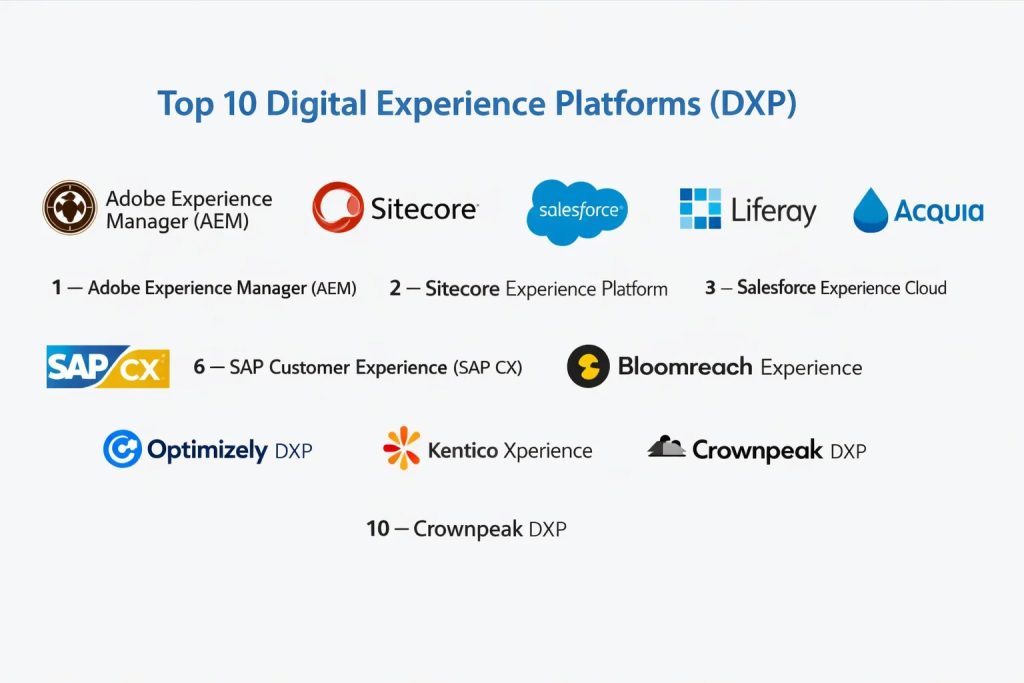
Top 10 Digital Experience Platforms (DXP)
#1 — Adobe Experience Manager (AEM)
Short description: A leading enterprise DXP combining content management, digital asset management, and personalization tools.
Key Features
- Advanced content management
- Digital asset management (DAM)
- Personalization and targeting
- Workflow automation
- Omnichannel delivery
- AI-powered insights
- Integration with Adobe ecosystem
Pros
- Comprehensive enterprise solution
- Strong personalization capabilities
Cons
- High cost
- Complex implementation
Platforms / Deployment
Web
Cloud / On-premise
Security & Compliance
SSO, encryption, access controls
Other certifications not publicly stated
Integrations & Ecosystem
Adobe Experience Manager integrates deeply with marketing and analytics tools.
- Adobe Analytics
- Adobe Target
- APIs
Support & Community
Enterprise-grade support and large ecosystem.
#2 — Sitecore Experience Platform
Short description: A robust DXP focused on personalization, content management, and customer experience optimization.
Key Features
- Content management
- Personalization engine
- Customer journey tracking
- Marketing automation
- Analytics
- Omnichannel delivery
Pros
- Strong personalization features
- Enterprise scalability
Cons
- Complex setup
- Expensive licensing
Platforms / Deployment
Web
Cloud / Hybrid
Security & Compliance
Access control, encryption
Other details not publicly stated
Integrations & Ecosystem
- CRM systems
- Marketing tools
- APIs
Support & Community
Strong enterprise support.
#3 — Salesforce Experience Cloud
Short description: A DXP built on Salesforce for creating customer portals, communities, and digital experiences.
Key Features
- Customer portals and communities
- Integration with Salesforce CRM
- Personalization
- Workflow automation
- Analytics
- Low-code tools
Pros
- Deep CRM integration
- Strong ecosystem
Cons
- Dependent on Salesforce stack
- Pricing complexity
Platforms / Deployment
Web
Cloud
Security & Compliance
SSO, encryption, access controls
Other certifications not publicly stated
Integrations & Ecosystem
- Salesforce CRM
- Marketing Cloud
- APIs
Support & Community
Large enterprise ecosystem.
#4 — Liferay DXP
Short description: An open-source-based DXP focused on portals, intranets, and enterprise applications.
Key Features
- Portal and intranet management
- Content management
- Workflow automation
- Personalization
- API integrations
- Modular architecture
Pros
- Flexible and customizable
- Strong for enterprise portals
Cons
- Requires technical expertise
- UI less modern
Platforms / Deployment
Web
Cloud / On-premise
Security & Compliance
Access control, authentication
Other details not publicly stated
Integrations & Ecosystem
- Enterprise systems
- APIs
Support & Community
Active open-source and enterprise support.
#5 — Acquia DXP
Short description: A Drupal-based DXP offering content management, personalization, and hosting solutions.
Key Features
- Drupal CMS foundation
- Personalization tools
- Digital asset management
- Cloud hosting
- Workflow automation
Pros
- Strong open-source foundation
- Flexible architecture
Cons
- Requires Drupal expertise
- Setup complexity
Platforms / Deployment
Web
Cloud
Security & Compliance
Not publicly stated
Integrations & Ecosystem
- Drupal ecosystem
- APIs
Support & Community
Strong community support.
#6 — SAP Customer Experience (SAP CX)
Short description: A DXP suite focused on commerce, marketing, and customer data management.
Key Features
- Customer data platform
- E-commerce capabilities
- Marketing automation
- Personalization
- Analytics
Pros
- Strong enterprise integration
- End-to-end customer experience
Cons
- Complex implementation
- High cost
Platforms / Deployment
Web
Cloud
Security & Compliance
Enterprise security controls
Other certifications not publicly stated
Integrations & Ecosystem
- SAP ERP
- CRM systems
- APIs
Support & Community
Enterprise-level support.
#7 — Bloomreach Experience
Short description: A DXP focused on e-commerce personalization and content-driven experiences.
Key Features
- AI-driven personalization
- Content management
- Search and merchandising
- Customer journey orchestration
- Analytics
Pros
- Strong for e-commerce
- AI-powered insights
Cons
- Niche focus
- Pricing varies
Platforms / Deployment
Web
Cloud
Security & Compliance
Not publicly stated
Integrations & Ecosystem
- E-commerce platforms
- APIs
Support & Community
Growing ecosystem.
#8 — Optimizely DXP
Short description: A DXP combining content management, experimentation, and personalization tools.
Key Features
- CMS capabilities
- A/B testing and experimentation
- Personalization
- Analytics
- Workflow tools
Pros
- Strong experimentation features
- Good marketing tools
Cons
- Pricing complexity
- Requires setup
Platforms / Deployment
Web
Cloud
Security & Compliance
Not publicly stated
Integrations & Ecosystem
- Marketing tools
- APIs
Support & Community
Strong support and documentation.
#9 — Kentico Xperience
Short description: A hybrid DXP offering content management and digital marketing capabilities.
Key Features
- CMS and marketing tools
- Personalization
- Email marketing
- Analytics
- E-commerce features
Pros
- All-in-one solution
- Easier to implement than enterprise DXPs
Cons
- Less scalable than top-tier platforms
- Limited ecosystem
Platforms / Deployment
Web
Cloud / On-premise
Security & Compliance
Not publicly stated
Integrations & Ecosystem
- CRM tools
- APIs
Support & Community
Good documentation and support.
#10 — Crownpeak DXP
Short description: A cloud-based DXP focused on content management and digital accessibility.
Key Features
- Headless CMS capabilities
- Personalization
- Digital quality management
- Accessibility tools
- Cloud delivery
Pros
- Strong compliance and accessibility focus
- Cloud-native
Cons
- Smaller ecosystem
- Limited flexibility compared to larger platforms
Platforms / Deployment
Web
Cloud
Security & Compliance
Not publicly stated
Integrations & Ecosystem
- APIs
- Marketing tools
Support & Community
Moderate support.
Comparison Table (Top 10)
| Tool Name | Best For | Platform(s) Supported | Deployment | Standout Feature | Public Rating |
|---|---|---|---|---|---|
| Adobe AEM | Enterprises | Web | Hybrid | Personalization | N/A |
| Sitecore | Enterprises | Web | Hybrid | Customer journeys | N/A |
| Salesforce Experience Cloud | CRM-driven experiences | Web | Cloud | CRM integration | N/A |
| Liferay | Portals | Web | Hybrid | Open-source | N/A |
| Acquia | Drupal users | Web | Cloud | Drupal ecosystem | N/A |
| SAP CX | Enterprise CX | Web | Cloud | Commerce integration | N/A |
| Bloomreach | E-commerce | Web | Cloud | AI personalization | N/A |
| Optimizely | Experimentation | Web | Cloud | A/B testing | N/A |
| Kentico | SMB to mid-market | Web | Hybrid | All-in-one | N/A |
| Crownpeak | Compliance | Web | Cloud | Accessibility | N/A |
Evaluation & Scoring of Digital Experience Platforms (DXP)
| Tool Name | Core (25%) | Ease (15%) | Integrations (15%) | Security (10%) | Performance (10%) | Support (10%) | Value (15%) | Weighted Total |
|---|---|---|---|---|---|---|---|---|
| Adobe AEM | 9 | 6 | 9 | 9 | 9 | 9 | 6 | 8.3 |
| Sitecore | 9 | 6 | 8 | 9 | 9 | 9 | 6 | 8.2 |
| Salesforce Experience Cloud | 8 | 7 | 9 | 9 | 8 | 9 | 7 | 8.2 |
| Liferay | 8 | 6 | 7 | 7 | 8 | 7 | 9 | 7.6 |
| Acquia | 8 | 6 | 7 | 7 | 8 | 7 | 8 | 7.5 |
| SAP CX | 9 | 6 | 9 | 9 | 9 | 9 | 6 | 8.4 |
| Bloomreach | 8 | 7 | 7 | 7 | 8 | 7 | 7 | 7.5 |
| Optimizely | 8 | 7 | 8 | 7 | 8 | 8 | 7 | 7.7 |
| Kentico | 7 | 8 | 7 | 7 | 7 | 7 | 8 | 7.5 |
| Crownpeak | 7 | 7 | 6 | 7 | 7 | 7 | 7 | 7.0 |
How to interpret the scores:
- Scores reflect relative strengths across enterprise use cases
- Higher scores indicate broader DXP capabilities
- Lower scores may still fit niche needs
- Always align tool choice with your architecture and business goals
Which Digital Experience Platforms (DXP) Tool Is Right for You?
Solo / Freelancer
Best options: Kentico
Focus on simplicity and lower complexity.
SMB
Best options: Kentico, Optimizely
Balance features and ease of use.
Mid-Market
Best options: Liferay, Acquia
Need flexibility and scalability.
Enterprise
Best options: Adobe AEM, Sitecore, SAP CX
Focus on personalization, scale, and integrations.
Budget vs Premium
- Budget: Liferay (open-source base)
- Premium: Adobe AEM, Sitecore
Feature Depth vs Ease of Use
- Feature-rich: Adobe AEM, SAP CX
- Easier: Kentico, Optimizely
Integrations & Scalability
- Strong: Salesforce Experience Cloud, SAP CX
- Moderate: Crownpeak
Security & Compliance Needs
- Strong: Adobe AEM, SAP CX
- Moderate: Others
Frequently Asked Questions (FAQs)
What is a DXP?
A platform that manages and delivers digital experiences across channels.
How is DXP different from CMS?
DXP includes personalization, analytics, and customer data management.
Are DXPs cloud-based?
Most modern DXPs are cloud-native or hybrid.
Do DXPs support personalization?
Yes, personalization is a core feature.
Are they suitable for small businesses?
Usually not, due to complexity and cost.
Do DXPs integrate with CRM systems?
Yes, integration is a key capability.
Is AI used in DXPs?
Yes, for personalization and analytics.
Are DXPs secure?
They include enterprise-grade security features.
What industries use DXPs?
Retail, finance, healthcare, and media.
What are alternatives?
CMS platforms and headless CMS solutions.
Conclusion
Digital Experience Platforms are essential for organizations aiming to deliver personalized, scalable, and omnichannel digital experiences. They bring together content, data, and customer insights into a unified ecosystem.