Introduction
Many new traders focus entirely on finding winning stocks. They spend hours studying charts, reading financial news, and looking for the next big breakout. However, many of these traders still lose money over time.
Why does this happen? They often ignore one of the most powerful tools in trading: money management.
Even the best stock pickers lose trades sometimes. Markets are unpredictable, and unexpected news can ruin even the most careful plan. The secret to surviving and growing your money in the stock market is not winning every trade. It is managing how much you lose when you are wrong and maximizing what you make when you are right.
This guide will explain what a risk reward ratio is, why it matters, how to calculate it, and how to use it to protect your hard-earned money.
What Is a Risk Reward Ratio?
The risk reward ratio is a mathematical comparison of your potential loss against your potential profit on a single stock trade.
To understand it, let us break down the two main parts:
- Risk: The amount of money you plan to lose if the trade goes against you. You define this using a stop-loss order, which is an instruction to your broker to sell a stock automatically if its price drops to a specific level.
- Reward: The amount of profit you expect to make if the trade goes your way. You define this using a take-profit target, which is an instruction to sell your stock automatically when it reaches a higher price.
Simple Meaning
Think of it like a business investment. If you invest $100 in a new project, how much are you risking, and how much do you expect to get back? If you are willing to risk losing $50 to make $150, your ratio is 1 to 3.
How Risk Reward Ratios Work in the Stock Market
When you buy a stock, you enter the market with uncertainty. You cannot control where the stock price goes next, but you can control where you exit.
Here is how the numbers work in practice:
- Entry Price: The price at which you buy the stock.
- Stop-Loss Level: The price below your entry where you accept defeat and sell to limit your losses.
- Target Level: The price above your entry where you take your profits and close the trade.
The Math Behind the Ratio
Suppose you buy a share of a company at $100.
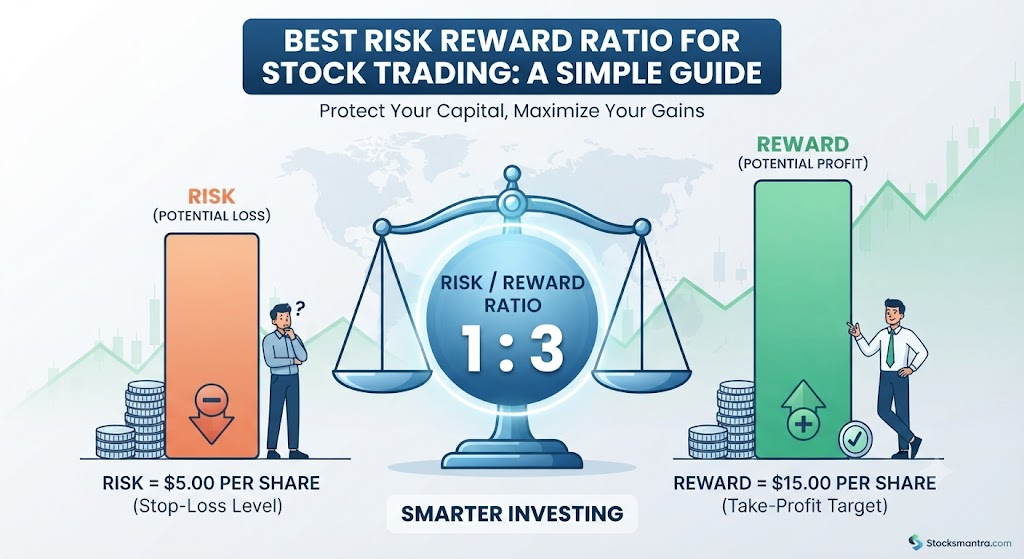
- You set your stop-loss at $95. If the trade fails, you lose $5 per share. That is your risk.
- You set your profit target at $115. If the trade succeeds, you make $15 per share. That is your reward.
To find the ratio, divide your risk by your reward:
- Risk = $5
- Reward = $15
- Ratio = 5 to 15, which simplifies to 1:3.
Why the Risk Reward Ratio Matters
Many beginners ask: “If I pick good stocks, why do I need to worry about ratios?”
The answer lies in human psychology and math. No trader has a 100% win rate. Even professional investors make bad predictions 40% to 50% of the time.
If you use a poor risk reward ratio—such as risking $10 to make $5 (a 2:1 risk-to-reward against you)—you have to win almost every single trade just to break even. One or two bad trades can wipe out weeks of hard work.
On the other hand, if you use a favorable ratio like 1:3, your math changes completely:
- Imagine you take 10 trades.
- You lose 6 trades and win only 4 trades.
- On each losing trade, you lose $100 (Total loss = $600).
- On each winning trade, you make $300 (Total profit = $1,200).
- Net Result: You made a profit of $600, even though you lost more trades than you won!
This mathematical advantage is why experienced traders obsess over risk reward ratios rather than just focusing on winning stock picks.
What Is the Best Risk Reward Ratio for Stock Trading?
There is no single “magic” ratio that works for every single person, but the trading community generally recognizes a few standard benchmarks.
1. The 1:1 Ratio
- What it means: You risk $1 to make $1.
- The reality: To make money here, you must win more than 50% of your trades after accounting for trading fees and commissions. This leaves very little room for error.
2. The 1:2 Ratio
- What it means: You risk $1 to make $2.
- The reality: This is a solid, achievable baseline for many everyday swing traders. With a 1:2 ratio, you only need to win about 35% to 40% of your trades to remain profitable.
3. The 1:3 Ratio (Often Considered the Gold Standard)
- What it means: You risk $1 to make $3.
- The reality: This is widely viewed by professional traders as an ideal target. It gives you a strong safety cushion. You can afford to be wrong more than half the time and still grow your account balance.
4. Ratios Higher Than 1:3 (1:4, 1:5, and Beyond)
- What it means: You risk $1 to make $4 or more.
- The reality: While this sounds amazing, these setups are rare. To achieve a 1:4 ratio, your profit target must be very far away, which means the stock has to travel a long distance without pulling back. Trying to force these trades often leads to missed opportunities because the target is rarely reached.
Practical Example: Setting Up a Trade
Let us look at a real-world scenario to see how a trader applies a 1:3 risk reward ratio.
- Stock Name: Company XYZ
- Current Trend: The stock is breaking out of a consolidation pattern.
- Entry Plan: You buy 100 shares at $50 per share. Total investment = $5,000.
- Defining the Risk: Technical analysis shows strong support at $48. If the stock falls below $48, your trade idea is proven wrong. You place your stop-loss at $48.
- Risk per share: $50 – $48 = $2.
- Total potential risk: 100 shares × $2 = $200.
- Defining the Reward: To achieve a 1:3 ratio, your profit target needs to be three times your risk ($2 × 3 = $6). You add $6 to your entry price and set your take-profit target at $56.
- Reward per share: $56 – $50 = $6.
- Total potential reward: 100 shares × $6 = $600.
If the trade hits your stop-loss, you lose $200. If it hits your target, you make $600. You enter the market knowing your exact numbers before the trade even moves.
Common Mistakes Beginners Make
Understanding the math is easy, but applying it consistently is difficult. Watch out for these common pitfalls:
- Moving Stop-Losses: A trader enters a trade, but when the stock price drops toward their stop-loss, panic sets in. They move the stop-loss lower to “give the stock room to breathe.” This destroys the risk reward ratio and turns small losses into devastating disasters.
- Chasing Unrealistic Ratios: Trying to force a 1:5 ratio on every single trade means your profit target might be set so high that the stock rarely reaches it, resulting in missed profits and frustration.
- Ignoring Market Conditions: Setting rigid targets without looking at chart resistance levels. If your 1:3 target sits right below a massive wall of sellers (resistance), the stock will likely reverse before hitting your goal.
- Forgetting Trading Costs: Forgetting to factor in brokerage fees, commissions, and taxes, which can eat into your net reward.
Risks and Limitations
While a good risk reward ratio is essential, it is not a shield against all market dangers. Keep these limitations in mind:
- Lower Win Rates: Higher ratios (like 1:3 or 1:4) often mean your actual win rate will drop because the price has to travel further. Experiencing 5 or 6 losses in a row can test your emotional discipline.
- False Security: A great ratio on paper does not save a bad stock choice. If you pick a fundamentally broken company, no risk management plan can rescue the investment over the long term.
- Slippage: In fast-moving markets, your stop-loss order might execute at a worse price than expected, increasing your actual risk beyond what you planned.
Decision-Making Framework for Your Trades
Before you click the buy button on any stock, run through this quick checklist to ensure your risk reward setup is solid:
- Identify the Trend: Is the stock moving in a clear direction that supports your trade idea?
- Find the Entry: Where exactly are you buying the stock?
- Determine the Stop-Loss: Where does the technical setup fail? Place your stop-loss just past that point. Calculate your risk per share.
- Calculate the Target: Multiply your risk by at least 2 or 3 to find a realistic profit target based on chart history.
- Check the Ratio: Is the resulting ratio at least 1:2 or 1:3? If not, do not take the trade. Wait for a better setup.
- Size Your Position: Ensure that the total dollar amount at risk does not exceed a safe percentage of your total trading account (usually 1% to 2% per trade).
Key Terms
- Stop-Loss Order: An automated instruction to sell a stock if it falls to a specific price, limiting your potential loss.
- Take-Profit Target: An automated instruction to close a winning trade and lock in gains when the stock reaches a desired price level.
- Win Rate: The percentage of trades that result in a profit out of all the trades you take.
- Position Sizing: The calculation of how many shares to buy so that your financial risk stays within safe limits.
- Support and Resistance: Key price levels on a chart where a stock tends to stop falling (support) or stop rising (resistance).
Frequently Asked Questions
What is a good risk reward ratio for day trading?
Day traders often look for a minimum of 1:1.5 or 1:2 because they capture smaller, quicker price movements throughout the trading session.
Can I use a risk reward ratio for long-term investing?
Yes, though long-term investors usually focus more on company fundamentals. However, knowing your downside risk and upside potential helps you decide how much capital to allocate to a specific stock.
Does a high risk reward ratio guarantee profits?
No. Even with a 1:3 ratio, if your stock selection is entirely random and your win rate drops too low, transaction costs and continuous losses can still drain your account.
How do I know where to place my stop-loss?
Place your stop-loss based on technical chart levels, such as just below a recent swing low or major support line, rather than picking an arbitrary dollar amount.
What should I do if my stock reaches my profit target?
Always stick to your plan. Close the trade, take your profit, and let go of emotions. Trying to squeeze extra pennies out of a trade often leads to giving back all your gains.
Is a 1:1 ratio ever acceptable?
A 1:1 ratio can work if your strategy has a very high win rate (above 65%), but it leaves very little room for unexpected market swings or trading fees.
Conclusion
Mastering the risk reward ratio transforms trading from an emotional guessing game into a structured, disciplined business. By aiming for a reliable 1:2 or 1:3 ratio, you free yourself from the pressure of needing to be right all the time.
Protect your capital by setting strict stop-losses, let your winners run toward realistic profit targets, and always measure your potential risk before chasing potential rewards.