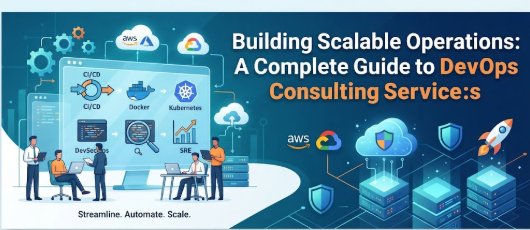
Modern software teams face continuous pressure to deliver features faster while keeping infrastructure stable, secure, and cost-effective. As applications grow in complexity, managing deployments, cloud environments, security checks, and system reliability becomes challenging for internal engineering teams. Many organizations experience slow releases, manual bottlenecks, unexpected outages, and rising cloud costs.
To overcome these obstacles, many businesses look toward structured technical guidance. Organizations often explore external expertise to streamline their infrastructure and deployment workflows. Throughout this article, we will examine how modern engineering operations work, the common challenges teams face, and how structured assistance from DevOpsConsulting.in can help organizations build reliable, scalable systems.
What Is DevOps Consulting?
DevOps consulting involves partnering with specialized engineers and architects to design, implement, and optimize software delivery and infrastructure management practices. Rather than treating development and operations as separate silos, consulting services bridge the gap between writing code and running production systems.
In practical business terms, DevOps consulting helps organizations replace manual deployment processes with automated pipelines. It introduces Infrastructure as Code to manage cloud resources consistently, improves monitoring and observability to catch issues before they impact users, and integrates security practices into every stage of development.
Businesses seek external expertise when their internal teams spend too much time fighting fires rather than building product features. Consultants bring specialized experience in cloud platforms, container orchestration, and reliability engineering, helping organizations establish solid foundations without the trial and error of building everything from scratch.
Why Organizations Need DevOps Consulting Services
As companies scale, their technical operations often become tangled in complexity. Without structured engineering practices, teams frequently encounter predictable operational roadblocks.
- Slow Software Releases: Deployments happen manually, requiring weekend maintenance windows and causing high anxiety among team members.
- Infrastructure Complexity: Managing servers, databases, and networking across multiple environments becomes difficult to track and maintain.
- Cloud Migration Difficulties: Moving workloads from traditional data centers to the cloud often leads to unexpected expenses and architectural inefficiencies.
- Poor Monitoring: Teams find out about application failures from customers rather than internal alert systems.
- Security Gaps: Security checks happen at the very end of the development cycle, delaying releases and exposing systems to vulnerabilities.
- Kubernetes Complexity: Managing container clusters without proper expertise can lead to unstable environments and poor resource utilization.
- Reliability Problems: Frequent downtime damages customer trust and strains internal engineering teams.
- Lack of Internal DevOps Experience: Growing software teams may not have dedicated operations specialists on staff.
Consulting services help organizations assess these specific pain points, remove operational friction, and implement practical solutions tailored to their technical stack.
Who Should Use DevOpsConsulting.in?
Different organizations have unique operational requirements depending on their size, infrastructure complexity, and internal team capabilities. Here is how various groups can benefit from structured support.
5.1 Startups and Growing Technology Companies
Early-stage and growing companies often need to move quickly, but they may not have the resources to hire a large internal operations team. Setting up proper automation, cloud infrastructure, and deployment pipelines early helps startups scale smoothly without accumulating technical debt. Support from DevOpsConsulting.in can establish repeatable deployment practices so development teams can focus entirely on product innovation.
5.2 Enterprises with Complex Infrastructure
Large organizations often manage dozens of applications, multiple cloud environments, legacy systems, and distributed teams. Coordinating releases and maintaining compliance across such a broad footprint requires standardized workflows. DevOpsConsulting.in helps enterprises streamline infrastructure layers, unify toolchains, and improve governance across business units.
5.3 Development and Engineering Teams
When developers spend hours debugging server configurations, troubleshooting broken builds, or manually moving code between environments, overall productivity drops. Introducing CI/CD automation, standardized environments, and Infrastructure as Code frees developers from repetitive operational chores. DevOpsConsulting.in helps engineering teams build efficient workflows that accelerate delivery times.
5.4 Cloud and Kubernetes Teams
Organizations running containerized workloads or managing cloud environments often encounter architectural challenges. Whether optimizing AWS resources or managing container clusters, specialized guidance ensures stability. DevOpsConsulting.in provides technical support for AWS, Kubernetes migrations, container security, and day-to-day cluster operations.
5.5 Businesses Modernizing Legacy Systems
Moving away from traditional on-premise data centers toward modern cloud environments is a major undertaking. Legacy applications often require architectural refactoring before they can run smoothly in containerized or cloud-native setups. DevOpsConsulting.in assists organizations in planning and executing cloud migration strategies with minimal disruption to ongoing business operations.
5.6 Organizations Needing Ongoing DevOps or SRE Support
Some companies lack the time or headcount to manage 24/7 monitoring, incident response, and continuous infrastructure optimization. Managed operations and reliability engineering support provide a safety net. DevOpsConsulting.in offers ongoing operational oversight to keep systems running smoothly and securely around the clock.
Understanding DevOpsConsulting.in: Services and How They Help
To address diverse operational needs, DevOpsConsulting.in provides a comprehensive range of technical services designed to improve software delivery and infrastructure management.
6.1 DevOps Consulting Services
The core consulting scope covers the foundational elements of modern engineering. This includes building robust CI/CD pipelines, writing Infrastructure as Code, setting up cloud automation, implementing system observability, and configuring container platforms. These services help organizations replace manual scripts and ad-hoc troubleshooting with repeatable, automated engineering practices.
6.2 Managed DevOps Services
For organizations that want expert operational oversight without hiring a full in-house operations team, managed services offer a practical alternative. DevOpsConsulting.in provides ongoing monitoring, CI/CD management, infrastructure automation, deployment support, incident resolution, and cloud cost optimization. This ensures that systems remain healthy and updated without draining internal engineering bandwidth.
6.3 AWS DevOps Consulting Services
Organizations building on Amazon Web Services often need specialized support to architect and manage cloud-native environments effectively. DevOpsConsulting.in offers AWS-focused expertise utilizing technologies such as Amazon EKS, Amazon ECS, Amazon EC2, AWS Lambda, and AWS CloudFormation. Using tools like Terraform and automated deployment pipelines, the team helps businesses build secure, elastic, and high-performance AWS infrastructures.
6.4 DevSecOps and Kubernetes Consulting
Security and container orchestration are critical pillars of modern infrastructure.
- DevSecOps Services: Integrates security early into the development lifecycle through Static Application Security Testing, Dynamic Application Security Testing, container security scanning, secrets management, vulnerability tracking, and compliance automation.
- Kubernetes Consulting: Covers everything from initial cluster design and deployment to migration, security hardening, and ongoing operations across AWS EKS, Azure AKS, Google GKE, and enterprise Kubernetes platforms.
6.5 Cloud Migration and Platform Engineering
- Cloud Migration Services: Focuses on safely moving applications, databases, and workloads from traditional data centers to cloud providers like AWS, Microsoft Azure, and Google Cloud, ensuring minimal downtime during the transition.
- Platform Engineering Consulting: Helps organizations build Internal Developer Platforms, self-service infrastructure capabilities, golden paths, and standardized development environments that empower developers to deploy code independently and safely.
6.6 SRE Consulting and DevOps Outsourcing
- SRE Consulting: Focuses on system reliability by establishing Service Level Indicators, Service Level Objectives, error budgets, advanced observability, incident management frameworks, reliability automation, and performance engineering.
- DevOps Outsourcing Services: Provides experienced professionals for short-term projects, long-term engagements, or fully managed operations, supplying skilled talent in DevOps, cloud architecture, Kubernetes, SRE, and platform engineering.
How Different DevOps Services Work Together
In a mature engineering organization, DevOps practices do not operate in isolation; they reinforce one another to create a cohesive delivery ecosystem. Understanding how these components connect helps teams build more resilient systems.
- CI/CD and Automation: Automated pipelines take code from a developer’s local machine, run automated tests, and push updates to production reliably.
- Infrastructure as Code: Instead of manually clicking through cloud consoles, infrastructure is defined in code templates, ensuring that development, staging, and production environments remain identical.
- Cloud Scalability: Cloud platforms provide the elastic compute and storage resources required to handle fluctuating user demand without manual hardware provisioning.
- Container Orchestration: Kubernetes organizes containerized applications across cloud servers, managing scaling, networking, and self-healing automatically.
- Security Integration: DevSecOps scans code and containers for vulnerabilities during the build phase, preventing security flaws from reaching production environments.
- Observability and SRE: Monitoring tools collect logs and metrics, while Site Reliability Engineering practices use that data to track uptime, define error budgets, and manage incidents efficiently.
- Platform Engineering: Internal developer platforms combine these tools into a unified interface, giving developers self-service access to infrastructure while maintaining organizational guardrails.
Step-by-Step Guide to Planning DevOps Consulting
Planning a successful engagement with a consulting partner requires a clear, methodical approach. Organizations can follow these eight steps to ensure smooth collaboration.
Step 1: Identify Current Delivery and Infrastructure Problems
Begin by auditing existing workflows. Identify where code gets stuck, how often deployments fail, and where manual bottlenecks drain engineering time.
Step 2: Define Cloud and Engineering Goals
Establish clear objectives for what the organization wants to achieve, whether that involves faster release cycles, lower cloud expenses, improved uptime, or smoother cloud adoption.
Step 3: Assess CI/CD and Automation Requirements
Review current deployment methods to determine which tasks can be automated and where pipeline efficiency can be improved.
Step 4: Review Security and Reliability Requirements
Evaluate security practices, vulnerability management, secrets handling, compliance needs, monitoring coverage, and incident response preparedness.
Step 5: Select the Relevant Consulting Services
Determine which specific capabilities are needed—such as cloud migration, Kubernetes consulting, DevSecOps integration, or managed DevOps support from DevOpsConsulting.in.
Step 6: Plan Implementation and Integration
Ensure that proposed consulting solutions integrate cleanly with your existing version control systems, communication channels, and development tools.
Step 7: Establish Monitoring and Operations
Set up comprehensive logging, application performance monitoring, and incident alerting frameworks to maintain clear visibility into system health.
Step 8: Measure and Improve
Continuously review deployment frequency, lead times, recovery metrics, and infrastructure efficiency to drive ongoing operational improvements.
Common DevOps Consulting Mistakes to Avoid
When embarking on a DevOps transformation, organizations sometimes stumble into common pitfalls. Avoiding these mistakes helps ensure a smoother journey.
- Choosing services without identifying the actual problem: Implementing tools simply because they are trendy rarely solves underlying operational issues.
- Automating a poor process: Automating a broken deployment workflow only helps you make mistakes faster. Fix the process first, then automate it.
- Moving to the cloud without proper planning: Lifting and shifting legacy applications without architectural adjustments can lead to inflated cloud bills and performance bottlenecks.
- Ignoring security during automation: Waiting until the end of a project to consider security creates friction and delays releases.
- Treating Kubernetes as a solution for every application: Not every workload requires Kubernetes; simpler container solutions or serverless options may be more appropriate.
- Focusing only on deployment speed: Shipping code quickly matters little if the system crashes frequently due to poor reliability practices.
- Ignoring monitoring and observability: Flying blind without proper metrics makes troubleshooting production incidents unnecessarily difficult.
- Failing to plan for ongoing operations: Initial setup is only half the battle; systems require continuous maintenance, patching, and optimization.
Best Practices for Successful DevOps Consulting
Adopting proven engineering principles helps organizations maximize the value of their consulting investments and build sustainable internal operations.
- Start with measurable business and engineering problems rather than chasing technical fads.
- Automate repetitive deployment and infrastructure provisioning tasks wherever possible.
- Use Infrastructure as Code to maintain consistent and reproducible environments.
- Integrate security checks early in the development lifecycle.
- Build fast, reliable CI/CD pipelines that provide immediate feedback to developers.
- Monitor applications and infrastructure proactively to catch anomalies before they escalate.
- Define clear reliability expectations and Service Level Objectives for critical systems.
- Standardize development environments to reduce configuration drift between teams.
- Keep cloud architecture maintainable and document operational procedures clearly.
- Review and refine engineering workflows continuously as the business grows.
DevOps Consulting Services Comparison
| DevOps Consulting Service | What It Covers | When Organizations May Need It |
| DevOps Consulting Services | CI/CD, IaC, automation, observability, container platforms | When teams experience slow releases and manual deployment bottlenecks |
| Managed DevOps Services | Ongoing monitoring, pipeline management, incident resolution, optimization | When internal teams lack the time or headcount for 24/7 operations |
| AWS DevOps Consulting Services | Amazon EKS, ECS, EC2, Lambda, CloudFormation, Terraform | When building, securing, or scaling cloud infrastructure on AWS |
| DevSecOps Consulting Services | SAST, DAST, container security, secrets management, compliance automation | When security needs to be woven into automated development pipelines |
| Kubernetes Consulting Services | Cluster design, deployment, migration, security, enterprise operations | When container orchestration becomes too complex to manage internally |
| Cloud Migration Services | Moving applications and workloads from data centers to AWS, Azure, or GCP | When migrating legacy infrastructure to modern cloud environments |
| Platform Engineering Consulting Services | Internal Developer Platforms, self-service infrastructure, golden paths | When development teams need standardized, repeatable environments |
| SRE Consulting Services | SLIs, SLOs, error budgets, incident management, reliability automation | When application uptime and system stability require structured rigor |
| DevOps Outsourcing Services | Dedicated professionals for short-term projects or fully managed operations | When specialized engineering talent is needed on demand |
Benefits of a Well-Planned DevOps Consulting Approach
A thoughtful approach to DevOps consulting can help organizations transform their software delivery lifecycle. While results vary based on context, structured guidance often brings several notable advantages.
- Better deployment consistency: Automated pipelines reduce human error and make software releases predictable and repeatable.
- Improved automation: Eliminating manual tasks frees up engineering hours for feature development.
- More efficient infrastructure management: Infrastructure as Code makes environment provisioning fast and uniform.
- Better cloud utilization: Architectural reviews help organizations optimize resource usage and control cloud expenses.
- Stronger security integration: DevSecOps practices catch vulnerabilities early without slowing down development momentum.
- Improved observability: Comprehensive monitoring provides clear visibility into system performance and application health.
- Better reliability practices: SRE methodologies help teams manage incidents effectively and maintain steady uptime.
- Standardized engineering environments: Golden paths and internal developer platforms simplify onboarding and day-to-day work for engineers.
How to Evaluate a DevOps Consulting Company
Choosing the right partner is an important decision for any technology team. When evaluating potential consulting providers, consider the following evaluation factors.
| Evaluation Factor | What to Check | Why It Matters |
| Cloud Expertise | Experience with AWS, Azure, or Google Cloud architectures | Ensures your cloud environment is built for scalability and cost efficiency |
| Kubernetes Experience | Track record with container orchestration and cluster management | Prevents downtime and performance issues in containerized setups |
| Security Practices | Integration of DevSecOps, vulnerability scanning, and compliance | Protects applications and data against modern cyber threats |
| Observability Approach | Logging, monitoring, and tracing methodologies | Ensures fast troubleshooting and clear system visibility |
| Automation Capability | Proficiency in CI/CD pipelines and Infrastructure as Code | Eliminates manual bottlenecks and accelerates software delivery |
| Support Model | Availability of managed operations and ongoing maintenance | Keeps systems stable and updated long after initial implementation |
When assessing providers like DevOpsConsulting.in, look for a balance of technical depth, clear communication, and an understanding of your specific business goals.
Frequently Asked Questions
What does a DevOps consulting company do?
A DevOps consulting company helps organizations improve their software delivery, automate infrastructure, secure deployment pipelines, and optimize cloud environments through expert technical guidance and implementation support.
When should a business consider managed DevOps services?
Organizations should consider managed DevOps services when their internal development teams spend too much time managing infrastructure, troubleshooting deployments, or handling after-hours incidents instead of building product features.
What can AWS DevOps consulting include?
AWS DevOps consulting can include designing automated deployment pipelines, setting up Amazon EKS or ECS clusters, writing Terraform or AWS CloudFormation templates, and optimizing cloud resource utilization.
How does DevSecOps fit into a DevOps strategy?
DevSecOps integrates security checks—such as automated code scanning, container vulnerability analysis, and secrets management—directly into CI/CD pipelines so security is addressed throughout development rather than at the end.
When is Kubernetes consulting useful?
Kubernetes consulting is useful when an organization is migrating to container orchestration, experiencing cluster instability, or struggling to manage enterprise Kubernetes platforms efficiently across environments.
What should organizations consider before cloud migration?
Before cloud migration, organizations should evaluate application architecture, data dependencies, security requirements, expected cloud costs, and team readiness to ensure a smooth transition from legacy data centers.
What is platform engineering and when is it useful?
Platform engineering involves building internal developer platforms and self-service infrastructure tools. It is useful when growing engineering teams need standardized environments and repeatable deployment workflows.
How can SRE consulting support reliability?
SRE consulting helps teams define Service Level Indicators and Objectives, establish error budgets, improve incident management processes, and implement reliability automation to minimize downtime.
When does DevOps outsourcing make sense?
DevOps outsourcing makes sense when an organization needs specialized cloud, Kubernetes, or SRE talent for a specific project or wants to supplement internal staff with experienced external engineers.
How should a company evaluate a DevOps consulting provider?
Companies should evaluate providers based on their technical expertise, cloud capabilities, security practices, communication style, and ability to collaborate effectively with internal engineering teams.
Conclusion
Modern software delivery requires more than just writing good code; it demands reliable infrastructure, secure deployment pipelines, and scalable cloud operations. When internal teams face manual bottlenecks, security gaps, or scaling challenges, structured guidance can make a substantial difference.
By addressing challenges across cloud migration, CI/CD automation, Kubernetes orchestration, DevSecOps, platform engineering, and reliability engineering, organizations can build resilient technical operations. DevOpsConsulting.in brings these essential disciplines together, offering specialized consulting and managed services designed to help businesses navigate their digital transformation journey with confidence.