Introduction
IoT Device Management Platforms help organizations connect, monitor, secure, update, configure, and manage connected devices across distributed environments. These platforms are used to manage sensors, gateways, industrial devices, smart meters, cameras, medical devices, retail equipment, connected vehicles, edge devices, and other internet-connected assets from a centralized system.
As businesses deploy more connected devices across factories, hospitals, utilities, logistics networks, offices, smart buildings, and field locations, manual device management becomes difficult and risky. IT, operations, and engineering teams need reliable visibility into device health, firmware versions, connectivity status, telemetry data, security posture, and lifecycle activity.
Real-world use cases include:
- Managing industrial sensors across manufacturing sites
- Monitoring smart meters and utility field devices
- Updating firmware on connected medical or retail equipment
- Tracking device health across logistics and fleet environments
- Securing IoT gateways and edge devices in remote locations
Buyers evaluating IoT Device Management Platforms should consider:
- Device onboarding and provisioning
- Remote monitoring and diagnostics
- Firmware and software update management
- Security and identity controls
- Edge computing support
- Data ingestion and telemetry handling
- Cloud and hybrid deployment flexibility
- API and integration ecosystem
- Scalability across large device fleets
- Compliance, audit, and lifecycle reporting
Best for: IoT product teams, industrial operations teams, telecom providers, utilities, healthcare technology teams, logistics companies, smart building operators, manufacturers, cloud architects, and enterprises managing large connected device fleets.
Not ideal for: Very small teams managing only a few connected devices, organizations that only need basic device connectivity without lifecycle management, or businesses that already use highly specialized embedded systems with no requirement for centralized monitoring, updates, or analytics.
Key Trends in IoT Device Management Platforms
- Edge device management is becoming more important as organizations process data closer to equipment, factories, vehicles, and remote sites.
- Over-the-air firmware updates are now a core requirement for secure and scalable IoT operations.
- Zero Trust principles are increasingly applied to IoT device identity, access control, and certificate management.
- Industrial IoT platforms are becoming more specialized for manufacturing, energy, utilities, and logistics environments.
- Cloud-native IoT management is growing, but hybrid deployment remains important for regulated and industrial use cases.
- Device telemetry is increasingly integrated with analytics, observability, and predictive maintenance workflows.
- Digital twins are becoming more common for modeling devices, assets, processes, and operational environments.
- IoT security posture management is becoming a priority as unmanaged connected devices increase attack surface risk.
- API-first platforms are gaining adoption because IoT teams need custom integrations with business systems and operational tools.
- Lifecycle management from provisioning to retirement is becoming a major buying factor for large IoT deployments.
How We Selected These Tools
The tools in this list were selected based on IoT device management depth, market adoption, ecosystem maturity, scalability, security features, and practical business fit.
Selection criteria included:
- Device onboarding and provisioning capabilities
- Remote monitoring and diagnostics depth
- Firmware update and lifecycle management support
- Security controls for device identity and access
- Telemetry ingestion, routing, and analytics capabilities
- Edge computing and gateway support
- Integration with cloud, enterprise, and industrial systems
- Scalability for large and distributed device fleets
- Support for industrial, commercial, and enterprise IoT use cases
- Documentation, support, and ecosystem maturity
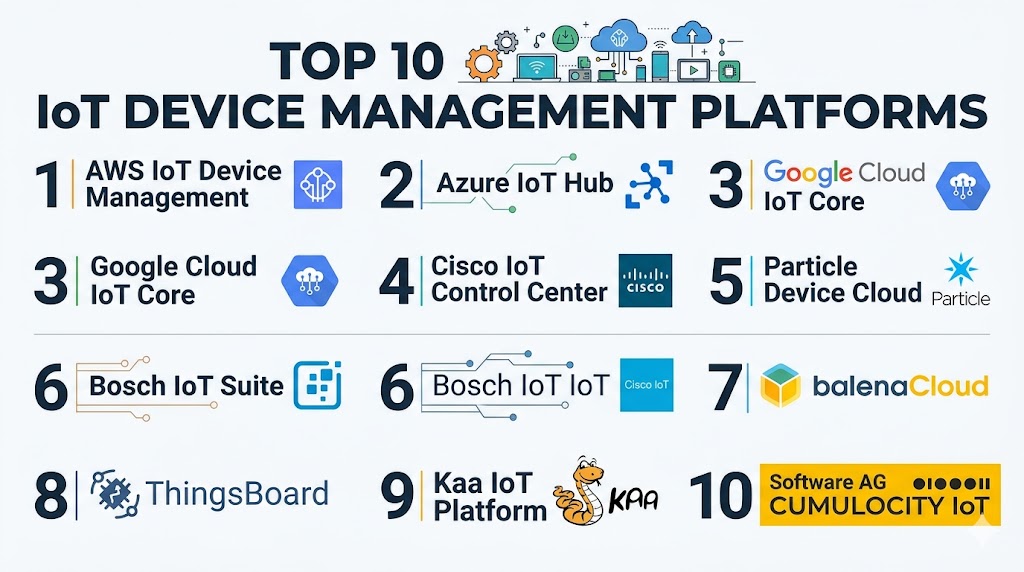
Top 10 IoT Device Management Platforms
1- AWS IoT Device Management
Short description: AWS IoT Device Management helps organizations onboard, organize, monitor, and remotely manage IoT devices at scale. It is well suited for companies already using AWS cloud services and needing scalable device provisioning, fleet indexing, remote actions, and secure device operations.
Key Features
- Bulk device onboarding
- Fleet indexing and search
- Remote device monitoring
- Secure device provisioning
- Over-the-air update workflows
- Device grouping and policies
- Integration with AWS IoT services
Pros
- Strong scalability for large IoT fleets
- Deep AWS ecosystem integration
- Good fit for cloud-native IoT applications
Cons
- Best suited for AWS-centric environments
- Setup can be complex for new IoT teams
- Cost planning requires careful monitoring at scale
Platforms / Deployment
- Web / Linux / Embedded devices / Edge gateways
- Cloud
Security & Compliance
- MFA
- RBAC
- Encryption
- Audit logs
- Certificate-based device authentication
- IAM-based access controls
- Compliance details vary by AWS service configuration
Integrations & Ecosystem
AWS IoT Device Management integrates deeply with cloud, analytics, storage, compute, and security services inside the AWS ecosystem.
- AWS IoT Core
- AWS Lambda
- Amazon S3
- Amazon CloudWatch
- AWS IoT Greengrass
- Amazon Kinesis
Support & Community
AWS provides extensive documentation, enterprise support options, partner ecosystem, training resources, and a large cloud developer community.
2- Microsoft Azure IoT Hub
Short description: Microsoft Azure IoT Hub provides secure device connectivity, management, and telemetry handling for IoT solutions. It is commonly used by enterprises building connected products, industrial IoT systems, smart infrastructure, and cloud-integrated device fleets.
Key Features
- Secure device connectivity
- Device twin management
- Telemetry ingestion
- Remote device commands
- Device provisioning support
- Message routing
- Integration with Azure services
Pros
- Strong enterprise cloud ecosystem
- Good device twin capabilities
- Useful for Microsoft-centric organizations
Cons
- Requires Azure architecture knowledge
- Advanced IoT workflows may need additional services
- Pricing and scaling require planning
Platforms / Deployment
- Web / Linux / Windows / Embedded devices / Edge gateways
- Cloud / Hybrid
Security & Compliance
- MFA
- RBAC
- Encryption
- Audit logs
- Device authentication
- Microsoft Entra ID integration
- Compliance support varies by Azure configuration
Integrations & Ecosystem
Azure IoT Hub integrates with analytics, storage, security, edge, and business applications across Microsoft environments.
- Azure IoT Edge
- Azure Stream Analytics
- Azure Functions
- Microsoft Defender
- Power BI
- Dynamics environments
Support & Community
Microsoft provides strong enterprise documentation, support plans, partner ecosystem, and a large developer community.
3- Google Cloud IoT and Partner Ecosystem
Short description: Google Cloud supports IoT device management and connected device solutions through cloud analytics, data ingestion, edge partnerships, and integration-ready services. It is useful for teams prioritizing data pipelines, AI, analytics, and scalable cloud infrastructure around IoT deployments.
Key Features
- Device data ingestion workflows
- Cloud analytics integration
- Pub/Sub messaging support
- Edge and partner ecosystem support
- Data processing pipelines
- Security and identity controls
- AI and machine learning integration
Pros
- Strong analytics and data processing
- Good fit for data-heavy IoT use cases
- Powerful AI and cloud integration options
Cons
- Device management may require partner tools or custom architecture
- Less turnkey for device lifecycle management
- Requires cloud engineering expertise
Platforms / Deployment
- Web / Linux / Embedded devices / Edge gateways
- Cloud / Hybrid
Security & Compliance
- MFA
- RBAC
- Encryption
- Audit logs
- Identity and access management
- Compliance support varies by configuration
Integrations & Ecosystem
Google Cloud works well for IoT teams building analytics-first and AI-driven connected device solutions.
- Google Cloud Pub/Sub
- BigQuery
- Cloud Functions
- Vertex AI
- Dataflow
- Partner IoT platforms
Support & Community
Google Cloud provides technical documentation, enterprise support options, partner ecosystem, and developer resources.
4- IBM Watson IoT Platform
Short description: IBM Watson IoT Platform is designed for enterprise and industrial IoT environments that require device connectivity, data collection, analytics, and operational visibility. It is especially relevant for organizations focusing on asset-intensive operations and industrial use cases.
Key Features
- Device connectivity management
- IoT data collection
- Asset monitoring
- Analytics support
- Rules and alerts
- Industrial IoT workflows
- Integration with enterprise systems
Pros
- Strong enterprise and industrial focus
- Good analytics and asset monitoring capabilities
- Useful for complex operational environments
Cons
- Enterprise implementation may be complex
- Best suited for IBM-oriented environments
- Smaller general developer mindshare than hyperscale clouds
Platforms / Deployment
- Web / Embedded devices / Edge gateways
- Cloud / Hybrid
Security & Compliance
- RBAC
- Encryption
- Audit logs
- Identity and access controls
- Compliance details vary by deployment
Integrations & Ecosystem
IBM IoT capabilities connect with enterprise asset management, analytics, automation, and hybrid cloud environments.
- IBM Maximo
- IBM Cloud
- Analytics platforms
- Enterprise asset systems
- Industrial systems
- APIs
Support & Community
IBM provides enterprise support, consulting services, implementation partners, and industrial IoT expertise.
5- Siemens MindSphere
Short description: Siemens MindSphere is an industrial IoT platform designed for connecting machines, equipment, production systems, and operational assets. It is well suited for manufacturing, industrial automation, energy, and asset-heavy environments.
Key Features
- Industrial device connectivity
- Machine data monitoring
- Asset performance analytics
- Edge integration
- Application development support
- Operational dashboards
- Industrial ecosystem support
Pros
- Strong industrial IoT specialization
- Good fit for manufacturing environments
- Useful asset performance visibility
Cons
- Best suited for Siemens and industrial ecosystems
- May be too specialized for general IoT projects
- Implementation often requires industrial expertise
Platforms / Deployment
- Web / Industrial devices / Edge gateways
- Cloud / Hybrid
Security & Compliance
- RBAC
- Encryption
- Audit logs
- Industrial security controls
- Compliance details vary by deployment
Integrations & Ecosystem
MindSphere integrates with industrial automation, manufacturing, and enterprise operational systems.
- Siemens industrial systems
- Edge devices
- Manufacturing systems
- Analytics tools
- Enterprise applications
- APIs
Support & Community
Siemens provides industrial support, partner services, implementation guidance, and a specialized industrial ecosystem.
6- PTC ThingWorx
Short description: PTC ThingWorx is an industrial IoT platform focused on connected products, smart manufacturing, remote monitoring, analytics, and application enablement. It is commonly used by manufacturers and product companies building connected asset solutions.
Key Features
- Device and asset connectivity
- Remote monitoring
- Industrial analytics
- Application development tools
- Digital twin support
- Edge connectivity
- Predictive maintenance workflows
Pros
- Strong industrial IoT application development
- Good connected product support
- Useful digital twin and analytics capabilities
Cons
- Enterprise implementation can be complex
- Best suited for industrial and product-focused use cases
- Requires skilled technical resources
Platforms / Deployment
- Web / Industrial devices / Edge gateways
- Cloud / Hybrid
Security & Compliance
- RBAC
- Encryption
- Audit logs
- Identity controls
- Compliance details vary by deployment
Integrations & Ecosystem
ThingWorx integrates with industrial systems, enterprise software, edge infrastructure, and analytics workflows.
- PTC ecosystem
- Industrial equipment
- ERP systems
- PLM systems
- Edge gateways
- APIs
Support & Community
PTC offers enterprise support, training, implementation partners, and industrial IoT expertise.
7- Particle
Short description: Particle is an IoT platform focused on connected product development, device connectivity, fleet management, over-the-air updates, and hardware-to-cloud workflows. It is popular with teams building commercial IoT products and connected devices.
Key Features
- Device fleet management
- Connectivity management
- Over-the-air updates
- Hardware modules
- Device monitoring
- Cloud APIs
- Edge-to-cloud development tools
Pros
- Strong product development experience
- Good hardware and cloud integration
- Useful for connected device startups and product teams
Cons
- Less suited for broad industrial enterprise ecosystems
- Best value comes with Particle hardware and services
- Advanced enterprise workflows may require customization
Platforms / Deployment
- Embedded devices / Web
- Cloud
Security & Compliance
- Device authentication
- Encryption
- Access controls
- Audit visibility varies by plan
- Compliance details not publicly stated
Integrations & Ecosystem
Particle integrates device hardware, connectivity, cloud APIs, and application workflows for connected product teams.
- Particle devices
- Cloud APIs
- Webhooks
- Data platforms
- Mobile and web applications
- Custom backend systems
Support & Community
Particle has strong developer documentation, active community resources, and support options for product teams.
8- ThingsBoard
Short description: ThingsBoard is an open-source IoT platform for device management, data collection, visualization, rule processing, and telemetry analytics. It is useful for teams that need flexible deployment options and customizable IoT workflows.
Key Features
- Device management
- Telemetry collection
- Rule engine
- Dashboards and visualization
- Remote device control
- Multi-tenant support
- Cloud and self-hosted options
Pros
- Open-source flexibility
- Strong dashboard and telemetry capabilities
- Useful for custom IoT solutions
Cons
- Requires technical expertise
- Enterprise scaling needs careful planning
- Advanced support depends on edition and deployment model
Platforms / Deployment
- Web / Linux / Embedded devices
- Cloud / Self-hosted / Hybrid
Security & Compliance
- RBAC
- Encryption
- Device authentication
- Audit logs vary by edition
- Compliance details vary by deployment
Integrations & Ecosystem
ThingsBoard supports flexible integrations through protocols, APIs, and custom workflows.
- MQTT
- CoAP
- HTTP
- Kafka
- REST APIs
- Custom applications
Support & Community
ThingsBoard has open-source community resources, documentation, and commercial support options depending on edition.
9- EMQX
Short description: EMQX is a highly scalable MQTT messaging and IoT connectivity platform used for device messaging, data ingestion, real-time communication, and IoT infrastructure. While not a full device lifecycle platform by itself, it is highly relevant for large-scale IoT connectivity management.
Key Features
- MQTT broker platform
- Massive device connectivity
- Real-time messaging
- Rule engine
- Data integration pipelines
- Edge messaging support
- High availability clustering
Pros
- Strong MQTT scalability
- Good for high-volume IoT messaging
- Flexible deployment options
Cons
- Not a complete device management suite alone
- Requires integration with other systems for full lifecycle management
- Best suited for technical engineering teams
Platforms / Deployment
- Linux / Docker / Kubernetes / Web
- Cloud / Self-hosted / Hybrid
Security & Compliance
- Authentication controls
- Authorization policies
- Encryption
- Audit logs vary by edition
- RBAC support varies by deployment
Integrations & Ecosystem
EMQX integrates with cloud services, databases, analytics systems, and IoT application platforms.
- MQTT devices
- Kafka
- PostgreSQL
- MongoDB
- Cloud platforms
- REST APIs
Support & Community
EMQX has strong technical documentation, open-source community resources, and enterprise support options.
10- Balena
Short description: Balena is an edge device management platform focused on deploying, updating, and managing Linux-based IoT and edge devices. It is popular with teams building distributed edge applications, gateways, and connected device products.
Key Features
- Linux edge device management
- Container-based application deployment
- Remote updates
- Fleet monitoring
- Device diagnostics
- Secure remote access
- Edge application lifecycle management
Pros
- Strong edge device workflow
- Good developer experience
- Useful for Linux-based IoT fleets
Cons
- Best suited for containerized edge applications
- Less focused on industrial device protocols
- Requires technical and DevOps skills
Platforms / Deployment
- Linux / Embedded devices / Edge gateways
- Cloud / Self-hosted options vary
Security & Compliance
- Device authentication
- Encryption
- Access controls
- Audit visibility varies by plan
- Compliance details not publicly stated
Integrations & Ecosystem
Balena integrates with Linux edge environments, container workflows, and application development pipelines.
- Docker containers
- Raspberry Pi
- Edge gateways
- Cloud APIs
- Git workflows
- Custom applications
Support & Community
Balena has strong developer documentation, active community resources, and support options for edge and IoT product teams.
Comparison Table
| Tool Name | Best For | Platforms Supported | Deployment | Standout Feature | Public Rating |
|---|---|---|---|---|---|
| AWS IoT Device Management | Cloud-scale IoT fleets | Web / Linux / Embedded devices | Cloud | Scalable fleet indexing and onboarding | N/A |
| Microsoft Azure IoT Hub | Enterprise IoT connectivity | Web / Linux / Windows / Embedded devices | Cloud / Hybrid | Device twins and cloud integration | N/A |
| Google Cloud IoT and Partner Ecosystem | Data-heavy IoT analytics | Web / Linux / Embedded devices | Cloud / Hybrid | Cloud analytics and AI integration | N/A |
| IBM Watson IoT Platform | Enterprise and industrial IoT | Web / Embedded devices / Edge gateways | Cloud / Hybrid | Asset monitoring and analytics | N/A |
| Siemens MindSphere | Industrial IoT operations | Web / Industrial devices / Edge gateways | Cloud / Hybrid | Industrial asset performance visibility | N/A |
| PTC ThingWorx | Connected products and smart manufacturing | Web / Industrial devices / Edge gateways | Cloud / Hybrid | Industrial IoT application development | N/A |
| Particle | Connected product teams | Embedded devices / Web | Cloud | Hardware-to-cloud fleet management | N/A |
| ThingsBoard | Custom IoT solutions | Web / Linux / Embedded devices | Cloud / Self-hosted / Hybrid | Open-source telemetry dashboards | N/A |
| EMQX | Large-scale IoT messaging | Linux / Docker / Kubernetes / Web | Cloud / Self-hosted / Hybrid | Scalable MQTT connectivity | N/A |
| Balena | Linux edge device fleets | Linux / Embedded devices / Edge gateways | Cloud / Self-hosted options vary | Containerized edge deployment | N/A |
Evaluation & Scoring of IoT Device Management Platforms
| Tool Name | Core 25% | Ease 15% | Integrations 15% | Security 10% | Performance 10% | Support 10% | Value 15% | Weighted Total |
|---|---|---|---|---|---|---|---|---|
| AWS IoT Device Management | 9.3 | 7.8 | 9.4 | 9.2 | 9.4 | 8.9 | 8.0 | 8.88 |
| Microsoft Azure IoT Hub | 9.2 | 7.9 | 9.3 | 9.1 | 9.1 | 8.8 | 8.1 | 8.82 |
| Google Cloud IoT and Partner Ecosystem | 8.1 | 7.4 | 8.8 | 8.7 | 8.9 | 8.2 | 7.8 | 8.21 |
| IBM Watson IoT Platform | 8.5 | 7.3 | 8.2 | 8.6 | 8.4 | 8.5 | 7.4 | 8.09 |
| Siemens MindSphere | 8.9 | 7.2 | 8.4 | 8.7 | 8.8 | 8.6 | 7.5 | 8.30 |
| PTC ThingWorx | 8.8 | 7.4 | 8.5 | 8.5 | 8.6 | 8.4 | 7.6 | 8.28 |
| Particle | 8.2 | 8.7 | 8.0 | 8.0 | 8.3 | 8.1 | 8.5 | 8.28 |
| ThingsBoard | 8.3 | 7.8 | 8.2 | 7.9 | 8.2 | 7.7 | 8.9 | 8.19 |
| EMQX | 8.0 | 7.6 | 8.6 | 8.1 | 9.2 | 8.0 | 8.6 | 8.28 |
| Balena | 8.1 | 8.4 | 7.9 | 8.0 | 8.4 | 8.0 | 8.7 | 8.24 |
These scores are comparative and should be used as a practical buying guide rather than a fixed ranking. Hyperscale cloud platforms score highly in scalability, integrations, and security controls, while industrial platforms score better for asset-heavy operational environments. Open-source and developer-focused platforms may offer better flexibility and value but require stronger internal technical expertise.
Which IoT Device Management Platform Is Right for You?
Solo / Freelancer
Solo developers and consultants usually need affordable, flexible, and developer-friendly platforms for prototypes, pilots, and small connected device projects. Particle, Balena, ThingsBoard, and EMQX are practical options depending on whether the priority is connected hardware, edge deployment, telemetry dashboards, or MQTT messaging.
SMB
SMBs typically need simple onboarding, remote monitoring, secure device updates, and clear dashboards without excessive platform complexity. Particle is useful for connected product teams, Balena works well for Linux edge devices, and ThingsBoard provides strong flexibility for custom IoT solutions.
Mid-Market
Mid-market organizations often require better scalability, APIs, cloud integrations, telemetry pipelines, and operational reporting. AWS IoT Device Management, Azure IoT Hub, ThingsBoard, EMQX, and Balena are strong choices depending on the technical architecture and device fleet size.
Enterprise
Large enterprises usually need security governance, device identity, audit visibility, high-scale telemetry handling, compliance support, and integration with cloud, analytics, and business systems. AWS IoT Device Management, Azure IoT Hub, Siemens MindSphere, PTC ThingWorx, and IBM Watson IoT Platform are stronger options for enterprise-grade IoT operations.
Budget vs Premium
ThingsBoard, EMQX, and Balena can appeal to budget-conscious or engineering-led teams that want flexibility and technical control. AWS, Azure, Siemens, PTC, and IBM are better suited for organizations that need enterprise support, industrial workflows, governance, and large-scale cloud or hybrid architecture.
Feature Depth vs Ease of Use
AWS and Azure provide broad device management, telemetry, and cloud integration depth but require cloud architecture skills. Particle and Balena are easier for product and edge development teams. Siemens and PTC provide industrial depth but may require specialized implementation expertise.
Integrations & Scalability
Organizations building large-scale connected products should prioritize platforms with strong APIs, event routing, device identity, and analytics integration. AWS and Azure are strong for cloud-native scale, EMQX is strong for MQTT messaging scale, and Siemens or PTC may fit industrial equipment and manufacturing ecosystems better.
Security & Compliance Needs
Security-focused buyers should prioritize certificate-based device authentication, encryption, RBAC, audit logs, secure firmware updates, vulnerability visibility, device identity lifecycle management, and integration with security monitoring systems. AWS, Azure, Siemens, PTC, and IBM are strong options for governance-heavy environments, while ThingsBoard and EMQX can work well when configured carefully by technical teams.
Frequently Asked Questions
1. What is an IoT Device Management Platform?
An IoT Device Management Platform helps organizations onboard, monitor, configure, update, secure, and manage connected devices across distributed environments. It provides centralized visibility and control over device fleets throughout their lifecycle.
2. Why are IoT Device Management Platforms important?
They help reduce operational complexity, improve device uptime, strengthen security, and support scalable connected product operations. Without centralized management, large IoT fleets can become difficult to update, monitor, and secure.
3. What is device provisioning in IoT?
Device provisioning is the process of securely registering and configuring a device so it can connect to the platform and communicate with authorized services. It often includes identity setup, certificates, policies, and initial configuration.
4. What are over-the-air updates?
Over-the-air updates allow organizations to remotely update firmware, software, or configuration on connected devices without physically accessing them. This is critical for security patches, bug fixes, and feature improvements.
5. Are IoT Device Management Platforms only for enterprises?
No. Startups, SMBs, product teams, and developers also use IoT platforms to manage connected products and devices. The right platform depends on fleet size, technical skills, security needs, and deployment model.
6. What integrations are most important?
Important integrations include cloud services, analytics platforms, databases, security tools, enterprise applications, messaging systems, mobile apps, and operational dashboards. API flexibility is often a major factor.
7. What are common implementation mistakes?
Common mistakes include weak device identity design, poor update planning, limited monitoring, unclear ownership, insufficient testing, insecure default settings, and choosing a platform before defining scale and data requirements.
8. Can IoT platforms improve security?
Yes. They can improve security through device authentication, encryption, access controls, firmware updates, audit logs, certificate management, and device health monitoring. Security still depends heavily on correct implementation.
9. Should teams choose cloud or self-hosted IoT management?
Cloud platforms are easier to scale and integrate with analytics, while self-hosted or hybrid options may suit regulated, industrial, or latency-sensitive environments. The best choice depends on governance, connectivity, and operational requirements.
10. What should buyers evaluate before choosing a platform?
Buyers should evaluate device types, connectivity protocols, provisioning needs, update workflows, telemetry volume, security controls, cloud architecture, integration requirements, edge support, support quality, and total operational cost.
Conclusion
IoT Device Management Platforms are essential for organizations that need secure, scalable, and reliable control over connected devices across industrial, commercial, healthcare, utility, logistics, smart building, and consumer product environments. The right platform can simplify provisioning, telemetry collection, firmware updates, device health monitoring, security controls, remote diagnostics, and lifecycle management while reducing manual operational work. AWS IoT Device Management and Azure IoT Hub are strong choices for cloud-scale enterprise deployments, while Siemens MindSphere and PTC ThingWorx are better suited for industrial IoT and connected asset environments. Particle and Balena are practical for product teams and edge device fleets, while ThingsBoard and EMQX offer flexibility for technical teams that need customizable or messaging-heavy IoT architectures. The best choice depends on your device types, fleet size, security requirements, cloud strategy, technical skills, and long-term integration needs. Shortlist two or three platforms, test device onboarding and update workflows with real hardware, validate telemetry and security controls, and confirm that the platform can scale with your future IoT roadmap.
I think the real measure of an IoT management platform is how well it handles devices in remote locations where physical access is difficult or expensive.