Introduction
Hospital Information Systems (HIS) are comprehensive digital platforms used to manage the administrative, financial, and clinical operations of hospitals. These systems centralize patient data, streamline workflows, and enable coordination across departments such as radiology, pharmacy, billing, and patient care.
With increasing demand for digital healthcare transformation, HIS platforms have become critical for improving efficiency, reducing errors, and enhancing patient outcomes. They act as the backbone of hospital operations by integrating multiple subsystems like EHR/EMR, laboratory systems, and billing platforms into a unified environment.
Common use cases include:
- Patient registration and record management
- Clinical data management and decision support
- Hospital billing and revenue cycle management
- Appointment scheduling and resource allocation
- Integration with lab, pharmacy, and imaging systems
What buyers should evaluate:
- Scalability across departments and facilities
- Integration with EHR, LIS, and PACS systems
- Ease of use for clinical and administrative staff
- Compliance and data security capabilities
- Reporting and analytics features
- Customization for hospital workflows
- Deployment flexibility (cloud vs on-premise)
- Vendor support and training
Best for: Large hospitals, multi-specialty healthcare centers, and healthcare networks requiring centralized management of operations and patient data.
Not ideal for: Small clinics or practices that only need basic EMR/EHR functionality without full hospital-wide inter.
Key Trends in Hospital Information Systems
- AI-driven clinical decision support and automation
- Cloud-based HIS adoption for scalability and cost efficiency
- Interoperability improvements across healthcare systems
- Integration with telehealth and remote care platforms
- Mobile access for clinicians and hospital staff
- Automation of administrative workflows
- Real-time data analytics for hospital operations
- Enhanced cybersecurity and data protection
- Integration with IoT and medical devices
- Patient-centric platforms with self-service portals
How We Selected These Tools (Methodology)
- Evaluated adoption across hospitals and healthcare networks
- Assessed feature completeness across clinical and administrative workflows
- Reviewed scalability and performance capabilities
- Analyzed integration with healthcare IT systems
- Considered usability for healthcare professionals
- Evaluated deployment flexibility
- Included both enterprise and mid-market solutions
- Reviewed support ecosystem and vendor reputation
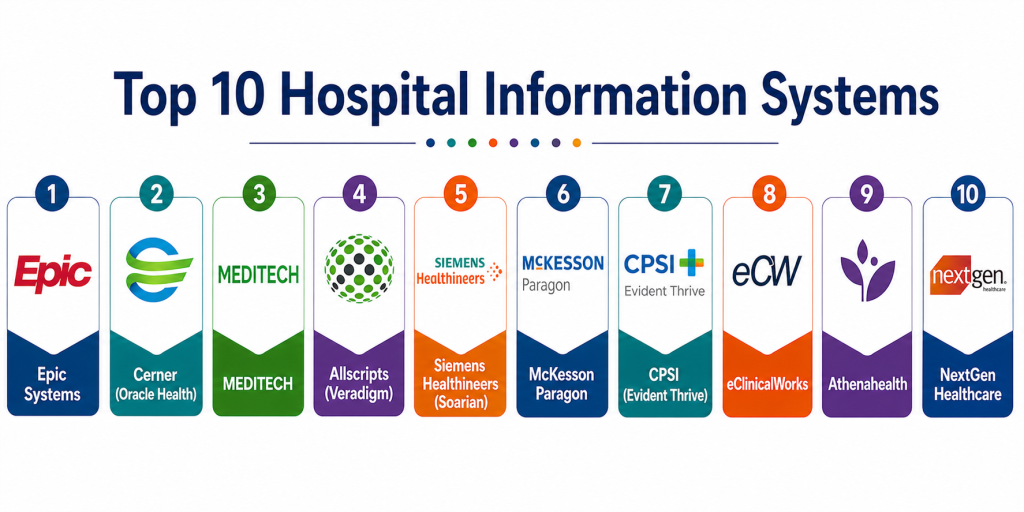
Top 10 Hospital Information Systems
#1 — Epic Systems
Short description: A leading HIS platform used by large hospitals and healthcare networks, offering comprehensive clinical and administrative functionalities.
Key Features
- Integrated patient records and clinical workflows
- Billing and revenue cycle management
- Interoperability tools
- Patient engagement portals
- Advanced analytics
Pros
- Highly scalable
- Comprehensive feature set
Cons
- Expensive implementation
- Complex setup
Platforms / Deployment
Web / Cloud / On-premise
Security & Compliance
Varies / N/A
Integrations & Ecosystem
Extensive integration with healthcare systems
- API ecosystem
- Lab and imaging integrations
- Data exchange tools
Support & Community
Enterprise-grade support and training
#2 — Cerner (Oracle Health)
Short description: A widely adopted HIS platform known for interoperability and strong data analytics capabilities.
Key Features
- Clinical workflow management
- Data analytics and reporting
- Patient engagement tools
- Revenue cycle management
- Interoperability support
Pros
- Strong integration capabilities
- Scalable for large hospitals
Cons
- Complex interface
- Cost considerations
Platforms / Deployment
Web / Cloud / On-premise
Security & Compliance
Varies / N/A
Integrations & Ecosystem
Broad healthcare integrations
- API support
- Cloud integration
Support & Community
Strong enterprise support
#3 — MEDITECH
Short description: A reliable HIS platform for mid-sized hospitals offering cost-effective and integrated solutions.
Key Features
- Patient data management
- Clinical workflows
- Billing and scheduling
- Reporting tools
- Interoperability features
Pros
- Affordable compared to enterprise systems
- Reliable performance
Cons
- Outdated UI
- Limited customization
Platforms / Deployment
Web / Cloud / On-premise
Security & Compliance
Varies / N/A
Integrations & Ecosystem
Supports healthcare integrations
- Data exchange tools
Support & Community
Established user community
#4 — Allscripts (Veradigm)
Short description: A flexible HIS platform designed for hospitals and physician groups with customizable workflows.
Key Features
- Electronic patient records
- Clinical workflows
- Revenue cycle management
- Data analytics
- Integration capabilities
Pros
- Flexible customization
- Strong integration support
Cons
- Complex interface
- Implementation challenges
Platforms / Deployment
Web / Cloud / On-premise
Security & Compliance
Varies / N/A
Integrations & Ecosystem
Supports multiple healthcare integrations
- API support
- Third-party integrations
Support & Community
Moderate support ecosystem
#5 — Siemens Healthineers (Soarian)
Short description: A hospital information system focused on clinical and administrative integration for healthcare providers.
Key Features
- Clinical documentation
- Workflow automation
- Patient management
- Reporting tools
- Integration capabilities
Pros
- Strong clinical workflows
- Integration capabilities
Cons
- Limited modern UI
- Requires training
Platforms / Deployment
Web / On-premise
Security & Compliance
Varies / N/A
Integrations & Ecosystem
Supports integration with healthcare systems
- Data exchange tools
Support & Community
Enterprise support
#6 — McKesson Paragon
Short description: A HIS solution designed for community hospitals with integrated clinical and financial workflows.
Key Features
- Patient management
- Clinical workflows
- Billing and revenue cycle
- Reporting tools
- Scheduling
Pros
- Suitable for mid-sized hospitals
- Integrated workflows
Cons
- Limited scalability
- UI limitations
Platforms / Deployment
Web / On-premise
Security & Compliance
Varies / N/A
Integrations & Ecosystem
Supports healthcare integrations
- API support
Support & Community
Moderate support
#7 — CPSI (Evident Thrive)
Short description: A HIS platform designed for rural and community hospitals with a focus on usability and cost efficiency.
Key Features
- Patient record management
- Clinical workflows
- Billing tools
- Reporting features
- Scheduling
Pros
- Affordable solution
- Easy to use
Cons
- Limited advanced features
- Not ideal for large hospitals
Platforms / Deployment
Web / Cloud
Security & Compliance
Varies / N/A
Integrations & Ecosystem
Basic integration support
- Healthcare data exchange
Support & Community
Focused support for smaller hospitals
#8 — eClinicalWorks
Short description: A cloud-based HIS solution offering integrated clinical and administrative tools for healthcare providers.
Key Features
- Patient records
- Telehealth integration
- Billing and scheduling
- Reporting tools
- Patient portal
Pros
- Easy deployment
- Cloud-based
Cons
- Performance limitations
- Support concerns
Platforms / Deployment
Web / Cloud
Security & Compliance
Varies / N/A
Integrations & Ecosystem
Supports healthcare integrations
- API ecosystem
Support & Community
Mixed support reviews
#9 — Athenahealth
Short description: A cloud-based HIS platform offering integrated clinical, financial, and operational workflows.
Key Features
- Cloud-based system
- Revenue cycle management
- Patient engagement tools
- Analytics dashboards
- Workflow automation
Pros
- User-friendly
- Strong cloud capabilities
Cons
- Pricing variability
- Limited customization
Platforms / Deployment
Web / Cloud
Security & Compliance
Varies / N/A
Integrations & Ecosystem
API-driven integrations
- Healthcare apps
Support & Community
Strong support ecosystem
#10 — NextGen Healthcare
Short description: A HIS platform tailored for specialty hospitals and healthcare providers with customizable workflows.
Key Features
- Specialty workflows
- Patient engagement
- Revenue cycle management
- Reporting tools
- Scheduling
Pros
- Customizable
- Good analytics
Cons
- Learning curve
- Interface complexity
Platforms / Deployment
Web / Cloud / On-premise
Security & Compliance
Varies / N/A
Integrations & Ecosystem
Supports integration with healthcare tools
- API support
Support & Community
Moderate support
Comparison Table
| Tool Name | Best For | Platform(s) Supported | Deployment | Standout Feature | Public Rating |
|---|---|---|---|---|---|
| Epic Systems | Large hospitals | Web | Hybrid | Enterprise scale | N/A |
| Cerner | Hospitals | Web | Hybrid | Interoperability | N/A |
| MEDITECH | Mid-sized hospitals | Web | Hybrid | Cost efficiency | N/A |
| Allscripts | Flexible workflows | Web | Hybrid | Customization | N/A |
| Siemens Soarian | Clinical workflows | Web | On-premise | Integration | N/A |
| McKesson Paragon | Community hospitals | Web | On-premise | Simplicity | N/A |
| CPSI Thrive | Rural hospitals | Web | Cloud | Affordability | N/A |
| eClinicalWorks | Ambulatory care | Web | Cloud | Telehealth | N/A |
| Athenahealth | Clinics | Web | Cloud | Cloud-native | N/A |
| NextGen | Specialty hospitals | Web | Hybrid | Custom workflows | N/A |
Evaluation & Scoring of Hospital Information Systems
| Tool Name | Core (25%) | Ease (15%) | Integrations (15%) | Security (10%) | Performance (10%) | Support (10%) | Value (15%) | Weighted Total |
|---|---|---|---|---|---|---|---|---|
| Epic Systems | 10 | 6 | 9 | 9 | 9 | 9 | 6 | 8.8 |
| Cerner | 9 | 6 | 9 | 9 | 8 | 9 | 6 | 8.5 |
| MEDITECH | 8 | 7 | 7 | 8 | 7 | 7 | 8 | 7.7 |
| Allscripts | 8 | 7 | 8 | 8 | 7 | 7 | 7 | 7.8 |
| Siemens Soarian | 7 | 6 | 7 | 8 | 7 | 7 | 7 | 7.2 |
| McKesson Paragon | 7 | 7 | 7 | 7 | 7 | 6 | 7 | 7.0 |
| CPSI Thrive | 6 | 8 | 6 | 7 | 6 | 6 | 8 | 6.9 |
| eClinicalWorks | 7 | 8 | 7 | 7 | 7 | 6 | 8 | 7.4 |
| Athenahealth | 8 | 9 | 8 | 8 | 8 | 8 | 7 | 8.2 |
| NextGen | 8 | 7 | 8 | 8 | 7 | 7 | 7 | 7.7 |
How to interpret scores:
These scores reflect comparative strengths across key criteria. Higher scores indicate enterprise readiness and scalability, while mid-range scores highlight suitability for smaller or specialized hospital environments.
Which Hospital Information System Is Right for You?
Solo / Freelancer
- Not applicable; HIS systems are designed for hospitals
SMB (Small Hospitals / Clinics)
- CPSI Thrive, eClinicalWorks
- Affordable and easier to deploy
Mid-Market
- MEDITECH, NextGen
- Balanced features and scalability
Enterprise
- Epic Systems, Cerner
- Full-scale hospital management
Budget vs Premium
- Budget: CPSI, MEDITECH
- Premium: Epic, Cerner
Feature Depth vs Ease of Use
- Deep features: Epic, Cerner
- Ease of use: Athenahealth
Integrations & Scalability
- Enterprise systems offer broad integration capabilities
- Smaller systems focus on simplicity
Security & Compliance Needs
- Enterprise HIS platforms are better suited for regulated environments
Frequently Asked Questions (FAQs)
1. What is a Hospital Information System?
A HIS is a comprehensive software platform used to manage hospital operations, including clinical, administrative, and financial processes.
2. How is HIS different from EHR?
HIS covers the entire hospital system, while EHR focuses on patient records and clinical data.
3. Are HIS systems expensive?
Costs vary widely depending on features, scale, and deployment.
4. Do HIS systems support cloud deployment?
Yes, many modern HIS platforms offer cloud-based deployment options.
5. What industries use HIS?
Hospitals, healthcare networks, and specialty medical centers use HIS systems.
6. Are HIS systems secure?
Security depends on the vendor, but most systems include strong data protection features.
7. Can HIS integrate with other systems?
Yes, integration with lab, imaging, and billing systems is a core feature.
8. What are common challenges?
Implementation complexity, cost, and training requirements.
9. Can small hospitals use HIS?
Yes, some solutions are designed for small and mid-sized hospitals.
10. How do I choose the right HIS?
Evaluate based on scale, integration needs, budget, and usability.
Conclusion
Hospital Information Systems are essential for managing the complexity of modern healthcare operations. They unify clinical, administrative, and financial workflows, enabling hospitals to deliver efficient and high-quality patient care. The right HIS depends on your organization’s size, operational requirements, and budget. Enterprise solutions offer deep integration and scalability, while smaller systems focus on affordability and ease of use. Before making a decision, it is important to evaluate usability, integration capabilities, and long-term scalability. Security and compliance considerations are also critical in healthcare environments. Rather than selecting a single system immediately, hospitals should shortlist a few options and conduct pilot implementations. This helps validate real-world performance and workflow compatibility. Ultimately, the best Hospital Information System is the one that aligns with your operational goals, clinical workflows, and long-term digital transformation strategy.