Introduction
Museum Collection Management Software refers to specialized platforms used to catalog, manage, preserve, and track artifacts, artworks, and historical objects across museums and cultural institutions. These tools act as a centralized system to store detailed metadata, manage collections, handle loans, and support research and exhibitions.
As museums continue to digitize collections and expand public access, managing artifacts manually is no longer practical. Modern systems provide digital cataloging, asset tracking, reporting, and integration with online exhibits, enabling institutions to improve preservation, accessibility, and operational efficiency.
Real-world use cases
- Cataloging and documenting artifacts and artworks
- Managing loans and exhibitions
- Tracking conservation and restoration activities
- Digitizing collections for online access
- Supporting research and archival work
What buyers should evaluate
- Cataloging and metadata management capabilities
- Collection tracking and lifecycle management
- Support for digital assets and media
- Integration with museum and archival systems
- Reporting and analytics features
- Scalability for large collections
- Security and access control
- Cloud vs on-premise deployment
Best for: Museums, galleries, archives, cultural institutions, and heritage organizations.
Not ideal for: Very small collections or institutions without digitization needs.
Key Trends in Museum Collection Management Software
- Digitization of collections and online exhibits
- Cloud-based systems for global access
- Integration with digital asset management platforms
- AI-assisted tagging and metadata enrichment
- Mobile access for field cataloging
- Enhanced reporting and analytics
- Multi-institution collaboration and sharing
- Support for 3D models and multimedia artifacts
- Automation of conservation workflows
- Public-facing collection portals
How We Selected These Tools
- Evaluated adoption across museums and archives
- Assessed cataloging and metadata capabilities
- Considered scalability for large collections
- Reviewed integration with digital asset systems
- Analyzed usability for curators and researchers
- Evaluated reporting and analytics features
- Considered deployment flexibility
- Assessed overall value and flexibility
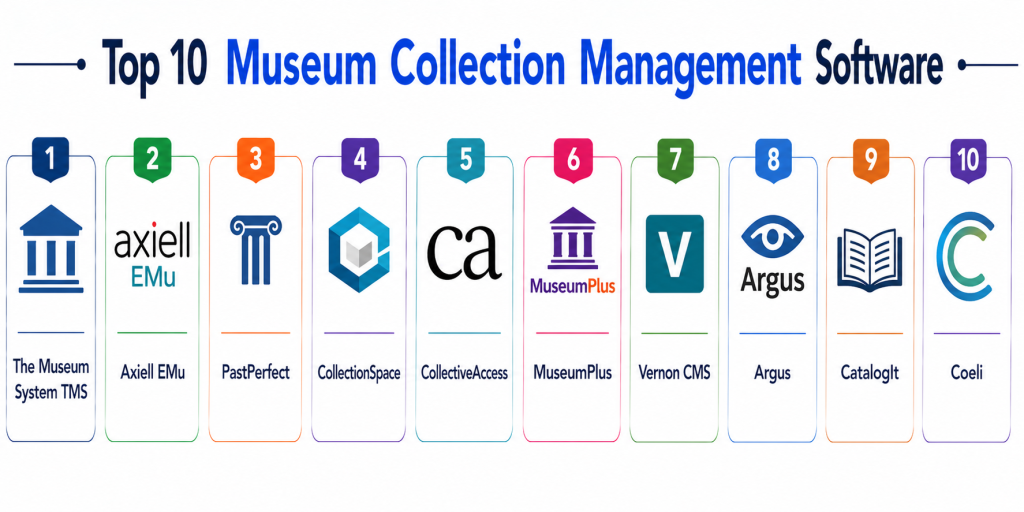
Top 10 Museum Collection Management Software
#1 — The Museum System TMS
Short description: TMS is a widely used museum management platform offering advanced cataloging and collection tracking features for large institutions.
Key Features
- Collection cataloging
- Loan management
- Exhibition tracking
- Reporting tools
- Digital asset integration
Pros
- Industry-standard
- Scalable
- Strong functionality
Cons
- Expensive
- Complex
- Requires training
Platforms / Deployment
- Web Windows
- Cloud On-premise
Security & Compliance
- Role-based access
- Not publicly stated
Integrations & Ecosystem
Integrates with museum and asset systems.
- APIs
- DAM tools
Support & Community
Enterprise support
#2 — Axiell EMu
Short description: Axiell EMu is a powerful collection management system used by large museums for managing complex datasets.
Key Features
- Advanced cataloging
- Collection tracking
- Multimedia support
- Reporting
- Workflow automation
Pros
- Highly flexible
- Scalable
- Strong data management
Cons
- Complex setup
- Expensive
- Learning curve
Platforms / Deployment
- Web
- Cloud On-premise
Security & Compliance
- Not publicly stated
Integrations & Ecosystem
Supports integration with museum systems.
- APIs
- Data tools
Support & Community
Enterprise support
#3 — PastPerfect
Short description: PastPerfect is a user-friendly collection management tool designed for small to mid-sized museums.
Key Features
- Cataloging
- Donor management
- Reporting
- Multimedia support
- Collection tracking
Pros
- Easy to use
- Affordable
- Good for smaller institutions
Cons
- Limited advanced features
- Windows-focused
- Smaller ecosystem
Platforms / Deployment
- Windows
- On-premise
Security & Compliance
- Not publicly stated
Integrations & Ecosystem
Supports integrations via add-ons.
- APIs
- Tools
Support & Community
Good support
#4 — CollectionSpace
Short description: CollectionSpace is an open-source platform designed for managing museum collections and workflows.
Key Features
- Cataloging
- Workflow management
- Reporting
- Digital asset support
- Customization
Pros
- Open-source
- Flexible
- Community-driven
Cons
- Requires setup
- Limited official support
- Technical complexity
Platforms / Deployment
- Web
- Cloud Self-hosted
Security & Compliance
- Not publicly stated
Integrations & Ecosystem
Supports integration via APIs.
- APIs
- Plugins
Support & Community
Open-source community
#5 — CollectiveAccess
Short description: CollectiveAccess is an open-source platform for managing collections and digital assets.
Key Features
- Cataloging
- Digital asset management
- Metadata handling
- Search and access
- Customization
Pros
- Flexible
- Open-source
- Strong metadata support
Cons
- Technical setup
- Limited support
- Complex configuration
Platforms / Deployment
- Web
- Self-hosted
Security & Compliance
- Not publicly stated
Integrations & Ecosystem
Supports integration via APIs.
- APIs
- Data tools
Support & Community
Open-source support
#6 — MuseumPlus
Short description: MuseumPlus is a professional collection management system used by museums worldwide.
Key Features
- Collection management
- Loan tracking
- Reporting
- Multimedia support
- Workflow tools
Pros
- Scalable
- Reliable
- Strong features
Cons
- Expensive
- Complex
- Requires training
Platforms / Deployment
- Web
- Cloud On-premise
Security & Compliance
- Not publicly stated
Integrations & Ecosystem
Integrates with museum tools.
- APIs
- Systems
Support & Community
Enterprise support
#7 — Vernon CMS
Short description: Vernon CMS provides collection management solutions for museums and galleries.
Key Features
- Cataloging
- Collection tracking
- Reporting
- Workflow management
- Integration
Pros
- User-friendly
- Scalable
- Good support
Cons
- Pricing
- Limited customization
- Smaller ecosystem
Platforms / Deployment
- Web
- Cloud
Security & Compliance
- Not publicly stated
Integrations & Ecosystem
Supports integration with museum tools.
- APIs
- Systems
Support & Community
Good support
#8 — Argus
Short description: Argus is a museum collection management tool with strong tracking and reporting capabilities.
Key Features
- Collection tracking
- Cataloging
- Reporting
- Workflow tools
- Analytics
Pros
- Easy to use
- Reliable
- Good tracking
Cons
- Limited advanced features
- Smaller ecosystem
- Pricing
Platforms / Deployment
- Web
- Cloud
Security & Compliance
- Not publicly stated
Integrations & Ecosystem
Supports integrations via APIs.
- APIs
- Tools
Support & Community
Good support
#9 — CatalogIt
Short description: CatalogIt is a cloud-based tool designed for cataloging and managing collections.
Key Features
- Cataloging
- Cloud storage
- Reporting
- Multimedia support
- Collaboration
Pros
- Easy to use
- Cloud-based
- Affordable
Cons
- Limited enterprise features
- Smaller ecosystem
- Basic analytics
Platforms / Deployment
- Web Mobile
- Cloud
Security & Compliance
- Not publicly stated
Integrations & Ecosystem
Supports integrations via APIs.
- APIs
- Data tools
Support & Community
Growing support
#10 — Coeli
Short description: Coeli is a collection management system focused on digitization and accessibility.
Key Features
- Digital cataloging
- Metadata management
- Reporting
- Integration
- Workflow management
Pros
- Digital-first approach
- Flexible
- Scalable
Cons
- Smaller ecosystem
- Limited documentation
- Pricing
Platforms / Deployment
- Web
- Cloud
Security & Compliance
- Not publicly stated
Integrations & Ecosystem
Supports integration with museum tools.
- APIs
- Systems
Support & Community
Growing support
Comparison Table Top 10
| Tool Name | Best For | Platform Supported | Deployment | Standout Feature | Public Rating |
|---|---|---|---|---|---|
| TMS | Large museums | Web Windows | Cloud On-premise | Industry standard | N/A |
| Axiell EMu | Enterprise | Web | Cloud On-premise | Data management | N/A |
| PastPerfect | Small museums | Windows | On-premise | Ease of use | N/A |
| CollectionSpace | Open-source | Web | Cloud Self-hosted | Flexibility | N/A |
| CollectiveAccess | Digital assets | Web | Self-hosted | Metadata support | N/A |
| MuseumPlus | Global museums | Web | Cloud On-premise | Reliability | N/A |
| Vernon CMS | Galleries | Web | Cloud | User-friendly | N/A |
| Argus | Tracking | Web | Cloud | Analytics | N/A |
| CatalogIt | Small teams | Web Mobile | Cloud | Cloud-based | N/A |
| Coeli | Digital collections | Web | Cloud | Digitization | N/A |
Evaluation & Scoring of Museum Collection Management Software
| Tool Name | Core | Ease | Integrations | Security | Performance | Support | Value | Weighted Total |
|---|---|---|---|---|---|---|---|---|
| TMS | 10 | 6 | 9 | 8 | 9 | 9 | 6 | 8.5 |
| Axiell EMu | 9 | 6 | 9 | 8 | 9 | 8 | 6 | 8.2 |
| PastPerfect | 8 | 9 | 6 | 7 | 8 | 7 | 9 | 8.0 |
| CollectionSpace | 8 | 7 | 7 | 7 | 8 | 7 | 9 | 7.9 |
| CollectiveAccess | 8 | 6 | 7 | 7 | 8 | 7 | 9 | 7.8 |
| MuseumPlus | 9 | 7 | 8 | 8 | 9 | 8 | 6 | 8.1 |
| Vernon CMS | 8 | 8 | 7 | 7 | 8 | 7 | 8 | 7.9 |
| Argus | 7 | 8 | 6 | 7 | 7 | 7 | 8 | 7.5 |
| CatalogIt | 7 | 9 | 6 | 7 | 7 | 7 | 9 | 7.7 |
| Coeli | 7 | 8 | 7 | 7 | 7 | 7 | 8 | 7.6 |
Scores are comparative and help evaluate tools based on usability, scalability, and value.
Which Museum Collection Management Software Is Right for You
Solo / Small Museums
CatalogIt and PastPerfect are simple and affordable.
SMB Institutions
Vernon CMS and Argus offer balanced features.
Mid-Market Museums
CollectionSpace and MuseumPlus provide flexibility.
Enterprise / Large Museums
TMS and Axiell EMu are ideal.
Budget vs Premium
Open-source tools are budget-friendly, TMS is premium.
Feature Depth vs Ease of Use
Axiell EMu for depth, CatalogIt for simplicity.
Integrations & Scalability
MuseumPlus and TMS are strong options.
Security & Compliance Needs
Enterprise tools provide stronger controls.
Frequently Asked Questions
1. What is museum collection management software
It is software used to catalog, manage, and track museum collections. It helps organize artifacts and improve accessibility.
2. Why is it important
It ensures proper documentation and preservation of collections. It also improves efficiency and research capabilities.
3. How does it work
It stores metadata about artifacts and tracks their lifecycle. It also manages loans and exhibitions.
4. Is it suitable for small museums
Yes, many tools are designed for small institutions. They offer simple and affordable features.
5. How much does it cost
Pricing varies depending on features and scale. Open-source tools are free, while enterprise tools are expensive.
6. Can it manage digital collections
Yes, most tools support digital assets and multimedia. This helps with digitization.
7. How long does implementation take
It can take days to weeks depending on complexity. Larger systems require more setup.
8. What are common mistakes
Choosing tools without scalability is a common mistake. Poor data migration can also cause issues.
9. Is it secure
Most tools provide access control and security features. Security levels vary by provider.
10. Are there alternatives
Manual systems or spreadsheets can be used. However, they lack automation and scalability.
Conclusion
Museum Collection Management Software plays a crucial role in preserving cultural heritage while enabling modern digital access and operational efficiency. These platforms help institutions catalog artifacts, manage collections, and support exhibitions with structured workflows and data-driven insights. From open-source tools like CollectionSpace to enterprise solutions like TMS and Axiell EMu, each option serves different organizational needs based on scale and complexity. The right choice depends on collection size, budget, and digitization goals rather than a one-size-fits-all approach. Museums should prioritize usability, scalability, and integration capabilities when selecting a system. A practical next step is to shortlist a few tools, run pilot implementations, and evaluate how well they support long-term preservation and accessibility goals.
Easy to understand guide explaining features, pros, and limitations of popular museum collection management software clearly.
I liked how the article explained both pros and limitations of each platform. That makes decision-making much easier for institutions.