Introduction
Trade Surveillance Systems are specialized software platforms designed to monitor trading activity in real time and detect suspicious behavior such as market manipulation, insider trading, and fraud. These systems analyze orders, executions, and market data to ensure compliance with regulatory requirements and internal policies.
They are essential because financial markets are highly regulated and increasingly complex, requiring firms to proactively detect risks and avoid penalties. These tools act as a “compliance engine,” helping institutions maintain transparency and trust.
Common use cases include monitoring trading desks for abuse, detecting algorithmic anomalies, regulatory reporting, compliance audits, and cross-market surveillance.
Buyers should evaluate real-time monitoring, alert accuracy, AI/ML capabilities, compliance coverage, integration with OMS/EMS, scalability, workflow automation, reporting, multi-asset support, and vendor reliability.
Best for: Banks, broker-dealers, hedge funds, exchanges, and regulatory bodies.
Not ideal for: Small firms with no trading activity or those relying fully on broker-provided compliance systems.
Key Trends in Trade Surveillance Systems
- AI and machine learning to reduce false positives and improve detection
- Real-time and cross-market surveillance across asset classes
- Integration with communications surveillance (emails, chats, voice)
- Cloud-based deployment for scalability and global coverage
- Behavioral analytics for insider trading detection
- Automated alert prioritization and case management
- Regulatory automation for frameworks like MiFID II and MAR
- Big data processing for high-volume trade analysis
- Integration with OMS/EMS and market data systems
- Advanced visualization dashboards for compliance teams
How We Selected These Tools
- Adoption among financial institutions and exchanges
- Coverage of pre-trade, post-trade, and market surveillance
- Ability to detect complex market abuse patterns
- Integration with trading systems and data sources
- Real-time analytics and alerting capabilities
- Automation of compliance workflows
- Scalability for high-volume environments
- AI/ML capabilities and false-positive reduction
- Regulatory compliance readiness
- Vendor ecosystem and support quality
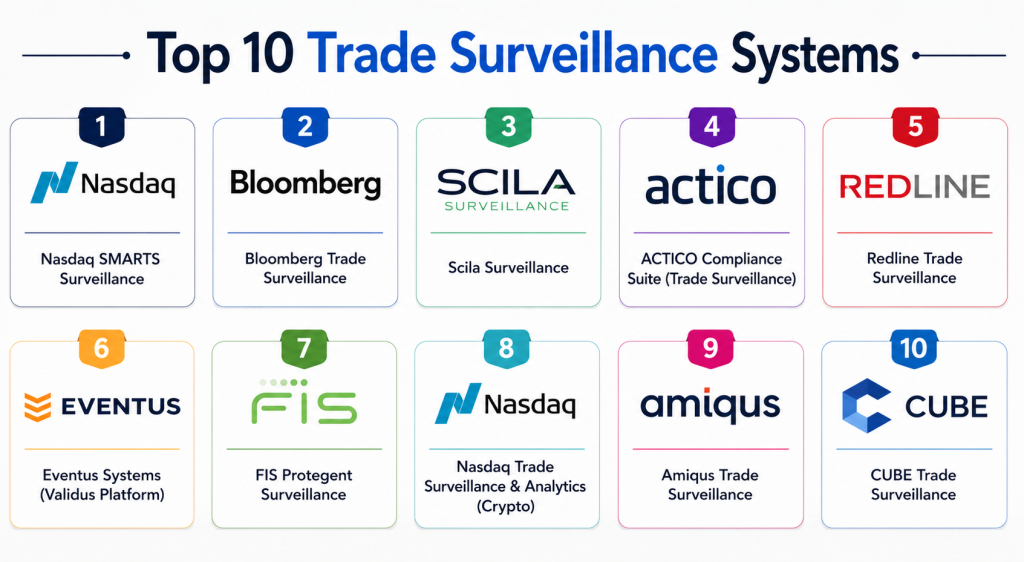
Top 10 Trade Surveillance Systems
#1 — Nasdaq SMARTS Surveillance
Short description: Nasdaq SMARTS is a leading surveillance platform used by exchanges and financial institutions to detect market abuse across multiple asset classes.
Key Features
- Real-time and historical surveillance
- Cross-asset monitoring
- Pattern detection for market abuse
- Advanced analytics dashboards
- Automated alert workflows
Pros
- Industry-leading solution
- Highly scalable
- Strong analytics
- Trusted by exchanges
Cons
- Enterprise-focused
- High cost
- Complex setup
- Requires expertise
Platforms / Deployment
Web
Cloud / On-prem
Security & Compliance
Not publicly stated
Integrations & Ecosystem
- Trading systems
- Market data feeds
- Compliance platforms
Support & Community
Enterprise support with global presence
#2 — Bloomberg Trade Surveillance
Short description: Bloomberg provides integrated trade surveillance with real-time monitoring and analytics tied to its data ecosystem.
Key Features
- Real-time monitoring
- Pattern recognition
- Alert prioritization
- Compliance reporting
- Integration with Bloomberg data
Pros
- Strong ecosystem
- Reliable analytics
- Widely adopted
- Real-time insights
Cons
- Requires Bloomberg ecosystem
- High cost
- Enterprise focus
- Limited flexibility outside ecosystem
Platforms / Deployment
Web / Desktop
Cloud
Security & Compliance
Not publicly stated
Integrations & Ecosystem
- Bloomberg Terminal
- OMS/EMS systems
- Market data feeds
Support & Community
Enterprise support
#3 — Scila Surveillance
Short description: Scila provides real-time multi-asset surveillance with strong analytics and customizable detection rules.
Key Features
- Real-time monitoring
- Machine learning analytics
- Pattern detection
- Custom rule engine
- Alert management
Pros
- Flexible configuration
- Strong analytics
- Scalable
- Multi-asset support
Cons
- Setup complexity
- Pricing varies
- Requires integration
- Enterprise focus
Platforms / Deployment
Web
Cloud
Security & Compliance
Not publicly stated
Integrations & Ecosystem
- OMS/EMS systems
- Market data feeds
- Compliance tools
Support & Community
Enterprise support available
#4 — ACTICO Compliance Suite (Trade Surveillance)
Short description: ACTICO provides rule-based and AI-driven trade surveillance with strong compliance automation.
Key Features
- Real-time monitoring
- Rule-based and AI detection
- Workflow automation
- Compliance reporting
- Alert management
Pros
- Strong compliance focus
- Flexible rules engine
- Scalable
- Automation features
Cons
- Integration effort required
- Enterprise focus
- Pricing varies
- Learning curve
Platforms / Deployment
Web
Cloud / On-prem
Security & Compliance
Not publicly stated
Integrations & Ecosystem
- Trading systems
- ERP systems
- Data platforms
Support & Community
Enterprise support available
#5 — Redline Surveillance
Short description: Redline offers advanced trade surveillance with anomaly detection and alert scoring capabilities.
Key Features
- Real-time and post-trade monitoring
- Anomaly detection
- Alert scoring
- Analytics dashboards
- Workflow automation
Pros
- Strong analytics
- Scalable
- Flexible workflows
- Reliable detection
Cons
- Enterprise-focused
- Setup complexity
- Pricing varies
- Integration required
Platforms / Deployment
Web
Cloud
Security & Compliance
Not publicly stated
Integrations & Ecosystem
- OMS/EMS systems
- Market data feeds
- Compliance platforms
Support & Community
Enterprise support available
#6 — Eventus Systems (Validus Platform)
Short description: Eventus provides trade surveillance with real-time and post-trade monitoring for global markets.
Key Features
- Real-time surveillance
- Market abuse detection
- Workflow automation
- Multi-asset support
- Analytics dashboards
Pros
- Scalable
- Strong detection capabilities
- Flexible workflows
- Multi-market support
Cons
- Enterprise-focused
- Pricing varies
- Setup required
- Integration effort
Platforms / Deployment
Web
Cloud
Security & Compliance
Not publicly stated
Integrations & Ecosystem
- Market data providers
- Trading platforms
- Compliance tools
Support & Community
Enterprise support available
#7 — FIS Protegent Surveillance
Short description: FIS Protegent offers surveillance and compliance tools for equities and derivatives markets.
Key Features
- Real-time monitoring
- Rule-based detection
- Compliance reporting
- Alert management
- Multi-asset support
Pros
- Strong compliance features
- Reliable
- Scalable
- Enterprise-ready
Cons
- Complex setup
- Pricing varies
- Enterprise focus
- Requires training
Platforms / Deployment
Web
Cloud
Security & Compliance
Not publicly stated
Integrations & Ecosystem
- Trading systems
- Market data feeds
- Risk platforms
Support & Community
Enterprise support available
#8 — Nasdaq Trade Surveillance & Analytics (Crypto)
Short description: Nasdaq offers surveillance tailored for digital asset markets with real-time monitoring and analytics.
Key Features
- Crypto market surveillance
- Real-time analytics
- Pattern detection
- Alert management
- Multi-market support
Pros
- Specialized for crypto
- Scalable
- Strong analytics
- Trusted vendor
Cons
- Focused on digital assets
- Enterprise pricing
- Integration effort
- Limited outside crypto
Platforms / Deployment
Web
Cloud
Security & Compliance
Not publicly stated
Integrations & Ecosystem
- Crypto exchanges
- Trading platforms
- Analytics tools
Support & Community
Enterprise support available
#9 — Amiqus Trade Surveillance
Short description: Amiqus provides real-time monitoring with machine learning-based detection and customizable workflows.
Key Features
- Real-time monitoring
- ML-based analytics
- Alert management
- Custom workflows
- Reporting dashboards
Pros
- Flexible
- Scalable
- Easy integration
- Strong analytics
Cons
- Pricing varies
- Setup required
- Enterprise focus
- Integration effort
Platforms / Deployment
Web
Cloud
Security & Compliance
Not publicly stated
Integrations & Ecosystem
- Trading systems
- Market data feeds
- Compliance tools
Support & Community
Support available
#10 — Cube Trade Surveillance
Short description: Cube offers a modern surveillance solution for detecting suspicious trading behaviors across markets.
Key Features
- Real-time and historical analysis
- Pattern detection
- Multi-market support
- Alert management
- Reporting tools
Pros
- User-friendly
- Scalable
- Flexible
- Modern interface
Cons
- Mid-market focus
- Pricing varies
- Limited enterprise depth
- Integration effort
Platforms / Deployment
Web
Cloud
Security & Compliance
Not publicly stated
Integrations & Ecosystem
- OMS/EMS systems
- Market data providers
- Analytics platforms
Support & Community
Support available
Comparison Table
| Tool Name | Best For | Platform(s) Supported | Deployment | Standout Feature | Public Rating |
|---|---|---|---|---|---|
| Nasdaq SMARTS | Exchanges & large firms | Web | Cloud/On-prem | Market abuse detection | N/A |
| Bloomberg | Institutional firms | Web/Desktop | Cloud | Integrated data ecosystem | N/A |
| Scila | Brokers & firms | Web | Cloud | ML analytics | N/A |
| ACTICO | Compliance teams | Web | Cloud/On-prem | Rule-based + AI detection | N/A |
| Redline | Trading firms | Web | Cloud | Anomaly detection | N/A |
| Eventus | Global markets | Web | Cloud | Real-time surveillance | N/A |
| FIS Protegent | Broker-dealers | Web | Cloud | Compliance reporting | N/A |
| Nasdaq Crypto | Crypto exchanges | Web | Cloud | Crypto surveillance | N/A |
| Amiqus | Mid-market firms | Web | Cloud | ML-based alerts | N/A |
| Cube | SMB & mid-market | Web | Cloud | User-friendly workflows | N/A |
Evaluation & Scoring of Trade Surveillance Systems
| Tool | Core | Ease | Integrations | Security | Performance | Support | Value | Weighted Total |
|---|---|---|---|---|---|---|---|---|
| Nasdaq SMARTS | 9 | 7 | 9 | 8 | 9 | 8 | 7 | 8.3 |
| Bloomberg | 9 | 7.5 | 9 | 8 | 9 | 8 | 7 | 8.3 |
| Scila | 8.5 | 8 | 8.5 | 8 | 8.5 | 8 | 7.5 | 8.2 |
| ACTICO | 8.5 | 7.5 | 8.5 | 8 | 8.5 | 8 | 7.5 | 8.1 |
| Redline | 8.5 | 7.5 | 8 | 8 | 8.5 | 8 | 7.5 | 8.0 |
| Eventus | 8.5 | 7.5 | 8.5 | 8 | 8.5 | 8 | 7.5 | 8.1 |
| FIS | 8.5 | 7 | 8 | 8 | 8.5 | 8 | 7 | 8.0 |
| Nasdaq Crypto | 8 | 7.5 | 8 | 8 | 8.5 | 8 | 7.5 | 8.0 |
| Amiqus | 8 | 8 | 8 | 8 | 8 | 7.5 | 7.5 | 7.9 |
| Cube | 8 | 8 | 7.5 | 8 | 8 | 7.5 | 7.5 | 7.8 |
How to interpret:
- Scores are comparative across tools, not absolute benchmarks
- Enterprise tools score higher on performance and integrations
- Mid-market tools offer better ease-of-use and value
- Choose based on scale, compliance needs, and complexity
Which Trade Surveillance System Is Right for You?
Solo / Freelancer
Not required unless directly trading regulated instruments.
SMB
Choose Cube or Amiqus for affordability and ease of use.
Mid-Market
Consider Scila, Redline, or ACTICO for balanced analytics and compliance.
Enterprise
Use Nasdaq SMARTS, Bloomberg, Eventus, or FIS Protegent for global, multi-asset surveillance.
Budget vs Premium
Budget tools offer basic monitoring; premium platforms provide AI-driven detection and global coverage.
Feature Depth vs Ease of Use
Enterprise tools offer deep analytics; mid-market tools focus on usability.
Integrations & Scalability
Ensure compatibility with OMS, EMS, and market data systems.
Security & Compliance Needs
Critical—must support regulatory frameworks and audit trails.
Frequently Asked Questions (numbring)
1. What is a trade surveillance system?
It is software that monitors trading activity to detect fraud, manipulation, and regulatory violations in financial markets.
2. Why is trade surveillance important?
It ensures compliance, prevents financial crime, and protects firms from penalties and reputational damage.
3. Who uses trade surveillance systems?
Banks, broker-dealers, hedge funds, exchanges, and regulators.
4. What types of abuse do these systems detect?
Insider trading, spoofing, wash trades, front-running, and market manipulation.
5. Are these systems real-time?
Yes, most modern platforms provide real-time and post-trade monitoring.
6. Do they use AI?
Yes, many platforms use machine learning to improve detection accuracy and reduce false positives.
7. How do alerts work?
Systems generate alerts when suspicious patterns are detected, which are then reviewed by compliance teams.
8. Can they monitor multiple markets?
Yes, enterprise platforms support cross-asset and cross-market surveillance.
9. How long does implementation take?
It varies from weeks to months depending on complexity and integration.
10. What are alternatives?
Manual monitoring or basic compliance tools, though they are less effective and scalable.
Conclusion
Trade Surveillance Systems are essential for maintaining integrity and compliance in financial markets. They enable real-time monitoring, fraud detection, and regulatory adherence across trading activities. Enterprise platforms like Nasdaq SMARTS and Bloomberg provide advanced analytics and global coverage. Mid-market tools such as Scila and ACTICO offer flexibility with strong compliance features. The right system depends on trading volume, regulatory requirements, and integration needs. Organizations should prioritize detection accuracy, automation, and scalability. Pilot deployments can help validate performance and reduce false positives. Ultimately, the best solution aligns with compliance strategy and operational risk management.