Introduction
Supplier Portal Platforms are centralized digital systems that enable seamless collaboration between businesses and their suppliers. These portals allow suppliers to manage purchase orders, submit invoices, track payments, upload compliance documents, and communicate—all within a single interface.
In modern procurement environments, supplier collaboration is critical. Without a centralized portal, communication becomes fragmented across emails, spreadsheets, and disconnected tools, leading to delays, errors, and compliance risks. Supplier portals solve this by providing real-time visibility, automation, and secure data exchange, improving efficiency and transparency across the supply chain.
Common Use Cases
- Supplier onboarding and self-service registration
- Purchase order and invoice management
- Payment tracking and financial transparency
- Compliance and document management
- Supplier communication and collaboration
What Buyers Should Evaluate
- Supplier self-service capabilities
- Integration with ERP and procurement systems
- Real-time visibility into orders and payments
- Workflow automation
- Document and compliance management
- Security and access control
- Scalability
- Ease of use
- Reporting and analytics
Best for: Procurement teams, supply chain managers, finance departments, and enterprises with multiple suppliers
Not ideal for: Small businesses with limited suppliers or manual procurement processes
Key Trends in Supplier Portal Platforms
- AI-powered supplier onboarding and validation
- Real-time invoice and payment tracking
- Self-service supplier portals reducing manual workload
- Integration with ERP, procurement, and finance systems
- Automated compliance tracking and alerts
- Role-based access and security controls
- API-first architectures for integration
- Cloud-native deployment models
- Supplier performance dashboards
- Focus on transparency and audit readiness
How We Selected These Tools Methodology
- Evaluated market adoption and procurement relevance
- Assessed supplier lifecycle and portal capabilities
- Reviewed integration with ERP and procurement systems
- Considered scalability and performance
- Analyzed usability and supplier experience
- Included tools for SMB, mid-market, and enterprise
- Focused on automation and collaboration features
- Balanced innovation with real-world usability
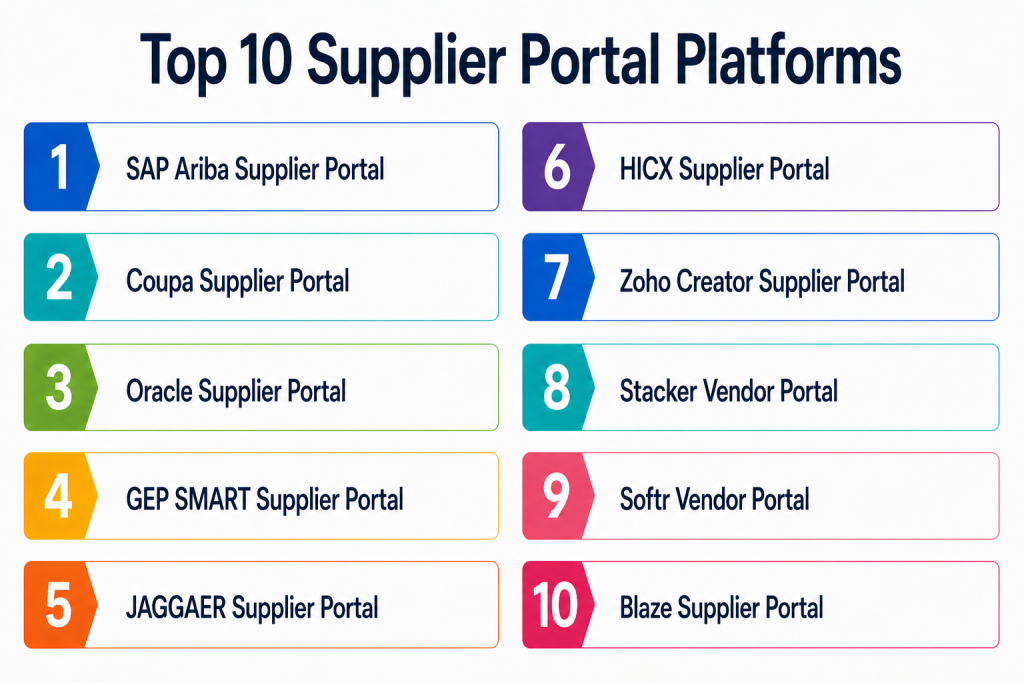
Top 10 Supplier Portal Platforms
#1 — SAP Ariba Supplier Portal
Short description: SAP Ariba Supplier Portal is a widely used enterprise solution that enables supplier onboarding, collaboration, and procurement automation within the SAP ecosystem.
Key Features
- Supplier onboarding and registration
- Purchase order management
- Invoice submission and tracking
- Supplier collaboration
- Compliance tracking
Pros
- Strong enterprise ecosystem
- Global supplier network
Cons
- Complex implementation
- Expensive
Platforms / Deployment
Web — Cloud
Security & Compliance
SSO, encryption — Not publicly stated
Integrations & Ecosystem
Deep integration with SAP ERP and procurement systems.
- SAP ERP
- Procurement tools
- APIs
Support & Community
Enterprise support and large partner ecosystem
#2 — Coupa Supplier Portal
Short description: Coupa Supplier Portal is a free supplier-facing platform that allows vendors to manage transactions, invoices, and payments with customers using Coupa.
Key Features
- Invoice submission
- Payment tracking
- Supplier collaboration
- Purchase order visibility
- Digital payments
Pros
- Free for suppliers
- Easy to use
Cons
- Limited customization
- Dependent on Coupa ecosystem
Platforms / Deployment
Web — Cloud
Security & Compliance
Not publicly stated
Integrations & Ecosystem
Integrates with Coupa spend management platform.
- Procurement tools
- Finance systems
Support & Community
Strong documentation and support
#3 — Oracle Supplier Portal
Short description: Oracle Supplier Portal provides a unified platform for supplier onboarding, collaboration, and transaction management within Oracle Cloud.
Key Features
- Supplier onboarding
- Order and invoice management
- Risk and compliance tracking
- Real-time dashboards
- Supplier communication
Pros
- Strong enterprise capabilities
- Unified procurement ecosystem
Cons
- Complex setup
- Higher cost
Platforms / Deployment
Web — Cloud
Security & Compliance
Not publicly stated
Integrations & Ecosystem
Integrates with Oracle Cloud and ERP systems.
- ERP
- Procurement tools
Support & Community
Enterprise-level support
#4 — GEP SMART Supplier Portal
Short description: GEP SMART provides a cloud-based supplier portal with strong analytics and collaboration features.
Key Features
- Supplier onboarding
- Collaboration tools
- Performance tracking
- Analytics dashboards
- Procurement automation
Pros
- Modern interface
- Strong analytics
Cons
- Learning curve
- Requires training
Platforms / Deployment
Web — Cloud
Security & Compliance
Not publicly stated
Integrations & Ecosystem
Integrates with enterprise procurement systems.
- ERP
- Supply chain tools
Support & Community
Professional support
#5 — JAGGAER Supplier Portal
Short description: JAGGAER offers supplier portals focused on compliance, onboarding, and collaboration for regulated industries.
Key Features
- Supplier onboarding
- Compliance tracking
- Spend analytics
- Collaboration tools
- Risk management
Pros
- Strong compliance features
- Industry-focused
Cons
- Complex interface
- Implementation effort
Platforms / Deployment
Web — Cloud
Security & Compliance
Not publicly stated
Integrations & Ecosystem
Integrates with ERP and procurement systems.
- ERP
- Supply chain tools
Support & Community
Enterprise support
#6 — Zoho Creator Supplier Portal
Short description: Zoho Creator enables businesses to build custom supplier portals with real-time visibility into transactions and payments.
Key Features
- Custom portal builder
- Real-time order tracking
- Invoice management
- Workflow automation
- Reporting dashboards
Pros
- Highly customizable
- Affordable
Cons
- Requires configuration
- Limited enterprise depth
Platforms / Deployment
Web, Mobile — Cloud
Security & Compliance
Not publicly stated
Integrations & Ecosystem
Integrates with Zoho ecosystem and external tools.
- Zoho apps
- APIs
Support & Community
Strong documentation and support
#7 — HICX Supplier Portal
Short description: HICX focuses on supplier data management and collaboration, providing a centralized portal for enterprise supplier operations.
Key Features
- Supplier data management
- Collaboration tools
- Risk monitoring
- Performance tracking
- Workflow automation
Pros
- Strong data management
- Enterprise-focused
Cons
- Complex setup
- Premium pricing
Platforms / Deployment
Web — Cloud
Security & Compliance
Not publicly stated
Integrations & Ecosystem
Integrates with enterprise systems.
- ERP
- Procurement tools
Support & Community
Enterprise support
#8 — Stacker Vendor Portal
Short description: Stacker is a no-code platform that allows businesses to build custom supplier portals quickly without development effort.
Key Features
- No-code portal builder
- Workflow automation
- Data visualization
- Custom dashboards
- Role-based access
Pros
- Easy to build
- Flexible
Cons
- Limited enterprise features
- Customization limits
Platforms / Deployment
Web — Cloud
Security & Compliance
Not publicly stated
Integrations & Ecosystem
Connects with databases and apps.
- CRM
- Data tools
Support & Community
Active support and documentation
#9 — Softr Vendor Portal
Short description: Softr enables businesses to create AI-powered supplier portals using no-code tools and integrations.
Key Features
- No-code portal builder
- AI automation
- Workflow management
- Role-based access
- Reporting
Pros
- Easy to use
- Quick deployment
Cons
- Limited enterprise depth
- Customization limits
Platforms / Deployment
Web — Cloud
Security & Compliance
Not publicly stated
Integrations & Ecosystem
Integrates with business tools and databases.
- APIs
- Data platforms
Support & Community
Strong community
#10 — Blaze Supplier Portal
Short description: Blaze offers a platform for building custom supplier portals with strong automation and workflow capabilities.
Key Features
- Custom portal creation
- Workflow automation
- Supplier onboarding
- Data management
- Reporting tools
Pros
- Flexible customization
- Automation capabilities
Cons
- Requires setup effort
- Smaller ecosystem
Platforms / Deployment
Web — Cloud
Security & Compliance
Not publicly stated
Integrations & Ecosystem
Supports integration with enterprise systems.
- ERP
- APIs
Support & Community
Standard support
Comparison Table
| Tool Name | Best For | Platform Supported | Deployment | Standout Feature | Public Rating |
|---|---|---|---|---|---|
| SAP Ariba | Enterprise | Web | Cloud | Global supplier network | N/A |
| Coupa | Enterprise | Web | Cloud | Free supplier portal | N/A |
| Oracle | Enterprise | Web | Cloud | Unified procurement | N/A |
| GEP SMART | Enterprise | Web | Cloud | Analytics | N/A |
| JAGGAER | Enterprise | Web | Cloud | Compliance focus | N/A |
| Zoho Creator | SMB | Web, Mobile | Cloud | Custom portal | N/A |
| HICX | Enterprise | Web | Cloud | Data management | N/A |
| Stacker | SMB | Web | Cloud | No-code builder | N/A |
| Softr | SMB | Web | Cloud | AI portal builder | N/A |
| Blaze | SMB | Web | Cloud | Custom workflows | N/A |
Evaluation & Scoring of Supplier Portal Platforms
| Tool Name | Core | Ease | Integrations | Security | Performance | Support | Value | Weighted Total |
|---|---|---|---|---|---|---|---|---|
| SAP Ariba | 9 | 7 | 9 | 8 | 9 | 9 | 6 | 8.3 |
| Coupa | 8 | 9 | 8 | 7 | 8 | 8 | 8 | 8.1 |
| Oracle | 9 | 7 | 9 | 8 | 9 | 8 | 6 | 8.2 |
| GEP SMART | 8 | 8 | 8 | 7 | 8 | 8 | 8 | 8.0 |
| JAGGAER | 8 | 7 | 8 | 8 | 8 | 8 | 7 | 7.9 |
| Zoho Creator | 7 | 9 | 7 | 7 | 7 | 7 | 9 | 7.9 |
| HICX | 8 | 7 | 8 | 7 | 8 | 8 | 7 | 7.8 |
| Stacker | 7 | 9 | 7 | 7 | 7 | 7 | 9 | 7.8 |
| Softr | 7 | 9 | 7 | 7 | 7 | 7 | 9 | 7.8 |
| Blaze | 7 | 8 | 7 | 7 | 7 | 7 | 8 | 7.6 |
These scores are comparative and reflect relative strengths. Organizations should choose based on integration needs, scale, and customization requirements.
Which Supplier Portal Platform Is Right for You
Solo / Small Business
No-code tools like Softr and Stacker are suitable for quick deployment.
SMB
Zoho Creator and Blaze offer flexibility and affordability.
Mid-Market
GEP SMART and HICX provide strong collaboration and analytics.
Enterprise
SAP Ariba, Oracle, and Coupa offer advanced capabilities.
Budget vs Premium
Budget tools include Softr and Zoho Creator, while enterprise tools require higher investment.
Feature Depth vs Ease of Use
Enterprise platforms offer depth, while no-code tools focus on simplicity.
Integrations & Scalability
SAP and Oracle provide strong integration ecosystems.
Security & Compliance Needs
Enterprises should prioritize platforms with strong compliance capabilities.
Frequently Asked Questions
1. What is a supplier portal platform
A supplier portal is a centralized platform that enables businesses and suppliers to exchange information and manage transactions.
2. What are the key benefits of supplier portals
They improve efficiency, reduce manual work, and enhance supplier collaboration.
3. What features should I look for
Look for onboarding, invoicing, payment tracking, and compliance management.
4. Do supplier portals integrate with ERP systems
Yes, integration with ERP systems is essential for seamless workflows.
5. Are supplier portals secure
Most platforms offer secure access controls and encryption.
6. Can suppliers access the portal themselves
Yes, supplier self-service is a key feature.
7. How long does implementation take
It depends on complexity and customization requirements.
8. Do these tools support compliance tracking
Yes, most platforms include compliance and document management features.
9. Are no-code platforms viable
Yes, for SMBs and simple use cases, no-code tools are effective.
10. What are alternatives
Manual processes or basic vendor management systems.
Conclusion
Supplier portal platforms are essential for modern procurement operations, enabling businesses to streamline supplier interactions, improve transparency, and reduce operational inefficiencies. The right platform depends on your organization’s size, complexity, and integration needs. Smaller businesses benefit from no-code or flexible solutions, while enterprises require robust platforms with advanced capabilities. Modern supplier portals are evolving with automation, AI, and real-time data visibility, making supplier collaboration more efficient and scalable. Security, compliance, and integration remain critical factors when selecting a solution. A practical approach is to shortlist a few platforms and evaluate them through pilot implementations.