Introduction
Logistics Visibility Platforms are software systems that provide real-time tracking and insights across the entire supply chain—from raw material pickup to final delivery. In simple terms, they act like a “live map” of your shipments, showing where goods are, what’s happening, and what might happen next.
In today’s fast-moving global supply chains, delays, disruptions, and customer expectations make visibility critical. These platforms combine data from carriers, GPS, IoT sensors, and logistics systems to provide a single source of truth. They not only track shipments but also predict delays, automate alerts, and improve decision-making.
Common use cases include:
- Real-time shipment tracking across modes (road, rail, ocean, air)
- Predictive ETA and delay management
- Exception alerts and proactive issue resolution
- Inventory and order visibility
- Customer communication and delivery updates
What buyers should evaluate:
- Carrier network coverage and data accuracy
- Predictive ETA capabilities
- Integration with TMS, ERP, and WMS
- Real-time alerts and exception handling
- Scalability across regions and transport modes
- Ease of onboarding carriers and partners
- Analytics and reporting capabilities
- Security and compliance features
- API availability and extensibility
Best for: Shippers, logistics providers, manufacturers, retailers, and enterprises managing complex, multi-modal supply chains.
Not ideal for: Very small businesses with simple shipping needs or low shipment volumes.
Key Trends in Logistics Visibility Platforms
- AI-driven predictive ETAs and risk detection
- Real-time multi-modal tracking across global supply chains
- Cloud-native platforms replacing legacy systems
- Integration with IoT sensors for asset-level visibility
- Automated exception management workflows
- Sustainability tracking (carbon emissions visibility)
- API-first architecture for ecosystem integration
- Digital twins for supply chain simulation
- Increased focus on last-mile visibility
- Data-driven decision-making and automation
How We Selected These Tools (Methodology)
- Evaluated global adoption and market leadership
- Assessed multi-modal tracking capabilities
- Compared predictive analytics and ETA accuracy
- Reviewed integration with logistics ecosystems
- Considered scalability for enterprise operations
- Evaluated usability and onboarding complexity
- Assessed reporting and analytics depth
- Reviewed vendor reputation and reliability
- Balanced enterprise and mid-market platforms
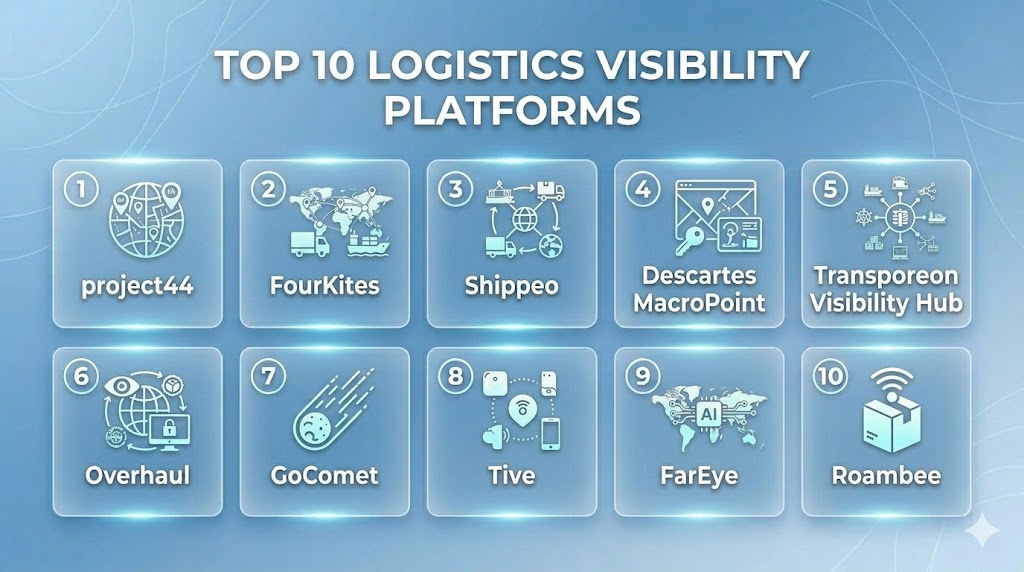
Top 10 Logistics Visibility Platforms
#1 — project44
Short description: A leading global visibility platform offering real-time tracking across all transport modes. It is designed for large enterprises needing high data accuracy and predictive insights. It provides deep carrier integrations and automation.
Key Features
- Multi-modal tracking (road, air, ocean, rail)
- Predictive ETA using machine learning
- Exception management and alerts
- Large carrier network integrations
- Advanced analytics dashboards
- Yard and dock visibility
Pros
- Strong global carrier network
- High data accuracy
Cons
- Premium pricing
- Complex implementation
Platforms / Deployment
Web
Cloud
Security & Compliance
SOC 2, GDPR, encryption, SSO
Integrations & Ecosystem
Strong ecosystem integrations.
- TMS and ERP systems
- APIs
- Carrier networks
Support & Community
Enterprise-grade support and onboarding.
#2 — FourKites
Short description: A real-time supply chain visibility platform focusing on predictive analytics and collaboration. It helps enterprises track shipments and improve operational efficiency.
Key Features
- Real-time tracking
- Predictive ETAs
- Collaboration tools
- Yard visibility
- Analytics dashboards
Pros
- Strong predictive capabilities
- Enterprise-ready
Cons
- High cost
- Complex setup
Platforms / Deployment
Web
Cloud
Security & Compliance
Not publicly stated
Integrations & Ecosystem
Wide integrations.
- ERP systems
- APIs
Support & Community
Strong enterprise support.
#3 — Shippeo
Short description: A visibility platform known for high data reliability and strong European market presence. It offers real-time tracking and predictive analytics.
Key Features
- Multi-modal tracking
- Predictive ETA
- Carrier performance monitoring
- Real-time alerts
- Carbon tracking
Pros
- High data reliability
- Strong customer support
Cons
- Region-focused strength
- Pricing varies
Platforms / Deployment
Web
Cloud
Security & Compliance
Not publicly stated
Integrations & Ecosystem
API-driven integrations.
- Logistics systems
- APIs
Support & Community
Strong support ecosystem.
#4 — Descartes MacroPoint
Short description: A widely used freight visibility platform focused on truckload tracking and carrier connectivity, especially in North America.
Key Features
- Real-time freight tracking
- Carrier network integration
- Predictive ETAs
- Exception alerts
- Analytics tools
Pros
- Strong carrier connectivity
- Proven reliability
Cons
- Limited global coverage
- Focus on trucking
Platforms / Deployment
Web
Cloud
Security & Compliance
Not publicly stated
Integrations & Ecosystem
Broad integrations.
- Carrier systems
- APIs
Support & Community
Established support network.
#5 — Transporeon Visibility Hub
Short description: A logistics platform providing visibility and collaboration tools across transportation networks. It is widely used in Europe.
Key Features
- Shipment tracking
- Carrier collaboration
- Real-time alerts
- Analytics dashboards
- Integration tools
Pros
- Strong collaboration features
- Scalable platform
Cons
- Regional strength
- Learning curve
Platforms / Deployment
Web
Cloud
Security & Compliance
Not publicly stated
Integrations & Ecosystem
Supports integrations.
- ERP systems
- APIs
Support & Community
Enterprise support.
#6 — Overhaul
Short description: A platform focused on real-time visibility and risk management, especially for high-value shipments and security-sensitive logistics.
Key Features
- Real-time tracking
- Risk monitoring
- Incident management
- Predictive analytics
- Security insights
Pros
- Strong risk management
- Real-time insights
Cons
- Specialized use case
- Limited general features
Platforms / Deployment
Web
Cloud
Security & Compliance
Not publicly stated
Integrations & Ecosystem
Supports integrations.
- Security systems
- APIs
Support & Community
Enterprise support.
#7 — GoComet
Short description: A logistics visibility and procurement platform focused on ocean freight and container tracking with predictive analytics.
Key Features
- Ocean tracking
- Predictive ETAs
- Freight rate benchmarking
- Analytics dashboards
- Alerts and notifications
Pros
- Strong ocean visibility
- User-friendly interface
Cons
- Limited multi-modal depth
- Focus on ocean freight
Platforms / Deployment
Web
Cloud
Security & Compliance
Not publicly stated
Integrations & Ecosystem
Supports integrations.
- Shipping lines
- APIs
Support & Community
Growing support ecosystem.
#8 — Tive
Short description: A visibility platform that combines software with IoT tracking devices to monitor shipment location and condition in real time.
Key Features
- GPS tracking devices
- Condition monitoring (temperature, humidity)
- Real-time alerts
- Analytics dashboards
- Shipment tracking
Pros
- Hardware + software solution
- High accuracy tracking
Cons
- Requires devices
- Additional cost
Platforms / Deployment
Web / Mobile
Cloud
Security & Compliance
Not publicly stated
Integrations & Ecosystem
Supports integrations.
- IoT systems
- APIs
Support & Community
Good support.
#9 — FarEye
Short description: A last-mile delivery visibility platform that focuses on tracking, optimization, and customer experience.
Key Features
- Last-mile tracking
- Route optimization
- Customer notifications
- Delivery analytics
- Real-time visibility
Pros
- Strong last-mile focus
- Improves customer experience
Cons
- Limited upstream visibility
- Focus on delivery stage
Platforms / Deployment
Web / Mobile
Cloud
Security & Compliance
Not publicly stated
Integrations & Ecosystem
Supports integrations.
- Delivery systems
- APIs
Support & Community
Enterprise support.
#10 — Roambee
Short description: A supply chain visibility platform using IoT sensors to track shipments, assets, and environmental conditions globally.
Key Features
- IoT-based tracking
- Real-time monitoring
- Condition tracking
- Predictive analytics
- Alerts and notifications
Pros
- Strong IoT capabilities
- High visibility accuracy
Cons
- Hardware dependency
- Cost considerations
Platforms / Deployment
Web
Cloud
Security & Compliance
Not publicly stated
Integrations & Ecosystem
Supports integrations.
- IoT platforms
- APIs
Support & Community
Standard enterprise support.
Comparison Table
| Tool Name | Best For | Platform(s) Supported | Deployment | Standout Feature | Public Rating |
|---|---|---|---|---|---|
| project44 | Enterprise | Web | Cloud | Large carrier network | N/A |
| FourKites | Enterprise | Web | Cloud | Predictive analytics | N/A |
| Shippeo | Global tracking | Web | Cloud | Data reliability | N/A |
| MacroPoint | Trucking | Web | Cloud | Carrier connectivity | N/A |
| Transporeon | Europe | Web | Cloud | Collaboration tools | N/A |
| Overhaul | Risk management | Web | Cloud | Security tracking | N/A |
| GoComet | Ocean freight | Web | Cloud | Container tracking | N/A |
| Tive | IoT tracking | Web, Mobile | Cloud | Hardware sensors | N/A |
| FarEye | Last mile | Web, Mobile | Cloud | Delivery optimization | N/A |
| Roambee | Asset tracking | Web | Cloud | IoT visibility | N/A |
Evaluation & Scoring of Logistics Visibility Platforms
| Tool Name | Core (25%) | Ease (15%) | Integrations (15%) | Security (10%) | Performance (10%) | Support (10%) | Value (15%) | Weighted Total |
|---|---|---|---|---|---|---|---|---|
| project44 | 10 | 7 | 9 | 8 | 9 | 9 | 6 | 8.5 |
| FourKites | 9 | 7 | 9 | 8 | 9 | 9 | 6 | 8.4 |
| Shippeo | 9 | 8 | 8 | 7 | 8 | 8 | 7 | 8.2 |
| MacroPoint | 8 | 8 | 8 | 7 | 8 | 8 | 8 | 8.0 |
| Transporeon | 8 | 7 | 8 | 7 | 8 | 8 | 7 | 7.8 |
| Overhaul | 8 | 7 | 7 | 8 | 8 | 7 | 7 | 7.7 |
| GoComet | 7 | 8 | 7 | 6 | 7 | 7 | 8 | 7.3 |
| Tive | 8 | 7 | 7 | 7 | 8 | 7 | 7 | 7.5 |
| FarEye | 7 | 8 | 7 | 6 | 7 | 7 | 8 | 7.3 |
| Roambee | 8 | 7 | 7 | 7 | 8 | 7 | 7 | 7.5 |
How to interpret scores:
- Higher scores indicate stronger overall capability
- Enterprise tools lead in integrations and scale
- IoT platforms excel in accuracy and tracking depth
- Choose based on shipment type and complexity
Which Logistics Visibility Platform Is Right for You?
Solo / Freelancer
Lightweight tools or API-based tracking solutions are sufficient.
SMB
Descartes MacroPoint, Tive for quick deployment and usability.
Mid-Market
Shippeo, GoComet for balanced features and cost.
Enterprise
project44, FourKites for global, multi-modal operations.
Budget vs Premium
- Budget: GoComet
- Premium: project44, FourKites
Feature Depth vs Ease of Use
- Feature-rich: project44
- Easy-to-use: Tive
Integrations & Scalability
- Strong: project44, FourKites
Security & Compliance Needs
- Enterprise platforms recommended
Frequently Asked Questions (FAQs)
Q1: What is a logistics visibility platform?
It is software that provides real-time tracking and insights across the supply chain.
Q2: Who uses these platforms?
Shippers, logistics providers, manufacturers, and retailers.
Q3: Do they support real-time tracking?
Yes, real-time tracking is a core feature.
Q4: Are they cloud-based?
Most modern platforms are cloud-based.
Q5: Do they predict delays?
Yes, many use AI for predictive ETAs and alerts.
Q6: Can they integrate with ERP systems?
Yes, integration is a key capability.
Q7: Are they secure?
Security features vary by platform.
Q8: Do they support multi-modal transport?
Yes, most platforms support road, rail, ocean, and air.
Q9: How long does implementation take?
It can take weeks to months depending on complexity.
Q10: What are common challenges?
Data quality, integration complexity, and carrier onboarding.
Conclusion
Logistics Visibility Platforms have become essential for modern supply chains, offering real-time tracking, predictive insights, and better decision-making. They help organizations move from reactive operations to proactive management by identifying risks and delays early. The best platform depends on your supply chain complexity, geographic coverage, and integration needs. Enterprise solutions provide deep visibility and analytics, while smaller tools offer simplicity and faster deployment. As logistics continues to evolve with AI, IoT, and automation, visibility platforms will play a critical role in improving efficiency, reducing costs, and enhancing customer experience.