Introduction
Public Transit Scheduling Tools are specialized software platforms that help transportation agencies plan, optimize, and manage timetables for buses, trains, metros, and other public transit systems. In simple terms, these tools decide which vehicle runs where, when, and with which driver—while balancing demand, costs, and operational constraints.
In modern cities, transit systems are under pressure due to population growth, changing travel patterns, and sustainability goals. These tools use automation, optimization algorithms, and real-time data to improve service reliability, reduce delays, and optimize resource usage.
Common use cases include:
- Creating and optimizing transit timetables
- Managing driver shifts and labor compliance
- Coordinating multi-modal transport systems
- Adjusting schedules during disruptions or peak hours
- Improving on-time performance and efficiency
What buyers should evaluate:
- Scheduling and optimization capabilities
- Ease of use for planners and operators
- Integration with AVL, GPS, and passenger systems
- Scalability for large transit networks
- Real-time adjustment capabilities
- Compliance with labor and safety regulations
- Reporting and analytics features
- Cloud vs on-premise deployment
- Cost and long-term value
Best for: Transit agencies, metro systems, municipal transport authorities, and private operators managing complex transport networks.
Not ideal for: Very small operators or services with simple, fixed routes that can be managed manually.
Key Trends in Public Transit Scheduling Tools
- AI-powered demand prediction and route optimization
- Cloud-native platforms replacing legacy desktop systems
- Integration with real-time tracking (AVL, GPS)
- Hybrid scheduling (fixed-route + on-demand transit)
- Electric vehicle (EV) scheduling and charging optimization
- Data-driven planning using historical and live data
- Multi-modal transport coordination (bus, rail, metro)
- API-first architecture for system interoperability
- Increased focus on sustainability and fuel efficiency
- Visualization tools for planning and stakeholder collaboration
How We Selected These Tools (Methodology)
- Evaluated global adoption and industry recognition
- Assessed scheduling, rostering, and optimization capabilities
- Compared real-time monitoring and analytics features
- Reviewed integration with transit systems and standards
- Considered scalability across different city sizes
- Evaluated usability for planners and dispatchers
- Assessed vendor reliability and ecosystem strength
- Reviewed reporting and decision-support capabilities
- Balanced enterprise and mid-market solutions
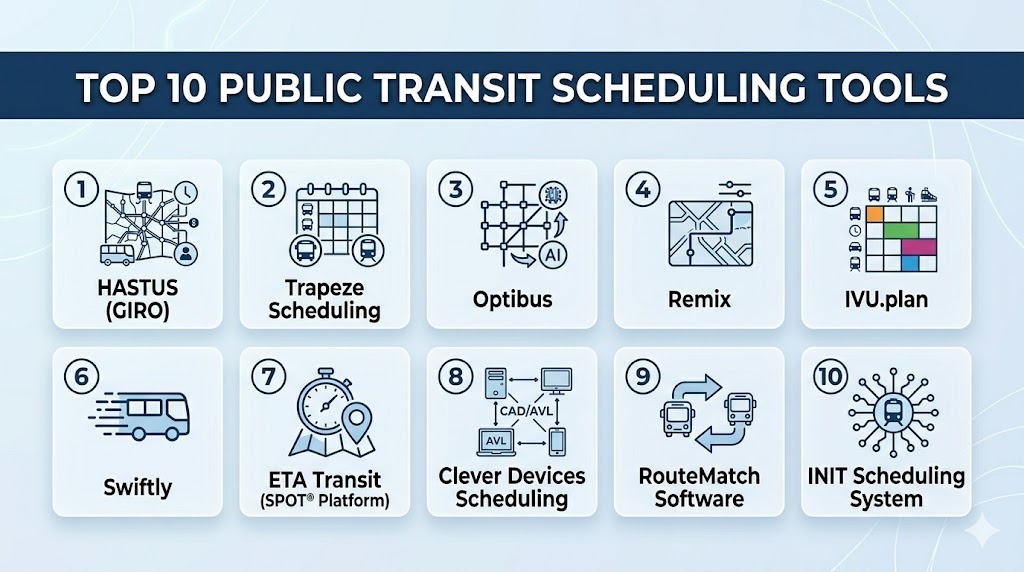
Top 10 Public Transit Scheduling Tools
#1 — Optibus
Short description: A cloud-native platform that uses AI and high-speed optimization to design and manage transit schedules. It is widely used by modern transit agencies for fast, data-driven planning. It supports both vehicle and crew scheduling workflows.
Key Features
- AI-powered scheduling optimization
- Vehicle blocking and crew rostering
- Scenario planning and comparison
- EV fleet and charging scheduling
- Real-time collaboration tools
- Performance analytics
Pros
- Fast and modern interface
- Strong optimization capabilities
Cons
- Premium pricing
- Requires configuration
Platforms / Deployment
Web
Cloud
Security & Compliance
SSO, MFA, RBAC, Encryption, ISO 27001
Integrations & Ecosystem
Supports modern integrations.
- APIs
- Transit data standards (GTFS)
- Analytics systems
Support & Community
Enterprise support with onboarding and training.
#2 — HASTUS (GIRO)
Short description: An enterprise-grade scheduling system used by large transit agencies worldwide. It is known for its powerful optimization engine and ability to handle complex transit networks.
Key Features
- Advanced timetable scheduling
- Crew and duty management
- Optimization algorithms
- Scenario modeling
- Multi-modal support
- Integration with operations systems
Pros
- Highly powerful and scalable
- Proven in large networks
Cons
- Steep learning curve
- High implementation cost
Platforms / Deployment
Web / Windows
Cloud / On-premise
Security & Compliance
SSO, RBAC, encryption, GDPR
Integrations & Ecosystem
Deep integration capabilities.
- Real-time operations systems
- ERP platforms
- APIs
Support & Community
Strong enterprise support and global user base.
#3 — Trapeze Scheduling
Short description: A comprehensive scheduling and planning solution for transit agencies. It is part of a larger ecosystem covering operations, passenger information, and fleet management.
Key Features
- Route and timetable planning
- Crew scheduling and rostering
- GIS-based tools
- GTFS data management
- Reporting and analytics
Pros
- Strong ecosystem integration
- Proven reliability
Cons
- Complex system
- Requires training
Platforms / Deployment
Web / Desktop
Cloud / On-premise
Security & Compliance
SOC-aligned security, encryption
Integrations & Ecosystem
Broad integrations.
- Passenger information systems
- Fleet management
- APIs
Support & Community
Large global support network.
#4 — Remix
Short description: A visual and collaborative planning tool that helps transit planners design routes and schedules quickly. It is widely used for early-stage planning and stakeholder collaboration.
Key Features
- Visual route design
- Scenario comparison
- Demand analysis
- Collaboration tools
- GIS integration
Pros
- Easy to use
- Excellent visualization
Cons
- Limited deep optimization
- Not ideal for full operations
Platforms / Deployment
Web
Cloud
Security & Compliance
GDPR support
Integrations & Ecosystem
Supports integrations.
- GIS systems
- APIs
Support & Community
Active user community and documentation.
#5 — IVU.plan
Short description: A modular planning and scheduling tool used for bus and rail operations. It offers strong optimization and integration with broader transit systems.
Key Features
- Timetable planning
- Crew scheduling
- Vehicle management
- Optimization tools
- Reporting dashboards
Pros
- Flexible and modular
- Strong planning capabilities
Cons
- Requires setup effort
- Learning curve
Platforms / Deployment
Web
Cloud
Security & Compliance
Not publicly stated
Integrations & Ecosystem
Supports integrations.
- ERP systems
- APIs
Support & Community
Enterprise support.
#6 — Swiftly
Short description: A data-driven platform focused on improving schedule accuracy and on-time performance. It uses real-time and historical data to optimize transit schedules.
Key Features
- Performance analytics
- Real-time tracking
- Schedule validation
- Reporting tools
- Data visualization
Pros
- Strong analytics
- Improves punctuality
Cons
- Limited full scheduling depth
- Focused on performance
Platforms / Deployment
Web
Cloud
Security & Compliance
Not publicly stated
Integrations & Ecosystem
Supports integrations.
- AVL systems
- APIs
Support & Community
Good documentation and support.
#7 — RouteMatch Scheduling
Short description: A scheduling platform designed for fixed-route and demand-response transit services. It is suitable for agencies managing diverse transport models.
Key Features
- Fixed-route scheduling
- Demand-response optimization
- Driver assignment
- Compliance tracking
- Reporting tools
Pros
- Supports flexible transit models
- Good compliance features
Cons
- Interface may vary
- Customization required
Platforms / Deployment
Web
Cloud
Security & Compliance
Not publicly stated
Integrations & Ecosystem
Supports integrations.
- APIs
- Transit systems
Support & Community
Standard enterprise support.
#8 — OpenTripPlanner
Short description: An open-source platform for transit scheduling and routing. It is widely used for journey planning and custom deployments.
Key Features
- Multi-modal routing
- GTFS integration
- Customizable algorithms
- Open-source flexibility
- Journey planning
Pros
- Highly customizable
- No licensing cost
Cons
- Requires technical expertise
- Limited out-of-box support
Platforms / Deployment
Web
Self-hosted
Security & Compliance
Varies / N/A
Integrations & Ecosystem
Strong open ecosystem.
- APIs
- Custom integrations
Support & Community
Active open-source community.
#9 — PTV Visum
Short description: A strategic planning and scheduling tool used for large-scale transport modeling and simulation. It is widely used by consultants and transit planners.
Key Features
- Network modeling
- Demand forecasting
- Scenario simulation
- Performance analysis
- Multi-modal planning
Pros
- Strong strategic planning
- Detailed simulations
Cons
- Not for real-time operations
- Complex tool
Platforms / Deployment
Windows
Desktop / Cloud
Security & Compliance
Enterprise standards
Integrations & Ecosystem
Supports integrations.
- Data platforms
- APIs
Support & Community
Professional support and training.
#10 — Moovit Transit Suite
Short description: A data-driven platform that combines scheduling, analytics, and real-time passenger insights. It is widely used for smart mobility solutions.
Key Features
- Data-driven scheduling
- Real-time tracking
- Passenger analytics
- On-demand transit support
- Mobility dashboards
Pros
- Strong data insights
- Global reach
Cons
- Limited deep rostering features
- Focus on analytics
Platforms / Deployment
Web / Mobile
Cloud
Security & Compliance
Not publicly stated
Integrations & Ecosystem
Supports integrations.
- Mobile apps
- APIs
Support & Community
Large global ecosystem.
Comparison Table (Top 10)
| Tool Name | Best For | Platform(s) Supported | Deployment | Standout Feature | Public Rating |
|---|---|---|---|---|---|
| Optibus | Modern agencies | Web | Cloud | AI optimization | N/A |
| HASTUS | Large networks | Web, Desktop | Hybrid | Deep optimization | N/A |
| Trapeze | Enterprise | Web, Desktop | Hybrid | Full ecosystem | N/A |
| Remix | Planning teams | Web | Cloud | Visual design | N/A |
| IVU.plan | Modular ops | Web | Cloud | Flexible modules | N/A |
| Swiftly | Performance | Web | Cloud | Real-time analytics | N/A |
| RouteMatch | Flexible transit | Web | Cloud | Demand-response | N/A |
| OpenTripPlanner | Developers | Web | Self-hosted | Open-source | N/A |
| PTV Visum | Strategic planning | Desktop | Hybrid | Simulation | N/A |
| Moovit | Smart mobility | Web, Mobile | Cloud | Data insights | N/A |
Evaluation & Scoring of Public Transit Scheduling Tools
| Tool Name | Core (25%) | Ease (15%) | Integrations (15%) | Security (10%) | Performance (10%) | Support (10%) | Value (15%) | Weighted Total |
|---|---|---|---|---|---|---|---|---|
| Optibus | 9 | 9 | 8 | 8 | 9 | 8 | 7 | 8.5 |
| HASTUS | 10 | 6 | 9 | 9 | 9 | 9 | 6 | 8.6 |
| Trapeze | 9 | 7 | 9 | 8 | 9 | 9 | 6 | 8.4 |
| Remix | 7 | 9 | 7 | 7 | 8 | 7 | 8 | 7.7 |
| IVU.plan | 8 | 7 | 8 | 7 | 8 | 8 | 7 | 7.8 |
| Swiftly | 7 | 8 | 7 | 7 | 8 | 7 | 8 | 7.5 |
| RouteMatch | 7 | 7 | 7 | 7 | 7 | 7 | 8 | 7.2 |
| OpenTripPlanner | 7 | 6 | 8 | 6 | 7 | 6 | 9 | 7.1 |
| PTV Visum | 8 | 6 | 7 | 7 | 8 | 7 | 6 | 7.2 |
| Moovit | 7 | 8 | 7 | 7 | 8 | 7 | 8 | 7.5 |
How to interpret scores:
- Higher scores indicate stronger overall capability
- Enterprise tools excel in core features and integrations
- Cloud tools score higher in usability and speed
- Open-source tools provide better cost efficiency
Which Public Transit Scheduling Tools Is Right for You?
Solo / Freelancer
Remix or OpenTripPlanner for lightweight planning and flexibility.
SMB
Swiftly, RouteMatch for cost-effective and easy-to-use solutions.
Mid-Market
Optibus, IVU.plan for scalable and modern scheduling.
Enterprise
HASTUS, Trapeze for large and complex transit systems.
Budget vs Premium
- Budget: OpenTripPlanner
- Premium: HASTUS, Optibus
Feature Depth vs Ease of Use
- Feature-rich: HASTUS
- Easy-to-use: Remix
Integrations & Scalability
- Strong integrations: Trapeze, Optibus
Security & Compliance Needs
- Enterprise-grade tools recommended for large agencies
Frequently Asked Questions (FAQs)
Q1: What are public transit scheduling tools?
They are software systems used to plan and manage transit timetables, routes, and driver assignments.
Q2: Who uses these tools?
Transit agencies, metro operators, and private transport companies.
Q3: Are these tools cloud-based?
Most modern tools are cloud-based, though some legacy systems support hybrid deployment.
Q4: Do they support real-time updates?
Yes, many tools integrate real-time data for dynamic scheduling.
Q5: Can they manage driver shifts?
Yes, crew scheduling and labor compliance are core features.
Q6: Do they improve efficiency?
Yes, they optimize routes and reduce operational costs.
Q7: Are they scalable?
Yes, most tools support both small and large transit networks.
Q8: Do they integrate with GPS systems?
Yes, integration with AVL and GPS systems is common.
Q9: What are common challenges?
Implementation complexity and training requirements.
Q10: Can small agencies use them?
Yes, some tools are designed specifically for smaller operators.
Conclusion
Public Transit Scheduling Tools are essential for building efficient, reliable, and scalable transportation systems. They help transit agencies manage complex operations by combining scheduling, optimization, and real-time data into one platform. The right tool depends on your organization’s size, complexity, and goals. Large transit networks require enterprise-grade solutions with deep optimization, while smaller agencies benefit from simpler and more affordable tools. Modern platforms are evolving with AI, cloud computing, and real-time analytics, enabling smarter and more adaptive transit systems.