Introduction
Computerized Maintenance Management Systems (CMMS) are software platforms designed to help organizations manage maintenance operations, assets, and work orders efficiently. They centralize maintenance data, automate workflows, and provide insights that improve equipment reliability and reduce downtime.
In modern operations, relying on manual maintenance tracking leads to inefficiencies, unexpected breakdowns, and increased costs. CMMS tools bring structure, automation, and visibility into maintenance processes—making them essential for industries like manufacturing, healthcare, logistics, and facilities management.
Real-world use cases
- Preventive maintenance scheduling – Reduce equipment failure and downtime
- Work order management – Track and manage maintenance tasks efficiently
- Asset lifecycle management – Monitor performance and maintenance history
- Inventory management – Track spare parts and reduce shortages
- Compliance tracking – Maintain safety and regulatory standards
What buyers should evaluate
- Ease of use and technician adoption
- Work order and asset management capabilities
- Mobile accessibility for field teams
- Integration with ERP and IoT systems
- Reporting and analytics features
- Scalability across locations
- Customization and workflow flexibility
- Security and data protection
- Total cost of ownership
Best for: Maintenance teams, facility managers, operations leaders, and organizations managing physical assets across industries.
Not ideal for: Very small teams with minimal equipment or organizations without structured maintenance workflows.
Key Trends in Computerized Maintenance Management Systems
- AI-powered predictive maintenance for early issue detection
- IoT integration for real-time asset monitoring
- Mobile-first CMMS platforms for field technicians
- Cloud-based deployments replacing legacy systems
- Automation in maintenance workflows
- Digital twin integration for asset visualization
- Advanced analytics and reporting dashboards
- Integration with ERP and supply chain systems
- Compliance and audit automation
- Low-code customization for workflows
How We Selected These Tools (Methodology)
- Strong industry adoption and reputation
- Comprehensive maintenance and asset management features
- Reliability and system performance
- Security and compliance capabilities
- Integration ecosystem strength
- Suitability across SMB, mid-market, and enterprise
- Ease of implementation and usability
- Value for cost and scalability
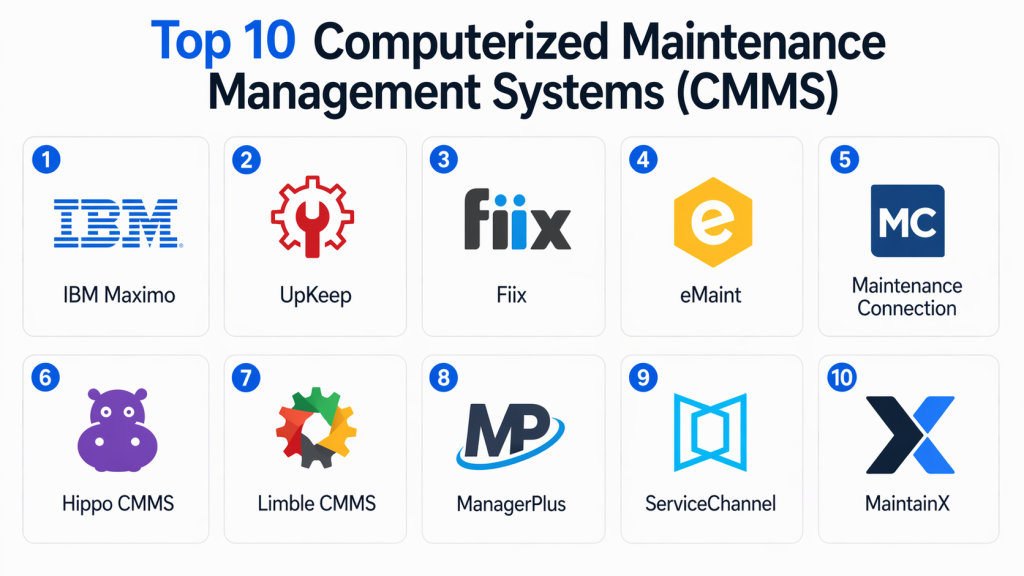
Top 10 Computerized Maintenance Management Systems (CMMS)
#1 — IBM Maximo
Short description: IBM Maximo is an enterprise-grade CMMS and asset management platform designed for large-scale operations. It provides advanced analytics, automation, and predictive maintenance capabilities.
Key Features
- Asset lifecycle management
- Predictive maintenance
- Work order automation
- IoT integration
- Advanced analytics
- Compliance tracking
Pros
- Highly scalable
- Strong analytics capabilities
Cons
- Complex setup
- Expensive for smaller teams
Platforms / Deployment
Cloud / On-premise / Hybrid
Security & Compliance
RBAC, encryption (Not publicly stated fully)
Integrations & Ecosystem
Integrates with enterprise systems and IoT platforms.
- ERP systems
- IoT devices
- APIs
Support & Community
Enterprise-grade support with extensive documentation.
#2 — UpKeep
Short description: UpKeep is a mobile-first CMMS designed for maintenance teams that need quick and efficient work order management and asset tracking.
Key Features
- Work order management
- Preventive maintenance
- Asset tracking
- Mobile app
- Reporting tools
Pros
- Easy to use
- Strong mobile experience
Cons
- Limited advanced features
- Not ideal for large enterprises
Platforms / Deployment
Web / iOS / Android / Cloud
Security & Compliance
Not publicly stated
Integrations & Ecosystem
- APIs
- ERP integrations
- Maintenance tools
Support & Community
Good onboarding and customer support.
#3 — Fiix
Short description: Fiix is a cloud-based CMMS that helps organizations manage maintenance operations with automation and reporting capabilities.
Key Features
- Preventive maintenance scheduling
- Asset tracking
- Workflow automation
- Reporting dashboards
- Mobile access
Pros
- User-friendly interface
- Scalable for mid-market
Cons
- Limited customization
- Integration limitations
Platforms / Deployment
Cloud
Security & Compliance
Not publicly stated
Integrations & Ecosystem
- APIs
- ERP systems
- IoT tools
Support & Community
Reliable documentation and support.
#4 — eMaint
Short description: eMaint provides flexible maintenance management tools with strong reporting and customization capabilities.
Key Features
- Work order management
- Preventive maintenance
- Asset tracking
- Custom reporting
- Workflow automation
Pros
- Highly customizable
- Strong reporting
Cons
- Learning curve
- UI can feel outdated
Platforms / Deployment
Cloud
Security & Compliance
Not publicly stated
Integrations & Ecosystem
- APIs
- ERP tools
- Data systems
Support & Community
Good support and training resources.
#5 — Maintenance Connection
Short description: Maintenance Connection is a CMMS platform that offers asset tracking and maintenance automation with strong reporting features.
Key Features
- Asset management
- Work order tracking
- Preventive maintenance
- Reporting dashboards
- Automation tools
Pros
- Strong reporting
- Reliable performance
Cons
- UI needs improvement
- Limited flexibility
Platforms / Deployment
Cloud / On-premise
Security & Compliance
Not publicly stated
Integrations & Ecosystem
- ERP systems
- APIs
- Business tools
Support & Community
Reliable support and training.
#6 — Hippo CMMS
Short description: Hippo CMMS is a simple and affordable solution for small businesses managing maintenance operations.
Key Features
- Work order tracking
- Asset management
- Preventive maintenance
- Reporting tools
- Easy setup
Pros
- Easy to use
- Budget-friendly
Cons
- Limited advanced features
- Not suitable for enterprises
Platforms / Deployment
Cloud
Security & Compliance
Not publicly stated
Integrations & Ecosystem
- Basic integrations
- APIs
Support & Community
Good customer support.
#7 — Limble CMMS
Short description: Limble CMMS is a modern, user-friendly maintenance platform designed to simplify work order management and asset tracking.
Key Features
- Work order management
- Preventive maintenance
- Asset tracking
- Mobile access
- Reporting tools
Pros
- Intuitive interface
- Quick deployment
Cons
- Limited enterprise features
- Fewer integrations
Platforms / Deployment
Cloud
Security & Compliance
Not publicly stated
Integrations & Ecosystem
- APIs
- Maintenance tools
Support & Community
Strong onboarding and support.
#8 — ManagerPlus
Short description: ManagerPlus provides maintenance management and asset tracking tools for organizations looking to streamline operations.
Key Features
- Asset tracking
- Work order management
- Preventive maintenance
- Reporting dashboards
- Inventory management
Pros
- Comprehensive features
- Good for mid-market
Cons
- Interface complexity
- Learning curve
Platforms / Deployment
Cloud
Security & Compliance
Not publicly stated
Integrations & Ecosystem
- ERP systems
- APIs
Support & Community
Reliable support and training.
#9 — ServiceChannel
Short description: ServiceChannel focuses on facilities maintenance and contractor management, helping organizations manage external service providers.
Key Features
- Vendor management
- Work order tracking
- Analytics dashboards
- Invoice management
- Compliance tracking
Pros
- Strong vendor management
- Enterprise scalability
Cons
- Complex pricing
- Requires onboarding
Platforms / Deployment
Cloud
Security & Compliance
Not publicly stated
Integrations & Ecosystem
- ERP systems
- Vendor tools
- APIs
Support & Community
Enterprise support and onboarding.
#10 — Dude Solutions (Brightly)
Short description: Brightly (formerly Dude Solutions) offers CMMS tools focused on maintenance, asset tracking, and operations management.
Key Features
- Work order management
- Asset tracking
- Preventive maintenance
- Reporting tools
- Compliance tracking
Pros
- Easy to use
- Strong SMB focus
Cons
- Limited advanced features
- Scalability limitations
Platforms / Deployment
Cloud
Security & Compliance
Not publicly stated
Integrations & Ecosystem
- APIs
- Business tools
Support & Community
Good support and onboarding.
Comparison Table (Top 10)
| Tool Name | Best For | Platform(s) Supported | Deployment | Standout Feature | Public Rating |
|---|---|---|---|---|---|
| IBM Maximo | Enterprise CMMS | Web | Hybrid | Predictive maintenance | N/A |
| UpKeep | SMB teams | Web/Mobile | Cloud | Mobile-first CMMS | N/A |
| Fiix | Mid-market | Web | Cloud | Workflow automation | N/A |
| eMaint | Custom workflows | Web | Cloud | Reporting | N/A |
| Maintenance Connection | Asset mgmt | Web | Hybrid | Automation | N/A |
| Hippo CMMS | Small teams | Web | Cloud | Easy setup | N/A |
| Limble CMMS | Modern UI | Web | Cloud | Ease of use | N/A |
| ManagerPlus | Mid-market | Web | Cloud | Inventory mgmt | N/A |
| ServiceChannel | Vendor mgmt | Web | Cloud | Contractor mgmt | N/A |
| Brightly | SMB | Web | Cloud | Compliance tools | N/A |
Evaluation & Scoring of Computerized Maintenance Management Systems
| Tool Name | Core (25%) | Ease (15%) | Integrations (15%) | Security (10%) | Performance (10%) | Support (10%) | Value (15%) | Weighted Total |
|---|---|---|---|---|---|---|---|---|
| IBM Maximo | 9 | 6 | 9 | 8 | 9 | 9 | 6 | 8.2 |
| UpKeep | 7 | 9 | 7 | 6 | 7 | 8 | 9 | 7.8 |
| Fiix | 7 | 8 | 7 | 6 | 7 | 7 | 8 | 7.5 |
| eMaint | 8 | 7 | 7 | 6 | 7 | 8 | 7 | 7.5 |
| Maintenance Connection | 8 | 7 | 7 | 6 | 8 | 7 | 7 | 7.5 |
| Hippo CMMS | 6 | 9 | 6 | 6 | 7 | 7 | 9 | 7.3 |
| Limble CMMS | 7 | 9 | 6 | 6 | 7 | 7 | 8 | 7.4 |
| ManagerPlus | 7 | 7 | 7 | 6 | 7 | 7 | 7 | 7.0 |
| ServiceChannel | 8 | 7 | 8 | 7 | 8 | 8 | 6 | 7.7 |
| Brightly | 7 | 8 | 6 | 6 | 7 | 7 | 8 | 7.3 |
How to interpret scores:
These scores provide a comparative benchmark across tools. Higher scores indicate stronger overall capability, but the best tool depends on your specific needs. Enterprise tools score higher in features, while SMB tools excel in ease of use and affordability.
Which Computerized Maintenance Management Systems Tool Is Right for You?
Solo / Freelancer
Not required. Simple tools are sufficient.
SMB
UpKeep, Hippo CMMS, and Limble CMMS are ideal.
Mid-Market
Fiix, eMaint, and ManagerPlus offer balanced features.
Enterprise
IBM Maximo and ServiceChannel are best choices.
Budget vs Premium
- Budget: Hippo CMMS, Limble
- Premium: IBM Maximo
Feature Depth vs Ease of Use
- Advanced: IBM Maximo
- Easy: UpKeep
Integrations & Scalability
Choose API-driven platforms like IBM Maximo.
Security & Compliance Needs
Enterprises should prioritize compliance-ready tools.
Frequently Asked Questions (FAQs)
1. What is a CMMS?
A CMMS is software that helps manage maintenance operations, assets, and work orders. It centralizes data and improves efficiency.
2. What industries use CMMS?
Manufacturing, healthcare, logistics, and facilities management commonly use CMMS tools.
3. What are the benefits of CMMS?
Improved asset performance, reduced downtime, and better maintenance planning.
4. Is CMMS suitable for small businesses?
Yes, especially simple and affordable tools.
5. Does CMMS support mobile access?
Most modern CMMS tools provide mobile apps for technicians.
6. How long does implementation take?
From a few days to several weeks depending on complexity.
7. Can CMMS integrate with ERP systems?
Yes, most tools support ERP and IoT integrations.
8. What are common challenges?
Adoption issues, data migration, and complexity.
9. Is cloud CMMS better?
Cloud solutions are easier to deploy and scale.
10. Can CMMS reduce costs?
Yes, by improving maintenance efficiency and reducing downtime.
Conclusion
Computerized Maintenance Management Systems have become essential for organizations aiming to improve maintenance efficiency and reduce operational risks. By centralizing maintenance data, automating workflows, and providing real-time insights, CMMS tools enable better decision-making and asset performance. However, choosing the right CMMS depends on your organization’s size, complexity, and operational goals. Enterprise platforms offer deep analytics and scalability, while smaller tools focus on simplicity and affordability.Before selecting a tool, it is important to evaluate real-world usability, integration capabilities, and long-term value. Running a pilot can help validate whether the system meets your requirements.