Introduction
CRM Platforms Customer Relationship Management platforms help businesses manage customer interactions, sales pipelines, marketing campaigns, and support processes in a centralized system. In simple terms, CRM tools act as a single source of truth for customer data, enabling teams to build stronger relationships and drive revenue growth.
As businesses scale and customer expectations increase, managing interactions across multiple channels becomes challenging. CRM platforms solve this by offering automation, real-time insights, omnichannel communication, and AI-driven recommendations, helping organizations deliver personalized experiences and improve efficiency.
Common use cases include:
- Lead and contact management
- Sales pipeline tracking
- Customer support and ticketing
- Marketing automation and campaigns
- Customer analytics and reporting
Key evaluation criteria:
- Contact and lead management capabilities
- Automation and workflow features
- Integration with business tools
- Reporting and analytics
- AI-driven insights
- Scalability for growing teams
- Security and compliance
- Pricing and ROI
Best for: Sales teams, marketing teams, customer support teams, startups, SMBs, and enterprises managing customer relationships.
Not ideal for: Businesses with minimal customer interaction or very simple sales processes.
Key Trends in CRM Platforms
- AI-powered sales and marketing automation
- Omnichannel customer engagement across email, chat, and social media
- Cloud-based CRM platforms becoming standard
- Real-time analytics and predictive insights
- Integration with marketing, support, and finance tools
- No-code and low-code customization capabilities
- Mobile-first CRM applications for field teams
- Customer data platforms integrated with CRM
- Personalization and customer journey tracking
- Automation of repetitive customer interactions
How We Selected These Tools
- Market adoption and global popularity
- Coverage of CRM features across sales, marketing, and support
- Automation and AI capabilities
- Integration ecosystem
- Ease of use and onboarding
- Scalability for different business sizes
- Security and compliance readiness
- Customer support and reliability
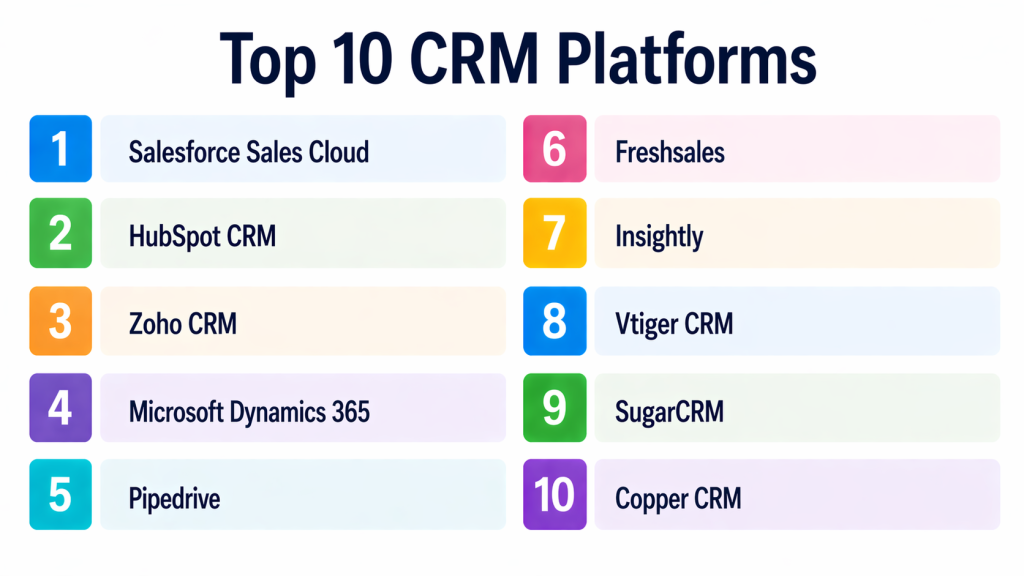
Top 10 CRM Platforms
1 — Salesforce Sales Cloud
Short description:
Salesforce Sales Cloud is one of the most powerful and widely used CRM platforms globally. It offers advanced sales automation, AI insights, and deep customization. It is designed for enterprises and large teams. It provides a complete ecosystem for managing customer relationships.
Key Features
- Lead and opportunity management
- AI-driven insights
- Workflow automation
- Reporting and dashboards
- Customization
Pros
- Highly scalable
- Extensive ecosystem
Cons
- Expensive
- Complex setup
Platforms / Deployment
Web, Mobile
Cloud
Security & Compliance
Encryption, SSO, audit logs
Integrations & Ecosystem
Salesforce integrates with a wide range of tools and services.
- CRM ecosystem
- Marketing tools
- APIs
Support & Community
Large global community and enterprise support.
2 — HubSpot CRM
Short description:
HubSpot CRM is a user-friendly platform designed for SMBs and growing businesses. It offers sales, marketing, and customer service tools in one system. It is easy to use and scalable. It provides a free entry-level option.
Key Features
- Contact management
- Sales automation
- Marketing tools
- Reporting
- Workflow automation
Pros
- Easy to use
- Free plan available
Cons
- Limited advanced features
- Cost increases with scale
Platforms / Deployment
Web, Mobile
Cloud
Security & Compliance
Encryption, access control
Integrations & Ecosystem
- Marketing tools
- CRM integrations
- APIs
Support & Community
Strong support and community.
3 — Zoho CRM
Short description:
Zoho CRM is a flexible and cost-effective platform for SMBs and mid-market businesses. It offers automation, analytics, and customization. It supports multiple communication channels. It is widely adopted.
Key Features
- Lead management
- Workflow automation
- AI assistant
- Reporting
- Omnichannel support
Pros
- Affordable
- Highly customizable
Cons
- Learning curve
- UI complexity
Platforms / Deployment
Web, Mobile
Cloud
Security & Compliance
Encryption, access control
Integrations & Ecosystem
- Zoho ecosystem
- Third-party apps
Support & Community
Good support.
4 — Microsoft Dynamics 365
Short description:
Microsoft Dynamics 365 is an enterprise CRM platform integrated with Microsoft ecosystem. It offers sales, marketing, and service automation. It is ideal for large organizations. It provides strong analytics and integration capabilities.
Key Features
- Sales automation
- Customer insights
- Reporting
- Workflow automation
- Integration with Microsoft tools
Pros
- Strong Microsoft integration
- Enterprise-grade capabilities
Cons
- Expensive
- Complex implementation
Platforms / Deployment
Web, Mobile
Cloud
Security & Compliance
Encryption, compliance
Integrations & Ecosystem
- Office tools
- Analytics platforms
- APIs
Support & Community
Enterprise support.
5 — Pipedrive
Short description:
Pipedrive is a simple and visual CRM platform designed for small businesses. It focuses on pipeline management and sales productivity. It is easy to use and quick to implement. It is ideal for SMBs.
Key Features
- Visual pipeline
- Automation
- Reporting
- Email tracking
- AI assistant
Pros
- Very intuitive
- Easy setup
Cons
- Limited enterprise features
- Less customization
Platforms / Deployment
Web, Mobile
Cloud
Security & Compliance
Encryption, access control
Integrations & Ecosystem
- CRM tools
- APIs
Support & Community
Good support.
6 — Freshsales
Short description:
Freshsales is a modern CRM platform offering sales automation and communication tools. It is designed for SMBs. It combines CRM with engagement features. It is easy to use and cost-effective.
Key Features
- Lead management
- Automation
- Communication tools
- AI insights
- Reporting
Pros
- All-in-one functionality
- Affordable
Cons
- Limited enterprise features
- Customization limits
Platforms / Deployment
Web, Mobile
Cloud
Security & Compliance
Encryption, access control
Integrations & Ecosystem
- CRM tools
- Communication platforms
Support & Community
Good support.
7 — Insightly
Short description:
Insightly is a CRM platform focused on relationship management and project tracking. It is suitable for SMBs. It offers automation and reporting features. It is easy to use and practical.
Key Features
- Contact management
- Project tracking
- Automation
- Reporting
- Integration
Pros
- Good for project-based teams
- Easy to use
Cons
- Limited advanced features
- Smaller ecosystem
Platforms / Deployment
Web, Mobile
Cloud
Security & Compliance
Encryption, access control
Integrations & Ecosystem
- CRM tools
- APIs
Support & Community
Good support.
8 — Vtiger CRM
Short description:
Vtiger CRM is a flexible platform offering sales, marketing, and support features. It is suitable for SMBs. It provides automation and customization options. It is affordable and adaptable.
Key Features
- Lead management
- Automation
- Reporting
- Customer support
- Marketing tools
Pros
- Affordable
- Flexible
Cons
- UI needs improvement
- Limited enterprise features
Platforms / Deployment
Web
Cloud / Self-hosted
Security & Compliance
Encryption, access control
Integrations & Ecosystem
- CRM tools
- APIs
Support & Community
Good support.
9 — SugarCRM
Short description:
SugarCRM is a CRM platform designed for enterprises and mid-market organizations. It offers automation, analytics, and customization. It supports complex workflows. It is scalable and powerful.
Key Features
- Sales automation
- Reporting
- Workflow automation
- Analytics
- Customization
Pros
- Highly customizable
- Scalable
Cons
- Complex setup
- Pricing varies
Platforms / Deployment
Web
Cloud / On-premise
Security & Compliance
Encryption, compliance
Integrations & Ecosystem
- ERP systems
- APIs
Support & Community
Enterprise support.
10 — Copper CRM
Short description:
Copper CRM is designed for Google Workspace users and integrates seamlessly with Gmail and related tools. It is simple and user-friendly. It is ideal for small teams. It focuses on ease of adoption.
Key Features
- Contact management
- Automation
- Email integration
- Reporting
- Pipeline tracking
Pros
- Google integration
- Easy to use
Cons
- Limited advanced features
- Not suitable for large enterprises
Platforms / Deployment
Web
Cloud
Security & Compliance
Encryption, access control
Integrations & Ecosystem
- Google Workspace
- APIs
Support & Community
Good support.
Comparison Table
| Tool Name | Best For | Platforms Supported | Deployment | Standout Feature | Public Rating |
|---|---|---|---|---|---|
| Salesforce | Enterprise | Web, Mobile | Cloud | AI automation | N/A |
| HubSpot | SMB | Web, Mobile | Cloud | Ease of use | N/A |
| Zoho CRM | SMB | Web, Mobile | Cloud | Customization | N/A |
| Microsoft Dynamics | Enterprise | Web, Mobile | Cloud | Microsoft integration | N/A |
| Pipedrive | SMB | Web, Mobile | Cloud | Visual pipeline | N/A |
| Freshsales | SMB | Web, Mobile | Cloud | Built-in tools | N/A |
| Insightly | SMB | Web, Mobile | Cloud | Project tracking | N/A |
| Vtiger | SMB | Web | Cloud | Affordability | N/A |
| SugarCRM | Enterprise | Web | Hybrid | Customization | N/A |
| Copper | SMB | Web | Cloud | Google integration | N/A |
Evaluation and Scoring of CRM Platforms
| Tool Name | Core 25% | Ease 15% | Integrations 15% | Security 10% | Performance 10% | Support 10% | Value 15% | Weighted Total |
|---|---|---|---|---|---|---|---|---|
| Salesforce | 9 | 6 | 10 | 9 | 9 | 9 | 6 | 8.5 |
| HubSpot | 8 | 9 | 9 | 8 | 8 | 8 | 9 | 8.5 |
| Zoho CRM | 8 | 8 | 8 | 8 | 8 | 8 | 9 | 8.2 |
| Microsoft | 9 | 6 | 9 | 9 | 9 | 8 | 6 | 8.2 |
| Pipedrive | 7 | 9 | 7 | 8 | 8 | 8 | 9 | 8.0 |
| Freshsales | 8 | 8 | 8 | 8 | 8 | 8 | 9 | 8.1 |
| Insightly | 7 | 8 | 7 | 8 | 7 | 7 | 8 | 7.6 |
| Vtiger | 7 | 8 | 7 | 7 | 7 | 7 | 9 | 7.7 |
| SugarCRM | 8 | 7 | 8 | 8 | 8 | 8 | 7 | 7.9 |
| Copper | 7 | 9 | 7 | 8 | 7 | 7 | 8 | 7.7 |
These scores are comparative and help evaluate tools across multiple criteria.
Which CRM Platform Is Right for You
Solo / Freelancer
HubSpot and Pipedrive are ideal.
SMB
Zoho CRM, Freshsales, and HubSpot are best.
Mid-Market
Pipedrive and Insightly offer flexibility.
Enterprise
Salesforce, Microsoft Dynamics, and SugarCRM are top choices.
Budget vs Premium
Zoho CRM is budget-friendly, Salesforce is premium.
Feature Depth vs Ease of Use
HubSpot is easy to adopt, while Salesforce provides deeper functionality.
Integrations and Scalability
Salesforce and Microsoft Dynamics excel in large-scale environments.
Security and Compliance Needs
Salesforce and SugarCRM provide strong enterprise-grade security capabilities.
Frequently Asked Questions
1. What is a CRM platform?
CRM platforms help businesses manage customer relationships and interactions. They centralize customer data. They improve communication and efficiency.
2. Why do businesses need CRM?
CRM tools help improve customer engagement and sales performance. They automate workflows. They provide valuable insights for decision-making.
3. Are CRM tools suitable for small businesses?
Yes, many CRM platforms are designed for SMBs. They are easy to use and affordable. They can scale as businesses grow.
4. Do CRM platforms support automation?
Yes, automation is a core feature. It reduces manual tasks. It improves productivity and consistency.
5. Can CRM integrate with other tools?
Yes, integration with marketing, finance, and support tools is common. This ensures seamless workflows. It enhances data accuracy.
6. Are CRM platforms secure?
Most CRM platforms provide encryption and compliance features. Security varies by provider. Businesses should evaluate based on needs.
7. Do CRM tools require training?
Some platforms require training, especially enterprise tools. Others are designed for quick adoption. Support resources are usually available.
8. What are common challenges?
Implementation complexity, cost, and data management are common challenges. Proper planning helps avoid these issues.
9. Can startups use CRM platforms?
Yes, tools like HubSpot and Zoho CRM are ideal for startups. They offer flexibility. They support growth.
10. Which CRM platform is best?
There is no single best CRM platform. It depends on business size, needs, and budget. Testing tools before final selection is recommended.
Conclusion
CRM platforms have become a critical foundation for modern businesses aiming to build stronger customer relationships and drive consistent revenue growth. By centralizing customer data, automating repetitive workflows, and providing actionable insights, these tools enable teams to work more efficiently and deliver better customer experiences. Enterprise solutions such as Salesforce and Microsoft Dynamics offer deep customization and scalability for complex operations, while platforms like Zoho CRM and Freshsales provide a balanced mix of features and usability for growing businesses. For startups and small teams, tools like HubSpot and Pipedrive stand out for their simplicity and quick adoption.