Introduction
Product Information Management (PIM) tools help businesses centralize, manage, enrich, and distribute product data across multiple sales and marketing channels. Instead of managing product information across spreadsheets, ERPs, and eCommerce platforms, PIM systems act as a single source of truth, ensuring consistency, accuracy, and scalability.
As businesses expand across marketplaces, websites, mobile apps, and global regions, managing product data becomes increasingly complex. PIM tools simplify this by enabling teams to standardize product catalogs, automate workflows, and deliver consistent product experiences across all touchpoints.
Common use cases include:
- Managing large product catalogs for eCommerce platforms
- Syndicating product data across marketplaces and channels
- Enriching product content with media, descriptions, and attributes
- Supporting global expansion with multilingual product data
- Improving product data quality and consistency
What buyers should evaluate:
- Data modeling flexibility
- Workflow automation capabilities
- Integration with ERP, CMS, and eCommerce platforms
- Multi-channel publishing support
- User roles and collaboration features
- Scalability for large catalogs
- Localization and translation support
- API and extensibility
- Data governance and validation tools
- Pricing and deployment options
Best for: eCommerce businesses, retailers, manufacturers, distributors, and digital commerce teams managing complex product catalogs.
Not ideal for: Small businesses with limited product SKUs or teams that manage product data manually without multi-channel needs.
Key Trends in Product Information Management (PIM)
- AI-driven product data enrichment and content generation
- Automation of product onboarding and classification
- Integration with headless commerce and composable architectures
- Real-time data synchronization across channels
- Increased focus on data governance and compliance
- Expansion into Product Experience Management (PXM)
- Cloud-native and API-first platforms
- Multi-language and localization automation
- Visual asset management integration
- Marketplace and omnichannel syndication
How We Selected These Tools (Methodology)
- Market adoption across industries
- Feature completeness in product data management
- Flexibility in data modeling and workflows
- Integration capabilities with commerce ecosystems
- Scalability for enterprise and SMB use cases
- Security and governance features
- Ease of use and onboarding
- Vendor support and ecosystem maturity
- Performance and reliability in large catalogs
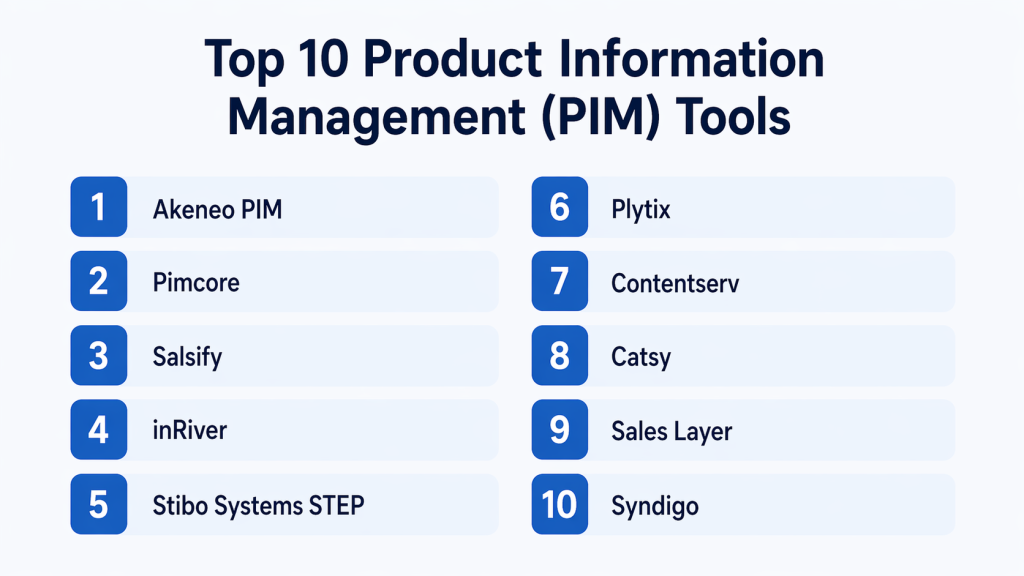
Top 10 Product Information Management (PIM) Tools
#1 — Akeneo PIM
Short description :
Akeneo is one of the most widely used PIM platforms, designed to help businesses centralize and enrich product information. It offers both open-source and enterprise editions. The platform focuses on improving product data quality and collaboration. It is suitable for growing and enterprise eCommerce businesses. Strong ecosystem and scalability make it a popular choice. Ideal for organizations prioritizing product experience.
Key Features
- Product data modeling
- Data enrichment workflows
- Bulk editing capabilities
- Multi-channel distribution
- Data quality insights
- API-first architecture
Pros
- Strong community and ecosystem
- Flexible data modeling
Cons
- Advanced features require enterprise plan
- Setup can be complex
Platforms / Deployment
Cloud / Self-hosted
Security & Compliance
SSO, RBAC (other certifications: Not publicly stated)
Integrations & Ecosystem
Integrates with major commerce and ERP systems.
- Magento
- Shopify
- SAP
- APIs
Support & Community
Large community and strong documentation.
#2 — Pimcore
Short description:
Pimcore is a comprehensive data management platform combining PIM, DAM, and CMS capabilities. It is open-source and highly customizable. Suitable for enterprises needing a unified data platform. Offers strong flexibility in data modeling and workflows. Ideal for organizations with technical teams. Known for its extensibility.
Key Features
- Unified PIM + DAM + CMS
- Workflow automation
- Data governance
- Multi-channel publishing
- Custom data models
Pros
- Highly flexible
- Open-source foundation
Cons
- Requires technical expertise
- Implementation complexity
Platforms / Deployment
Self-hosted / Cloud
Security & Compliance
Varies / N/A
Integrations & Ecosystem
Supports extensive integrations.
- ERP systems
- eCommerce platforms
- APIs
Support & Community
Active community with enterprise support options.
#3 — Salsify
Short description :
Salsify is a cloud-based PIM and product experience management platform. It helps brands manage and distribute product content across digital channels. Known for strong syndication capabilities. Ideal for consumer brands and retailers. Focuses on improving product discoverability and conversions.
Key Features
- Product content syndication
- Digital shelf analytics
- Workflow automation
- Data enrichment
- Channel management
Pros
- Strong marketplace integrations
- User-friendly interface
Cons
- Premium pricing
- Limited customization
Platforms / Deployment
Cloud
Security & Compliance
Not publicly stated
Integrations & Ecosystem
Integrates with marketplaces and retailers.
- Amazon
- Walmart
- APIs
Support & Community
Good support with enterprise focus.
#4 — inRiver
Short description :
inRiver is an enterprise-grade PIM platform focused on product marketing and sales enablement. It helps businesses deliver consistent product experiences across channels. Offers advanced workflow and collaboration features. Suitable for large enterprises. Strong focus on product storytelling.
Key Features
- Product lifecycle management
- Workflow automation
- Multi-channel publishing
- Content enrichment
- Analytics
Pros
- Strong enterprise capabilities
- Advanced workflows
Cons
- Expensive
- Complex setup
Platforms / Deployment
Cloud
Security & Compliance
Not publicly stated
Integrations & Ecosystem
Supports enterprise integrations.
- ERP systems
- eCommerce platforms
- APIs
Support & Community
Enterprise-level support.
#5 — Stibo Systems STEP
Short description :
Stibo Systems offers a robust PIM solution within its master data management platform. Designed for large enterprises with complex data needs. Provides strong governance and scalability. Ideal for global organizations. Focuses on data consistency and compliance.
Key Features
- Master data management
- Data governance
- Multi-domain data support
- Workflow automation
- Scalability
Pros
- Enterprise-grade solution
- Strong data governance
Cons
- High cost
- Implementation complexity
Platforms / Deployment
Cloud / Hybrid
Security & Compliance
Not publicly stated
Integrations & Ecosystem
Supports enterprise integrations.
- SAP
- APIs
Support & Community
Strong enterprise support.
#6 — Plytix
Short description :
Plytix is a user-friendly PIM platform designed for SMBs. It helps teams manage product data and collaborate efficiently. Offers easy onboarding and intuitive interface. Suitable for small to mid-sized eCommerce businesses. Focuses on simplicity and affordability.
Key Features
- Product data management
- Collaboration tools
- Data enrichment
- Export and distribution
- Reporting
Pros
- Easy to use
- Affordable
Cons
- Limited enterprise features
- Scalability constraints
Platforms / Deployment
Cloud
Security & Compliance
Not publicly stated
Integrations & Ecosystem
Supports integrations with eCommerce tools.
- Shopify
- APIs
Support & Community
Good support for SMB users.
#7 — Contentserv
Short description :
Contentserv is a PIM and PXM platform focused on product content optimization. It helps brands deliver consistent product experiences. Offers strong data governance and workflow capabilities. Suitable for mid-market and enterprise businesses. Focuses on content-driven commerce.
Key Features
- Product content management
- Workflow automation
- Data quality tools
- Multi-channel publishing
- Analytics
Pros
- Strong content capabilities
- Scalable
Cons
- Complex implementation
- Pricing varies
Platforms / Deployment
Cloud
Security & Compliance
Not publicly stated
Integrations & Ecosystem
Supports integrations with commerce tools.
- ERP systems
- APIs
Support & Community
Enterprise-level support.
#8 — Catsy
Short description :
Catsy is a PIM and DAM platform designed for brands and distributors. It simplifies product content management and syndication. Offers strong catalog management features. Suitable for mid-sized businesses. Focuses on ease of use.
Key Features
- Product data management
- Digital asset management
- Syndication tools
- Workflow automation
- Catalog publishing
Pros
- Easy to use
- Strong DAM integration
Cons
- Limited scalability
- Fewer integrations
Platforms / Deployment
Cloud
Security & Compliance
Not publicly stated
Integrations & Ecosystem
Basic integrations available.
- APIs
Support & Community
Moderate support.
#9 — Sales Layer
Short description:
Sales Layer is a cloud-based PIM focused on speed and usability. It enables businesses to manage and distribute product data efficiently. Known for fast onboarding and simple interface. Suitable for SMBs and mid-market teams. Focuses on ease of adoption.
Key Features
- Product data management
- Multi-channel distribution
- Data enrichment
- API integration
- Reporting
Pros
- Fast setup
- User-friendly
Cons
- Limited advanced features
- Customization constraints
Platforms / Deployment
Cloud
Security & Compliance
Not publicly stated
Integrations & Ecosystem
Supports integrations with commerce tools.
- Shopify
- APIs
Support & Community
Good support for SMB users.
#10 — Syndigo
Short description :
Syndigo is a PIM and product content syndication platform. It helps brands distribute product data across retailers and marketplaces. Offers strong data synchronization capabilities. Suitable for large brands and retailers. Focuses on product data distribution.
Key Features
- Product data syndication
- Content management
- Data synchronization
- Analytics
- Workflow automation
Pros
- Strong syndication capabilities
- Enterprise-ready
Cons
- Premium pricing
- Limited flexibility
Platforms / Deployment
Cloud
Security & Compliance
Not publicly stated
Integrations & Ecosystem
Supports marketplace integrations.
- Retail platforms
- APIs
Support & Community
Enterprise support available.
Comparison Table (Top 10)
| Tool Name | Best For | Platform(s) Supported | Deployment | Standout Feature | Public Rating |
|---|---|---|---|---|---|
| Akeneo | SMB/Enterprise | Web | Cloud/Self-hosted | Data enrichment | N/A |
| Pimcore | Enterprises | Web | Hybrid | Unified platform | N/A |
| Salsify | Brands | Web | Cloud | Syndication | N/A |
| inRiver | Enterprise | Web | Cloud | Product workflows | N/A |
| Stibo Systems | Enterprise | Web | Hybrid | Data governance | N/A |
| Plytix | SMB | Web | Cloud | Ease of use | N/A |
| Contentserv | Mid-market | Web | Cloud | Content optimization | N/A |
| Catsy | SMB | Web | Cloud | DAM integration | N/A |
| Sales Layer | SMB | Web | Cloud | Fast onboarding | N/A |
| Syndigo | Enterprise | Web | Cloud | Data syndication | N/A |
Evaluation & Scoring of Product Information Management (PIM) Tools
| Tool Name | Core | Ease | Integrations | Security | Performance | Support | Value | Weighted Total |
|---|---|---|---|---|---|---|---|---|
| Akeneo | 9 | 8 | 9 | 8 | 9 | 9 | 8 | 8.6 |
| Pimcore | 9 | 6 | 9 | 7 | 8 | 7 | 8 | 8.1 |
| Salsify | 8 | 8 | 8 | 7 | 8 | 8 | 7 | 7.9 |
| inRiver | 9 | 7 | 8 | 8 | 9 | 8 | 7 | 8.2 |
| Stibo Systems | 9 | 6 | 8 | 9 | 9 | 8 | 6 | 8.0 |
| Plytix | 7 | 9 | 7 | 6 | 7 | 8 | 9 | 7.7 |
| Contentserv | 8 | 7 | 8 | 7 | 8 | 8 | 7 | 7.8 |
| Catsy | 7 | 8 | 6 | 6 | 7 | 7 | 8 | 7.2 |
| Sales Layer | 7 | 9 | 7 | 6 | 7 | 7 | 8 | 7.4 |
| Syndigo | 8 | 7 | 9 | 7 | 8 | 8 | 7 | 7.9 |
How to interpret scores:
These scores are comparative and highlight strengths across features, usability, and value. Enterprise tools score higher in scalability and governance, while SMB-focused tools excel in ease of use and affordability. Choose based on your organization’s needs, not just total score.
Which Product Information Management (PIM) Tools Is Right for You?
Solo / Freelancer
Not typically required unless managing multiple SKUs.
SMB
Plytix or Sales Layer are ideal for simplicity and cost-effectiveness.
Mid-Market
Contentserv or Salsify provide balanced features and scalability.
Enterprise
Akeneo, Pimcore, and Stibo Systems are strong choices.
Budget vs Premium
Budget tools focus on usability; premium tools offer advanced automation and governance.
Feature Depth vs Ease of Use
Choose based on team expertise and complexity of catalog.
Integrations & Scalability
Ensure compatibility with your commerce stack.
Security & Compliance Needs
Enterprises should prioritize governance and access control.
Frequently Asked Questions (FAQs)
1. What is a PIM tool?
A PIM tool helps centralize and manage product data across channels. It ensures consistency and accuracy. It improves collaboration across teams. It supports multi-channel distribution. It is essential for eCommerce businesses.
2. Why is PIM important?
PIM improves data quality and reduces errors. It enables faster product launches. It supports scalability. It enhances customer experience. It helps manage complex catalogs.
3. Who needs a PIM system?
Businesses with large product catalogs need PIM. Retailers, manufacturers, and distributors benefit the most. It is useful for multi-channel selling. Helps teams manage product data efficiently.
4. How does PIM integrate with other systems?
PIM integrates with ERP, CMS, and eCommerce platforms. APIs enable data synchronization. Integration improves workflow efficiency. It ensures consistency across systems.
5. Is PIM only for large enterprises?
No, SMBs can also benefit. Many tools offer affordable options. It depends on product catalog complexity. Even small teams can use PIM effectively.
6. What are common challenges in PIM implementation?
Data migration can be complex. Integration requires planning. Training teams takes time. Choosing the right data model is critical. Proper governance is necessary.
7. How secure are PIM systems?
Security varies by provider. Enterprise tools offer access control and audit logs. Data protection is critical. Always evaluate security features before choosing.
8. Can PIM improve SEO?
Yes, better product data improves search visibility. Consistent information enhances discoverability. Helps with structured data. Improves product listings.
9. How long does PIM implementation take?
It depends on complexity. Small setups take weeks. Enterprise deployments take months. Planning and data preparation are key.
10. What are alternatives to PIM?
Spreadsheets or ERP systems are alternatives. However, they lack scalability. PIM provides better control. It is more efficient for large catalogs.
Conclusion
Product Information Management tools are essential for businesses managing large and complex product catalogs across multiple channels. They help centralize product data, improve accuracy, and streamline workflows, ultimately enhancing customer experience and operational efficiency. While simpler tools work well for small teams, enterprise platforms offer deeper capabilities such as automation, governance, and scalability. The best choice depends on your business size, technical capabilities, and integration needs. Rather than selecting a tool based solely on features, focus on how well it fits into your existing ecosystem and workflows. Shortlist a few options, test them in real scenarios, and validate their performance before making a long-term commitment.