Introduction
Robotics Fleet Management Tools are platforms that help organizations monitor, control, and optimize multiple robots operating simultaneously across warehouses, factories, hospitals, and outdoor environments. Instead of managing individual robots separately, these tools provide a centralized system to coordinate tasks, track performance, and ensure efficient collaboration among robotic fleets.
As robotics adoption scales across industries, managing fleets has become increasingly complex. Organizations now rely on advanced fleet management systems to handle real-time scheduling, navigation optimization, predictive maintenance, and AI-driven decision-making. These tools play a critical role in improving operational efficiency, reducing downtime, and maximizing return on robotic investments.
Common use cases include:
- Warehouse automation and logistics optimization
- Autonomous mobile robot (AMR) fleet coordination
- Industrial robotics orchestration
- Hospital and service robot management
- Last-mile delivery robot operations
Key evaluation criteria:
- Multi-robot orchestration capabilities
- Real-time monitoring and analytics
- Task scheduling and routing optimization
- Integration with robotics platforms (ROS, APIs)
- Scalability for large fleets
- Security and access control
- Ease of deployment and use
- Predictive maintenance features
Best for: Enterprises, logistics companies, robotics startups, and organizations operating multiple robots across distributed environments.
Not ideal for: Single-robot deployments or small-scale automation projects that do not require centralized fleet coordination.
Key Trends in Robotics Fleet Management Tools for 2026 and Beyond
- AI-driven fleet optimization and task allocation
- Multi-vendor fleet interoperability
- Cloud-based fleet orchestration platforms
- Real-time analytics and predictive maintenance
- Digital twin integration for fleet simulation
- Edge computing for low-latency control
- Autonomous traffic management and collision avoidance
- Integration with warehouse and ERP systems
- Scalable fleet orchestration for hundreds of robots
- Enhanced security and compliance for connected robots
How We Selected These Tools (Methodology)
- Evaluated adoption across robotics and logistics industries
- Assessed multi-robot orchestration capabilities
- Compared real-time monitoring and analytics features
- Reviewed integration with robotics frameworks and APIs
- Analyzed scalability for large deployments
- Considered usability and deployment flexibility
- Included both enterprise and emerging platforms
- Focused on real-world operational use cases
- Balanced innovation with reliability
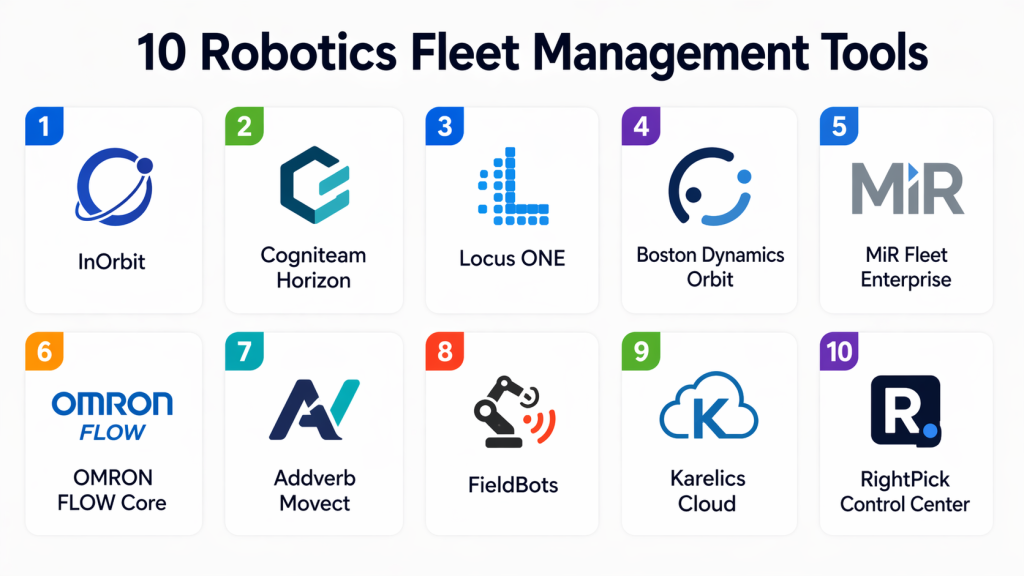
Top 10 Robotics Fleet Management Tools
#1 — InOrbit
Short description:
InOrbit is a cloud-based robotics operations platform designed to manage and optimize multi-vendor robot fleets with real-time analytics and AI-driven insights.
Key Features
- Multi-robot orchestration
- Real-time monitoring dashboards
- AI-based analytics
- Remote operations control
- Integration APIs
Pros
- Vendor-agnostic platform
- Strong analytics capabilities
Cons
- Requires integration effort
- Enterprise-focused pricing
Platforms / Deployment
Cloud
Security & Compliance
RBAC, encryption
Integrations & Ecosystem
InOrbit integrates with robotics platforms, APIs, and enterprise systems to enable unified fleet management across environments.
- ROS
- APIs
- Cloud platforms
Support & Community
Enterprise support with growing ecosystem.
#2 — Cogniteam Horizon
Short description:
Cogniteam Horizon is a robotics fleet management platform focused on autonomous robot orchestration and remote operations.
Key Features
- Fleet orchestration
- Remote monitoring
- Task scheduling
- Autonomous navigation control
- Cloud-based management
Pros
- Easy remote operations
- Scalable platform
Cons
- Limited ecosystem
- Requires setup
Platforms / Deployment
Cloud
Security & Compliance
Not publicly stated
Integrations & Ecosystem
Integrates with robotics systems and APIs for seamless fleet coordination.
- APIs
- Robotics platforms
Support & Community
Growing support and documentation.
#3 — Locus ONE
Short description:
Locus ONE is a warehouse automation platform that manages fleets of robots for order fulfillment and logistics operations.
Key Features
- Warehouse orchestration
- Real-time analytics
- Task optimization
- Robot coordination
- Performance tracking
Pros
- Optimized for logistics
- High efficiency
Cons
- Limited outside warehouse use
- Proprietary ecosystem
Platforms / Deployment
Cloud
Security & Compliance
Not publicly stated
Integrations & Ecosystem
Integrates with warehouse management systems for optimized operations.
- WMS
- APIs
Support & Community
Enterprise-level support.
#4 — Boston Dynamics Orbit
Short description:
Orbit is a fleet management platform designed for Boston Dynamics robots, providing monitoring, analytics, and mission planning capabilities.
Key Features
- Fleet monitoring
- Mission planning
- Data analytics
- Remote control
- Inspection workflows
Pros
- High-quality analytics
- Strong robotics integration
Cons
- Limited to Boston Dynamics robots
- Proprietary platform
Platforms / Deployment
Cloud / Hybrid
Security & Compliance
RBAC, encryption
Integrations & Ecosystem
Designed to integrate with Boston Dynamics ecosystem and enterprise tools.
- APIs
- Robotics systems
Support & Community
Enterprise support.
#5 — MiR Fleet Enterprise
Short description:
MiR Fleet Enterprise is a fleet management system for mobile robots, enabling centralized control and coordination across industrial environments.
Key Features
- Fleet coordination
- Traffic management
- Task scheduling
- Performance analytics
- Scalability
Pros
- Reliable for industrial use
- Easy integration
Cons
- Limited flexibility
- Vendor-specific
Platforms / Deployment
Cloud / On-premise
Security & Compliance
RBAC
Integrations & Ecosystem
Integrates with industrial systems and robotics infrastructure.
- APIs
- ERP systems
Support & Community
Strong enterprise support.
#6 — OMRON FLOW Core
Short description:
FLOW Core is a fleet management platform designed for mobile robots, offering real-time coordination and traffic management.
Key Features
- Fleet orchestration
- Traffic control
- Task management
- Real-time monitoring
- Scalable architecture
Pros
- Strong industrial focus
- Reliable performance
Cons
- Limited customization
- Vendor lock-in
Platforms / Deployment
On-premise / Cloud
Security & Compliance
RBAC
Integrations & Ecosystem
Supports integration with industrial automation systems for coordinated operations.
- APIs
- Automation tools
Support & Community
Enterprise-level support.
#7 — Addverb Movect
Short description:
Movect is a fleet management platform for warehouse robotics, focusing on automation and optimization of logistics operations.
Key Features
- Fleet control
- Task scheduling
- Warehouse optimization
- Real-time analytics
- Integration tools
Pros
- Strong logistics focus
- Scalable
Cons
- Limited outside warehousing
- Niche ecosystem
Platforms / Deployment
Cloud
Security & Compliance
Not publicly stated
Integrations & Ecosystem
Integrates with warehouse and logistics systems for automation workflows.
- WMS
- APIs
Support & Community
Enterprise support.
#8 — FieldBots
Short description:
FieldBots is a robotics fleet management platform designed for outdoor and field-based robot operations.
Key Features
- Outdoor fleet management
- Real-time tracking
- Remote control
- Analytics
- Task coordination
Pros
- Suitable for field robotics
- Flexible
Cons
- Limited enterprise features
- Smaller ecosystem
Platforms / Deployment
Cloud
Security & Compliance
Not publicly stated
Integrations & Ecosystem
Supports integration with robotics platforms and outdoor systems.
- APIs
- Robotics tools
Support & Community
Growing community.
#9 — Karelics Cloud
Short description:
Karelics Cloud is a fleet management platform built on ROS, designed for scalable multi-robot orchestration.
Key Features
- ROS-based orchestration
- Multi-robot coordination
- Cloud deployment
- Monitoring tools
- API integration
Pros
- Open ecosystem
- Scalable
Cons
- Requires ROS expertise
- Setup complexity
Platforms / Deployment
Cloud
Security & Compliance
Varies / N/A
Integrations & Ecosystem
Integrates deeply with ROS ecosystem and robotics tools.
- ROS
- APIs
Support & Community
Active developer community.
#10 — RightPick Control Center
Short description:
RightPick Control Center is a warehouse-focused robotics fleet management platform for optimizing picking and fulfillment operations.
Key Features
- Warehouse orchestration
- Task management
- Real-time monitoring
- Performance analytics
- Integration tools
Pros
- Optimized for fulfillment
- Strong analytics
Cons
- Limited outside logistics
- Proprietary system
Platforms / Deployment
Cloud
Security & Compliance
Not publicly stated
Integrations & Ecosystem
Integrates with warehouse and logistics platforms for optimized operations.
- WMS
- APIs
Support & Community
Enterprise-level support.
Comparison Table (Top 10)
| Tool Name | Best For | Platform(s) Supported | Deployment | Standout Feature | Public Rating |
|---|---|---|---|---|---|
| InOrbit | Multi-vendor fleets | Web | Cloud | AI analytics | N/A |
| Cogniteam Horizon | Remote ops | Web | Cloud | Orchestration | N/A |
| Locus ONE | Warehousing | Web | Cloud | Optimization | N/A |
| Orbit | BD robots | Web | Cloud/Hybrid | Mission control | N/A |
| MiR Fleet | AMRs | Web | Cloud/On-prem | Traffic mgmt | N/A |
| OMRON FLOW | Industrial | Web | Cloud/On-prem | Coordination | N/A |
| Movect | Logistics | Web | Cloud | Automation | N/A |
| FieldBots | Outdoor robots | Web | Cloud | Tracking | N/A |
| Karelics Cloud | ROS fleets | Web | Cloud | Open ecosystem | N/A |
| RightPick | Fulfillment | Web | Cloud | Picking optimization | N/A |
Evaluation & Scoring of Robotics Fleet Management Tools
| Tool Name | Core (25%) | Ease (15%) | Integrations (15%) | Security (10%) | Performance (10%) | Support (10%) | Value (15%) | Weighted Total (0–10) |
|---|---|---|---|---|---|---|---|---|
| InOrbit | 9 | 8 | 9 | 8 | 9 | 9 | 7 | 8.6 |
| Cogniteam | 8 | 8 | 8 | 7 | 8 | 7 | 8 | 8.0 |
| Locus ONE | 9 | 8 | 8 | 7 | 9 | 8 | 7 | 8.3 |
| Orbit | 8 | 7 | 7 | 8 | 8 | 8 | 7 | 7.8 |
| MiR Fleet | 8 | 8 | 8 | 7 | 8 | 8 | 8 | 8.1 |
| OMRON FLOW | 8 | 7 | 7 | 7 | 8 | 7 | 8 | 7.7 |
| Movect | 7 | 8 | 7 | 6 | 7 | 7 | 8 | 7.4 |
| FieldBots | 7 | 7 | 7 | 6 | 7 | 6 | 8 | 7.1 |
| Karelics | 8 | 6 | 9 | 6 | 8 | 7 | 8 | 7.8 |
| RightPick | 8 | 8 | 7 | 7 | 8 | 8 | 7 | 7.9 |
How to interpret scores:
These scores provide a comparative evaluation across orchestration capabilities, usability, and ecosystem strength. Higher scores indicate enterprise-ready platforms with strong scalability, while lower scores may still be suitable for niche or specialized use cases.
Which Robotics Fleet Management Tool Is Right for You?
Solo / Freelancer
Most fleet tools are overkill; consider simulation tools instead.
SMB
Cogniteam Horizon or Karelics Cloud offer flexible and scalable entry points.
Mid-Market
MiR Fleet Enterprise and InOrbit provide strong orchestration with manageable complexity.
Enterprise
InOrbit, Locus ONE, and OMRON FLOW Core are ideal for large-scale deployments.
Budget vs Premium
- Budget: Karelics Cloud
- Premium: InOrbit, Locus ONE
Feature Depth vs Ease of Use
- Deep features: InOrbit, OMRON FLOW
- Easy to use: Cogniteam, MiR Fleet
Integrations & Scalability
Choose platforms with strong API and ROS integrations.
Security & Compliance Needs
Enterprise users should prioritize tools with RBAC and secure cloud infrastructure.
Frequently Asked Questions (FAQs)
What is robotics fleet management?
It is the process of managing multiple robots through a centralized system to optimize operations and efficiency.
Why is fleet management important?
It ensures efficient coordination, reduces downtime, and improves productivity.
Can these tools manage multi-vendor robots?
Some platforms like InOrbit support multi-vendor fleets.
Are these tools cloud-based?
Most modern platforms are cloud-based, though some offer hybrid options.
Do they support real-time monitoring?
Yes, real-time monitoring is a core feature of most tools.
What industries use these tools?
Logistics, manufacturing, healthcare, and delivery services.
Are these tools scalable?
Yes, many tools support large fleets with hundreds of robots.
Do I need technical expertise?
Yes, especially for integration and deployment.
Can I switch platforms later?
Yes, but migration may require reconfiguration.
Are these tools secure?
Most enterprise tools provide security features like RBAC and encryption.
Conclusion
Robotics Fleet Management Tools are becoming essential for organizations operating multiple robots across complex environments. As robotics adoption continues to grow, managing fleets efficiently is critical to achieving scalability, reliability, and operational success. These platforms provide centralized control, real-time monitoring, and intelligent task allocation, enabling businesses to maximize the value of their robotic investments. The tools in this category range from flexible, multi-vendor platforms like InOrbit to specialized solutions designed for warehouse and industrial automation. Each tool offers unique strengths depending on the use case, infrastructure, and scale of deployment. Choosing the right solution requires careful evaluation of integration capabilities, scalability, and long-term operational needs. Organizations should start with pilot deployments to validate performance and compatibility with existing systems. As AI and robotics continue to evolve, fleet management tools will play an even more critical role in enabling autonomous operations at scale. Investing in the right platform today can significantly improve efficiency, reduce downtime, and enhance overall system performance. Begin by shortlisting a few tools, testing them in real environments, and scaling based on measurable outcomes.