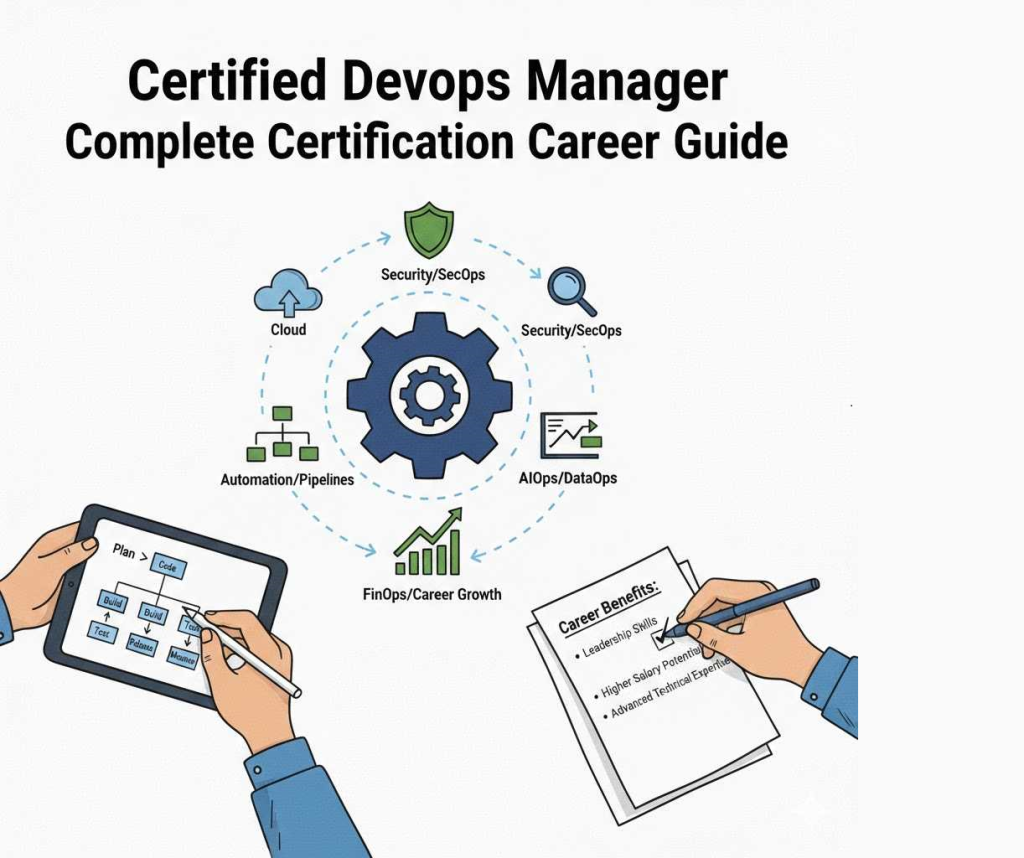
Introduction
1. Defining the Role: What is a Certified DevOps Manager?
A Certified DevOps Manager is the bridge between the technical team and business stakeholders. While a DevOps Engineer focuses on how tools and automation work, a DevOps Manager focuses on why those tools are being used and how they impact the company’s goals, productivity, and bottom line.
This certification acts as a professional roadmap that teaches you how to oversee DevOps automation, manage cloud infrastructure, improve CI/CD workflows, and lead engineering teams toward faster, safer, and more reliable software releases.
The Value of Leadership in Modern Tech Ecosystems
In the current world of high-speed software delivery, companies often face “automation chaos.” This happens when too many tools are used without a clear strategy. A certified manager brings order to this chaos. They ensure that every piece of technology—from CI/CD pipelines to security protocols—actually serves the business goals. For professionals in India and across the globe, this role is becoming one of the most sought-after positions in the IT industry.
Why Investing in Certification is a Smart Career Move
Certifications are more than just a piece of paper; they are proof of a structured learning journey. For a working engineer, it validates that you have moved beyond “just coding” and can now handle responsibility at scale. For organizations, hiring a certified manager reduces risk, as they know the candidate understands industry-standard frameworks and best practices.
2. Quick Reference: Certification Details
| Category | Career Tier | Target User | Necessary Skills | Core Learning | Path Order |
| Leadership | Senior/Expert | Aspiring Managers & Leads | 5+ Years IT Experience | Strategy, ROI, & Governance | Post-Technical Certs |
Why Choose DevOpsSchool?
When you decide to upgrade your career, the institution you choose matters as much as the course itself. DevOpsSchool stands out because they do not just offer generic video lectures. They provide a deep-dive, mentor-led experience. With trainers who have decades of real-world industry experience, the curriculum is always updated to reflect what is actually happening in the tech world today. They focus on “learning by doing,” ensuring that when you finish the course, you aren’t just a certificate holder—you are a subject matter expert ready to solve complex problems.
3. Deep-Dive: Mastering the Managerial Track
Core Concept: What does this program involve?
The Certified DevOps Manager program is built to transform senior engineers into strategic leaders. It moves the focus away from day-to-day coding and toward high-level orchestration of people and technology.
Who is the ideal candidate?
This program is perfect for Senior Developers, Team Leads, and Project Managers who find themselves managing DevOps teams but feel they lack a formal framework to guide their decisions.
Skills You Will Master
- Strategic Roadmap Design: Learn how to plan a multi-year DevOps transition for a large enterprise.
- Financial Management (FinOps): Understand how to control cloud spending on platforms like AWS and Azure.
- Cultural Transformation: Master the art of breaking down silos between Dev and Ops teams.
- Advanced Governance: Learn how to implement security and compliance without slowing down the release cycle.
- Data-Driven Leadership: Use DORA metrics and other KPIs to prove the value of your team to the CEO.
Real-World Projects for Practical Mastery
- The ROI Analysis: You will be tasked with creating a report that shows the financial benefits of moving from manual testing to automated pipelines.
- The Incident Response Plan: Design a communication and technical strategy for handling major production outages.
- The Migration Strategy: Develop a step-by-step plan to move a legacy monolithic application into a modern microservices architecture.
Your Step-by-Step Preparation Roadmap
- The 14-Day “Quick Start” Phase: Focus on the core philosophy of DevOps (The Three Ways). Understand the vocabulary of management and the lifecycle of software delivery.
- The 30-Day “Deep Integration” Phase: Study how different toolchains (GitHub, Jenkins, Terraform, Prometheus) interact. You don’t need to be an expert in every tool, but you must know how they connect.
- The 60-Day “Mastery” Phase: Work on case studies. Analyze real-world business problems and use your knowledge to provide technical and managerial solutions. Take practice exams to sharpen your decision-making skills.
Errors to Avoid During Your Journey
- Over-focusing on Tools: Remember, a manager manages people and processes. Don’t get stuck only learning the latest software updates.
- Neglecting Soft Skills: Communication is the most important tool for a manager. If you can’t explain DevOps to a non-technical person, you haven’t mastered it yet.
Future Learning Steps
- In the Same Field: Advanced Release Orchestration.
- In a Related Field: Certified DevSecOps Specialist.
- In Senior Leadership: Site Reliability Engineering (SRE) Director.
4. Selecting Your Professional Specialization
- General DevOps: Focuses on the overall speed and quality of software delivery. Great for all-rounders.
- Security-Focused (DevSecOps): Ideal for those who want to specialize in protecting data and preventing cyber threats.
- Reliability-Focused (SRE): For professionals who care about uptime, performance, and making sure systems never fail.
- AI/Machine Learning Operations (AIOps/MLOps): Best for those working with large datasets and automated intelligence.
- Data-Centric Operations (DataOps): Designed for experts managing the massive flow of information in modern apps.
- Financial Operations (FinOps): For those who want to be the “CFO of the Cloud,” optimizing every dollar spent on infrastructure.
5. Career Role to Certification Roadmap
- If you are a DevOps Engineer: Pursue Certified DevOps Professional.
- If you are a Site Reliability Engineer: Pursue Certified SRE Specialist.
- If you are a Platform Engineer: Pursue IDP and Infrastructure Automation.
- If you are a Cloud Engineer: Focus on Multi-Cloud Architecture and Terraform.
- If you are a Security Engineer: Pursue Certified DevSecOps Professional.
- If you are a Data Engineer: Look into Certified DataOps Professional.
- If you are an Engineering Manager: The Certified DevOps Manager is your primary goal.
6. Your Next Steps for Growth
Based on industry trends from GurukulGalaxy, we recommend:
- The Horizontal Step: If you are in DevOps, try a GitOps certification to understand modern deployment styles.
- The Vertical Step: If you are an engineer, take a Leadership certification to prepare for your next promotion.
- The Expansion Step: Try an SRE track to understand how to manage massive production environments.
7. Trusted Institutions for Career Support
DevOpsSchool
An industry pioneer that provides end-to-end support. They are known for their high-quality training materials and live support that helps students bridge the gap between theory and reality.
Cotocus
A specialized organization that focuses on helping businesses and individuals master high-end automation tools. Their training is highly practical and designed for the modern workplace.
ScmGalaxy
A massive knowledge hub. If you need a deep understanding of Software Configuration Management, this is the place to start. They offer thousands of resources for aspiring engineers.
BestDevOps
This platform simplifies the complex world of DevOps. They provide clear, easy-to-follow paths for beginners and experts alike who want to stay updated with industry changes.
devsecopsschool.com
The ultimate destination for security professionals. They teach you how to make security a part of the code rather than an obstacle to the developers.
sreschool.com
Dedicated to the world of Site Reliability. They help you understand how to keep systems running smoothly under heavy pressure and high scale.
aiopsschool.com
A forward-thinking institution focusing on the intersection of AI and IT operations. They prepare you for the future of “smart” automation.
dataopsschool.com
Focuses on the management of data pipelines. They help data teams work with the same agility and speed as software development teams.
finopsschool.com
Specializes in cloud economics. They teach you the skills needed to manage cloud budgets and ensure every cent of cloud spending is justified.
8. Common Questions & Expert Answers
Essential Questions
- Is this program hard?
It is challenging but manageable with the right focus on strategy. - How long will it take?
Most people complete it within 2 months. - What are the requirements?
A background in IT and some experience with DevOps tools is very helpful. - How should I start?
Begin with the foundational principles before moving to management modules. - Will this help my career?
Absolutely. It opens doors to senior-level and leadership positions. - Is the market growing?
Yes, the demand for DevOps leaders is at an all-time high in India and the US. - Is it recognized?
It is a globally recognized standard for DevOps management. - Do I need to be a coding expert?
No, you need to be a strategy and process expert. - What are the typical job titles?
DevOps Lead, VP of Engineering, or Infrastructure Manager. - Is there a practical component?
Yes, real-world project scenarios are a core part of the learning. - How long does the certificate last?
It usually requires a refresh every few years to stay current. - Can non-technical managers take this?
Yes, if they have a basic understanding of how software is made.
Focused FAQs: Certified DevOps Manager
- What is the main goal of this cert?
To create leaders who can align tech with business. - Does it cover Lean principles?
Yes, Lean and Agile are key parts of the management curriculum. - Will I learn about team building?
Yes, managing human capital is a major module. - How do I handle cloud costs?
The FinOps module covers this in great detail. - What are DORA metrics?
These are the four key metrics used to measure the success of a DevOps team. - Does it include crisis management?
Yes, you will learn how to lead during major system outages. - Is it good for large companies?
Yes, it is specifically designed for enterprise-scale management. - Is there community support?
Through platforms like ScmGalaxy and DevOpsSchool, you get lifetime community access.
9. Insights from the Community
Ananya
“I finally understood that my job wasn’t just fixing bugs, but improving how my whole team works. This gave me so much more clarity.”
Vikram
“The focus on the financial side of the cloud was a game-changer for me. I was able to save my company thousands of dollars in my first month as a manager.”
Siddharth
“I used to feel lost in meetings with senior leadership. Now, I have the vocabulary and the data to prove what my team is doing is valuable.”
Priya
“The transition from a senior developer to a lead was scary. This course provided the exact roadmap I needed to handle the new responsibilities.”
Arjun
“I gained the confidence to implement security guardrails that actually worked for the devs. It made the whole culture of our office much better.”
Final Thoughts
The Certified DevOps Manager credential is more than just a title; it is a transformation in how you view technology. As the software industry becomes more complex, the world needs people who can lead with both technical knowledge and managerial wisdom. By choosing a structured path and learning from industry veterans, you are ensuring your career remains relevant and high-paying for years to come.