Introduction
Database Replication Tools are platforms that enable organizations to synchronize data across multiple databases in real time or near real time, ensuring consistency, availability, and performance across systems. These tools are essential for use cases like disaster recovery, high availability, analytics pipelines, and multi-region deployments.
Modern replication relies heavily on Change Data Capture (CDC), a technique that tracks and replicates only the data that changes (inserts, updates, deletes) instead of copying entire datasets. This approach significantly reduces system load and latency while keeping systems up to date.
As businesses increasingly depend on real-time data, replication tools have become a core component of data architecture, enabling faster decision-making and resilient systems.
Common use cases include:
- Real-time database synchronization
- Disaster recovery and failover systems
- Data warehousing and analytics pipelines
- Multi-cloud and hybrid data movement
- Microservices and event-driven architectures
What buyers should evaluate:
- Real-time vs batch replication capabilities
- CDC support and latency performance
- Scalability across large datasets
- Multi-database and cross-platform support
- Data consistency and integrity guarantees
- Integration with cloud and analytics tools
- Security and compliance features
- Ease of setup and monitoring
- Cost and operational overhead
- Fault tolerance and recovery mechanisms
Best for: Data engineers, architects, DevOps teams, and enterprises requiring high availability and real-time data synchronization.
Not ideal for: Small workloads or static datasets that do not require continuous synchronization.
Key Trends in Database Replication Tools
- Widespread adoption of log-based CDC replication
- Real-time streaming architectures using Kafka and event pipelines
- Cloud-native replication platforms replacing legacy tools
- Multi-cloud and hybrid data synchronization
- Automation and no-code replication pipelines
- Schema evolution handling without manual intervention
- Low-latency replication for analytics and AI workloads
- Integration with data lakes and warehouses
- Improved observability and monitoring
- Incremental replication reducing system overhead
How We Selected These Tools (Methodology)
- Evaluated CDC and real-time replication capabilities
- Assessed performance impact on source systems
- Reviewed cross-database and multi-cloud support
- Analyzed scalability and latency performance
- Evaluated automation and ease of deployment
- Considered integration with modern data stacks
- Reviewed reliability, fault tolerance, and recovery
- Assessed vendor adoption and ecosystem maturity
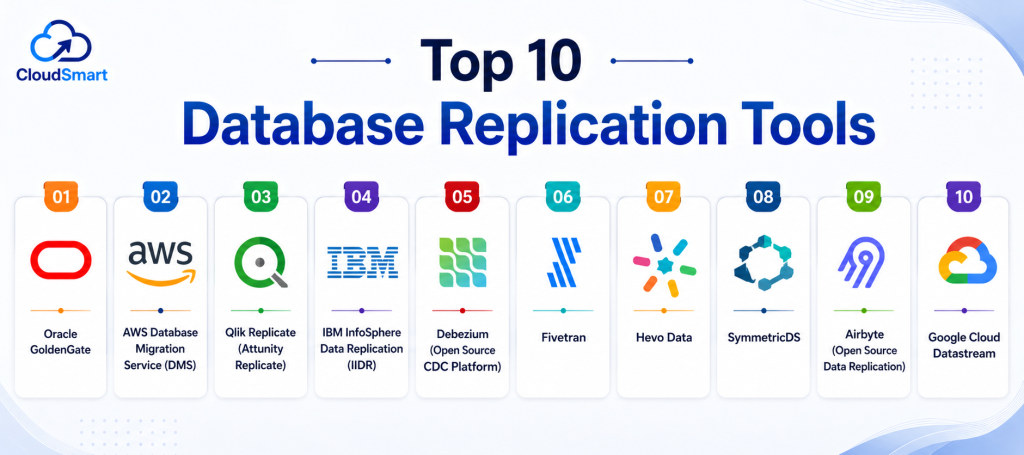
Top 10 Database Replication Tools
#1 — Oracle GoldenGate
Short description:
Oracle GoldenGate is an enterprise-grade replication platform known for high-performance, real-time data replication across heterogeneous databases and cloud environments.
Key Features
- Log-based CDC replication
- Cross-database replication
- Real-time streaming
- High availability support
- Data transformation
Pros
- Industry-leading performance
- Strong enterprise adoption
Cons
- Complex setup
- Premium pricing
Platforms / Deployment
Web / Linux
Cloud / Hybrid
Security & Compliance
Encryption, RBAC
Integrations & Ecosystem
- Oracle ecosystem
- Cloud platforms
Support & Community
Enterprise support.
#2 — AWS Database Migration Service (DMS)
Short description:
AWS DMS enables continuous replication and migration of databases with minimal downtime, supporting both homogeneous and heterogeneous environments.
Key Features
- Continuous replication
- Minimal downtime migration
- Multi-database support
- Monitoring dashboards
Pros
- Easy AWS integration
- Scalable
Cons
- AWS-centric
- Requires configuration
Platforms / Deployment
Web
Cloud
Security & Compliance
Encryption, IAM
Integrations & Ecosystem
- AWS services
- Databases
Support & Community
Extensive documentation.
#3 — Qlik Replicate
Short description:
Qlik Replicate is a robust enterprise tool that simplifies data replication across legacy and modern systems using log-based CDC.
Key Features
- Log-based CDC
- GUI-based setup
- Real-time replication
- Multi-source support
Pros
- Easy configuration
- Enterprise-grade
Cons
- Licensing cost
- Setup complexity
Platforms / Deployment
Web
Cloud / Hybrid
Security & Compliance
Encryption
Integrations & Ecosystem
- Enterprise systems
Support & Community
Strong enterprise support.
#4 — IBM InfoSphere Data Replication
Short description:
IBM IIDR provides enterprise-grade CDC replication for real-time synchronization across databases and data platforms.
Key Features
- CDC replication
- High throughput
- Data consistency
- Multi-platform support
Pros
- High reliability
- Enterprise integration
Cons
- Complex setup
- Premium pricing
Platforms / Deployment
Web
Cloud / Hybrid
Security & Compliance
Encryption
Integrations & Ecosystem
- IBM ecosystem
Support & Community
Enterprise support.
#5 — Debezium
Short description:
Debezium is an open-source CDC platform that streams database changes using Kafka, enabling real-time data pipelines.
Key Features
- Open-source CDC
- Kafka integration
- Real-time streaming
- Schema evolution
Pros
- Free and flexible
- Strong community
Cons
- Requires setup expertise
- Maintenance overhead
Platforms / Deployment
Linux / Web
Cloud / Self-hosted
Security & Compliance
Varies / N/A
Integrations & Ecosystem
- Kafka ecosystem
Support & Community
Active open-source community.
#6 — Fivetran
Short description:
Fivetran is a fully managed data replication platform that automates CDC pipelines with minimal setup.
Key Features
- Automated replication
- Managed connectors
- Schema evolution
- Real-time sync
Pros
- No maintenance
- Easy setup
Cons
- Usage-based pricing
- Limited customization
Platforms / Deployment
Web
Cloud
Security & Compliance
Encryption
Integrations & Ecosystem
- SaaS platforms
- Data warehouses
Support & Community
Strong support.
#7 — Hevo Data
Short description:
Hevo is a no-code data pipeline tool supporting both batch and CDC replication across multiple data sources.
Key Features
- No-code pipelines
- Real-time replication
- Data transformation
- Monitoring
Pros
- Easy to use
- Quick deployment
Cons
- Limited deep customization
- Scaling limitations
Platforms / Deployment
Web
Cloud
Security & Compliance
Encryption
Integrations & Ecosystem
- SaaS apps
- Databases
Support & Community
Responsive support.
#8 — SymmetricDS
Short description:
SymmetricDS is an open-source database replication tool supporting multi-master replication and synchronization across heterogeneous databases.
Key Features
- Multi-master replication
- Data synchronization
- Cross-database support
- Offline sync capability
Pros
- Open-source flexibility
- Supports many databases
Cons
- Requires configuration
- UI limitations
Platforms / Deployment
Windows / Linux / macOS
Self-hosted
Security & Compliance
Varies / N/A
Integrations & Ecosystem
- JDBC-based systems
Support & Community
Open-source community.
#9 — Airbyte
Short description:
Airbyte is an open-source data integration platform that supports replication and CDC pipelines across databases and SaaS systems.
Key Features
- Open-source connectors
- CDC support
- Custom pipelines
- API integration
Pros
- Flexible
- Growing ecosystem
Cons
- Requires setup
- Maturity evolving
Platforms / Deployment
Web
Cloud / Self-hosted
Security & Compliance
Varies / N/A
Integrations & Ecosystem
- 300+ connectors
Support & Community
Active community.
#10 — Google Cloud Datastream
Short description:
Datastream provides serverless CDC replication for Google Cloud, enabling real-time data movement into analytics systems.
Key Features
- Serverless CDC
- Real-time streaming
- Integration with BigQuery
- Monitoring
Pros
- Fully managed
- Scalable
Cons
- Google Cloud dependency
- Limited outside ecosystem
Platforms / Deployment
Web
Cloud
Security & Compliance
Encryption
Integrations & Ecosystem
- Google Cloud
Support & Community
Cloud support.
Comparison Table
| Tool Name | Best For | Platform(s) Supported | Deployment | Standout Feature | Public Rating |
|---|---|---|---|---|---|
| Oracle GoldenGate | Enterprise | Linux/Web | Hybrid | High-performance CDC | N/A |
| AWS DMS | AWS users | Web | Cloud | Continuous replication | N/A |
| Qlik Replicate | Enterprise IT | Web | Hybrid | GUI-based CDC | N/A |
| IBM IIDR | Large enterprises | Web | Hybrid | High throughput CDC | N/A |
| Debezium | Developers | Linux/Web | Self-hosted | Kafka streaming | N/A |
| Fivetran | SaaS pipelines | Web | Cloud | Fully managed CDC | N/A |
| Hevo | No-code users | Web | Cloud | Easy pipelines | N/A |
| SymmetricDS | Open-source | Multi-OS | Self-hosted | Multi-master replication | N/A |
| Airbyte | Open-source | Web | Hybrid | Connector ecosystem | N/A |
| Datastream | GCP users | Web | Cloud | Serverless CDC | N/A |
Evaluation & Scoring of Database Replication Tools
| Tool Name | Core | Ease | Integrations | Security | Performance | Support | Value | Weighted Total |
|---|---|---|---|---|---|---|---|---|
| GoldenGate | 9 | 6 | 9 | 9 | 9 | 9 | 7 | 8.3 |
| AWS DMS | 8 | 7 | 9 | 9 | 9 | 9 | 8 | 8.4 |
| Qlik | 8 | 7 | 8 | 8 | 8 | 8 | 7 | 7.9 |
| IBM IIDR | 9 | 6 | 9 | 9 | 9 | 9 | 7 | 8.2 |
| Debezium | 8 | 6 | 8 | 7 | 8 | 7 | 9 | 7.8 |
| Fivetran | 8 | 9 | 9 | 8 | 8 | 8 | 8 | 8.3 |
| Hevo | 7 | 9 | 7 | 8 | 7 | 8 | 9 | 8.0 |
| SymmetricDS | 7 | 6 | 7 | 7 | 7 | 7 | 9 | 7.3 |
| Airbyte | 8 | 7 | 8 | 7 | 8 | 7 | 8 | 7.8 |
| Datastream | 8 | 8 | 8 | 8 | 8 | 8 | 7 | 8.0 |
How to interpret scores:
These scores compare tools based on replication performance, ease of use, integration capabilities, and value. Enterprise tools excel in scalability and reliability, while open-source tools provide flexibility. CDC-based platforms stand out for real-time use cases due to lower latency and system impact.
Which Database Replication Tool Is Right for You?
Solo / Small Teams
Hevo and Airbyte provide simple and affordable replication.
SMB
Fivetran and AWS DMS offer ease and automation.
Mid-Market
Qlik Replicate and Datastream balance performance and usability.
Enterprise
GoldenGate and IBM IIDR deliver scalability and high performance.
Budget vs Premium
Open-source tools are budget-friendly; enterprise tools are premium.
Feature Depth vs Ease of Use
GoldenGate offers depth; Fivetran offers simplicity.
Integrations & Scalability
Enterprise tools support broader integrations.
Security & Compliance Needs
Enterprise platforms provide stronger compliance capabilities.
Frequently Asked Questions
1. What is database replication?
Database replication is the process of copying and synchronizing data across multiple systems to ensure consistency and availability.
2. What is CDC in replication?
CDC tracks changes in data and replicates only those changes, reducing system load and improving efficiency.
3. Why is replication important?
It ensures high availability, disaster recovery, and real-time analytics.
4. What types of replication exist?
Common types include batch replication, real-time replication, and CDC-based replication.
5. Can replication reduce downtime?
Yes, replication enables failover systems and high availability setups.
6. Are these tools secure?
Most tools provide encryption and access control features.
7. Do these tools support multi-cloud?
Many modern tools support hybrid and multi-cloud environments.
8. What industries benefit most?
Finance, healthcare, e-commerce, and SaaS industries benefit heavily.
9. How fast is real-time replication?
It can achieve near real-time sync with minimal latency using CDC.
10. What is the biggest challenge?
Maintaining data consistency and managing latency at scale.
Conclusion
Database Replication Tools are critical for organizations that require real-time data synchronization, high availability, and scalable data architectures. With the rise of CDC and streaming technologies, modern replication tools offer efficient, low-latency solutions that minimize system impact while keeping data consistent across platforms. Whether you choose enterprise solutions like Oracle GoldenGate and IBM IIDR or flexible platforms like Fivetran and Debezium, the right tool depends on your infrastructure, scale, and performance requirements. Start by defining your replication needs, shortlist a few tools, and test them in real-world scenarios to ensure reliability, scalability, and seamless integration into your data ecosystem.