Introduction
Data Migration Tools are software platforms designed to transfer data between systems, databases, applications, or cloud environments while ensuring accuracy, security, and minimal downtime. These tools handle complex processes like extraction, transformation, validation, and loading of data into target systems.
While data migration may sound simple, it involves challenges like compatibility issues, data corruption risks, and performance constraints. Modern tools solve these challenges through automation, real-time replication, and intelligent mapping, enabling organizations to migrate large datasets efficiently and securely.
Common use cases include:
- Migrating databases between platforms
- Moving data from on-premise systems to the cloud
- SaaS and application data migration
- Data consolidation after mergers
- Data warehouse modernization
What buyers should evaluate:
- Data extraction, transformation, and loading capabilities
- Real-time vs batch migration support
- Scalability for large datasets
- Data validation and integrity checks
- Security and compliance features
- Integration with cloud and SaaS platforms
- Automation and scheduling
- Ease of use and monitoring dashboards
- Cost model and licensing
- Vendor ecosystem and support
Best for: Data engineers, IT teams, cloud architects, and enterprises managing large-scale data movement.
Not ideal for: Small datasets or one-time manual transfers where basic tools suffice.
Key Trends in Data Migration Tools
- Cloud-to-cloud and hybrid data migration
- Real-time replication using Change Data Capture
- AI-driven data mapping and transformation
- Automation-first migration pipelines
- Integration with analytics and data warehouses
- Security-first migration with encryption and access control
- Low-code and no-code migration tools
- Multi-cloud data movement strategies
- Continuous migration and synchronization
- Observability and monitoring during migration
How We Selected These Tools (Methodology)
- Evaluated ETL and ELT capabilities
- Assessed real-time and batch migration performance
- Reviewed scalability for enterprise workloads
- Analyzed security and compliance readiness
- Considered integration with cloud platforms
- Evaluated ease of use and automation
- Reviewed ecosystem and connector availability
- Considered adoption and industry relevance
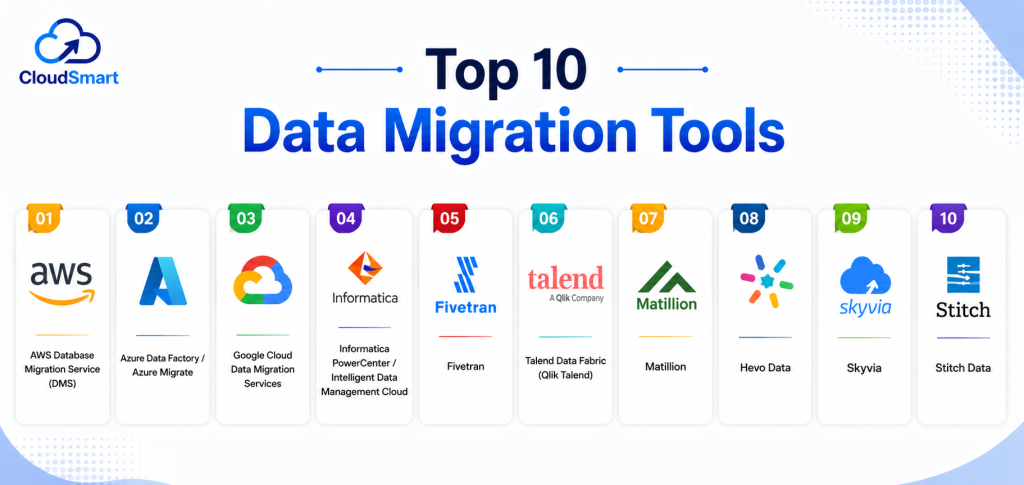
Top 10 Data Migration Tools
#1 — AWS Database Migration Service (DMS)
Short description:
AWS DMS enables secure and efficient migration of databases to AWS with minimal downtime. It supports homogeneous and heterogeneous migrations.
Key Features
- Continuous data replication
- Minimal downtime migration
- Multi-database support
- Schema conversion
- Monitoring tools
Pros
- Highly scalable
- Strong AWS integration
Cons
- AWS dependency
- Requires expertise
Platforms / Deployment
Web
Cloud
Security & Compliance
Encryption, IAM
Integrations & Ecosystem
- AWS ecosystem
- Database engines
Support & Community
Extensive AWS support.
#2 — Azure Data Factory
Short description:
Azure Data Factory provides a cloud-based data integration and migration service for building ETL pipelines and orchestrating data movement.
Key Features
- ETL/ELT pipelines
- Data transformation
- Workflow orchestration
- Hybrid data integration
Pros
- Strong Microsoft ecosystem
- Scalable
Cons
- Learning curve
- Azure dependency
Platforms / Deployment
Web
Cloud
Security & Compliance
Encryption
Integrations & Ecosystem
- Azure services
- Microsoft tools
Support & Community
Enterprise support.
#3 — Google Cloud Data Migration Tools
Short description:
Google Cloud offers tools for migrating databases and data workloads into Google Cloud with high performance and reliability.
Key Features
- Database migration services
- Real-time replication
- Data transfer services
- Monitoring
Pros
- Strong data processing
- Scalable
Cons
- Google ecosystem dependency
- Setup complexity
Platforms / Deployment
Web
Cloud
Security & Compliance
Encryption
Integrations & Ecosystem
- Google Cloud services
Support & Community
Strong support.
#4 — Informatica Intelligent Data Management Cloud
Short description:
Informatica provides enterprise-grade data migration and integration with advanced automation, governance, and data quality tools.
Key Features
- ETL and ELT pipelines
- Data governance
- Data quality tools
- Automation
Pros
- Enterprise-grade features
- Strong data quality
Cons
- Premium pricing
- Complexity
Platforms / Deployment
Web
Cloud / Hybrid
Security & Compliance
Encryption, compliance support
Integrations & Ecosystem
- Enterprise systems
- Cloud platforms
Support & Community
Enterprise support.
#5 — Fivetran
Short description:
Fivetran is a fully managed data pipeline platform that automates data migration and integration across SaaS, databases, and cloud warehouses.
Key Features
- Automated connectors
- Schema evolution handling
- Real-time sync
- Managed pipelines
Pros
- Fully automated
- Easy setup
Cons
- Pricing based on usage
- Limited customization
Platforms / Deployment
Web
Cloud
Security & Compliance
Encryption
Integrations & Ecosystem
- 700+ connectors
- SaaS platforms
Support & Community
Strong support.
#6 — Talend Data Fabric
Short description:
Talend offers flexible data integration and migration with strong transformation and governance capabilities.
Key Features
- Data pipelines
- Transformation tools
- Data quality
- Governance
Pros
- Highly customizable
- Open-source roots
Cons
- Requires expertise
- Maintenance overhead
Platforms / Deployment
Web
Cloud / Hybrid
Security & Compliance
Encryption
Integrations & Ecosystem
- Enterprise systems
Support & Community
Active community.
#7 — Matillion
Short description:
Matillion is a cloud-native ETL platform designed for complex transformations and migration workflows.
Key Features
- ETL pipelines
- Data transformation
- Cloud-native design
- Integration with warehouses
Pros
- Strong transformation capabilities
- Cloud-native
Cons
- Pricing
- Learning curve
Platforms / Deployment
Web
Cloud
Security & Compliance
Encryption
Integrations & Ecosystem
- Snowflake
- Redshift
Support & Community
Professional support.
#8 — Hevo Data
Short description:
Hevo Data provides no-code data migration and integration with real-time pipelines and automated workflows.
Key Features
- No-code pipelines
- Real-time data sync
- Data transformation
- Monitoring
Pros
- Easy to use
- Fast setup
Cons
- Limited advanced customization
- Pricing tiers
Platforms / Deployment
Web
Cloud
Security & Compliance
Encryption
Integrations & Ecosystem
- SaaS apps
- Databases
Support & Community
Responsive support.
#9 — Skyvia
Short description:
Skyvia offers cloud-based data migration with affordable pricing and easy integration for SMBs and startups.
Key Features
- Automated backups
- Data sync
- Cloud storage
- Integration tools
Pros
- Affordable
- Easy to use
Cons
- Limited enterprise features
- Smaller ecosystem
Platforms / Deployment
Web
Cloud
Security & Compliance
Encryption
Integrations & Ecosystem
- SaaS apps
Support & Community
Standard support.
#10 — Stitch Data
Short description:
Stitch is a simple and scalable ETL tool designed for moving data into data warehouses with minimal setup.
Key Features
- ETL pipelines
- Data replication
- SaaS integrations
- Monitoring
Pros
- Easy setup
- Affordable
Cons
- Limited advanced features
- Basic transformation
Platforms / Deployment
Web
Cloud
Security & Compliance
Encryption
Integrations & Ecosystem
- SaaS platforms
- Data warehouses
Support & Community
Standard support.
Comparison Table
| Tool Name | Best For | Platform(s) Supported | Deployment | Standout Feature | Public Rating |
|---|---|---|---|---|---|
| AWS DMS | Enterprise | Web | Cloud | Real-time migration | N/A |
| Azure Data Factory | Microsoft ecosystem | Web | Cloud | ETL pipelines | N/A |
| Google Cloud | Data workloads | Web | Cloud | Real-time replication | N/A |
| Informatica | Enterprise | Web | Hybrid | Data governance | N/A |
| Fivetran | SaaS pipelines | Web | Cloud | Automation | N/A |
| Talend | Custom pipelines | Web | Hybrid | Flexibility | N/A |
| Matillion | Transformations | Web | Cloud | ELT workflows | N/A |
| Hevo | No-code | Web | Cloud | Ease of use | N/A |
| Skyvia | SMB | Web | Cloud | Affordable | N/A |
| Stitch | Startups | Web | Cloud | Simple ETL | N/A |
Evaluation & Scoring of Data Migration Tools
| Tool Name | Core | Ease | Integrations | Security | Performance | Support | Value | Weighted Total |
|---|---|---|---|---|---|---|---|---|
| AWS DMS | 9 | 7 | 9 | 9 | 9 | 9 | 7 | 8.4 |
| Azure Data Factory | 9 | 7 | 9 | 9 | 9 | 9 | 7 | 8.4 |
| Google Cloud | 8 | 7 | 8 | 9 | 9 | 8 | 7 | 8.0 |
| Informatica | 9 | 7 | 9 | 9 | 9 | 9 | 7 | 8.4 |
| Fivetran | 8 | 9 | 9 | 8 | 8 | 8 | 8 | 8.3 |
| Talend | 8 | 7 | 8 | 8 | 8 | 8 | 7 | 7.9 |
| Matillion | 8 | 7 | 8 | 8 | 8 | 8 | 7 | 7.9 |
| Hevo | 7 | 9 | 7 | 8 | 7 | 8 | 9 | 8.0 |
| Skyvia | 7 | 9 | 6 | 8 | 7 | 8 | 9 | 7.8 |
| Stitch | 7 | 9 | 7 | 8 | 7 | 7 | 9 | 7.8 |
How to interpret scores:
These scores compare tools across migration capability, ease of use, integration, and value. Enterprise tools excel in scalability and performance, while no-code tools prioritize ease and affordability. Choose based on data volume, complexity, and ecosystem alignment.
Which Data Migration Tool Is Right for You?
Solo / Small Projects
Skyvia and Stitch provide simple, affordable migration solutions.
SMB
Hevo and Fivetran balance automation and usability.
Mid-Market
Matillion and Talend offer transformation and customization.
Enterprise
AWS DMS, Azure Data Factory, Informatica, and Google tools provide scalability and advanced features.
Budget vs Premium
Skyvia and Stitch are budget-friendly; Informatica and AWS are premium.
Feature Depth vs Ease of Use
Informatica offers depth; Hevo offers simplicity.
Integrations & Scalability
Enterprise tools provide broader integrations.
Security & Compliance Needs
Cloud-native and enterprise tools provide strong compliance and encryption.
Frequently Asked Questions
1. What is data migration?
Data migration is the process of transferring data from one system, format, or environment to another to improve efficiency and performance.
2. Why is data migration important?
It enables organizations to modernize systems, consolidate data, and improve decision-making capabilities.
3. What types of migration exist?
Common types include storage, database, application, and cloud migration.
4. What features should I look for?
Look for ETL capabilities, automation, real-time sync, validation, and security features.
5. Can migration tools reduce downtime?
Yes, many tools use real-time replication to minimize downtime during migration.
6. Are these tools secure?
Yes, they use encryption and secure transfer protocols to protect data.
7. How long does migration take?
It depends on data size, complexity, and migration strategy.
8. Can I migrate data between clouds?
Yes, most tools support multi-cloud and hybrid migration.
9. What industries benefit most?
Finance, healthcare, retail, and IT industries benefit significantly.
10. What are common challenges?
Data loss, downtime, compatibility issues, and data quality concerns.
Conclusion
Data Migration Tools are essential for organizations managing growing volumes of data across diverse systems. They simplify complex processes, ensure data integrity, and reduce risks associated with large-scale migrations. From enterprise-grade platforms like AWS DMS and Informatica to user-friendly tools like Hevo and Skyvia, organizations have a wide range of options depending on scale and complexity. The key to success lies in selecting a tool aligned with your data architecture, testing migration scenarios, and ensuring strong security and validation processes. Start with a clear migration plan, shortlist tools, and run pilot migrations to ensure a smooth and reliable transition.