Introduction
Application Modernization Tools are platforms that help organizations transform legacy applications into modern, cloud-native, scalable systems. This includes migrating monolithic applications, refactoring code, adopting microservices, containerizing workloads, and integrating with modern DevOps pipelines.
Application modernization has become essential because legacy systems often struggle with performance, scalability, and security. Modernization enables organizations to improve agility, reduce costs, enhance security, and support innovation by leveraging cloud, APIs, and automation technologies.
These tools guide teams through modernization strategies such as rehosting, replatforming, refactoring, and rearchitecting — ensuring applications remain competitive and future-ready.
Common use cases include:
- Migrating legacy apps to cloud-native architectures
- Breaking monoliths into microservices
- Modernizing user interfaces and APIs
- Integrating legacy systems with modern platforms
- Improving application performance and scalability
What buyers should evaluate:
- Support for modernization strategies
- Containerization and microservices capabilities
- Integration with DevOps and CI/CD pipelines
- Multi-cloud and hybrid cloud support
- Automation and orchestration features
- Security and compliance capabilities
- Performance monitoring and optimization
- Ease of developer adoption
- Scalability across applications
- Cost efficiency and licensing
Best for: Developers, DevOps teams, cloud architects, IT leaders, and enterprises modernizing legacy systems.
Not ideal for: Small teams with simple applications or no modernization requirements.
Key Trends in Application Modernization Tools
- Microservices architecture replacing monolithic systems
- Containerization using Kubernetes and Docker
- AI-driven modernization recommendations
- Low-code and no-code platforms for rapid development
- API-first design and integration strategies
- DevOps and CI/CD integration
- Serverless computing adoption
- Hybrid and multi-cloud modernization
- Automated code refactoring tools
- Observability and performance monitoring
How We Selected These Tools (Methodology)
- Evaluated modernization capabilities across strategies
- Assessed cloud-native and container support
- Reviewed DevOps and CI/CD integrations
- Analyzed scalability and performance optimization
- Considered developer experience and usability
- Evaluated ecosystem and integration flexibility
- Reviewed security and compliance features
- Considered adoption across enterprise environments
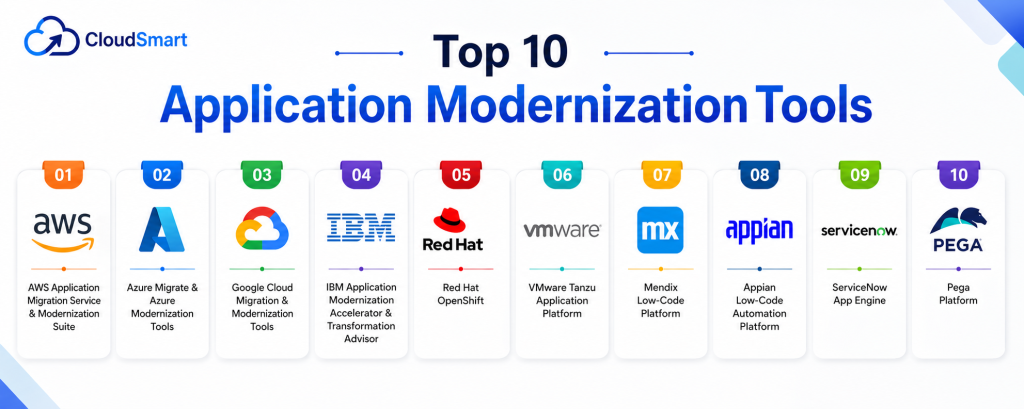
Top 10 Application Modernization Tools
#1 — AWS Application Migration & Modernization Suite
Short description:
AWS provides a comprehensive suite for migrating and modernizing applications, including tools for refactoring, containerization, and serverless deployment.
Key Features
- Migration and modernization tools
- Container services (EKS, ECS)
- Serverless computing
- Automation and orchestration
- Integration with AWS ecosystem
Pros
- Scalable and flexible
- Strong cloud-native ecosystem
Cons
- AWS dependency
- Learning curve
Platforms / Deployment
Web
Cloud
Security & Compliance
Encryption, IAM
Integrations & Ecosystem
- AWS services
- DevOps tools
Support & Community
Extensive documentation and support.
#2 — Azure Modernization Tools
Short description:
Azure offers tools for application modernization, including migration, containerization, and DevOps integration within the Microsoft ecosystem.
Key Features
- Migration and assessment
- Kubernetes support
- DevOps integration
- AI-powered insights
Pros
- Strong enterprise integration
- End-to-end modernization
Cons
- Azure-focused
- Setup complexity
Platforms / Deployment
Web
Cloud
Security & Compliance
Encryption, Azure security
Integrations & Ecosystem
- Microsoft tools
- Azure services
Support & Community
Enterprise support.
#3 — Google Cloud Modernization Tools
Short description:
Google Cloud offers tools for modernizing applications through containerization, microservices, and data-driven insights.
Key Features
- Kubernetes (GKE)
- Migration and refactoring
- API management
- Analytics
Pros
- Strong data capabilities
- Cloud-native design
Cons
- Google Cloud dependency
- Learning curve
Platforms / Deployment
Web
Cloud
Security & Compliance
Encryption
Integrations & Ecosystem
- Google Cloud services
Support & Community
Strong support.
#4 — IBM Transformation Advisor
Short description:
IBM’s tool analyzes legacy applications and recommends modernization strategies, helping teams refactor applications for cloud environments.
Key Features
- Application assessment
- Modernization recommendations
- Cloud readiness analysis
- Migration planning
Pros
- Strong analytics
- Enterprise-ready
Cons
- Limited UI flexibility
- Requires IBM ecosystem
Platforms / Deployment
Web
Cloud
Security & Compliance
Encryption
Integrations & Ecosystem
- IBM Cloud
Support & Community
Enterprise support.
#5 — Red Hat OpenShift
Short description:
OpenShift is a Kubernetes-based platform that enables application modernization through containerization and microservices.
Key Features
- Kubernetes orchestration
- Container management
- DevOps pipelines
- Hybrid cloud support
Pros
- Open-source foundation
- Strong container ecosystem
Cons
- Complex setup
- Requires expertise
Platforms / Deployment
Web / Linux
Cloud / Hybrid
Security & Compliance
Encryption
Integrations & Ecosystem
- Kubernetes ecosystem
Support & Community
Strong open-source community.
#6 — VMware Tanzu
Short description:
VMware Tanzu helps modernize applications by enabling Kubernetes adoption, microservices development, and cloud-native workflows.
Key Features
- Kubernetes platform
- Application lifecycle management
- DevOps integration
- Multi-cloud support
Pros
- Strong enterprise adoption
- Hybrid cloud support
Cons
- Learning curve
- Premium pricing
Platforms / Deployment
Web
Cloud / Hybrid
Security & Compliance
Encryption
Integrations & Ecosystem
- VMware ecosystem
Support & Community
Enterprise support.
#7 — Mendix
Short description:
Mendix is a low-code platform that enables rapid modernization of legacy applications through visual development and automation.
Key Features
- Low-code development
- Workflow automation
- Cloud deployment
- Integration tools
Pros
- Fast development
- User-friendly
Cons
- Limited deep customization
- Licensing cost
Platforms / Deployment
Web
Cloud
Security & Compliance
Encryption
Integrations & Ecosystem
- Enterprise systems
Support & Community
Active community.
#8 — Appian
Short description:
Appian provides low-code automation and application modernization tools, enabling organizations to rebuild legacy systems quickly.
Key Features
- Low-code platform
- Process automation
- Integration tools
- Workflow management
Pros
- Rapid deployment
- Strong automation
Cons
- Premium pricing
- Learning curve
Platforms / Deployment
Web
Cloud
Security & Compliance
Encryption
Integrations & Ecosystem
- Enterprise tools
Support & Community
Enterprise support.
#9 — ServiceNow App Engine
Short description:
ServiceNow enables application modernization through workflow automation and low-code development within its enterprise platform.
Key Features
- Low-code app development
- Workflow automation
- Integration tools
- Cloud platform
Pros
- Strong enterprise integration
- Easy automation
Cons
- Platform dependency
- Cost
Platforms / Deployment
Web
Cloud
Security & Compliance
Encryption
Integrations & Ecosystem
- ServiceNow ecosystem
Support & Community
Strong support.
#10 — Pega Platform
Short description:
Pega offers low-code application modernization with automation and AI-driven workflows for enterprise transformation.
Key Features
- Low-code development
- AI-driven automation
- Workflow management
- Integration tools
Pros
- Strong automation
- Enterprise scalability
Cons
- Complex implementation
- Premium pricing
Platforms / Deployment
Web
Cloud
Security & Compliance
Encryption
Integrations & Ecosystem
- Enterprise systems
Support & Community
Enterprise support.
Comparison Table
| Tool Name | Best For | Platform(s) Supported | Deployment | Standout Feature | Public Rating |
|---|---|---|---|---|---|
| AWS Tools | AWS users | Web | Cloud | Cloud-native ecosystem | N/A |
| Azure Tools | Microsoft users | Web | Cloud | Integrated DevOps | N/A |
| Google Tools | Data-driven teams | Web | Cloud | Kubernetes | N/A |
| IBM Advisor | Enterprise | Web | Cloud | Migration insights | N/A |
| OpenShift | Containers | Web/Linux | Hybrid | Kubernetes platform | N/A |
| VMware Tanzu | Hybrid cloud | Web | Hybrid | Multi-cloud | N/A |
| Mendix | Low-code | Web | Cloud | Rapid development | N/A |
| Appian | Automation | Web | Cloud | Process automation | N/A |
| ServiceNow | Enterprise apps | Web | Cloud | Workflow automation | N/A |
| Pega | AI automation | Web | Cloud | AI workflows | N/A |
Evaluation & Scoring of Application Modernization Tools
| Tool Name | Core | Ease | Integrations | Security | Performance | Support | Value | Weighted Total |
|---|---|---|---|---|---|---|---|---|
| AWS | 9 | 7 | 9 | 9 | 9 | 9 | 7 | 8.4 |
| Azure | 9 | 7 | 9 | 9 | 9 | 9 | 7 | 8.4 |
| 8 | 7 | 8 | 9 | 9 | 8 | 7 | 8.0 | |
| IBM | 8 | 7 | 8 | 8 | 8 | 8 | 7 | 7.9 |
| OpenShift | 9 | 6 | 9 | 9 | 9 | 9 | 7 | 8.3 |
| Tanzu | 8 | 7 | 9 | 9 | 9 | 9 | 7 | 8.2 |
| Mendix | 7 | 9 | 7 | 8 | 8 | 8 | 8 | 8.0 |
| Appian | 8 | 8 | 8 | 8 | 8 | 8 | 7 | 7.9 |
| ServiceNow | 8 | 8 | 8 | 8 | 8 | 8 | 7 | 7.9 |
| Pega | 8 | 7 | 8 | 8 | 8 | 8 | 7 | 7.8 |
How to interpret scores:
These scores compare tools across modernization capabilities, ease of use, integrations, and scalability. Enterprise platforms like AWS, Azure, and OpenShift excel in depth and scalability, while low-code tools like Mendix and Appian prioritize speed and usability. Organizations should align scores with their modernization strategy—whether focused on cloud-native transformation or rapid development.
Application modernization tools play a crucial role in improving performance, scalability, security, and agility, helping businesses stay competitive and innovate faster.
Which Application Modernization Tool Is Right for You
Solo / Small Teams
Mendix and Appian provide easy-to-use low-code solutions.
SMB
ServiceNow and Pega offer balanced automation and development.
Mid-Market
VMware Tanzu and Google Cloud tools provide scalability.
Enterprise
AWS, Azure, and OpenShift deliver advanced capabilities.
Budget vs Premium
Low-code tools are cost-effective; enterprise platforms are premium.
Feature Depth vs Ease of Use
AWS offers depth; Mendix offers simplicity.
Integrations & Scalability
Enterprise tools provide the most integrations.
Security & Compliance Needs
Cloud-native platforms offer strong compliance features.
Frequently Asked Questions
1. What is application modernization?
Application modernization is the process of updating legacy software to improve performance, scalability, and security using modern technologies.
2. Why is it important?
It helps organizations stay competitive, reduce costs, and improve agility by upgrading outdated systems.
3. What are common strategies?
Rehosting, replatforming, refactoring, and rearchitecting are the main approaches.
4. What technologies are used?
Cloud computing, microservices, APIs, and DevOps tools are key technologies.
5. Can modernization improve performance?
Yes, modernized applications scale better and handle higher workloads efficiently.
6. Does it reduce costs?
Yes, modern systems reduce maintenance and infrastructure costs over time.
7. Is modernization risky?
It can be complex, but proper planning and tools reduce risks.
8. How long does modernization take?
It varies depending on application complexity and strategy.
9. Who should lead modernization?
IT leaders, architects, and DevOps teams typically lead these initiatives.
10. What industries benefit most?
Finance, healthcare, retail, and enterprise IT benefit significantly.
Conclusion
Application Modernization Tools are essential for organizations looking to transform legacy systems into scalable, secure, and cloud-ready applications. By enabling microservices adoption, containerization, and DevOps integration, these tools help businesses innovate faster and respond to changing market demands. Whether you choose enterprise-grade platforms like AWS, Azure, and OpenShift or low-code solutions like Mendix and Appian, the right tool depends on your modernization strategy, technical capabilities, and business goals. Start by assessing your existing applications, shortlist a few tools, and run pilot projects to validate performance, integrations, and scalability before committing to a full modernization journey.