Introduction
Content Delivery Networks (CDNs) are distributed networks of servers that deliver web content—such as images, videos, scripts, and APIs—to users based on their geographic location. Instead of loading content from a single origin server, CDNs cache and serve data from the nearest edge location, reducing latency and improving performance.
As digital experiences become more complex and global, CDNs play a critical role in ensuring fast load times, high availability, and secure content delivery. They are also increasingly integrated with security features like DDoS protection, web application firewalls, and bot mitigation, making them essential infrastructure for modern applications.
Common Use Cases
- Website acceleration and performance optimization
- Video streaming and media delivery
- API and application delivery
- E-commerce performance and uptime
- Security protection (DDoS, bot filtering)
What Buyers Should Evaluate
- Global network coverage and edge locations
- Performance and latency optimization
- Caching and content optimization features
- Security capabilities (WAF, DDoS protection)
- Integration with cloud and DevOps tools
- Scalability and reliability
- Pricing model (usage-based, bandwidth-based)
- Ease of setup and management
- Analytics and reporting
Best for: Enterprises, SaaS platforms, e-commerce businesses, media companies, and any website with global users or high traffic.
Not ideal for: Small static websites with minimal traffic where basic hosting performance is sufficient.
Key Trends in Content Delivery Networks (CDN)
- Edge computing integration enabling logic execution closer to users
- AI-driven traffic routing and optimization
- Zero-trust security models integrated into CDN layers
- Serverless edge functions for dynamic content delivery
- Real-time analytics and observability
- Multi-CDN strategies for redundancy and performance
- API-first CDN architectures
- Built-in security layers (WAF, bot protection, rate limiting)
- Video and streaming optimization enhancements
- Sustainability-focused infrastructure optimization
How We Selected These Tools (Methodology)
The tools were selected based on:
- Global market adoption and reputation
- Network size and edge presence
- Performance benchmarks and reliability
- Security feature set
- Integration ecosystem
- Ease of deployment and management
- Pricing transparency and flexibility
- Support quality and enterprise readiness
- Innovation in edge computing and AI
- Suitability across industries and scales
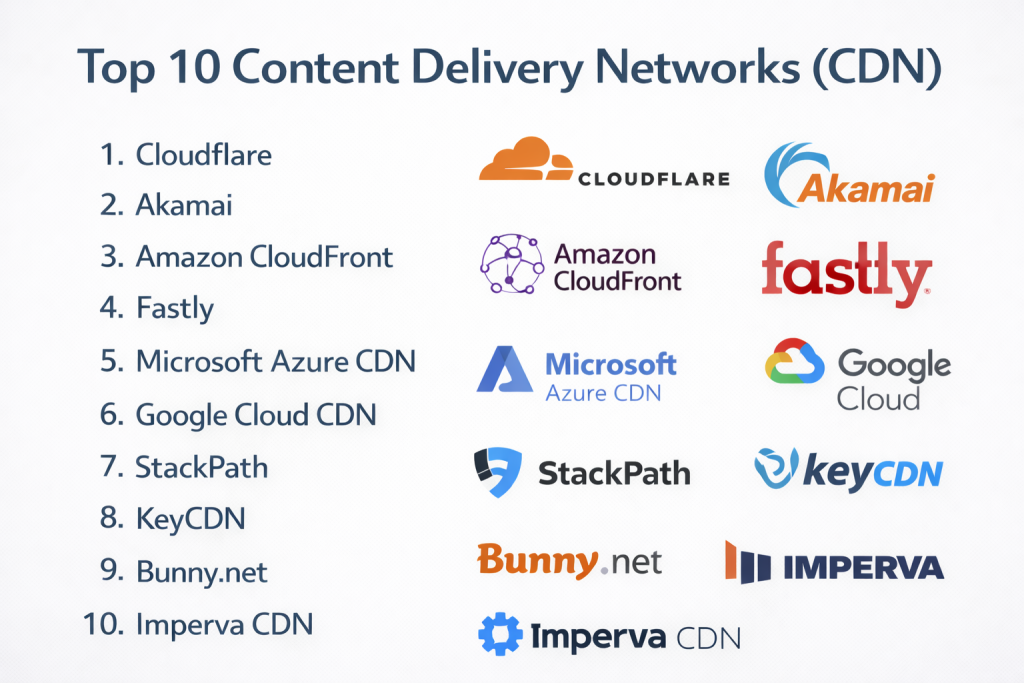
Top 10 Content Delivery Networks (CDN) Tools
#1 — Cloudflare
Short description: A widely used CDN platform offering performance, security, and edge computing capabilities in a single solution.
Key Features
- Global CDN with extensive edge network
- DDoS protection and WAF
- Edge computing (Workers)
- Smart caching and optimization
- Zero-trust security tools
- Real-time analytics
Pros
- Strong free tier available
- Excellent security features
Cons
- Advanced configurations can be complex
- Pricing can scale with usage
Platforms / Deployment
Web
Cloud
Security & Compliance
- DDoS protection, WAF, encryption, Zero Trust
- Additional certifications: Not publicly stated
Integrations & Ecosystem
Cloudflare integrates with a wide range of tools and platforms.
- APIs
- DevOps tools
- Hosting platforms
- Security tools
Support & Community
Large global community; enterprise support tiers available.
#2 — Akamai
Short description: One of the largest CDN providers, known for enterprise-grade performance, security, and global infrastructure.
Key Features
- Massive global edge network
- Advanced security solutions
- Media delivery optimization
- Edge computing capabilities
- Traffic management
- Analytics
Pros
- Industry-leading performance
- Strong enterprise capabilities
Cons
- Complex pricing
- Enterprise-focused setup
Platforms / Deployment
Web
Cloud
Security & Compliance
- Advanced security controls
- Additional certifications: Not publicly stated
Integrations & Ecosystem
Deep enterprise integrations.
- Cloud providers
- Security systems
- APIs
Support & Community
Enterprise-grade support and services.
#3 — Amazon CloudFront
Short description: A CDN service integrated with AWS, offering scalable and secure content delivery.
Key Features
- Global edge locations
- Integration with AWS services
- DDoS protection
- Real-time metrics
- Edge functions
- Content caching
Pros
- Seamless AWS integration
- Highly scalable
Cons
- Pricing complexity
- Requires AWS familiarity
Platforms / Deployment
Web
Cloud
Security & Compliance
- IAM, encryption, DDoS protection
- Additional certifications: Not publicly stated
Integrations & Ecosystem
Part of AWS ecosystem.
- S3
- Lambda
- API Gateway
Support & Community
Strong AWS support ecosystem.
#4 — Fastly
Short description: A high-performance CDN focused on real-time content delivery and edge computing.
Key Features
- Edge cloud platform
- Real-time caching control
- Instant purging
- Edge compute
- Streaming support
- API-driven control
Pros
- Fast content updates
- Developer-friendly
Cons
- Pricing may be high
- Requires technical knowledge
Platforms / Deployment
Web
Cloud
Security & Compliance
Not publicly stated
Integrations & Ecosystem
Developer-focused integrations.
- APIs
- DevOps tools
Support & Community
Good documentation; enterprise support available.
#5 — Microsoft Azure CDN
Short description: A CDN solution integrated into the Azure ecosystem, offering performance and security features.
Key Features
- Global edge network
- Integration with Azure services
- Load balancing
- Security features
- Analytics
- Custom domains
Pros
- Strong integration with Azure
- Enterprise-ready
Cons
- Complex pricing
- Azure dependency
Platforms / Deployment
Web
Cloud
Security & Compliance
- Encryption, access control
- Additional certifications: Not publicly stated
Integrations & Ecosystem
Part of Azure ecosystem.
- Azure services
- APIs
Support & Community
Enterprise-level support.
#6 — Google Cloud CDN
Short description: A high-performance CDN integrated with Google Cloud infrastructure.
Key Features
- Global edge network
- Load balancing
- SSL support
- Real-time analytics
- Integration with Google Cloud
- Caching controls
Pros
- Strong performance
- Scalable infrastructure
Cons
- Ecosystem dependency
- Pricing varies
Platforms / Deployment
Web
Cloud
Security & Compliance
- Encryption, IAM
- Additional compliance: Not publicly stated
Integrations & Ecosystem
Google Cloud integrations.
- Compute services
- APIs
Support & Community
Enterprise support available.
#7 — StackPath
Short description: A CDN and edge computing platform focused on performance and security.
Key Features
- Edge computing
- DDoS protection
- WAF
- Real-time analytics
- Content caching
- API access
Pros
- Good performance
- Security-focused
Cons
- Smaller network compared to leaders
- Limited ecosystem
Platforms / Deployment
Web
Cloud
Security & Compliance
- WAF, DDoS protection
- Additional compliance: Not publicly stated
Integrations & Ecosystem
Supports integrations via APIs.
- DevOps tools
- APIs
Support & Community
Moderate support; smaller community.
#8 — KeyCDN
Short description: A cost-effective CDN solution for developers and small businesses.
Key Features
- Pay-as-you-go pricing
- HTTP/2 support
- Real-time analytics
- Content optimization
- API access
- Easy setup
Pros
- Affordable pricing
- Simple configuration
Cons
- Limited advanced features
- Smaller network
Platforms / Deployment
Web
Cloud
Security & Compliance
Not publicly stated
Integrations & Ecosystem
Developer-friendly integrations.
- APIs
- CMS tools
Support & Community
Basic support; smaller community.
#9 — Bunny.net
Short description: A performance-focused CDN offering affordable and scalable content delivery.
Key Features
- Global edge network
- Video streaming support
- Edge storage
- Real-time analytics
- DDoS protection
- Simple pricing
Pros
- Cost-effective
- Easy to use
Cons
- Limited enterprise features
- Smaller ecosystem
Platforms / Deployment
Web
Cloud
Security & Compliance
Not publicly stated
Integrations & Ecosystem
Supports APIs and developer tools.
- APIs
- Hosting platforms
Support & Community
Growing community and support.
#10 — Imperva CDN
Short description: A CDN solution combined with strong security capabilities, including application protection.
Key Features
- CDN with integrated WAF
- DDoS protection
- Bot management
- Load balancing
- Content caching
- Analytics
Pros
- Strong security focus
- Enterprise-ready
Cons
- Pricing not transparent
- Complex setup
Platforms / Deployment
Web
Cloud
Security & Compliance
- WAF, DDoS, bot protection
- Additional compliance: Not publicly stated
Integrations & Ecosystem
Security-focused integrations.
- APIs
- Security tools
Support & Community
Enterprise-level support.
Comparison Table (Top 10)
| Tool Name | Best For | Platform(s) Supported | Deployment | Standout Feature | Public Rating |
|---|---|---|---|---|---|
| Cloudflare | All-in-one CDN | Web | Cloud | Security + performance | N/A |
| Akamai | Enterprises | Web | Cloud | Global infrastructure | N/A |
| Amazon CloudFront | AWS users | Web | Cloud | AWS integration | N/A |
| Fastly | Developers | Web | Cloud | Real-time edge control | N/A |
| Azure CDN | Azure users | Web | Cloud | Azure integration | N/A |
| Google Cloud CDN | GCP users | Web | Cloud | High performance | N/A |
| StackPath | Security CDN | Web | Cloud | Edge computing | N/A |
| KeyCDN | Budget users | Web | Cloud | Pay-as-you-go | N/A |
| Bunny.net | Affordable CDN | Web | Cloud | Cost efficiency | N/A |
| Imperva CDN | Security-first | Web | Cloud | WAF + CDN | N/A |
Evaluation & Scoring of Content Delivery Networks (CDN)
| Tool Name | Core (25%) | Ease (15%) | Integrations (15%) | Security (10%) | Performance (10%) | Support (10%) | Value (15%) | Weighted Total |
|---|---|---|---|---|---|---|---|---|
| Cloudflare | 9 | 9 | 9 | 9 | 9 | 8 | 9 | 9.0 |
| Akamai | 10 | 6 | 9 | 10 | 10 | 9 | 6 | 8.8 |
| CloudFront | 9 | 7 | 10 | 9 | 9 | 9 | 7 | 8.7 |
| Fastly | 9 | 7 | 8 | 8 | 10 | 8 | 7 | 8.3 |
| Azure CDN | 8 | 7 | 9 | 8 | 9 | 8 | 7 | 8.0 |
| Google CDN | 8 | 8 | 9 | 8 | 9 | 8 | 7 | 8.1 |
| StackPath | 7 | 8 | 7 | 8 | 8 | 7 | 8 | 7.6 |
| KeyCDN | 7 | 9 | 6 | 6 | 8 | 7 | 9 | 7.7 |
| Bunny.net | 7 | 9 | 6 | 6 | 8 | 7 | 9 | 7.7 |
| Imperva | 8 | 6 | 7 | 9 | 8 | 8 | 6 | 7.7 |
How to interpret scores:
- Higher scores indicate better balance across features and performance
- Enterprise tools score higher in security and scalability
- Budget tools score higher in value
- Developer-focused tools may score lower in ease but higher in flexibility
- Always prioritize your specific needs over total score
Which CDN Tool Is Right for You?
Solo / Freelancer
- Best options: KeyCDN, Bunny.net
- Focus on affordability and simplicity
SMB
- Best options: Cloudflare, Bunny.net
- Balance performance and cost
Mid-Market
- Best options: Fastly, StackPath
- Focus on performance and flexibility
Enterprise
- Best options: Akamai, CloudFront, Azure CDN
- Focus on scalability, security, and global reach
Budget vs Premium
- Budget: KeyCDN, Bunny.net
- Premium: Akamai, Cloudflare
Feature Depth vs Ease of Use
- Advanced: Akamai, Fastly
- Easy: Cloudflare, Bunny.net
Integrations & Scalability
- Strong integrations: CloudFront, Azure
- Lightweight: KeyCDN
Security & Compliance Needs
- High security: Cloudflare, Imperva
- Basic needs: KeyCDN
Frequently Asked Questions (FAQs)
What is a CDN?
A CDN is a network of distributed servers that deliver content based on user location.
Why do websites need a CDN?
To improve speed, reliability, and security.
Are CDNs expensive?
Pricing varies from free tiers to enterprise-level costs.
Can CDNs improve SEO?
Yes, faster load times can improve search rankings.
Do CDNs provide security?
Many include DDoS protection and web application firewalls.
How long does setup take?
Basic setups can take minutes to hours.
Can I use multiple CDNs?
Yes, multi-CDN strategies are common for redundancy.
Do CDNs work with APIs?
Yes, many support API acceleration.
Are CDNs only for large websites?
No, even small sites can benefit.
What are common mistakes?
Improper caching configuration and ignoring analytics.
Conclusion
CDNs are a critical component of modern web infrastructure, enabling faster, more secure, and scalable digital experiences.