Introduction
Restaurant Menu Engineering Tools help restaurants analyze menu performance, optimize pricing, control food costs, and maximize profitability. In simple terms, these tools use data from sales, recipes, and costs to determine which dishes are popular, profitable, or underperforming—and what to do about them.
Menu engineering is critical because a restaurant’s menu is its most powerful sales tool, directly influencing customer choices and profitability. These tools combine financial analysis (food cost, margins) with behavioral insights (menu design, pricing psychology) to improve revenue and reduce waste.
Common use cases include identifying high-margin items, optimizing menu layout, adjusting pricing, reducing food waste, and improving menu mix. Buyers should evaluate analytics depth, POS integration, recipe costing, reporting capabilities, scalability, ease of use, and real-time data insights.
Best for: restaurant owners, chefs, F&B managers, multi-location brands, and hospitality groups focused on profitability optimization.
Not ideal for: very small eateries with static menus or businesses not tracking food costs and sales data.
Key Trends in Restaurant Menu Engineering Tools
- AI-driven menu optimization and pricing recommendations
- Real-time food cost tracking and margin analysis
- Integration with POS, inventory, and procurement systems
- Automated menu engineering matrix (Star, Puzzle, Plowhorse, Dog)
- Predictive analytics for demand and pricing decisions
- Menu psychology insights (placement, pricing tiers, design)
- Cloud-based platforms for multi-location scalability
- Scenario testing for pricing and menu changes
- Integration with digital menus and online ordering systems
- Focus on reducing food waste and improving sustainability
How We Selected These Tools (Methodology)
- Evaluated adoption across restaurants and hospitality businesses
- Assessed menu engineering, costing, and analytics capabilities
- Reviewed integration with POS, inventory, and procurement systems
- Analyzed scalability for multi-location operations
- Considered ease of use for chefs and operators
- Evaluated real-time data and reporting features
- Reviewed AI and automation capabilities
- Assessed vendor ecosystem and integrations
- Considered pricing flexibility and ROI potential
- Ensured a mix of SMB and enterprise solutions
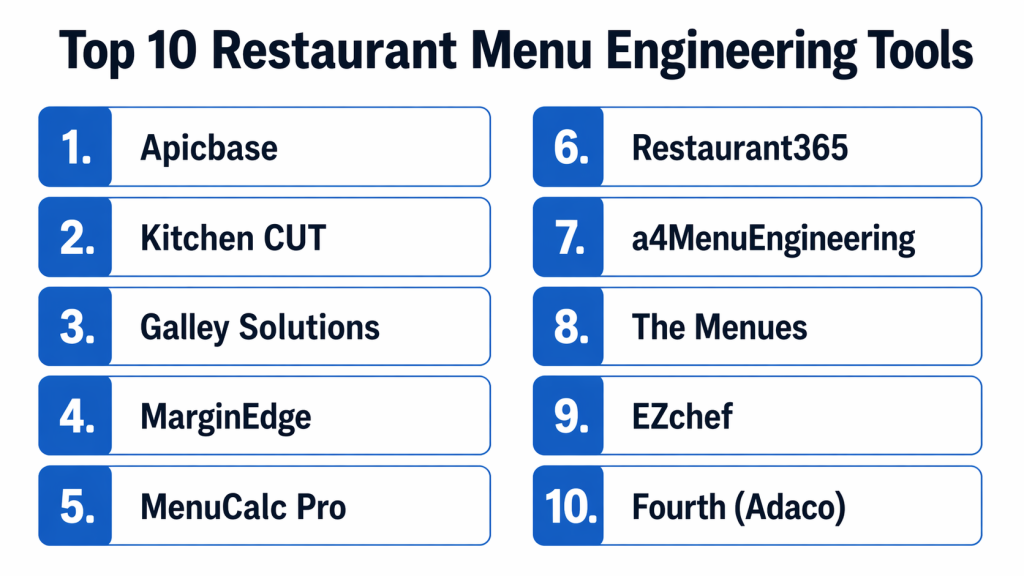
Top 10 Restaurant Menu Engineering Tools
#1 — Apicbase
Short description : Apicbase is a powerful back-of-house platform combining menu engineering, inventory, and recipe management to optimize food costs and operations across restaurant chains.
Key Features
- Recipe and cost management
- Menu engineering analytics
- Inventory tracking
- Procurement management
- Real-time cost updates
Pros
- Strong all-in-one platform
- Enterprise-ready
Cons
- Complex setup
- Higher cost
Platforms / Deployment
- Web / Cloud
Security & Compliance
- Not publicly stated
Integrations & Ecosystem
Apicbase integrates with core restaurant systems to provide end-to-end visibility.
- POS systems
- Inventory tools
- APIs
Support & Community
- Vendor onboarding and support
#2 — Kitchen CUT
Short description : Kitchen CUT provides menu engineering and costing tools focused on improving profitability and reducing food waste.
Key Features
- Food cost calculation
- Menu performance analysis
- Recipe management
- Waste reduction insights
- Profitability tracking
Pros
- Strong cost control
- Real-time insights
Cons
- Limited advanced AI
- Requires data input accuracy
Platforms / Deployment
- Web / Cloud
Security & Compliance
- Not publicly stated
Integrations & Ecosystem
- POS systems
- Inventory platforms
- APIs
Support & Community
- Vendor support
#3 — Galley Solutions
Short description : Galley Solutions focuses on data-driven menu engineering with deep integration into kitchen operations and recipe workflows.
Key Features
- Recipe-based data modeling
- Menu engineering analytics
- Kitchen workflow optimization
- Inventory integration
- Reporting dashboards
Pros
- Data-driven insights
- Strong back-of-house focus
Cons
- Learning curve
- Premium pricing
Platforms / Deployment
- Web / Cloud
Security & Compliance
- Not publicly stated
Integrations & Ecosystem
- Inventory systems
- POS tools
- APIs
Support & Community
- Enterprise support
#4 — MarginEdge
Short description : MarginEdge simplifies menu costing and profitability tracking by automating invoice processing and integrating financial data.
Key Features
- Food cost tracking
- Invoice automation
- Menu profitability insights
- Reporting dashboards
- Integration with accounting systems
Pros
- Easy to use
- Strong financial insights
Cons
- Limited advanced menu design features
- Focus on cost over UX
Platforms / Deployment
- Web / Cloud
Security & Compliance
- Not publicly stated
Integrations & Ecosystem
- Accounting tools
- POS systems
- APIs
Support & Community
- Vendor support
#5 — MenuCalc Pro
Short description : MenuCalc Pro is a data-focused tool designed for small to mid-sized restaurants to analyze menu profitability and performance.
Key Features
- Profitability analysis
- Menu matrix classification
- Food cost tracking
- Reporting tools
- POS data import
Pros
- Easy to understand analytics
- Affordable
Cons
- Limited scalability
- Basic integrations
Platforms / Deployment
- Web / Cloud
Security & Compliance
- Not publicly stated
Integrations & Ecosystem
- POS systems
- APIs
Support & Community
- Documentation and support
#6 — Restaurant365
Short description : Restaurant365 is a comprehensive platform combining accounting, inventory, and menu engineering insights.
Key Features
- Financial analytics
- Menu performance tracking
- Inventory management
- Reporting dashboards
- Multi-location support
Pros
- All-in-one platform
- Strong financial integration
Cons
- Complex setup
- Higher cost
Platforms / Deployment
- Web / Cloud
Security & Compliance
- Not publicly stated
Integrations & Ecosystem
- Accounting systems
- POS platforms
- APIs
Support & Community
- Enterprise support
#7 — a4MenuEngineering
Short description : a4MenuEngineering uses a matrix-based approach to categorize menu items and improve profitability.
Key Features
- Menu matrix analysis
- Profitability insights
- Item classification
- Reporting dashboards
- Optimization recommendations
Pros
- Simple analytics
- Clear decision-making
Cons
- Limited integrations
- Basic UI
Platforms / Deployment
- Web / Cloud
Security & Compliance
- Not publicly stated
Integrations & Ecosystem
- Data tools
- APIs
Support & Community
- Vendor support
#8 — The Menues
Short description : The Menues platform visualizes menu performance and helps restaurants make data-driven pricing and design decisions.
Key Features
- Menu visualization
- Performance analytics
- Cost tracking
- Pricing insights
- Reporting tools
Pros
- Easy visualization
- Good for decision-making
Cons
- Limited automation
- Smaller ecosystem
Platforms / Deployment
- Web / Cloud
Security & Compliance
- Not publicly stated
Integrations & Ecosystem
- POS systems
- APIs
Support & Community
- Vendor support
#9 — EZchef
Short description : EZchef provides detailed menu engineering reports including food cost, margin, and popularity analysis.
Key Features
- Menu matrix analysis
- Food cost tracking
- Profitability reports
- Category analysis
- Visual charts
Pros
- Detailed reporting
- Strong analytics
Cons
- Outdated UI
- Limited integrations
Platforms / Deployment
- Web / Cloud
Security & Compliance
- Not publicly stated
Integrations & Ecosystem
- POS data import
- APIs
Support & Community
- Documentation and support
#10 — Fourth (Adaco)
Short description : Fourth provides enterprise-level menu engineering combined with inventory, procurement, and recipe management.
Key Features
- Recipe management
- Cost tracking
- Procurement integration
- Menu analytics
- Reporting dashboards
Pros
- Enterprise-grade
- Strong integration
Cons
- Expensive
- Complex implementation
Platforms / Deployment
- Web / Cloud
Security & Compliance
- Not publicly stated
Integrations & Ecosystem
- Procurement systems
- POS tools
- APIs
Support & Community
- Enterprise support
Comparison Table (Top 10)
| Tool Name | Best For | Platform(s) Supported | Deployment | Standout Feature | Public Rating |
|---|---|---|---|---|---|
| Apicbase | Enterprise | Web | Cloud | All-in-one system | N/A |
| Kitchen CUT | SMB | Web | Cloud | Cost tracking | N/A |
| Galley Solutions | Enterprise | Web | Cloud | Data-driven insights | N/A |
| MarginEdge | SMB | Web | Cloud | Invoice automation | N/A |
| MenuCalc Pro | SMB | Web | Cloud | Simple analytics | N/A |
| Restaurant365 | Enterprise | Web | Cloud | Financial integration | N/A |
| a4MenuEngineering | SMB | Web | Cloud | Matrix analysis | N/A |
| The Menues | SMB | Web | Cloud | Visualization | N/A |
| EZchef | Analytics | Web | Cloud | Detailed reports | N/A |
| Fourth (Adaco) | Enterprise | Web | Cloud | Procurement integration | N/A |
Evaluation & Scoring of Restaurant Menu Engineering Tools
| Tool Name | Core (25%) | Ease (15%) | Integrations (15%) | Security (10%) | Performance (10%) | Support (10%) | Value (15%) | Weighted Total |
|---|---|---|---|---|---|---|---|---|
| Apicbase | 9 | 7 | 8 | 7 | 8 | 8 | 7 | 8.0 |
| Kitchen CUT | 8 | 8 | 7 | 7 | 8 | 7 | 8 | 7.8 |
| Galley Solutions | 9 | 6 | 8 | 7 | 9 | 8 | 6 | 7.9 |
| MarginEdge | 8 | 9 | 7 | 7 | 8 | 7 | 8 | 8.0 |
| MenuCalc Pro | 7 | 9 | 6 | 7 | 7 | 7 | 8 | 7.5 |
| Restaurant365 | 9 | 6 | 8 | 7 | 8 | 8 | 6 | 7.9 |
| a4MenuEngineering | 7 | 8 | 6 | 7 | 7 | 7 | 7 | 7.2 |
| The Menues | 7 | 8 | 6 | 7 | 7 | 6 | 7 | 7.1 |
| EZchef | 8 | 7 | 6 | 7 | 7 | 6 | 7 | 7.2 |
| Fourth | 9 | 6 | 9 | 7 | 8 | 8 | 6 | 8.0 |
Scores are comparative and should be used to shortlist tools based on priorities like analytics depth, integrations, and ease of use.
Which Restaurant Menu Engineering Tool Is Right for You?
Solo / Small Restaurant
- MenuCalc Pro or Kitchen CUT for simple insights and affordability
SMB
- MarginEdge, Kitchen CUT for cost control and usability
Mid-Market
- Galley Solutions, Restaurant365 for analytics and scalability
Enterprise
- Apicbase, Fourth for full operational integration
Budget vs Premium
- Budget → MenuCalc Pro
- Premium → Apicbase, Fourth
Feature Depth vs Ease of Use
- Easy → MarginEdge
- Advanced → Galley Solutions
Integrations & Scalability
- Choose tools integrated with POS and inventory systems
Security & Compliance Needs
- Enterprise platforms offer stronger control and reporting
Frequently Asked Questions (FAQs)
1. What is menu engineering software?
It analyzes menu items based on popularity and profitability to improve revenue.
2. Why is it important?
It helps maximize profit and reduce food costs.
3. How does it work?
It combines sales data and food costs to analyze performance.
4. What is the menu matrix?
It categorizes items into Star, Puzzle, Plowhorse, and Dog.
5. Can it reduce food waste?
Yes, by identifying underperforming items.
6. Does it integrate with POS systems?
Yes, most tools support POS integration.
7. Is it suitable for small restaurants?
Yes, SMB-friendly options exist.
8. How often should menus be analyzed?
Typically quarterly or during seasonal changes.
9. Can it improve pricing?
Yes, it helps optimize pricing strategies.
10. What is the biggest benefit?
Higher profitability through smarter menu decisions.
Conclusion
Restaurant menu engineering tools have become essential for data-driven decision-making in modern hospitality. By combining sales data, food costs, and customer behavior insights, these platforms help restaurants identify high-performing dishes, optimize pricing, and eliminate inefficiencies. Whether you are a small restaurant looking to improve margins or a large chain managing complex operations, there is a solution tailored to your needs. Tools like MarginEdge and Kitchen CUT offer simplicity and quick wins, while enterprise platforms like Apicbase and Fourth deliver deep operational integration. The best approach is to start with your biggest pain point—cost control, pricing, or analytics—and choose a tool that aligns with your workflow, then continuously refine your menu strategy for long-term profitability.