Introduction
Returns Management Software helps businesses handle product returns, exchanges, refunds, and reverse logistics efficiently. In simple terms, it manages everything that happens after a customer sends a product back—from request initiation to inspection, restocking, and refund processing. Instead of manual tracking or disconnected systems, these tools automate workflows, improve visibility, and reduce operational costs.
This category has become critical because returns are a major operational and financial challenge in e-commerce and retail. A structured returns system can improve customer satisfaction, reduce fraud, optimize inventory recovery, and retain revenue through exchanges or store credits .
Common use cases include return request automation, exchange handling, fraud detection, warehouse processing, refund automation, and analytics on return reasons. Buyers should evaluate automation capabilities, integration with OMS/WMS systems, analytics depth, customer experience, scalability, and compliance.
Best for: e-commerce brands, retailers, D2C businesses, logistics teams, and enterprises handling high return volumes.
Not ideal for: very small sellers with minimal returns or businesses that manage returns manually without complexity.
Key Trends in Returns Management Software
- AI-driven fraud detection and return validation
- Exchange-first workflows to retain revenue instead of refunds
- Omnichannel returns (online + offline integration)
- Automation of return approvals and workflows
- Real-time tracking of returned products
- Integration with logistics and warehouse systems
- Self-service return portals for customers
- Data analytics for return reasons and trends
- Reverse logistics optimization for cost reduction
- Focus on customer experience and retention
How We Selected These Tools (Methodology)
- Evaluated industry adoption across e-commerce and retail
- Assessed feature completeness (returns, exchanges, refunds, analytics)
- Reviewed integration with ERP, OMS, WMS, and logistics systems
- Considered scalability for high return volumes
- Evaluated automation and AI capabilities
- Assessed customer experience features (self-service portals)
- Reviewed reporting and analytics depth
- Considered vendor ecosystem and integrations
- Evaluated ease of use and onboarding
- Factored in ROI and cost efficiency
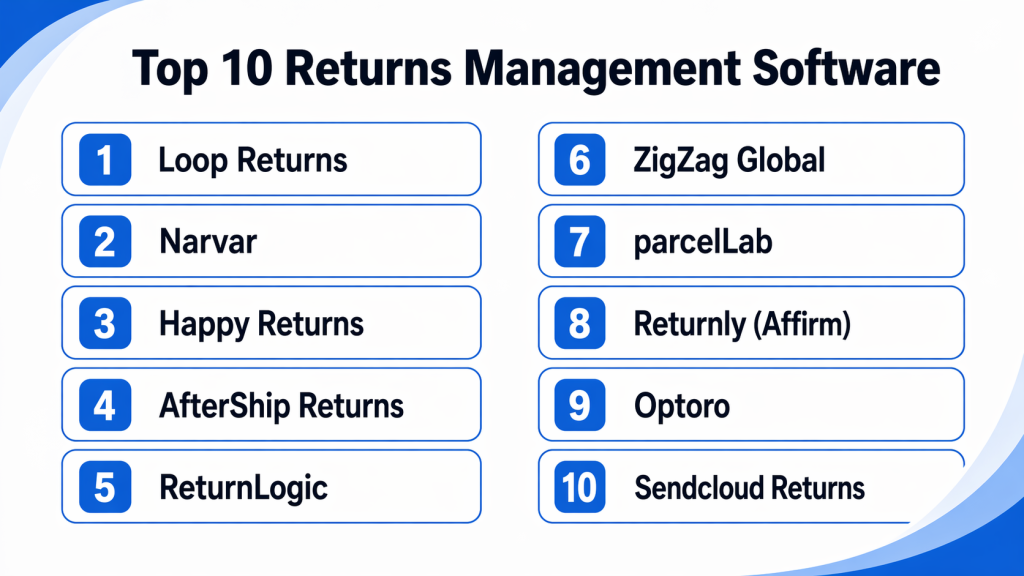
Top 10 Returns Management Software
#1 — Loop Returns
Short description : Loop Returns is a popular platform designed for e-commerce brands, focusing on exchange-first workflows to retain revenue and improve customer experience.
Key Features
- Exchange-first returns system
- Automated return workflows
- Customer self-service portal
- Fraud prevention tools
- Shipping and tracking integration
Pros
- Increases revenue retention
- Strong customer experience
Cons
- Best suited for Shopify and D2C brands
- Requires integration setup
Platforms / Deployment
- Web / Cloud
Security & Compliance
- Not publicly stated
Integrations & Ecosystem
- Shopify and e-commerce platforms
- Shipping providers
- APIs
Support & Community
- Vendor support and onboarding
#2 — Narvar
Short description : Narvar is an enterprise-grade post-purchase and returns platform designed for omnichannel retailers.
Key Features
- Omnichannel returns management
- Customer notifications
- Return tracking
- Analytics dashboards
- Fraud prevention
Pros
- Enterprise scalability
- Strong omnichannel support
Cons
- Expensive
- Complex implementation
Platforms / Deployment
- Web / Cloud
Security & Compliance
- Not publicly stated
Integrations & Ecosystem
- OMS, WMS, logistics providers
- APIs
Support & Community
- Enterprise support
#3 — Happy Returns
Short description : Happy Returns provides reverse logistics solutions with drop-off networks and AI-driven fraud detection.
Key Features
- Boxless return drop-offs
- Reverse logistics network
- Fraud detection tools
- Refund processing
- Analytics
Pros
- Fast return handling
- Strong logistics network
Cons
- Limited customization
- Region-specific availability
Platforms / Deployment
- Web / Cloud
Security & Compliance
- Not publicly stated
Integrations & Ecosystem
- Retailers and logistics partners
- APIs
Support & Community
- Vendor support
#4 — AfterShip Returns
Short description : AfterShip provides a returns management platform with tracking, automation, and analytics capabilities.
Key Features
- Return tracking
- Automated workflows
- Analytics dashboards
- Customer notifications
- Multi-channel support
Pros
- Easy integration
- Strong tracking features
Cons
- Limited advanced customization
- Requires integration effort
Platforms / Deployment
- Web / Cloud
Security & Compliance
- Not publicly stated
Integrations & Ecosystem
- E-commerce platforms
- APIs
- Logistics providers
Support & Community
- Documentation and support
#5 — ReturnLogic
Short description : ReturnLogic offers analytics-driven returns management, helping retailers optimize processes and reduce costs.
Key Features
- Returns analytics
- Exchange management
- Customer experience tools
- Fraud protection
- Reporting dashboards
Pros
- Strong analytics
- Good for optimization
Cons
- Learning curve
- Setup required
Platforms / Deployment
- Web / Cloud
Security & Compliance
- Not publicly stated
Integrations & Ecosystem
- E-commerce platforms
- APIs
Support & Community
- Vendor support
#6 — ZigZag Global
Short description : ZigZag Global focuses on cross-border returns and reverse logistics for global retailers.
Key Features
- Global returns network
- Multi-country support
- Return tracking
- Carrier integrations
- Analytics
Pros
- Strong international capabilities
- Logistics support
Cons
- Complex setup
- Premium pricing
Platforms / Deployment
- Web / Cloud
Security & Compliance
- Not publicly stated
Integrations & Ecosystem
- Logistics providers
- APIs
Support & Community
- Vendor support
#7 — parcelLab
Short description : parcelLab provides post-purchase and returns management solutions focused on customer communication and experience.
Key Features
- Returns tracking
- Customer notifications
- Analytics
- Integration with logistics
- Automation
Pros
- Strong customer communication
- Good analytics
Cons
- Limited full workflow automation
- Not standalone for all needs
Platforms / Deployment
- Web / Cloud
Security & Compliance
- Not publicly stated
Integrations & Ecosystem
- Logistics providers
- APIs
Support & Community
- Vendor support
#8 — Returnly (Affirm)
Short description : Returnly enables instant refunds and seamless return experiences for e-commerce customers.
Key Features
- Instant refunds
- Exchange workflows
- Customer portal
- Analytics
- Automation
Pros
- Improves customer experience
- Faster refunds
Cons
- Requires integration
- Cost considerations
Platforms / Deployment
- Web / Cloud
Security & Compliance
- Not publicly stated
Integrations & Ecosystem
- Payment providers
- E-commerce platforms
Support & Community
- Vendor support
#9 — FarEye Returns Management
Short description : FarEye provides end-to-end reverse logistics and returns management for large enterprises.
Key Features
- Reverse logistics management
- Pickup and inspection workflows
- Analytics dashboards
- Automation tools
- Integration with delivery systems
Pros
- Strong logistics integration
- Enterprise-ready
Cons
- Complex implementation
- Premium pricing
Platforms / Deployment
- Web / Cloud
Security & Compliance
- Not publicly stated
Integrations & Ecosystem
- Logistics and delivery systems
- APIs
Support & Community
- Enterprise support
#10 — Sendcloud Returns
Short description : Sendcloud provides a unified platform for managing returns across multiple sales channels.
Key Features
- Multi-channel returns
- Automation workflows
- Return policy control
- Tracking
- Analytics
Pros
- Easy to use
- Multi-channel support
Cons
- Limited advanced features
- Best for SMBs
Platforms / Deployment
- Web / Cloud
Security & Compliance
- Not publicly stated
Integrations & Ecosystem
- E-commerce platforms
- Shipping providers
Support & Community
- Vendor support
Comparison Table (Top 10)
| Tool Name | Best For | Platform | Deployment | Standout Feature | Public Rating |
|---|---|---|---|---|---|
| Loop Returns | D2C brands | Web | Cloud | Exchange-first model | N/A |
| Narvar | Enterprise | Web | Cloud | Omnichannel returns | N/A |
| Happy Returns | Logistics | Web | Cloud | Drop-off network | N/A |
| AfterShip | SMB | Web | Cloud | Tracking & automation | N/A |
| ReturnLogic | Analytics | Web | Cloud | Returns insights | N/A |
| ZigZag Global | Global retail | Web | Cloud | Cross-border returns | N/A |
| parcelLab | CX-focused | Web | Cloud | Customer communication | N/A |
| Returnly | Refunds | Web | Cloud | Instant refunds | N/A |
| FarEye | Enterprise | Web | Cloud | Reverse logistics | N/A |
| Sendcloud | SMB | Web | Cloud | Multi-channel returns | N/A |
Evaluation & Scoring of Returns Management Software
| Tool | Core | Ease | Integrations | Security | Performance | Support | Value | Total |
|---|---|---|---|---|---|---|---|---|
| Loop Returns | 9 | 8 | 8 | 7 | 8 | 8 | 8 | 8.2 |
| Narvar | 9 | 7 | 9 | 8 | 9 | 8 | 6 | 8.3 |
| Happy Returns | 8 | 8 | 7 | 7 | 8 | 7 | 7 | 7.6 |
| AfterShip | 8 | 9 | 8 | 7 | 8 | 7 | 8 | 8.0 |
| ReturnLogic | 8 | 7 | 7 | 7 | 8 | 7 | 7 | 7.4 |
| ZigZag | 8 | 7 | 8 | 7 | 8 | 7 | 7 | 7.6 |
| parcelLab | 7 | 7 | 7 | 7 | 7 | 7 | 7 | 7.0 |
| Returnly | 8 | 8 | 7 | 7 | 8 | 7 | 7 | 7.6 |
| FarEye | 9 | 6 | 9 | 8 | 9 | 8 | 6 | 8.1 |
| Sendcloud | 7 | 9 | 7 | 7 | 7 | 7 | 8 | 7.4 |
Scores are comparative and help shortlist tools based on priorities like automation, scalability, and integrations.
Which Returns Management Software Is Right for You?
Solo / Freelancer
- Sendcloud or AfterShip for simple and affordable returns workflows
SMB
- Loop Returns, AfterShip, or Sendcloud for automation and ease of use
Mid-Market
- ReturnLogic, ZigZag, or parcelLab for analytics and scalability
Enterprise
- Narvar, FarEye, or Happy Returns for full reverse logistics and omnichannel capabilities
Budget vs Premium
- SMB → cost-effective tools
- Enterprise → full-featured platforms
Feature Depth vs Ease of Use
- Simple tools → faster onboarding
- Advanced tools → better analytics and automation
Integrations & Scalability
- Choose tools that integrate with OMS, WMS, and logistics providers
Security & Compliance Needs
- Enterprises should prioritize compliance and fraud detection
Frequently Asked Questions (FAQs)
1. What is returns management software?
It automates the process of handling returns, refunds, and exchanges in retail or e-commerce.
2. Why is it important?
It improves customer satisfaction, reduces costs, and optimizes inventory recovery.
3. Can it reduce return rates?
Yes, by analyzing return reasons and improving product experience.
4. Does it support exchanges?
Yes, most platforms support exchanges and store credits.
5. Can it integrate with logistics?
Yes, integration with shipping and warehouse systems is common.
6. Is it suitable for small businesses?
Yes, there are SMB-friendly solutions available.
7. How long does implementation take?
Cloud solutions can be deployed quickly; enterprise tools take longer.
8. Does it help with fraud detection?
Yes, modern tools include fraud prevention features.
9. Can it handle omnichannel returns?
Yes, many tools support both online and offline returns.
10. What is the biggest benefit?
Efficient returns processing and improved customer experience.
Conclusion
Returns management software has become a critical component of modern retail and e-commerce operations, helping businesses balance customer satisfaction with cost control. As return volumes increase, manual processes are no longer sufficient—automation, analytics, and integration are essential for efficiency. SMBs can benefit from tools like AfterShip or Sendcloud, while larger enterprises should consider Narvar, FarEye, or Happy Returns for comprehensive reverse logistics capabilities. The right solution depends on your scale, return complexity, and integration needs. A smart approach is to shortlist a few tools, run pilot implementations, and evaluate their impact on operational efficiency and customer experience before full adoption.