Introduction
Fleet Management Tools are software platforms that help businesses monitor, manage, and optimize vehicles, drivers, fuel usage, maintenance, and overall fleet operations. These tools typically combine GPS tracking, telematics, analytics, and automation to provide real-time visibility and control over fleet performance.
In today’s logistics-heavy and service-driven industries, fleet efficiency directly impacts cost, safety, and customer satisfaction. Fleet management software enables organizations to reduce fuel consumption, improve driver behavior, and ensure compliance—all from a centralized dashboard.
Common use cases include:
- Real-time vehicle tracking and route optimization
- Monitoring driver behavior and safety
- Managing maintenance schedules and vehicle health
- Fuel usage tracking and cost optimization
- Compliance with transportation regulations
What buyers should evaluate:
- GPS tracking accuracy and real-time visibility
- Driver safety and telematics features
- Maintenance and fleet lifecycle management
- Integration with logistics and ERP systems
- Scalability for growing fleets
- Automation and alerts
- Reporting and analytics
- Mobile accessibility
- Security and compliance
- Pricing and ROI
Best for: logistics companies, delivery businesses, construction firms, transport operators, and enterprises managing vehicle fleets.
Not ideal for: businesses with very few vehicles or those not requiring real-time fleet monitoring.
Key Trends in Fleet Management Tools
- AI-powered route optimization and predictive maintenance
- Real-time GPS tracking and telematics integration
- Video telematics and driver safety monitoring
- Integration with IoT devices and sensors
- Cloud-based fleet platforms for scalability
- Fuel efficiency and emissions tracking
- Automation of fleet operations and workflows
- Mobile-first fleet management apps
- Data-driven decision-making and analytics
- Integration with broader supply chain systems
How We Selected These Tools (Methodology)
- Market adoption and industry recognition
- Feature completeness across fleet operations
- Integration capabilities with logistics systems
- Scalability for SMB and enterprise use cases
- Automation and telematics capabilities
- Security and compliance readiness
- Ease of use and onboarding
- Vendor support and ecosystem
- Performance in real-world fleet operations
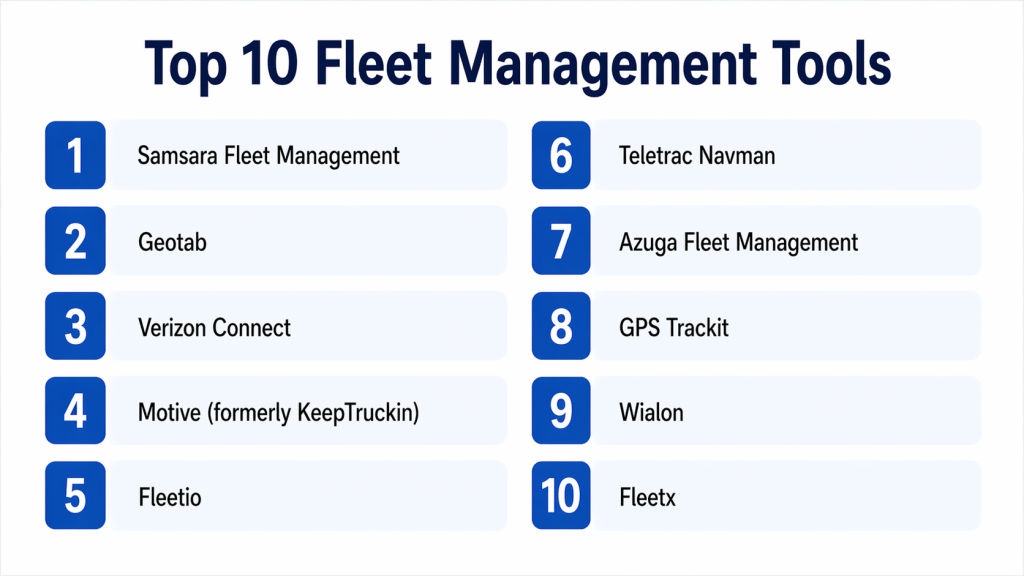
Top 10 Fleet Management Tools
#1 — Samsara Fleet Management
Short description:
Samsara is a leading fleet management platform offering real-time GPS tracking, driver safety monitoring, and AI-powered insights. It combines hardware and software for full fleet visibility. Ideal for enterprises and logistics companies. Known for strong analytics and automation capabilities.
Key Features
- Real-time GPS tracking
- Video telematics
- Route optimization
- Driver safety monitoring
- Fleet analytics
Pros
- Advanced AI capabilities
- Strong real-time visibility
Cons
- Hardware dependency
- Premium pricing
Platforms / Deployment
Cloud
Security & Compliance
Not publicly stated
Integrations & Ecosystem
- APIs
- ERP and logistics tools
Support & Community
Enterprise-level support.
#2 — Geotab
Short description:
Geotab is a highly scalable fleet management platform focused on data analytics and telematics. It provides detailed insights into vehicle performance, driver behavior, and compliance. Suitable for businesses of all sizes. Known for flexibility and customization.
Key Features
- GPS tracking
- Driver behavior monitoring
- Fleet analytics
- Compliance tools
- Custom dashboards
Pros
- Strong analytics
- Highly customizable
Cons
- Complex interface
- Requires configuration
Platforms / Deployment
Cloud
Security & Compliance
Not publicly stated
Integrations & Ecosystem
- Third-party marketplace
- APIs
Support & Community
Strong ecosystem and support.
#3 — Verizon Connect
Short description:
Verizon Connect provides fleet tracking and telematics solutions for businesses of all sizes. It helps track vehicles, optimize routes, and manage driver performance. Known for reliability and enterprise-grade features.
Key Features
- GPS tracking
- Route optimization
- Driver monitoring
- Maintenance tracking
- Reporting
Pros
- Reliable platform
- Strong brand trust
Cons
- Expensive
- Setup complexity
Platforms / Deployment
Cloud
Security & Compliance
Not publicly stated
Integrations & Ecosystem
- APIs
- Enterprise integrations
Support & Community
Enterprise support.
#4 — Fleetio
Short description:
Fleetio focuses on fleet maintenance and operational management. It helps businesses track vehicle health, automate maintenance schedules, and manage costs. Ideal for SMBs and mid-market companies.
Key Features
- Maintenance tracking
- Cost management
- Fleet analytics
- Automation
- Reporting
Pros
- Easy to use
- Strong maintenance features
Cons
- Limited GPS tracking features
- Requires integrations
Platforms / Deployment
Cloud
Security & Compliance
Not publicly stated
Integrations & Ecosystem
- APIs
- Maintenance tools
Support & Community
Good support.
#5 — Motive (KeepTruckin)
Short description:
Motive offers a comprehensive fleet management solution with telematics, safety, and compliance tools. It helps businesses monitor fleets in real time and improve driver safety. Suitable for logistics companies.
Key Features
- GPS tracking
- Driver safety monitoring
- Compliance tools
- Fleet analytics
- Automation
Pros
- Strong compliance features
- Real-time insights
Cons
- Hardware dependency
- Pricing varies
Platforms / Deployment
Cloud
Security & Compliance
Not publicly stated
Integrations & Ecosystem
- APIs
- Logistics systems
Support & Community
Strong support.
#6 — Fleetx
Short description:
Fleetx is an AI-powered fleet management platform focused on logistics optimization. It provides real-time tracking, analytics, and automation. Ideal for transport and logistics companies.
Key Features
- Real-time tracking
- AI analytics
- Route optimization
- Driver monitoring
- Automation
Pros
- AI-driven insights
- Scalable
Cons
- Learning curve
- Pricing varies
Platforms / Deployment
Cloud
Security & Compliance
Not publicly stated
Integrations & Ecosystem
- APIs
- Logistics tools
Support & Community
Good support.
#7 — Wialon
Short description:
Wialon is a flexible fleet management platform supporting various industries. It offers real-time tracking and advanced analytics. Known for customization and scalability.
Key Features
- Real-time tracking
- Analytics
- Custom dashboards
- Automation
- Reporting
Pros
- Highly customizable
- Scalable
Cons
- Requires setup
- UI complexity
Platforms / Deployment
Cloud
Security & Compliance
Not publicly stated
Integrations & Ecosystem
- APIs
- IoT integrations
Support & Community
Strong ecosystem.
#8 — Azuga
Short description:
Azuga focuses on driver safety and fleet tracking. It uses AI-powered insights to improve driver behavior and reduce risks. Ideal for SMBs and mid-sized businesses.
Key Features
- GPS tracking
- Driver scoring
- Safety monitoring
- Reporting
- Alerts
Pros
- Strong safety features
- Easy to use
Cons
- Limited enterprise depth
- Hardware required
Platforms / Deployment
Cloud
Security & Compliance
Not publicly stated
Integrations & Ecosystem
- APIs
- Fleet tools
Support & Community
Good support.
#9 — GPS Trackit
Short description:
GPS Trackit is a user-friendly fleet management platform offering tracking, compliance, and analytics features. Suitable for small to mid-sized businesses. Known for ease of use.
Key Features
- GPS tracking
- Compliance tools
- Reporting
- Alerts
- Automation
Pros
- Easy to use
- Affordable
Cons
- Limited advanced features
- Smaller ecosystem
Platforms / Deployment
Cloud
Security & Compliance
Not publicly stated
Integrations & Ecosystem
- APIs
Support & Community
Good SMB support.
#10 — Odoo Fleet
Short description:
Odoo Fleet is a simple and flexible fleet management module within the Odoo ecosystem. It helps manage vehicles, costs, and maintenance. Suitable for SMBs.
Key Features
- Vehicle tracking
- Cost management
- Maintenance tracking
- Reporting
- Integration with Odoo apps
Pros
- Affordable
- Easy to customize
Cons
- Limited advanced features
- Requires setup
Platforms / Deployment
Cloud / Self-hosted
Security & Compliance
Varies / N/A
Integrations & Ecosystem
- Odoo ecosystem
- APIs
Support & Community
Large community support.
Comparison Table (Top 10)
| Tool Name | Best For | Platform(s) Supported | Deployment | Standout Feature | Public Rating |
|---|---|---|---|---|---|
| Samsara | Enterprise | Web | Cloud | AI telematics | N/A |
| Geotab | All sizes | Web | Cloud | Analytics | N/A |
| Verizon Connect | Enterprise | Web | Cloud | Reliability | N/A |
| Fleetio | SMB | Web | Cloud | Maintenance | N/A |
| Motive | Logistics | Web | Cloud | Compliance | N/A |
| Fleetx | Logistics | Web | Cloud | AI insights | N/A |
| Wialon | Enterprise | Web | Cloud | Customization | N/A |
| Azuga | SMB | Web | Cloud | Driver safety | N/A |
| GPS Trackit | SMB | Web | Cloud | Ease of use | N/A |
| Odoo Fleet | SMB | Web | Hybrid | Flexibility | N/A |
Evaluation & Scoring of Fleet Management Tools
| Tool Name | Core (25%) | Ease (15%) | Integrations (15%) | Security (10%) | Performance (10%) | Support (10%) | Value (15%) | Weighted Total |
|---|---|---|---|---|---|---|---|---|
| Samsara | 9 | 7 | 9 | 8 | 9 | 8 | 7 | 8.3 |
| Geotab | 9 | 7 | 9 | 8 | 9 | 8 | 7 | 8.3 |
| Verizon | 9 | 7 | 8 | 8 | 9 | 8 | 6 | 8.1 |
| Fleetio | 7 | 9 | 7 | 6 | 7 | 7 | 9 | 7.7 |
| Motive | 8 | 8 | 8 | 7 | 8 | 8 | 7 | 7.9 |
| Fleetx | 8 | 7 | 8 | 7 | 8 | 7 | 7 | 7.7 |
| Wialon | 8 | 7 | 9 | 7 | 8 | 7 | 7 | 7.8 |
| Azuga | 7 | 9 | 7 | 6 | 7 | 7 | 8 | 7.5 |
| GPS Trackit | 7 | 9 | 7 | 6 | 7 | 7 | 8 | 7.5 |
| Odoo | 7 | 9 | 7 | 6 | 7 | 7 | 9 | 7.6 |
How to interpret scores:
These scores are comparative and highlight differences in features, usability, and value. Enterprise tools excel in analytics and scalability, while SMB tools perform better in ease of use and affordability.
Which Fleet Management Tool Is Right for You?
Solo / Freelancer
Basic GPS tracking tools are sufficient.
SMB
Fleetio, Azuga, and GPS Trackit are ideal.
Mid-Market
Motive and Fleetx provide balanced capabilities.
Enterprise
Samsara, Geotab, and Verizon Connect are best suited.
Budget vs Premium
Budget tools offer basic tracking, while premium tools provide analytics and automation.
Feature Depth vs Ease of Use
Choose based on operational complexity.
Integrations & Scalability
Ensure compatibility with logistics systems.
Security & Compliance Needs
Enterprises should prioritize compliance and audit features.
Frequently Asked Questions (FAQs)
1. What is fleet management software?
Fleet management software helps businesses manage vehicles, drivers, and operations from a centralized platform. It tracks location, performance, and maintenance. It improves efficiency and reduces costs.
2. How does fleet tracking work?
Fleet tracking uses GPS and telematics to monitor vehicle location and activity in real time.
3. Who needs fleet management tools?
Logistics companies, transport providers, and businesses with multiple vehicles benefit the most.
4. What features should I look for?
GPS tracking, analytics, automation, and integration capabilities are essential.
5. Is fleet management software expensive?
Costs vary based on features and fleet size.
6. Can fleet tools improve driver safety?
Yes, they monitor behavior and provide alerts to improve safety.
7. Do these tools support compliance?
Yes, many tools support regulatory compliance features.
8. Can I integrate fleet tools with ERP?
Most modern tools offer integration with ERP systems.
9. What are common challenges?
Implementation and training can be challenging.
10. What are alternatives?
Manual tracking or basic GPS tools, though less efficient.
Conclusion
Fleet Management Tools are essential for businesses looking to optimize transportation operations, improve safety, and reduce costs. They provide real-time visibility, automation, and analytics that enable better decision-making and operational efficiency. From simple tracking tools to enterprise-grade platforms, there are solutions for every business size and complexity. The right choice depends on your fleet size, operational needs, and integration requirements. Instead of focusing only on features, evaluate how well the tool fits into your workflows and long-term goals. Shortlist a few options, test them in real-world scenarios, and validate their impact before making a final decision.