Introduction
AutoML (Automated Machine Learning) platforms are designed to simplify and accelerate the creation, training, and deployment of machine learning models by automating complex steps such as data preprocessing, feature engineering, model selection, hyperparameter tuning, and evaluation. These platforms empower both data scientists and business analysts to build predictive models efficiently, reducing dependency on specialized ML expertise.
AutoML platforms have become increasingly essential for organizations seeking to operationalize AI and derive actionable insights from data without the need for extensive machine learning expertise.
Real-world use cases include:
- Predictive analytics for customer churn or sales forecasting
- Fraud detection and risk management
- Marketing personalization and recommendation systems
- Credit scoring and insurance risk modeling
- Time-series forecasting for operations and supply chain
Key evaluation criteria for buyers:
- Supported algorithms and model types (classification, regression, NLP, vision)
- Automated feature engineering and preprocessing
- Model evaluation, interpretability, and explainability
- Deployment capabilities and MLOps integration
- Integration with cloud services and data sources
- Scalability for large datasets and distributed computing
- Collaboration and workflow automation
- Security, governance, and compliance
- Visualization and reporting capabilities
- Ease of use and learning curve
Best for:
AutoML platforms are ideal for business analysts, data scientists, ML engineers, and IT teams who need to rapidly prototype and deploy predictive models.
Not ideal for:
Organizations with very small datasets, niche model requirements, or advanced custom model development may require traditional ML frameworks rather than AutoML.
Key Trends in AutoML Platforms
- Cloud-native AutoML services for on-demand compute and scalability
- Integration with MLOps pipelines for production deployment
- Automated feature engineering and preprocessing
- Support for tabular, image, text, and time-series data
- Explainable AI for model transparency
- Low-code and no-code AutoML interfaces
- Integration with data lakes, warehouses, and BI tools
- Support for ensemble models and hyperparameter optimization
- Collaboration tools for team-based ML development
- Security, governance, and compliance for enterprise usage
How We Selected These Tools (Methodology)
- Evaluated end-to-end AutoML capabilities, including preprocessing, feature engineering, and model selection
- Assessed algorithm coverage (tabular, NLP, vision, time-series)
- Reviewed scalability and performance for large datasets
- Checked MLOps, deployment, and model monitoring features
- Considered collaboration and workflow automation
- Examined integration with cloud services, storage, and BI tools
- Evaluated explainable AI and model interpretability
- Assessed ease of use, user experience, and low-code support
- Reviewed security, governance, and compliance features
- Ensured suitability across freelancers, SMBs, mid-market, and enterprise organizations
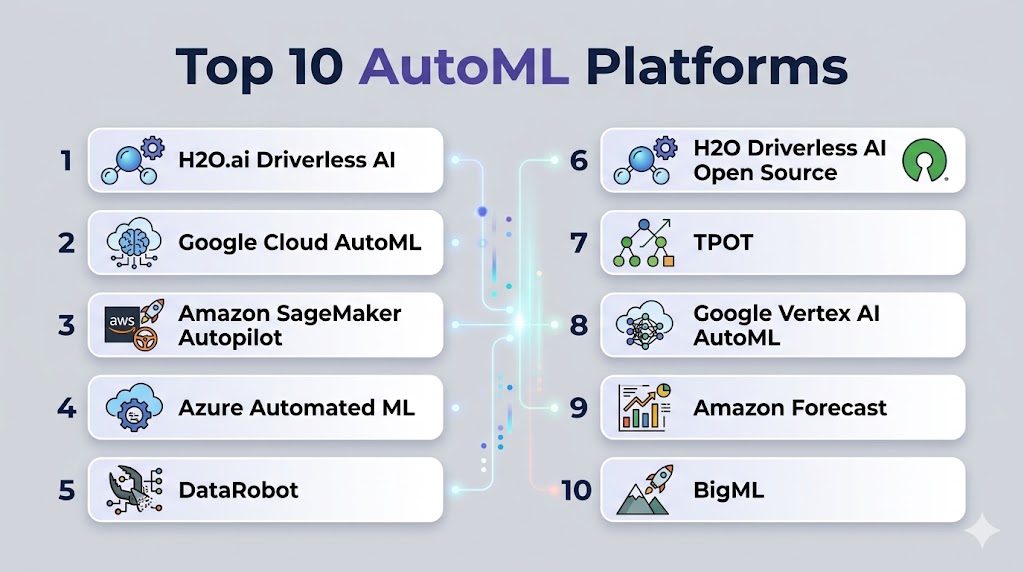
Top 10 AutoML Platforms
#1 — H2O.ai Driverless AI
Short description: H2O.ai Driverless AI is an enterprise AutoML platform designed for automatic model training, feature engineering, and deployment.
Key Features
- Automated feature engineering and model selection
- GPU-accelerated distributed training
- Explainable AI and model interpretability
- Time-series, tabular, NLP, and vision support
- Deployment to cloud or on-premise
- Model tracking and reproducibility
- Integration with Python and R
Pros
- Fast and scalable AutoML
- Enterprise-grade MLOps support
Cons
- High licensing cost
- Advanced usage requires ML understanding
Platforms / Deployment
- Linux / Cloud / On-prem / Hybrid
Security & Compliance
- RBAC, encryption, SOC 2, GDPR
Integrations & Ecosystem
- Python, R, Spark, cloud storage
Support & Community
- Enterprise support
- Active community
#2 — Google Cloud AutoML
Short description: Google Cloud AutoML is a suite of cloud services that provides automated model training for vision, language, and structured data.
Key Features
- Cloud-native AutoML for various data types
- Pre-trained model customization
- Deployment to Google Cloud endpoints
- Real-time prediction APIs
- Integration with BigQuery and GCS
- Visualization and evaluation tools
Pros
- Managed service with cloud scalability
- Easy-to-use for non-technical users
Cons
- Cloud-only, potential vendor lock-in
- Limited low-level customization
Platforms / Deployment
- Cloud
Security & Compliance
- IAM, encryption, SOC 2, GDPR
Integrations & Ecosystem
- GCP ecosystem, BigQuery, cloud storage
Support & Community
- Google Cloud support
- Active community
#3 — Amazon SageMaker Autopilot
Short description: SageMaker Autopilot automatically preprocesses data, selects algorithms, tunes hyperparameters, and deploys ML models on AWS.
Key Features
- Automated data preprocessing and feature engineering
- Model selection and hyperparameter tuning
- Cloud deployment to SageMaker endpoints
- Integration with notebooks and pipelines
- Supports tabular and structured data
- Explainability and model evaluation
Pros
- Fully managed AutoML
- Seamless AWS integration
Cons
- Cloud-only
- Pricing scales with compute usage
Platforms / Deployment
- Cloud
Security & Compliance
- IAM, encryption, SOC 2, GDPR
Integrations & Ecosystem
- AWS services, BI tools, ML frameworks
Support & Community
- AWS support
- Community forums
#4 — Azure Automated ML
Short description: Azure Automated ML provides a cloud platform to automatically build, train, and deploy ML models using a low-code approach.
Key Features
- AutoML for classification, regression, and forecasting
- Hyperparameter optimization
- Deployment to Azure endpoints
- Integration with Azure ML pipelines
- Explainable AI and model interpretability
- Visualization dashboards
Pros
- Cloud-native with enterprise MLOps
- Supports low-code experimentation
Cons
- Cloud-only
- Learning curve for non-Azure users
Platforms / Deployment
- Cloud
Security & Compliance
- SSO, RBAC, encryption, SOC 2, GDPR
Integrations & Ecosystem
- Azure ML, Data Lake, BI tools
Support & Community
- Microsoft enterprise support
- Active community
#5 — DataRobot
Short description: DataRobot is an enterprise AutoML platform that accelerates model building, deployment, and monitoring for predictive analytics.
Key Features
- Automated feature engineering and model selection
- Model interpretability and explainability
- Deployment to cloud or on-premise endpoints
- Supports tabular, text, image, and time-series data
- MLOps pipelines and model monitoring
- Collaboration tools for teams
Pros
- Comprehensive end-to-end AutoML
- Enterprise-grade scalability
Cons
- High licensing cost
- Limited custom algorithm flexibility
Platforms / Deployment
- Cloud / On-prem / Hybrid
Security & Compliance
- Encryption, SSO, SOC 2, GDPR
Integrations & Ecosystem
- Python, R, cloud storage, BI tools
Support & Community
- Enterprise support
- Knowledge base and community
#6 — H2O Driverless AI Open Source
Short description: Open-source variant of H2O.ai AutoML for individual data scientists and smaller projects.
Key Features
- AutoML pipelines
- Feature engineering and selection
- GPU acceleration
- Supports tabular datasets
- Model interpretability
Pros
- Free and open-source
- Flexible for smaller teams
Cons
- Limited enterprise features
- Less cloud deployment support
Platforms / Deployment
- Linux / Cloud / On-prem / Hybrid
Security & Compliance
- Depends on deployment
Integrations & Ecosystem
- Python, R, cloud storage, BI tools
Support & Community
- Open-source community
- Documentation and forums
#7 — TPOT
Short description: TPOT is a Python AutoML library that automatically optimizes machine learning pipelines using genetic programming.
Key Features
- Automated feature preprocessing and model selection
- Hyperparameter optimization
- Scikit-learn integration
- Open-source Python library
Pros
- Free and open-source
- Easy integration with Python pipelines
Cons
- CPU-intensive
- Less suitable for large datasets
Platforms / Deployment
- Linux / Windows / macOS / Cloud
- Cloud / On-prem / Hybrid
Security & Compliance
- Depends on deployment
Integrations & Ecosystem
- Scikit-learn, Python libraries, cloud storage
Support & Community
- Open-source community
- GitHub documentation
#8 — Google Vertex AI AutoML
Short description: Vertex AI AutoML is a Google Cloud service that automates model building and deployment with managed infrastructure.
Key Features
- AutoML for tabular, vision, NLP, and time-series data
- Deployment to managed endpoints
- Integrated with Vertex pipelines
- Pre-trained model templates
- Explainable AI and evaluation tools
Pros
- Fully managed and scalable
- Supports multiple data types
Cons
- Cloud-only
- GCP vendor lock-in
Platforms / Deployment
- Cloud
Security & Compliance
- IAM, encryption, SOC 2, GDPR
Integrations & Ecosystem
- GCS, BigQuery, ML frameworks
Support & Community
- Google Cloud support
- Active community
#9 — Amazon Forecast
Short description: Amazon Forecast is a fully managed AutoML service for time-series forecasting.
Key Features
- Automated feature selection and model building for forecasting
- Integration with AWS data sources
- Deployment and prediction endpoints
- Built-in evaluation and accuracy metrics
- Cloud-native
Pros
- Fully managed
- Optimized for time-series data
Cons
- Limited to forecasting
- Cloud-only
Platforms / Deployment
- Cloud
Security & Compliance
- IAM, encryption, SOC 2, GDPR
Integrations & Ecosystem
- AWS services, cloud storage
Support & Community
- AWS enterprise support
- Community forums
#10 — BigML
Short description: BigML is a cloud-based AutoML platform for predictive modeling and machine learning.
Key Features
- Classification, regression, clustering, and anomaly detection
- Automated feature engineering
- Model deployment and monitoring
- Low-code web interface
- Integration with cloud storage and APIs
Pros
- Easy-to-use interface
- Cloud-managed service
Cons
- Limited customizability
- Dependent on cloud environment
Platforms / Deployment
- Cloud
Security & Compliance
- Encryption, IAM, GDPR
Integrations & Ecosystem
- Cloud storage, APIs, BI tools
Support & Community
- Enterprise support
- Active user community
Comparison Table (Top 10)
| Tool Name | Best For | Platform(s) Supported | Deployment | Standout Feature | Public Rating |
|---|---|---|---|---|---|
| H2O.ai Driverless AI | Enterprise AutoML | Linux / Cloud / On-prem / Hybrid | Cloud / On-prem / Hybrid | GPU-accelerated AutoML | N/A |
| Google Cloud AutoML | Cloud ML | Cloud | Cloud | Pre-trained model customization | N/A |
| Amazon SageMaker Autopilot | Cloud ML | Cloud | Cloud | Full AWS integration | N/A |
| Azure Automated ML | Cloud ML | Cloud | Cloud | Low-code experimentation | N/A |
| DataRobot | Enterprise AutoML | Cloud / On-prem / Hybrid | Cloud / On-prem / Hybrid | End-to-end automation | N/A |
| H2O Driverless AI Open Source | Open-source AutoML | Linux / Cloud / On-prem / Hybrid | Cloud / On-prem / Hybrid | Feature engineering | N/A |
| TPOT | Python AutoML | Linux / Windows / macOS / Cloud | Cloud / On-prem / Hybrid | Genetic programming pipelines | N/A |
| Google Vertex AI AutoML | Cloud ML | Cloud | Cloud | Managed multi-data-type AutoML | N/A |
| Amazon Forecast | Time-series AutoML | Cloud | Cloud | Forecast-specific AutoML | N/A |
| BigML | Cloud ML | Cloud | Cloud | Low-code predictive modeling | N/A |
Evaluation & Scoring of AutoML Platforms
| Tool Name | Core (25%) | Ease (15%) | Integrations (15%) | Security (10%) | Performance (10%) | Support (10%) | Value (15%) | Weighted Total (0–10) |
|---|---|---|---|---|---|---|---|---|
| H2O.ai Driverless AI | 9 | 8 | 8 | 8 | 9 | 8 | 7 | 8.3 |
| Google Cloud AutoML | 8 | 8 | 8 | 8 | 8 | 7 | 7 | 7.8 |
| Amazon SageMaker Autopilot | 8 | 8 | 8 | 8 | 8 | 7 | 7 | 7.8 |
| Azure Automated ML | 8 | 8 | 8 | 8 | 8 | 7 | 7 | 7.8 |
| DataRobot | 9 | 8 | 8 | 8 | 9 | 8 | 7 | 8.3 |
| H2O Driverless AI Open Source | 8 | 7 | 7 | 7 | 8 | 7 | 7 | 7.4 |
| TPOT | 7 | 8 | 7 | 7 | 7 | 6 | 7 | 7.1 |
| Google Vertex AI AutoML | 8 | 8 | 8 | 8 | 8 | 7 | 7 | 7.8 |
| Amazon Forecast | 7 | 8 | 7 | 7 | 7 | 6 | 7 | 7.1 |
| BigML | 7 | 8 | 7 | 7 | 7 | 6 | 7 | 7.1 |
Which AutoML Platform Is Right for You?
Solo / Freelancer
H2O Driverless AI Open Source or TPOT provides free or open-source AutoML tools for experimentation.
SMB
Google Cloud AutoML, Azure Automated ML, or BigML offers cloud-managed AutoML services with low operational overhead.
Mid-Market
H2O.ai Driverless AI or DataRobot supports scalable automated ML workflows and enterprise-grade collaboration.
Enterprise
DataRobot, Vertex AI AutoML, and SageMaker Autopilot provide comprehensive AutoML features, governance, and deployment for large-scale ML initiatives.
Budget vs Premium
Open-source AutoML reduces licensing costs, while managed enterprise solutions offer advanced features and production readiness.
Feature Depth vs Ease of Use
Low-code platforms like BigML or Google AutoML simplify ML adoption, while DataRobot and H2O.ai Driverless AI provide deep customization and scalability.
Integrations & Scalability
Select AutoML platforms that connect with data warehouses, cloud services, and MLOps pipelines.
Security & Compliance Needs
For enterprise usage, choose platforms with RBAC, encryption, audit logs, and regulatory compliance features.
Frequently Asked Questions (FAQs)
What is an AutoML platform?
A platform that automates the creation, training, tuning, and deployment of machine learning models.
Can non-technical users use AutoML?
Yes, platforms like BigML, Google AutoML, and Azure Automated ML provide low-code/no-code interfaces.
Are these platforms cloud-only?
Many are cloud-native, but some like H2O Driverless AI offer on-premise deployment.
Can AutoML handle different data types?
Yes, modern AutoML platforms support tabular, text, image, and time-series data.
Do they support model deployment?
Most platforms include MLOps features for deployment, monitoring, and scaling.
Are these platforms scalable?
Cloud-native AutoML platforms can scale for large datasets and distributed training.
Are the models interpretable?
Top AutoML platforms provide explainable AI and model interpretability features.
Can AutoML replace data scientists?
AutoML accelerates workflows but cannot fully replace expertise for complex tasks.
How do I integrate AutoML with my data pipeline?
Platforms provide connectors for databases, cloud storage, and BI tools.
How to choose the right AutoML platform?
Consider team expertise, cloud/on-prem preference, data types, scalability, and deployment needs.
Conclusion
AutoML platforms simplify machine learning by automating model creation, feature engineering, hyperparameter tuning, and deployment. Freelancers and small teams can leverage H2O Driverless AI Open Source or TPOT for experimentation. SMBs benefit from cloud-managed services like Google Cloud AutoML, Azure Automated ML, or BigML for low-code predictive modeling. Mid-market organizations can adopt H2O.ai Driverless AI or DataRobot for scalable, enterprise-ready workflows. Enterprises requiring full-featured AutoML, governance, and deployment options can rely on DataRobot, Vertex AI AutoML, or SageMaker Autopilot. Choosing the right platform involves evaluating ease of use, scalability, integration, security, and deployment requirements. Testing with critical datasets ensures the platform meets business and technical goals, enabling faster AI-driven insights and operational efficiency.