Introduction
Audit Management Software helps organizations plan, execute, document, and monitor internal and external audits in a structured and automated way. These platforms replace manual spreadsheets and fragmented processes with a centralized system that improves audit efficiency, risk visibility, compliance tracking, and reporting accuracy.
In modern enterprises, audit complexity has increased due to stricter regulations, distributed systems, and large volumes of operational data. Audit management tools solve this by offering workflow automation, real-time dashboards, evidence collection, and integrated risk tracking.
Common Use Cases
- Internal audit planning and execution
- Compliance audits (regulatory frameworks)
- Risk-based auditing and controls testing
- Audit issue tracking and remediation
- Enterprise governance and reporting
What Buyers Should Evaluate
- Audit workflow automation and scheduling
- Risk-based audit planning capabilities
- Evidence collection and documentation tools
- Reporting and dashboard quality
- Integration with GRC and ERP systems
- Ease of use for audit teams
- Scalability for enterprise environments
- Compliance framework support
- Cost vs operational value
Best for: Internal audit teams, compliance officers, risk managers, and enterprise governance teams.
Not ideal for: Small organizations with minimal compliance or audit requirements.
Key Trends in Audit Management Software
- AI-powered audit planning and anomaly detection
- Continuous auditing instead of periodic audits
- Integration with GRC, ERP, and risk platforms
- Cloud-based audit management replacing legacy systems
- Automation of audit workflows and reporting
- Real-time risk and control monitoring
- Data-driven audit analytics and insights
- Standardization of audit processes across enterprises
- Low-code workflow customization for audit teams
- Improved collaboration between audit and compliance teams
How We Selected These Tools (Methodology)
- Strong industry adoption in audit and compliance domains
- Proven end-to-end audit lifecycle management capabilities
- Integration with GRC, ERP, and enterprise systems
- Availability of automation and analytics features
- Support for risk-based auditing frameworks
- Suitability for mid-market and enterprise organizations
- Strong documentation and vendor support
- Balance between usability and advanced functionality
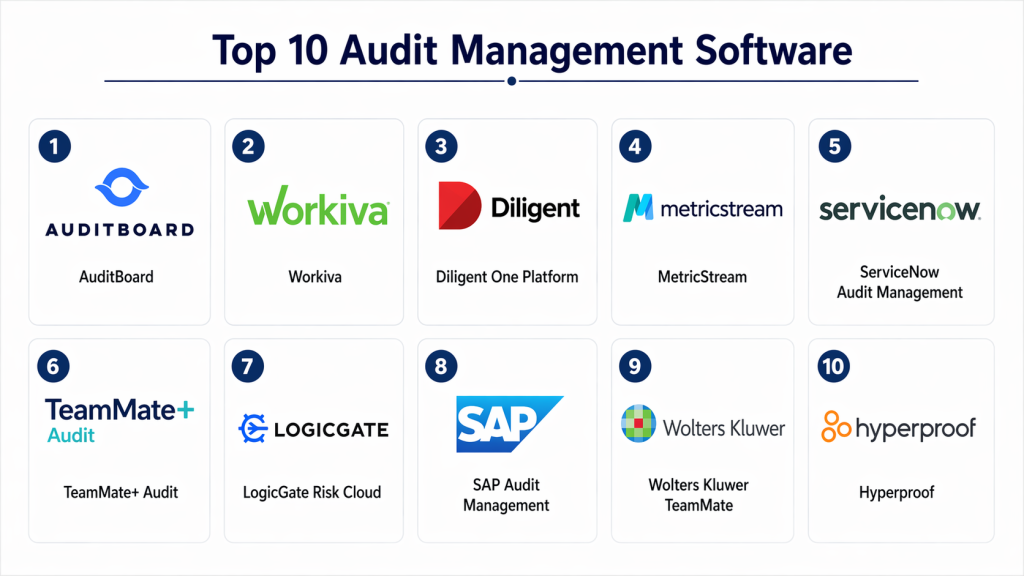
Top 10 Audit Management Software
#1 — AuditBoard
Short description: A leading audit management platform designed for internal audit, risk, and compliance teams.
Key Features
- Audit planning and execution
- Risk-based audit workflows
- Issue tracking and remediation
- Compliance management
- Reporting dashboards
- Control testing automation
Pros
- Highly scalable enterprise platform
- Strong audit workflow automation
Cons
- Premium pricing
- Requires onboarding and training
Platforms / Deployment
- Cloud
Security & Compliance
- RBAC, encryption
- Compliance support varies
Integrations & Ecosystem
- GRC platforms
- ERP systems
- APIs
Support & Community
Strong enterprise support and resources.
#2 — Workiva
Short description: A cloud platform focused on audit, compliance reporting, and financial controls.
Key Features
- Audit documentation
- Financial reporting
- Compliance workflows
- Data linking and traceability
- Collaboration tools
Pros
- Strong reporting capabilities
- Excellent collaboration features
Cons
- Limited deep audit specialization
- Premium cost
Platforms / Deployment
- Cloud
Security & Compliance
- Not publicly stated
Integrations & Ecosystem
- ERP systems
- APIs
Support & Community
Enterprise-grade support.
#3 — Diligent One Platform
Short description: A governance, risk, and audit platform combining multiple compliance functions.
Key Features
- Audit management
- Risk tracking
- Compliance workflows
- Board reporting
- Policy management
Pros
- Strong governance capabilities
- Unified GRC platform
Cons
- Complex setup
- Requires training
Platforms / Deployment
- Cloud
Security & Compliance
- Not publicly stated
Integrations & Ecosystem
- Enterprise systems
- APIs
Support & Community
Enterprise support.
#4 — MetricStream Audit Management
Short description: A robust enterprise audit platform integrated with risk and compliance management.
Key Features
- Risk-based auditing
- Compliance tracking
- Audit lifecycle management
- Controls testing
- Analytics dashboards
Pros
- Strong enterprise scalability
- Deep GRC integration
Cons
- Complex implementation
- Higher cost
Platforms / Deployment
- Cloud / Hybrid
Security & Compliance
- Not publicly stated
Integrations & Ecosystem
- GRC tools
- ERP systems
- APIs
Support & Community
Enterprise support.
#5 — ServiceNow Audit Management
Short description: An audit solution built within the ServiceNow ecosystem for workflow automation.
Key Features
- Audit planning
- Risk-based auditing
- Issue tracking
- Workflow automation
- Integration with ITSM
Pros
- Powerful workflow automation
- Strong integration ecosystem
Cons
- Requires ServiceNow platform
- Premium pricing
Platforms / Deployment
- Cloud
Security & Compliance
- Not publicly stated
Integrations & Ecosystem
- ServiceNow suite
- APIs
Support & Community
Strong enterprise support.
#6 — TeamMate+ Audit
Short description: A widely used internal audit management solution for enterprises.
Key Features
- Audit planning and scheduling
- Workpaper management
- Risk assessment
- Reporting tools
- Issue tracking
Pros
- Audit-focused design
- Strong enterprise usage
Cons
- Complex UI
- Requires training
Platforms / Deployment
- Cloud / On-prem
Security & Compliance
- Not publicly stated
Integrations & Ecosystem
- ERP systems
- APIs
Support & Community
Enterprise support.
#7 — LogicGate Risk Cloud
Short description: A flexible audit and risk management platform with no-code workflow capabilities.
Key Features
- Audit workflows
- Risk management
- Compliance tracking
- Automation tools
- Custom applications
Pros
- Highly flexible
- Easy customization
Cons
- Less audit-specific depth
- Growing ecosystem
Platforms / Deployment
- Cloud
Security & Compliance
- Not publicly stated
Integrations & Ecosystem
- APIs
- Business tools
Support & Community
Good support.
#8 — SAP Audit Management
Short description: Enterprise audit solution integrated within SAP ecosystem.
Key Features
- Audit planning
- Risk assessment
- Control testing
- SAP data integration
- Reporting
Pros
- Strong ERP integration
- Enterprise-grade scalability
Cons
- Complex setup
- SAP dependency
Platforms / Deployment
- Cloud / Hybrid
Security & Compliance
- Not publicly stated
Integrations & Ecosystem
- SAP ecosystem
- APIs
Support & Community
Enterprise support.
#9 — Wolters Kluwer TeamMate
Short description: A trusted audit solution widely used in regulated industries.
Key Features
- Audit lifecycle management
- Risk assessment
- Compliance tracking
- Reporting dashboards
- Workpaper management
Pros
- Strong regulatory focus
- Reliable platform
Cons
- Less modern UI
- Requires training
Platforms / Deployment
- Cloud / On-prem
Security & Compliance
- Not publicly stated
Integrations & Ecosystem
- Enterprise systems
- APIs
Support & Community
Strong support.
#10 — Hyperproof Audit Management
Short description: A modern compliance and audit platform focused on automation and visibility.
Key Features
- Audit automation
- Compliance tracking
- Risk management
- Evidence collection
- Reporting dashboards
Pros
- Easy to use
- Strong automation
Cons
- Limited deep audit customization
- Smaller ecosystem
Platforms / Deployment
- Cloud
Security & Compliance
- Not publicly stated
Integrations & Ecosystem
- APIs
- SaaS tools
Support & Community
Good support.
Comparison Table (Top 10)
| Tool Name | Best For | Platform(s) Supported | Deployment | Standout Feature | Public Rating |
|---|---|---|---|---|---|
| AuditBoard | Enterprise audit | Web | Cloud | Audit automation | N/A |
| Workiva | Reporting | Web | Cloud | Data linking | N/A |
| Diligent | Governance | Web | Cloud | GRC integration | N/A |
| MetricStream | Risk-heavy orgs | Web | Hybrid | Risk-based auditing | N/A |
| ServiceNow | IT enterprises | Web | Cloud | Workflow automation | N/A |
| TeamMate+ | Internal audit | Web | Hybrid | Audit lifecycle tools | N/A |
| LogicGate | Flexibility | Web | Cloud | No-code workflows | N/A |
| SAP Audit | SAP users | Web | Hybrid | ERP integration | N/A |
| Wolters Kluwer | Regulated industries | Web | Hybrid | Compliance focus | N/A |
| Hyperproof | SMB/modern teams | Web | Cloud | Automation-first | N/A |
Evaluation & Scoring of Audit Management Software
| Tool Name | Core (25%) | Ease (15%) | Integrations (15%) | Security (10%) | Performance (10%) | Support (10%) | Value (15%) | Weighted Total |
|---|---|---|---|---|---|---|---|---|
| AuditBoard | 9 | 9 | 8 | 9 | 9 | 8 | 7 | 8.5 |
| Workiva | 8 | 8 | 8 | 8 | 8 | 8 | 7 | 8.0 |
| Diligent | 8 | 7 | 8 | 8 | 8 | 8 | 7 | 7.9 |
| MetricStream | 9 | 7 | 9 | 9 | 9 | 8 | 7 | 8.5 |
| ServiceNow | 9 | 8 | 9 | 9 | 9 | 8 | 7 | 8.6 |
| TeamMate+ | 8 | 7 | 8 | 8 | 8 | 8 | 7 | 7.9 |
| LogicGate | 8 | 9 | 8 | 8 | 8 | 8 | 8 | 8.2 |
| SAP Audit | 8 | 7 | 9 | 9 | 9 | 8 | 7 | 8.3 |
| Wolters Kluwer | 8 | 7 | 8 | 8 | 8 | 8 | 7 | 7.9 |
| Hyperproof | 7 | 9 | 7 | 7 | 7 | 7 | 8 | 7.7 |
Which Audit Management Software Is Right for You?
Solo / Freelancer
Use Hyperproof for simplicity.
SMB
Use LogicGate or Hyperproof.
Mid-Market
Use Workiva or TeamMate+.
Enterprise
Use AuditBoard, MetricStream, or ServiceNow.
Budget vs Premium
- Budget: Hyperproof, LogicGate
- Premium: AuditBoard, ServiceNow
Feature Depth vs Ease of Use
- Deep features: ServiceNow
- Ease of use: Hyperproof
Integrations & Scalability
Best: SAP Audit, ServiceNow
Security & Compliance Needs
Best: MetricStream, Wolters Kluwer
Frequently Asked Questions (FAQs)
1. What is audit management software?
It is a tool for managing audit processes digitally.
2. Why is it important?
It improves audit efficiency and compliance.
3. Does it support automation?
Yes, most tools automate workflows.
4. Can it manage risk?
Yes, many tools include risk modules.
5. Is it cloud-based?
Most modern tools are cloud-native.
6. Who uses it?
Audit and compliance teams.
7. Can it integrate with ERP systems?
Yes, integration is common.
8. Is it suitable for enterprises?
Yes, it is widely used in enterprises.
9. Does it support reporting?
Yes, dashboards and reports are core features.
10. What is the biggest benefit?
Centralized and automated audit management.
Conclusion
Audit Management Software plays a critical role in helping organizations streamline audits, improve compliance, and strengthen risk visibility. By automating workflows and centralizing audit data, these platforms reduce manual effort and ensure consistency across audit processes. As regulatory expectations continue to grow, organizations need scalable and intelligent audit systems to maintain control and transparency. While enterprise platforms offer deep functionality and integration, mid-sized organizations can still benefit from flexible and easy-to-use solutions. The key is to evaluate your audit complexity, select a few suitable tools, and validate how well they integrate with your governance and risk ecosystem.