Introduction
eDiscovery Software is used to identify, collect, process, review, and produce electronically stored information (ESI) for legal, compliance, and investigative purposes. This includes emails, documents, chat messages, cloud data, and other digital records that may be required during litigation, audits, or regulatory inquiries.
As organizations generate massive volumes of data across multiple platforms, manual discovery processes are no longer practical. Modern eDiscovery tools leverage automation, AI-driven document review, analytics, and cloud scalability to streamline legal workflows, reduce costs, and improve accuracy. These tools are essential for legal teams, compliance officers, and organizations that must manage large-scale data investigations.
Common Use Cases
- Legal litigation and case preparation
- Regulatory compliance and audits
- Internal investigations and HR cases
- Data governance and risk management
- Managing large volumes of digital evidence
What Buyers Should Evaluate
- Data source coverage (email, cloud, endpoints, chat)
- Search, filtering, and analytics capabilities
- AI-assisted document review and tagging
- Ease of use for legal and non-technical users
- Scalability for large datasets
- Security and compliance features
- Integration with legal and IT systems
- Reporting and export capabilities
- Cost vs value
Best for: Legal teams, compliance officers, corporate investigators, and enterprises managing large volumes of digital data.
Not ideal for: Small organizations with minimal legal or compliance requirements.
Key Trends in eDiscovery Software
- AI-powered document review and predictive coding
- Cloud-native eDiscovery platforms replacing on-prem systems
- Integration with collaboration tools (email, chat, SaaS apps)
- Automation of data collection and processing workflows
- Advanced analytics and visualization of case data
- Focus on data privacy and compliance requirements
- Expansion into cross-border and multi-jurisdictional support
- API-driven integrations with legal tech ecosystems
- Real-time data processing and search capabilities
- Reduction of manual review through machine learning
How We Selected These Tools (Methodology)
- Strong market adoption and credibility in legal industry
- Proven capabilities across the full eDiscovery lifecycle
- Integration with modern data sources and cloud platforms
- Availability of AI and automation features
- Suitability for different organization sizes
- Strong security and compliance capabilities
- Robust documentation and support ecosystems
- Balance between enterprise and user-friendly platforms
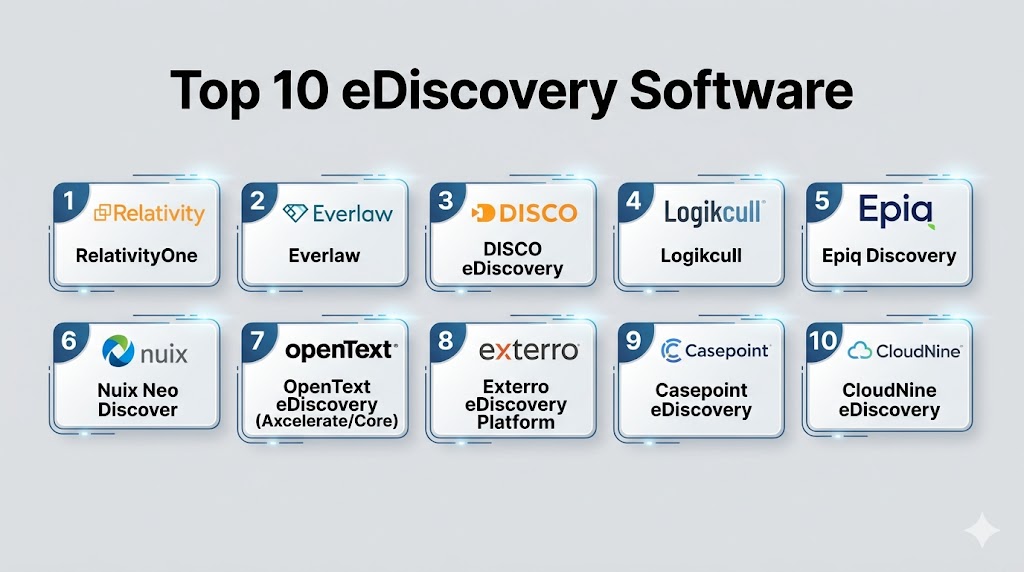
Top 10 eDiscovery Software
#1 — RelativityOne
Short description: A leading cloud-based eDiscovery platform offering end-to-end case management and analytics.
Key Features
- Data collection and processing
- AI-powered document review
- Advanced analytics
- Case management
- Compliance support
- Scalable cloud infrastructure
Pros
- Industry-leading platform
- Highly scalable
Cons
- Premium pricing
- Requires training
Platforms / Deployment
- Cloud
Security & Compliance
- RBAC, encryption
- Compliance support varies
Integrations & Ecosystem
- Legal tools
- APIs
- Cloud platforms
Support & Community
Strong enterprise support and ecosystem.
#2 — Everlaw
Short description: A modern eDiscovery platform focused on ease of use and advanced analytics.
Key Features
- AI-assisted review
- Visual analytics
- Cloud-native architecture
- Collaboration tools
- Data processing
Pros
- User-friendly interface
- Strong analytics
Cons
- Premium pricing
- Limited customization
Platforms / Deployment
- Cloud
Security & Compliance
- Not publicly stated
Integrations & Ecosystem
- Cloud platforms
- APIs
Support & Community
Strong support and onboarding.
#3 — DISCO eDiscovery
Short description: An AI-driven eDiscovery platform designed for speed and simplicity.
Key Features
- AI-powered document review
- Fast search and filtering
- Cloud-native design
- Automated workflows
- Case management
Pros
- Fast processing
- Easy to use
Cons
- Limited advanced features
- Smaller ecosystem
Platforms / Deployment
- Cloud
Security & Compliance
- Not publicly stated
Integrations & Ecosystem
- APIs
- Legal tools
Support & Community
Good support.
#4 — Logikcull
Short description: A cloud-based eDiscovery tool focused on simplicity and automation.
Key Features
- Automated data processing
- Document review
- Search and filtering
- Collaboration tools
- Reporting
Pros
- Easy to use
- Quick setup
Cons
- Limited advanced capabilities
- Less scalability
Platforms / Deployment
- Cloud
Security & Compliance
- Not publicly stated
Integrations & Ecosystem
- Cloud tools
- APIs
Support & Community
Good SMB support.
#5 — Epiq Discovery
Short description: A comprehensive eDiscovery solution offering advanced legal and compliance services.
Key Features
- Data collection
- Document review
- Analytics
- Case management
- Compliance tools
Pros
- Strong enterprise capabilities
- Full-service offering
Cons
- Higher cost
- Complex deployment
Platforms / Deployment
- Cloud / Hybrid
Security & Compliance
- Not publicly stated
Integrations & Ecosystem
- Legal tools
- APIs
Support & Community
Enterprise support.
#6 — Nuix Neo Discover
Short description: A powerful eDiscovery platform focused on large-scale data processing and analysis.
Key Features
- Data processing
- Advanced analytics
- Document review
- Automation
- Reporting
Pros
- High performance
- Scalable
Cons
- Complex interface
- Requires expertise
Platforms / Deployment
- Cloud / Hybrid
Security & Compliance
- Not publicly stated
Integrations & Ecosystem
- APIs
- Legal tools
Support & Community
Enterprise support.
#7 — OpenText eDiscovery (Axcelerate/Core)
Short description: An enterprise-grade eDiscovery solution with strong analytics and compliance features.
Key Features
- Data collection
- Document review
- Analytics
- Compliance tools
- Reporting
Pros
- Strong enterprise features
- Reliable platform
Cons
- Complex setup
- Requires training
Platforms / Deployment
- Cloud / Hybrid
Security & Compliance
- Not publicly stated
Integrations & Ecosystem
- APIs
- Enterprise tools
Support & Community
Enterprise support.
#8 — Exterro eDiscovery Platform
Short description: A unified platform combining eDiscovery, privacy, and data governance.
Key Features
- Data discovery
- Document review
- Privacy compliance
- Automation
- Reporting
Pros
- Strong compliance features
- Integrated platform
Cons
- Complex setup
- Requires expertise
Platforms / Deployment
- Cloud
Security & Compliance
- Not publicly stated
Integrations & Ecosystem
- APIs
- Legal tools
Support & Community
Enterprise support.
#9 — Casepoint eDiscovery
Short description: A cloud-native eDiscovery platform designed for large-scale investigations.
Key Features
- Data processing
- Document review
- Analytics
- Reporting
- Cloud scalability
Pros
- Scalable platform
- Good performance
Cons
- Limited customization
- Smaller ecosystem
Platforms / Deployment
- Cloud
Security & Compliance
- Not publicly stated
Integrations & Ecosystem
- APIs
- Legal tools
Support & Community
Good support.
#10 — CloudNine eDiscovery
Short description: A flexible eDiscovery platform offering data processing and review capabilities.
Key Features
- Data processing
- Document review
- Search and filtering
- Reporting
- Automation
Pros
- Flexible deployment
- Cost-effective
Cons
- Limited advanced analytics
- Smaller ecosystem
Platforms / Deployment
- Cloud / Hybrid
Security & Compliance
- Not publicly stated
Integrations & Ecosystem
- APIs
- Legal tools
Support & Community
Good support.
Comparison Table (Top 10)
| Tool Name | Best For | Platform(s) Supported | Deployment | Standout Feature | Public Rating |
|---|---|---|---|---|---|
| RelativityOne | Enterprise | Web | Cloud | Full lifecycle | N/A |
| Everlaw | Analytics | Web | Cloud | Visual insights | N/A |
| DISCO | Speed | Web | Cloud | AI review | N/A |
| Logikcull | SMB | Web | Cloud | Ease of use | N/A |
| Epiq | Enterprise | Web | Hybrid | Full service | N/A |
| Nuix | Large data | Web | Hybrid | High performance | N/A |
| OpenText | Enterprise | Web | Hybrid | Compliance | N/A |
| Exterro | Compliance | Web | Cloud | Privacy integration | N/A |
| Casepoint | Scale | Web | Cloud | Cloud-native | N/A |
| CloudNine | SMB | Web | Hybrid | Flexibility | N/A |
Evaluation & Scoring of eDiscovery Software
| Tool Name | Core (25%) | Ease (15%) | Integrations (15%) | Security (10%) | Performance (10%) | Support (10%) | Value (15%) | Weighted Total |
|---|---|---|---|---|---|---|---|---|
| RelativityOne | 9 | 7 | 9 | 9 | 9 | 8 | 7 | 8.5 |
| Everlaw | 9 | 8 | 8 | 8 | 8 | 8 | 7 | 8.2 |
| DISCO | 8 | 9 | 7 | 8 | 8 | 7 | 8 | 8.0 |
| Logikcull | 7 | 9 | 7 | 7 | 7 | 7 | 8 | 7.6 |
| Epiq | 9 | 7 | 8 | 9 | 9 | 8 | 7 | 8.3 |
| Nuix | 9 | 7 | 8 | 8 | 9 | 8 | 7 | 8.2 |
| OpenText | 8 | 7 | 8 | 9 | 8 | 8 | 7 | 8.0 |
| Exterro | 8 | 7 | 8 | 8 | 8 | 8 | 7 | 7.9 |
| Casepoint | 8 | 8 | 7 | 8 | 8 | 7 | 8 | 8.0 |
| CloudNine | 7 | 8 | 7 | 7 | 7 | 7 | 8 | 7.5 |
How to interpret scores:
- Scores are comparative across tools
- Higher scores indicate stronger overall capabilities
- Enterprise tools excel in scalability and compliance
- Simpler tools score higher in usability and value
- Choose based on your legal and data needs
Which eDiscovery Tool Is Right for You?
Solo / Freelancer
Use Logikcull or CloudNine for simplicity.
SMB
Use Logikcull or DISCO.
Mid-Market
Use Everlaw or Casepoint.
Enterprise
Use RelativityOne, Epiq, or Nuix.
Budget vs Premium
- Budget: Logikcull, CloudNine
- Premium: RelativityOne, Nuix
Feature Depth vs Ease of Use
- Deep features: RelativityOne
- Ease of use: Everlaw
Integrations & Scalability
Best: RelativityOne, Epiq
Security & Compliance Needs
Best: Exterro, OpenText
Frequently Asked Questions (FAQs)
1. What is eDiscovery?
It is the process of collecting and analyzing digital evidence.
2. Why is eDiscovery important?
It supports legal and compliance investigations.
3. Do tools support cloud data?
Yes, most modern tools support cloud sources.
4. Are they easy to use?
Some tools are user-friendly; others require training.
5. Can AI help in eDiscovery?
Yes, AI speeds up document review.
6. Are these tools expensive?
Pricing varies widely.
7. Who uses eDiscovery tools?
Legal teams and investigators.
8. Do they support compliance?
Yes, compliance is a core feature.
9. Can they handle large datasets?
Yes, enterprise tools are scalable.
10. What is the biggest benefit?
Faster and more accurate investigations.
Conclusion
eDiscovery software has become an essential component for organizations dealing with legal, compliance, and investigative challenges in data-rich environments. By automating the collection, processing, and review of electronically stored information, these tools significantly reduce manual effort while improving accuracy and defensibility. As data volumes continue to grow and regulatory expectations evolve, adopting a scalable and intelligent eDiscovery solution is no longer optional. Whether you choose an enterprise-grade platform or a simpler cloud-based tool, the key is to align your selection with your data sources, legal requirements, and operational workflows. Start by shortlisting a few tools, run pilot investigations, and validate how effectively they meet your organization’s needs.