Introduction
Data Loss Prevention (DLP) tools are cybersecurity solutions designed to identify, monitor, and prevent unauthorized access, sharing, or leakage of sensitive data across endpoints, networks, and cloud environments. These tools act as intelligent gatekeepers, ensuring that confidential information—such as personal data, financial records, or intellectual property—is not exposed intentionally or accidentally.
Modern DLP platforms go beyond simple monitoring by using content inspection, contextual analysis, and policy enforcement to block risky actions in real time. They protect data in all states—at rest, in motion, and in use—making them essential for organizations handling sensitive information.
Common Use Cases
- Preventing sensitive data leaks via email, cloud apps, or endpoints
- Monitoring insider threats and user behavior
- Enforcing compliance with data protection regulations
- Protecting intellectual property and customer data
- Securing data across remote and hybrid work environments
What Buyers Should Evaluate
- Coverage (endpoint, network, cloud, SaaS)
- Data classification and detection accuracy
- Policy enforcement flexibility
- Integration with security ecosystem (SIEM, CASB, IAM)
- Automation and incident response capabilities
- Scalability across enterprise environments
- Compliance reporting and audit readiness
- Ease of deployment and management
- Cost vs value
Best for: Enterprises, compliance-driven industries, security teams, and organizations handling sensitive or regulated data.
Not ideal for: Small teams with minimal sensitive data exposure or those needing only basic security controls.
Key Trends in Data Loss Prevention (DLP) Tools
- AI-driven data classification and anomaly detection
- Integration with cloud and SaaS platforms
- Shift toward unified data security platforms (DSPM + DLP)
- Real-time monitoring and automated policy enforcement
- Focus on insider threat detection
- Expansion into GenAI and data sharing controls
- API-first integrations for modern environments
- Behavior-based risk analysis
- Zero-trust data protection strategies
- Unified visibility across hybrid environments
How We Selected These Tools (Methodology)
- Strong industry adoption and credibility
- Proven data protection capabilities across environments
- Comprehensive feature sets (endpoint, network, cloud)
- Integration with modern security ecosystems
- Availability of automation and compliance features
- Suitability for enterprise and mid-market use cases
- Strong documentation and support ecosystems
- Balance between legacy leaders and modern cloud-native tools
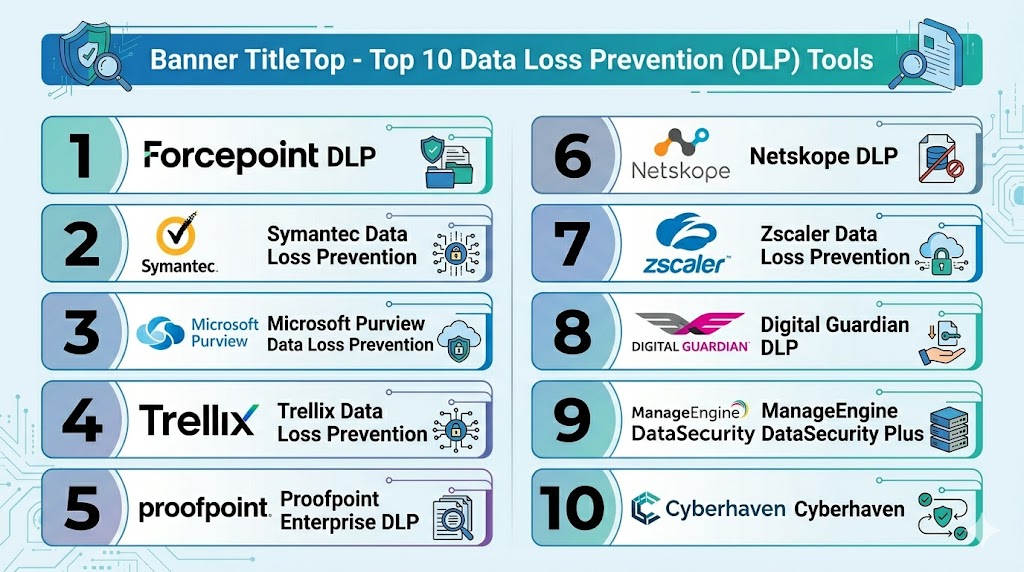
Top 10 Data Loss Prevention (DLP) Tools
#1 — Forcepoint DLP
Short description: A leading enterprise DLP platform providing unified data protection across endpoints, network, and cloud.
Key Features
- Unified policy management
- Data classification and fingerprinting
- Risk-adaptive protection
- Compliance templates
- Insider threat detection
- Multi-channel coverage
Pros
- Strong enterprise capabilities
- Advanced policy control
Cons
- Complex setup
- Premium pricing
Platforms / Deployment
- Cloud / Hybrid
Security & Compliance
- RBAC, encryption
- Compliance frameworks supported
Integrations & Ecosystem
- SIEM tools
- Cloud platforms
- APIs
- Endpoint solutions
Support & Community
Enterprise-grade support and documentation.
#2 — Symantec Data Loss Prevention (Broadcom)
Short description: A comprehensive DLP solution offering deep content inspection and enterprise-scale protection.
Key Features
- Data discovery and classification
- Policy-based enforcement
- OCR and fingerprinting
- Endpoint and cloud protection
- Risk analytics
Pros
- Highly scalable
- Advanced detection capabilities
Cons
- Complex deployment
- Requires expertise
Platforms / Deployment
- Cloud / On-prem
Security & Compliance
- RBAC, audit logs
- Compliance support
Integrations & Ecosystem
- CASB tools
- SIEM platforms
- APIs
Support & Community
Strong enterprise support.
#3 — Microsoft Purview Data Loss Prevention
Short description: A cloud-native DLP solution integrated into Microsoft ecosystem for unified data protection.
Key Features
- Unified policy management
- Sensitive data classification
- Integration with Microsoft 365
- Real-time monitoring
- Compliance reporting
Pros
- Seamless Microsoft integration
- Easy deployment
Cons
- Best for Microsoft environments
- Limited outside ecosystem
Platforms / Deployment
- Cloud
Security & Compliance
- SSO, MFA, RBAC
- Compliance frameworks supported
Integrations & Ecosystem
- Microsoft 365
- Azure
- APIs
Support & Community
Strong enterprise support.
#4 — Digital Guardian DLP
Short description: An endpoint-focused DLP solution offering deep visibility and control over sensitive data.
Key Features
- Endpoint data protection
- Data classification
- Risk monitoring
- Cloud integration
- Incident response
Pros
- Strong endpoint security
- Good for mid-sized teams
Cons
- Limited UI simplicity
- Requires setup
Platforms / Deployment
- Cloud / Hybrid
Security & Compliance
- Not publicly stated
Integrations & Ecosystem
- SIEM tools
- APIs
Support & Community
Good support and documentation.
#5 — Trellix DLP
Short description: A DLP solution designed for distributed enterprises with strong network and endpoint protection.
Key Features
- Network and endpoint DLP
- Policy enforcement
- Risk monitoring
- Data classification
- Compliance reporting
Pros
- Strong enterprise capabilities
- Scalable
Cons
- Complex configuration
- Legacy interface
Platforms / Deployment
- Hybrid
Security & Compliance
- Not publicly stated
Integrations & Ecosystem
- Security platforms
- APIs
Support & Community
Enterprise support.
#6 — Proofpoint Enterprise DLP
Short description: A DLP solution focused on email and cloud data protection.
Key Features
- Email data protection
- Cloud DLP
- Threat detection
- Policy enforcement
- Risk analysis
Pros
- Strong email security
- Easy integration
Cons
- Limited endpoint coverage
- Narrow focus
Platforms / Deployment
- Cloud
Security & Compliance
- Not publicly stated
Integrations & Ecosystem
- Email platforms
- APIs
Support & Community
Good support.
#7 — Netskope DLP
Short description: A cloud-native DLP platform integrated with CASB and SASE architecture.
Key Features
- Cloud data protection
- SaaS monitoring
- Risk prioritization
- Policy enforcement
- Compliance reporting
Pros
- Strong cloud coverage
- Integrated security approach
Cons
- Requires Netskope ecosystem
- Premium pricing
Platforms / Deployment
- Cloud
Security & Compliance
- Not publicly stated
Integrations & Ecosystem
- SaaS apps
- APIs
- Security platforms
Support & Community
Enterprise support.
#8 — Zscaler DLP
Short description: A cloud-based DLP solution providing data protection across web and SaaS applications.
Key Features
- Cloud-native protection
- Data classification
- Policy enforcement
- Real-time monitoring
- Integration with Zscaler platform
Pros
- Strong cloud security
- Scalable
Cons
- Requires ecosystem adoption
- Limited standalone use
Platforms / Deployment
- Cloud
Security & Compliance
- Not publicly stated
Integrations & Ecosystem
- SaaS platforms
- APIs
Support & Community
Enterprise support.
#9 — ManageEngine DataSecurity Plus
Short description: A DLP solution focused on file auditing, risk assessment, and compliance.
Key Features
- Data discovery
- File auditing
- Risk assessment
- Policy enforcement
- Incident response
Pros
- Easy to deploy
- Cost-effective
Cons
- Limited advanced features
- Smaller ecosystem
Platforms / Deployment
- On-prem / Hybrid
Security & Compliance
- Not publicly stated
Integrations & Ecosystem
- APIs
- IT tools
Support & Community
Good documentation and support.
#10 — Cyberhaven
Short description: A modern DLP platform focused on data lineage and behavioral analytics.
Key Features
- Data lineage tracking
- Behavioral analytics
- Risk detection
- Cloud and endpoint coverage
- Policy enforcement
Pros
- Innovative approach
- Strong analytics
Cons
- Emerging platform
- Limited enterprise maturity
Platforms / Deployment
- Cloud
Security & Compliance
- Not publicly stated
Integrations & Ecosystem
- APIs
- Cloud tools
Support & Community
Growing support ecosystem.
Comparison Table (Top 10)
| Tool Name | Best For | Platform(s) Supported | Deployment | Standout Feature | Public Rating |
|---|---|---|---|---|---|
| Forcepoint DLP | Enterprise | Web | Hybrid | Unified policy engine | N/A |
| Symantec DLP | Large enterprises | Web | Hybrid | Deep content inspection | N/A |
| Microsoft Purview | Microsoft users | Web | Cloud | Native integration | N/A |
| Digital Guardian | Endpoint security | Web | Hybrid | Endpoint DLP focus | N/A |
| Trellix DLP | Distributed orgs | Web | Hybrid | Network + endpoint | N/A |
| Proofpoint DLP | Email security | Web | Cloud | Email protection | N/A |
| Netskope DLP | Cloud apps | Web | Cloud | SaaS protection | N/A |
| Zscaler DLP | Web security | Web | Cloud | Cloud-native DLP | N/A |
| ManageEngine | SMB | Web | Hybrid | File auditing | N/A |
| Cyberhaven | Modern analytics | Web | Cloud | Data lineage tracking | N/A |
Evaluation & Scoring of Data Loss Prevention (DLP) Tools
| Tool Name | Core (25%) | Ease (15%) | Integrations (15%) | Security (10%) | Performance (10%) | Support (10%) | Value (15%) | Weighted Total |
|---|---|---|---|---|---|---|---|---|
| Forcepoint | 9 | 7 | 9 | 9 | 9 | 8 | 7 | 8.5 |
| Symantec | 9 | 7 | 9 | 9 | 9 | 8 | 7 | 8.5 |
| Microsoft | 8 | 8 | 9 | 9 | 8 | 8 | 8 | 8.3 |
| Digital Guardian | 8 | 7 | 8 | 8 | 8 | 8 | 7 | 7.9 |
| Trellix | 8 | 7 | 8 | 8 | 8 | 8 | 7 | 7.9 |
| Proofpoint | 7 | 8 | 7 | 7 | 7 | 7 | 8 | 7.4 |
| Netskope | 8 | 7 | 9 | 8 | 8 | 8 | 7 | 8.0 |
| Zscaler | 8 | 7 | 8 | 8 | 8 | 8 | 7 | 7.9 |
| ManageEngine | 7 | 8 | 7 | 7 | 7 | 7 | 8 | 7.5 |
| Cyberhaven | 8 | 8 | 8 | 7 | 8 | 7 | 7 | 7.8 |
How to interpret scores:
- Scores are comparative across tools
- Higher scores indicate stronger overall capability
- Enterprise tools lead in depth and integrations
- Simpler tools score higher in usability and value
- Choose based on your data protection needs
Which Data Loss Prevention Tool Is Right for You?
Solo / Freelancer
Use ManageEngine or lightweight tools for basic protection.
SMB
Use ManageEngine or Proofpoint for simplicity.
Mid-Market
Use Digital Guardian or Netskope for balanced features.
Enterprise
Use Forcepoint, Symantec, or Microsoft Purview.
Budget vs Premium
- Budget: ManageEngine
- Premium: Forcepoint, Symantec
Feature Depth vs Ease of Use
- Deep features: Symantec
- Ease of use: Microsoft Purview
Integrations & Scalability
Best: Microsoft, Netskope
Security & Compliance Needs
Best: Forcepoint, Symantec
Frequently Asked Questions (FAQs)
1. What is DLP?
It is a solution that prevents sensitive data from being leaked or misused.
2. Why is DLP important?
It protects data from breaches and ensures compliance.
3. Do DLP tools work in the cloud?
Yes, modern tools support cloud and SaaS environments.
4. Can DLP detect insider threats?
Yes, they monitor user behavior and data access.
5. Are DLP tools complex?
Some enterprise tools require expertise.
6. Do they support compliance?
Yes, most tools include compliance reporting.
7. Can DLP block data transfers?
Yes, they can block unauthorized transfers in real time.
8. Are DLP tools expensive?
Pricing varies based on scale and features.
9. Who should use DLP tools?
Organizations handling sensitive data.
10. What is the biggest benefit?
Preventing data breaches and leaks.
Conclusion
Data Loss Prevention tools are a critical component of modern cybersecurity strategies, helping organizations safeguard sensitive information across endpoints, networks, and cloud environments. By combining data discovery, classification, monitoring, and policy enforcement, these tools reduce the risk of data leaks and unauthorized access. While enterprise platforms provide advanced capabilities and deep integrations, smaller organizations can still achieve effective protection with simpler solutions. The key is to understand your data landscape, identify critical risks, and select a DLP solution that aligns with your operational needs. Start by shortlisting a few tools, test them in real-world scenarios, and ensure they integrate seamlessly with your existing security ecosystem.