Introduction
Privacy-preserving Analytics Tools help organizations collect, process, and analyze data while minimizing exposure of personally identifiable information and sensitive user data. These platforms use techniques such as anonymization, aggregation, differential privacy, cookieless tracking, encryption, federated analytics, and consent-aware measurement to generate insights without compromising user privacy.
As privacy regulations become stricter and browser tracking limitations increase, businesses are moving away from invasive tracking models toward privacy-first analytics strategies. Organizations now need analytics platforms that balance visibility, compliance, customer trust, and operational performance. Privacy-preserving analytics tools are becoming especially important for enterprises operating in regulated industries, global digital businesses, healthcare organizations, fintech companies, ecommerce brands, and SaaS platforms.
Common real-world use cases include:
- Cookie-less website and product analytics
- GDPR and privacy-compliant reporting
- Privacy-safe customer behavior analysis
- Secure analytics for healthcare and finance
- First-party data and consent-aware measurement
Buyers evaluating Privacy-preserving Analytics Tools should consider:
- Privacy architecture and anonymization methods
- Compliance and governance capabilities
- Cookieless tracking support
- Data ownership and hosting flexibility
- Analytics depth and reporting quality
- Integration ecosystem maturity
- Scalability and operational performance
- Security and encryption capabilities
- AI and machine learning compatibility
- Ease of deployment and maintenance
Best for: enterprises, SaaS companies, ecommerce businesses, healthcare organizations, fintech firms, publishers, privacy-conscious brands, analytics teams, and organizations operating under strict data protection regulations.
Not ideal for: organizations requiring unrestricted user-level tracking, teams dependent on highly invasive advertising identifiers, or businesses needing extensive cross-device fingerprinting workflows.
Key Trends in Privacy-preserving Analytics Tools
- Cookieless analytics is becoming a major industry standard.
- Differential privacy techniques are increasingly used in enterprise reporting.
- Server-side and first-party tracking are replacing browser-dependent measurement.
- Privacy-safe AI analytics workflows are becoming more common.
- Consent-aware measurement is becoming mandatory for many global businesses.
- Open-source privacy analytics platforms are gaining adoption.
- Edge-based analytics processing is reducing raw data exposure.
- Privacy-preserving attribution models are replacing invasive tracking methods.
- Enterprises are prioritizing data minimization and governance controls.
- Privacy-first analytics is becoming a competitive trust differentiator for brands.
How We Selected These Tools
The platforms included in this list were selected based on privacy capabilities, analytics quality, scalability, integration support, and practical usability across industries.
Evaluation factors included:
- Privacy-preserving analytics capabilities
- Compliance and governance support
- Cookieless and consent-aware tracking
- Security and encryption features
- Reporting and dashboard quality
- Integration ecosystem maturity
- Enterprise scalability
- Data ownership flexibility
- Ease of onboarding and implementation
- Industry adoption and reputation
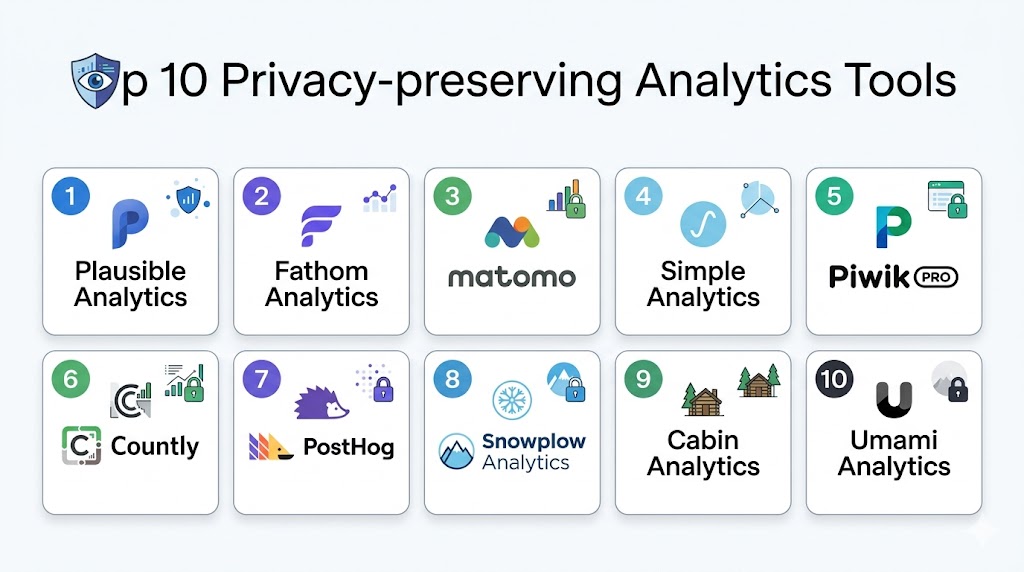
Top 10 Privacy-preserving Analytics Tools
#1 — Matomo
Short description: Matomo is a privacy-focused analytics platform that gives organizations full ownership and control over analytics data. It supports self-hosted and cloud deployment models with cookie-less tracking, consent management, and privacy-focused reporting capabilities. It is especially popular among enterprises and regulated industries prioritizing data sovereignty.
Key Features
- Self-hosted analytics
- Cookie-less tracking
- Consent management integration
- IP anonymization
- First-party analytics workflows
- GDPR-focused controls
- Custom reporting dashboards
Pros
- Strong data ownership model
- Good privacy and compliance flexibility
- Useful self-hosted deployment support
Cons
- Self-hosted environments require maintenance
- Advanced reporting setup may take time
- UI can feel complex for smaller teams
Platforms / Deployment
- Web
- Cloud
- Self-hosted
Security & Compliance
- GDPR support
- Access controls
- Audit capabilities
- Data ownership controls
- Additional certifications not publicly stated
Integrations & Ecosystem
Matomo integrates with CMS platforms, ecommerce systems, reporting tools, and enterprise analytics workflows.
- WordPress
- Shopify
- APIs
- CRM systems
- Tag management tools
- BI platforms
Support & Community
Large open-source community with enterprise support options and extensive documentation resources.
#2 — Plausible Analytics
Short description: Plausible Analytics is a lightweight privacy-first analytics platform designed for simple, cookie-free website analytics. It focuses on transparency, speed, and GDPR-friendly measurement without invasive user tracking. It is especially useful for startups, SaaS companies, publishers, and privacy-conscious businesses.
Key Features
- Cookie-less analytics
- Lightweight tracking scripts
- Privacy-first reporting
- Open-source core
- Event tracking
- Simple dashboards
- GDPR-ready workflows
Pros
- Easy to deploy and use
- Strong privacy-first positioning
- Fast and lightweight performance
Cons
- Limited enterprise analytics depth
- Fewer advanced attribution features
- Less customizable than larger platforms
Platforms / Deployment
- Web
- Cloud
- Self-hosted
Security & Compliance
- GDPR-focused architecture
- Minimal data collection
- Access controls
- Additional certifications not publicly stated
Integrations & Ecosystem
Plausible integrates with websites, CMS platforms, and lightweight analytics workflows.
- WordPress
- Ghost
- APIs
- Static websites
- Ecommerce systems
- Reporting tools
Support & Community
Strong developer community with accessible onboarding and documentation support.
#3 — Simple Analytics
Short description: Simple Analytics is a privacy-first Google Analytics alternative designed for businesses wanting lightweight website insights without invasive tracking. It focuses on cookieless measurement, GDPR compliance, and simple dashboards for operational decision-making.
Key Features
- Cookieless analytics
- Privacy-focused reporting
- Lightweight scripts
- Event tracking
- UTM campaign analysis
- Dashboard reporting
- Minimal data collection
Pros
- Extremely simple user experience
- Strong GDPR-focused workflows
- Fast implementation
Cons
- Limited advanced analytics functionality
- Less enterprise customization
- Smaller integration ecosystem
Platforms / Deployment
- Web
- Cloud
Security & Compliance
- GDPR-focused architecture
- Minimal tracking workflows
- Access controls
- Additional certifications not publicly stated
Integrations & Ecosystem
Simple Analytics integrates with websites, reporting tools, and lightweight digital analytics workflows.
- APIs
- CMS systems
- Reporting dashboards
- Ecommerce platforms
- Marketing workflows
- Event tracking systems
Support & Community
Provides straightforward onboarding and practical support for smaller teams and publishers.
#4 — Piwik PRO Analytics Suite
Short description: Piwik PRO Analytics Suite is an enterprise analytics and privacy platform designed for organizations operating under strict compliance requirements. It combines analytics, tag management, customer data workflows, and consent management into a privacy-focused ecosystem.
Key Features
- Enterprise analytics
- Consent management
- Tag management
- Customer data workflows
- Privacy-safe reporting
- Self-hosted deployment support
- Governance controls
Pros
- Strong enterprise compliance support
- Useful governance and consent workflows
- Good healthcare and finance suitability
Cons
- Enterprise-focused pricing
- Advanced setup may require expertise
- Smaller businesses may not need full feature depth
Platforms / Deployment
- Web
- Cloud
- Self-hosted
Security & Compliance
- GDPR support
- Access controls
- Audit logging
- Governance workflows
- Additional certifications not publicly stated
Integrations & Ecosystem
Piwik PRO integrates with enterprise reporting, CMS, analytics, and compliance ecosystems.
- CRM systems
- CMS platforms
- APIs
- Consent management systems
- BI tools
- Enterprise analytics workflows
Support & Community
Strong enterprise onboarding and implementation support for regulated industries.
#5 — PostHog
Short description: PostHog is an open-source product analytics platform that supports privacy-focused event tracking, feature flags, experimentation, and product analytics workflows. It is especially popular among developer-focused organizations and SaaS companies.
Key Features
- Event-based analytics
- Self-hosted deployment
- Feature flags
- Session replay
- Product analytics
- Experimentation workflows
- Privacy-aware tracking controls
Pros
- Strong developer flexibility
- Good self-hosted support
- Useful product analytics workflows
Cons
- Technical onboarding required
- UI may feel developer-oriented
- Advanced governance requires configuration
Platforms / Deployment
- Web
- Cloud
- Self-hosted
Security & Compliance
- Access controls
- Self-hosted privacy flexibility
- GDPR workflows
- Additional certifications not publicly stated
Integrations & Ecosystem
PostHog integrates with developer, product analytics, and experimentation ecosystems.
- APIs
- Data warehouses
- Product workflows
- Feature flag systems
- Cloud platforms
- Developer tools
Support & Community
Large open-source and developer community with strong documentation and onboarding resources.
#6 — Umami
Short description: Umami is an open-source privacy-focused web analytics platform designed for simple, cookie-free website analytics. It offers lightweight reporting, self-hosted flexibility, and privacy-aware measurement workflows.
Key Features
- Open-source analytics
- Cookie-free tracking
- Lightweight dashboards
- Self-hosted deployment
- Event tracking
- Website analytics
- Privacy-safe reporting
Pros
- Very lightweight and fast
- Strong self-hosted flexibility
- Good open-source accessibility
Cons
- Limited advanced analytics depth
- Smaller ecosystem compared with enterprise tools
- Fewer built-in enterprise workflows
Platforms / Deployment
- Web
- Self-hosted
- Cloud
Security & Compliance
- Minimal data collection
- Privacy-focused architecture
- Access controls
- Additional certifications not publicly stated
Integrations & Ecosystem
Umami integrates with websites, self-hosted environments, and lightweight analytics workflows.
- APIs
- CMS platforms
- Self-hosted environments
- Reporting tools
- Static websites
- Developer workflows
Support & Community
Active open-source community with accessible setup documentation.
#7 — Snowplow
Short description: Snowplow is a behavioral data platform focused on first-party event tracking and privacy-aware analytics workflows. It provides warehouse-native event pipelines and enterprise-grade analytics flexibility for organizations managing large-scale data operations.
Key Features
- First-party event tracking
- Warehouse-native analytics
- Real-time event pipelines
- Data ownership workflows
- Privacy-aware event processing
- Behavioral analytics
- Custom data modeling
Pros
- Strong first-party analytics capabilities
- Excellent enterprise scalability
- Flexible event pipeline architecture
Cons
- Requires technical expertise
- Complex implementation workflows
- Operational maintenance can be demanding
Platforms / Deployment
- Web
- Cloud
- Self-hosted
Security & Compliance
- Access controls
- Governance workflows
- Encryption support
- GDPR-focused controls
- Additional certifications not publicly stated
Integrations & Ecosystem
Snowplow integrates with cloud warehouses, analytics, and machine learning ecosystems.
- AWS
- Google Cloud
- Snowflake
- Databricks
- APIs
- BI systems
Support & Community
Strong enterprise implementation support and active developer ecosystem.
#8 — Mixpanel
Short description: Mixpanel is a product analytics platform that supports event-based analytics, user behavior analysis, and privacy-aware measurement workflows. It is widely used by SaaS companies and product teams requiring actionable product intelligence.
Key Features
- Event-based analytics
- Product usage reporting
- Funnel analysis
- Cohort reporting
- Retention analysis
- Experimentation support
- Privacy controls
Pros
- Strong product analytics workflows
- Good user behavior visibility
- Useful SaaS analytics capabilities
Cons
- Advanced privacy workflows require configuration
- Costs may increase with scale
- Enterprise governance varies by plan
Platforms / Deployment
- Web
- Cloud
Security & Compliance
- Access controls
- GDPR support
- Governance workflows
- Additional certifications not publicly stated
Integrations & Ecosystem
Mixpanel integrates with product analytics, CRM, and customer engagement ecosystems.
- Data warehouses
- APIs
- CRM systems
- Marketing automation tools
- Product workflows
- BI platforms
Support & Community
Strong onboarding resources and broad adoption among SaaS and product analytics teams.
#9 — Fathom Analytics
Short description: Fathom Analytics is a simple privacy-focused analytics platform built around cookieless website tracking and GDPR-friendly reporting. It prioritizes minimal data collection and operational simplicity for businesses seeking lightweight analytics.
Key Features
- Cookieless analytics
- Privacy-safe reporting
- Lightweight dashboards
- Event tracking
- Fast performance
- Minimal data collection
- Campaign analysis
Pros
- Very simple deployment
- Strong privacy-first positioning
- Fast and lightweight architecture
Cons
- Limited enterprise analytics functionality
- Smaller ecosystem
- Less customization flexibility
Platforms / Deployment
- Web
- Cloud
Security & Compliance
- GDPR-focused workflows
- Minimal tracking architecture
- Access controls
- Additional certifications not publicly stated
Integrations & Ecosystem
Fathom integrates with lightweight website analytics and marketing workflows.
- CMS platforms
- APIs
- Static websites
- Reporting systems
- Marketing analytics
- Ecommerce systems
Support & Community
Provides accessible onboarding and strong usability for smaller businesses and publishers.
#10 — Google Analytics 4
Short description: Google Analytics 4 is an event-driven analytics platform that includes privacy-aware controls, consent management support, and machine learning-based modeling. It helps organizations transition from legacy cookie-heavy tracking toward more privacy-conscious analytics workflows.
Key Features
- Event-based analytics
- Consent-aware measurement
- Data retention controls
- Aggregated reporting
- Machine learning insights
- Cross-platform analytics
- Predictive reporting
Pros
- Strong scalability
- Broad ecosystem integration
- Powerful reporting capabilities
Cons
- Privacy configuration can be complex
- Data modeling transparency is limited
- Advanced setup requires expertise
Platforms / Deployment
- Web
- Cloud
Security & Compliance
- Access controls
- Consent management support
- GDPR workflows depend on implementation
- Additional certifications not publicly stated
Integrations & Ecosystem
Google Analytics integrates deeply with advertising, reporting, and analytics ecosystems.
- Google Ads
- BigQuery
- Looker Studio
- Ecommerce platforms
- Tag management systems
- APIs
Support & Community
Large global user community with extensive documentation and enterprise support options.
Comparison Table
| Tool Name | Best For | Platform(s) Supported | Deployment | Standout Feature | Public Rating |
|---|---|---|---|---|---|
| Matomo | Enterprise privacy analytics | Web | Cloud / Self-hosted | Full data ownership | N/A |
| Plausible Analytics | Lightweight privacy analytics | Web | Cloud / Self-hosted | Cookie-free analytics | N/A |
| Simple Analytics | Simple GDPR-friendly reporting | Web | Cloud | Minimal tracking workflows | N/A |
| Piwik PRO Analytics Suite | Regulated enterprise analytics | Web | Cloud / Self-hosted | Consent and governance workflows | N/A |
| PostHog | Developer-focused product analytics | Web | Cloud / Self-hosted | Open-source product analytics | N/A |
| Umami | Lightweight open-source analytics | Web | Cloud / Self-hosted | Simple privacy-first tracking | N/A |
| Snowplow | Enterprise first-party analytics | Web | Cloud / Self-hosted | Warehouse-native analytics | N/A |
| Mixpanel | Product and SaaS analytics | Web | Cloud | Event-based product analytics | N/A |
| Fathom Analytics | Lightweight website analytics | Web | Cloud | Fast cookieless analytics | N/A |
| Google Analytics 4 | Broad digital analytics | Web | Cloud | Event-driven analytics model | N/A |
Evaluation & Scoring of Privacy-preserving Analytics Tools
| Tool Name | Core 25% | Ease 15% | Integrations 15% | Security 10% | Performance 10% | Support 10% | Value 15% | Weighted Total |
|---|---|---|---|---|---|---|---|---|
| Matomo | 8.8 | 7.8 | 8.2 | 8.9 | 8.5 | 8.4 | 8.5 | 8.5 |
| Plausible Analytics | 7.8 | 9.2 | 7.2 | 8.8 | 9.0 | 8.2 | 9.0 | 8.4 |
| Simple Analytics | 7.6 | 9.3 | 7.0 | 8.7 | 9.0 | 8.0 | 9.1 | 8.3 |
| Piwik PRO Analytics Suite | 8.9 | 7.5 | 8.3 | 9.0 | 8.6 | 8.5 | 8.0 | 8.5 |
| PostHog | 8.8 | 7.4 | 8.4 | 8.3 | 8.7 | 8.6 | 8.5 | 8.4 |
| Umami | 7.2 | 8.5 | 6.8 | 8.3 | 8.6 | 7.8 | 9.2 | 8.0 |
| Snowplow | 9.1 | 6.5 | 9.0 | 8.9 | 9.0 | 8.4 | 7.8 | 8.5 |
| Mixpanel | 8.5 | 8.3 | 8.6 | 8.0 | 8.8 | 8.5 | 8.0 | 8.4 |
| Fathom Analytics | 7.5 | 9.0 | 6.8 | 8.5 | 8.8 | 7.8 | 8.8 | 8.2 |
| Google Analytics 4 | 8.7 | 7.8 | 9.3 | 8.2 | 8.9 | 8.6 | 9.0 | 8.7 |
These scores are comparative rather than absolute. Enterprise analytics platforms generally score higher in governance, integrations, and scalability, while lightweight privacy-first tools perform better in simplicity and operational efficiency. Open-source platforms provide stronger data ownership flexibility, while cloud-native analytics tools often provide broader ecosystem integrations. Organizations should prioritize scoring categories aligned with their compliance, analytics, and operational needs.
Which Privacy-preserving Analytics Tool Is Right for You?
Solo / Freelancer
Independent creators and smaller websites typically benefit from Plausible Analytics, Simple Analytics, or Fathom Analytics because they are lightweight, easy to deploy, and privacy-focused without operational complexity.
SMB
SMBs often need practical analytics with strong privacy workflows and accessible dashboards. Matomo, Plausible Analytics, PostHog, and Google Analytics 4 provide balanced reporting and operational usability.
Mid-Market
Mid-market organizations usually require stronger integrations, governance, and first-party data workflows. PostHog, Mixpanel, Snowplow, and Piwik PRO offer broader analytics flexibility and scalability.
Enterprise
Large enterprises should prioritize Snowplow, Piwik PRO Analytics Suite, Matomo, or warehouse-native analytics ecosystems because of their governance capabilities, scalability, and privacy-focused architectures.
Budget vs Premium
Budget-conscious organizations may prefer Umami, Plausible Analytics, or Simple Analytics. Premium enterprise platforms provide stronger governance, integration depth, and operational scalability.
Feature Depth vs Ease of Use
Simple Analytics and Fathom prioritize usability and lightweight deployment, while Snowplow and PostHog provide deeper technical flexibility and advanced analytics customization.
Integrations & Scalability
Organizations with complex cloud, BI, CRM, and product analytics ecosystems should prioritize platforms with mature integration ecosystems and warehouse-native architectures.
Security & Compliance Needs
Enterprises operating in regulated environments should prioritize encryption support, RBAC controls, audit logging, consent management, and strong governance workflows.
Frequently Asked Questions
1. What are Privacy-preserving Analytics Tools?
Privacy-preserving Analytics Tools help organizations collect and analyze data while minimizing exposure of personal information and complying with privacy regulations.
2. Why are privacy-focused analytics platforms important?
These platforms help businesses maintain analytics visibility while respecting customer privacy expectations and meeting regulatory requirements such as GDPR and similar frameworks.
3. What is cookieless analytics?
Cookieless analytics tracks website and product activity without relying on traditional third-party cookies or invasive browser fingerprinting methods.
4. Are privacy-preserving analytics tools less accurate?
Some platforms intentionally reduce user-level tracking granularity for privacy reasons, but modern event-based and first-party analytics approaches still provide strong operational insights.
5. What industries benefit most from privacy-focused analytics?
Healthcare, finance, SaaS, ecommerce, publishing, advertising, and enterprise organizations operating in regulated or privacy-sensitive environments benefit significantly.
6. Can these tools integrate with existing analytics stacks?
Yes. Most platforms integrate with CRM systems, cloud warehouses, BI tools, CMS platforms, and marketing ecosystems.
7. What is differential privacy?
Differential privacy is a privacy-preserving technique that adds controlled noise to datasets or reporting outputs to prevent identification of individual users while maintaining useful aggregate insights.
8. Are open-source analytics tools secure?
Open-source platforms can be highly secure when configured properly. Self-hosted deployments often provide stronger data ownership and governance flexibility.
9. What are common implementation challenges?
Common challenges include consent management complexity, event tracking design, governance alignment, warehouse integration, and balancing privacy with analytics detail.
10. What are alternatives to Privacy-preserving Analytics Tools?
Alternatives include traditional analytics platforms, custom data warehouses, direct database reporting, and invasive advertising tracking systems, though these may introduce greater privacy and compliance risks.
Conclusion
Privacy-preserving Analytics Tools are becoming essential for organizations balancing customer insights, operational analytics, and regulatory compliance in increasingly privacy-focused digital environments. The right platform depends on analytics maturity, governance requirements, technical expertise, and operational scale. Lightweight platforms such as Plausible Analytics, Fathom Analytics, and Simple Analytics are excellent for smaller organizations prioritizing simplicity and compliance, while enterprise teams may prefer Snowplow, Matomo, Piwik PRO, or PostHog for advanced governance and first-party analytics workflows. Organizations with strong cloud and warehouse ecosystems may benefit from warehouse-native analytics strategies combined with privacy-aware event tracking. Instead of selecting a platform solely based on feature count, businesses should evaluate data ownership requirements, compliance obligations, integration ecosystems, operational complexity, and long-term scalability before committing to a privacy-preserving analytics strategy.