Introduction
Post-Quantum Cryptography migration tools help organizations transition from classical encryption algorithms to quantum-resistant cryptographic methods. These tools enable testing, integration, and deployment of algorithms designed to withstand attacks from future quantum computers, which could break widely used encryption systems like RSA and ECC.
As enterprises prepare for long-term data security, migrating to quantum-safe cryptography is becoming a strategic priority. Migration tools assist with algorithm experimentation, hybrid cryptography deployment, protocol upgrades, and system compatibility validation without disrupting existing infrastructure.
Common use cases include upgrading TLS encryption, securing communications, protecting sensitive data, modernizing PKI systems, and ensuring compliance with emerging quantum-safe standards.
What buyers should evaluate:
- Support for NIST post-quantum algorithms
- Integration with existing cryptographic libraries
- Hybrid cryptography capabilities
- Compatibility with TLS and PKI systems
- Ease of migration and testing
- Performance impact
- Automation and tooling support
- Security validation features
- Scalability for enterprise deployment
- Ecosystem maturity and updates
Best for: Security teams, cryptography engineers, DevSecOps teams, enterprises, and governments preparing for quantum-safe security.
Not ideal for: Organizations with short-lived data or minimal security requirements.
Key Trends in Post-Quantum Cryptography Migration Tools
- Adoption of hybrid cryptographic models combining classical and quantum-safe algorithms
- Integration into TLS protocols and secure communication channels
- Growing support for NIST-standardized PQ algorithms
- Increased focus on crypto-agility and upgrade flexibility
- Cloud providers offering quantum-safe encryption features
- Expansion into VPNs, PKI, and secure messaging systems
- Performance optimization for PQ algorithms
- Early adoption in financial and government sectors
- Tooling for testing and benchmarking quantum-safe systems
- Rising importance of long-term data protection
How We Selected These Tools
- Alignment with NIST PQ cryptography standards
- Adoption across security and cloud ecosystems
- Support for hybrid and migration strategies
- Integration with existing cryptographic libraries
- Performance and scalability considerations
- Ease of testing and deployment
- Active development and research backing
- Community and enterprise support
- Compatibility with modern infrastructure
- Innovation in quantum-safe solutions
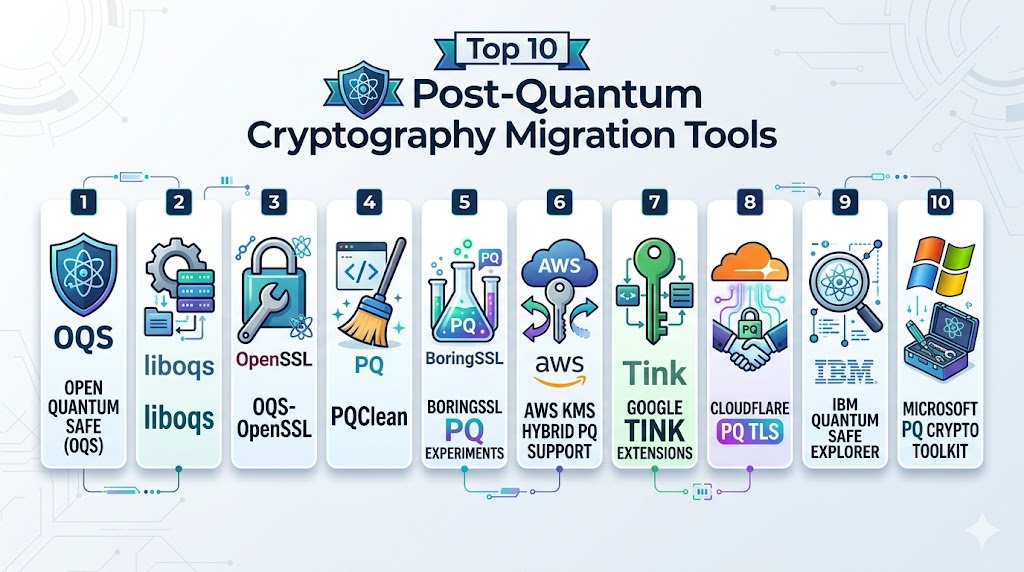
Top 10 Post-Quantum Cryptography Migration Tools
1. Open Quantum Safe OQS
Short description:
Open Quantum Safe is a leading open-source project providing tools and libraries for quantum-safe cryptography. It enables testing and integration of PQ algorithms. It is widely used in research and enterprise environments. It is ideal for early adoption and experimentation.
Key Features
- PQ algorithm implementations
- Open-source libraries
- Integration support
- Testing frameworks
- Hybrid cryptography
- Active development
- Cross-platform compatibility
Pros
- Strong community
- Flexible
- Open ecosystem
Cons
- Requires expertise
- Not production-ready for all use cases
- Complex setup
Platforms / Deployment
Linux / Windows / macOS
Deployment: Self-hosted
Security & Compliance
Supports NIST PQ algorithms
Integrations & Ecosystem
Integrates with cryptographic and security tools.
- OpenSSL
- TLS systems
- DevOps pipelines
- APIs
- Security frameworks
- Research tools
Support & Community
Very strong open-source community
2. liboqs
Short description:
liboqs is a core library within the Open Quantum Safe project providing implementations of PQ algorithms. It is designed for developers integrating quantum-safe cryptography. It supports multiple algorithms. It is ideal for building custom solutions.
Key Features
- PQ algorithm library
- Developer APIs
- Multiple algorithm support
- Testing tools
- Cross-platform support
- Lightweight
- Integration-ready
Pros
- Flexible
- Developer-friendly
- Strong ecosystem
Cons
- Requires coding
- Limited UI
- Early-stage adoption
Platforms / Deployment
Cross-platform
Deployment: Library
Security & Compliance
Supports NIST PQ algorithms
Integrations & Ecosystem
Integrates with development workflows.
- OpenSSL
- TLS systems
- APIs
- Dev tools
- Security libraries
- Build systems
Support & Community
Active development
3. OQS-OpenSSL
Short description:
OQS-OpenSSL is an extension of OpenSSL that adds support for post-quantum algorithms. It enables secure communication using PQ cryptography. It is widely used for testing TLS implementations. It is ideal for upgrading existing systems.
Key Features
- OpenSSL integration
- PQ TLS support
- Hybrid cryptography
- Algorithm testing
- Secure communication
- CLI tools
- Compatibility layers
Pros
- Familiar environment
- Strong integration
- Practical use cases
Cons
- Experimental
- Requires setup
- Performance overhead
Platforms / Deployment
Linux / Windows / macOS
Deployment: Self-hosted
Security & Compliance
Supports PQ TLS implementations
Integrations & Ecosystem
Integrates with TLS and security systems.
- OpenSSL
- Web servers
- APIs
- DevOps tools
- Security frameworks
- Networking systems
Support & Community
Strong research backing
4. PQClean
Short description:
PQClean provides clean and portable implementations of PQ algorithms. It focuses on code quality and standardization. It is used for research and development. It is ideal for secure and consistent implementations.
Key Features
- Clean implementations
- Multiple algorithms
- Code standardization
- Testing support
- Lightweight
- Cross-platform
- Developer tools
Pros
- High-quality code
- Easy integration
- Open-source
Cons
- Limited enterprise features
- Developer-focused
- No UI
Platforms / Deployment
Cross-platform
Deployment: Library
Security & Compliance
Supports standardized PQ algorithms
Integrations & Ecosystem
Integrates with development tools.
- Cryptographic libraries
- APIs
- Dev tools
- Build systems
- Research platforms
- Security tools
Support & Community
Academic and developer community
5. BoringSSL PQ Experiments
Short description:
BoringSSL includes experimental support for post-quantum cryptography. It is used by large-scale systems for testing. It focuses on performance and security. It is ideal for advanced use cases.
Key Features
- PQ algorithm support
- TLS integration
- Performance optimization
- Security testing
- Experimental features
- Cross-platform
- Developer tools
Pros
- High performance
- Real-world testing
- Strong backing
Cons
- Experimental
- Limited documentation
- Not production-ready
Platforms / Deployment
Linux / Windows / macOS
Deployment: Library
Security & Compliance
Supports PQ experiments
Integrations & Ecosystem
Integrates with large-scale systems.
- TLS systems
- APIs
- Dev tools
- Cloud platforms
- Security frameworks
- Networking systems
Support & Community
Backed by major tech ecosystem
6. AWS KMS Hybrid PQ Support
Short description:
AWS KMS provides hybrid post-quantum cryptography support for key management. It enables secure key generation and encryption. It integrates with AWS services. It is ideal for cloud-native environments.
Key Features
- Hybrid encryption
- Key management
- Cloud integration
- Security controls
- API support
- Automation
- Scalability
Pros
- Easy cloud integration
- Scalable
- Managed service
Cons
- Vendor lock-in
- Limited customization
- Cloud dependency
Platforms / Deployment
Cloud
Deployment: SaaS
Security & Compliance
Supports hybrid PQ encryption
Integrations & Ecosystem
Integrates with AWS ecosystem.
- AWS services
- APIs
- DevOps tools
- Security systems
- Cloud workflows
- Applications
Support & Community
Enterprise support
7. Google Tink PQ Extensions
Short description:
Google Tink provides extensions for post-quantum cryptography. It simplifies cryptographic implementation. It focuses on usability and security. It is ideal for application developers.
Key Features
- PQ extensions
- API-based cryptography
- Cross-platform support
- Security controls
- Developer-friendly
- Integration tools
- Lightweight
Pros
- Easy to use
- Secure design
- Strong ecosystem
Cons
- Limited PQ features
- Requires integration
- Developer-focused
Platforms / Deployment
Cross-platform
Deployment: Library
Security & Compliance
Supports PQ cryptographic features
Integrations & Ecosystem
Integrates with application development tools.
- APIs
- Dev tools
- Cloud platforms
- Security systems
- Applications
- Build systems
Support & Community
Strong developer support
8. Cloudflare PQ TLS
Short description:
Cloudflare provides post-quantum TLS support for secure communication. It enables hybrid encryption for web traffic. It is widely used for internet-scale security. It is ideal for web applications.
Key Features
- PQ TLS support
- Hybrid encryption
- Web security
- Performance optimization
- Cloud integration
- API support
- Global deployment
Pros
- Internet-scale
- Easy adoption
- Strong performance
Cons
- Cloud dependency
- Limited control
- Vendor lock-in
Platforms / Deployment
Cloud
Deployment: SaaS
Security & Compliance
Supports PQ TLS encryption
Integrations & Ecosystem
Integrates with web and cloud systems.
- Web apps
- APIs
- DevOps tools
- Security systems
- Cloud platforms
- Networking systems
Support & Community
Strong enterprise support
9. IBM Quantum Safe Explorer
Short description:
IBM Quantum Safe Explorer is a tool for discovering and analyzing cryptographic risks. It helps organizations plan migration strategies. It provides insights into vulnerabilities. It is ideal for enterprise planning.
Key Features
- Risk analysis
- Cryptographic discovery
- Migration planning
- Reporting tools
- Security insights
- Enterprise features
- Integration support
Pros
- Strategic insights
- Enterprise-ready
- Strong analytics
Cons
- Paid solution
- Limited hands-on tools
- Requires expertise
Platforms / Deployment
Cloud
Deployment: SaaS
Security & Compliance
Supports quantum-safe analysis
Integrations & Ecosystem
Integrates with enterprise systems.
- Security tools
- APIs
- DevOps systems
- Cloud platforms
- Compliance tools
- IT systems
Support & Community
Enterprise support
10. Microsoft PQ Crypto Toolkit
Short description:
Microsoft PQ Crypto Toolkit provides tools for experimenting with quantum-safe algorithms. It supports integration with enterprise systems. It focuses on research and development. It is ideal for organizations preparing for migration.
Key Features
- PQ algorithm support
- Developer tools
- Integration support
- Testing frameworks
- Security features
- Cross-platform
- Research tools
Pros
- Strong ecosystem
- Developer-friendly
- Enterprise support
Cons
- Early-stage
- Limited production use
- Requires expertise
Platforms / Deployment
Cross-platform
Deployment: Toolkit
Security & Compliance
Supports PQ cryptography
Integrations & Ecosystem
Integrates with enterprise and development tools.
- APIs
- Dev tools
- Cloud platforms
- Security systems
- Applications
- Build systems
Support & Community
Strong enterprise backing
Comparison Table
| Tool Name | Best For | Platform(s) Supported | Deployment | Standout Feature | Public Rating |
|---|---|---|---|---|---|
| OQS | Research | Multi-platform | Self-hosted | PQ libraries | N/A |
| liboqs | Developers | Cross-platform | Library | Algorithm support | N/A |
| OQS OpenSSL | TLS migration | Multi-platform | Self-hosted | PQ TLS | N/A |
| PQClean | Code quality | Cross-platform | Library | Clean implementations | N/A |
| BoringSSL | Testing | Multi-platform | Library | Performance | N/A |
| AWS KMS | Cloud security | Cloud | SaaS | Hybrid encryption | N/A |
| Google Tink | Developers | Cross-platform | Library | API-based crypto | N/A |
| Cloudflare | Web security | Cloud | SaaS | PQ TLS | N/A |
| IBM Explorer | Planning | Cloud | SaaS | Risk analysis | N/A |
| Microsoft Toolkit | Research | Cross-platform | Toolkit | PQ testing | N/A |
Evaluation & Scoring of Post-Quantum Cryptography Tools
| Tool Name | Core | Ease | Integrations | Security | Performance | Support | Value | Weighted Total |
|---|---|---|---|---|---|---|---|---|
| OQS | 9 | 7 | 9 | 10 | 8 | 9 | 9 | 9.0 |
| liboqs | 9 | 7 | 9 | 10 | 8 | 9 | 9 | 9.0 |
| OQS OpenSSL | 9 | 6 | 9 | 10 | 8 | 8 | 8 | 8.7 |
| PQClean | 8 | 7 | 8 | 9 | 8 | 8 | 9 | 8.3 |
| BoringSSL | 8 | 6 | 9 | 9 | 9 | 8 | 8 | 8.3 |
| AWS KMS | 9 | 9 | 10 | 10 | 9 | 9 | 8 | 9.3 |
| Google Tink | 8 | 9 | 9 | 9 | 8 | 9 | 9 | 8.8 |
| Cloudflare | 9 | 9 | 9 | 10 | 9 | 9 | 8 | 9.2 |
| IBM Explorer | 8 | 8 | 9 | 9 | 8 | 9 | 7 | 8.4 |
| Microsoft Toolkit | 8 | 7 | 9 | 9 | 8 | 8 | 8 | 8.3 |
Scores are comparative and reflect strengths in security, usability, and integration. The best tool depends on your migration strategy and infrastructure.
Which Post-Quantum Cryptography Tool Is Right for You
Solo / Freelancer
Use liboqs or Google Tink for experimentation and learning.
SMB
Combine OQS with OQS OpenSSL for practical migration testing.
Mid-Market
Use Cloudflare PQ TLS and AWS KMS for scalable solutions.
Enterprise
Adopt AWS, IBM, and Microsoft tools for full migration strategy.
Budget vs Premium
Open-source tools provide flexibility, while cloud tools offer convenience.
Feature Depth vs Ease of Use
Libraries offer control, while cloud services simplify deployment.
Integrations & Scalability
Cloud providers lead in integration and scalability.
Security & Compliance Needs
Choose tools aligned with NIST standards and hybrid models.
Frequently Asked Questions
1. What is post-quantum cryptography
It refers to cryptographic algorithms designed to resist quantum attacks. It ensures long-term data security. It is critical for future-proof encryption.
2. Why is migration needed
Quantum computers may break current encryption. Migration ensures data remains secure. It is a proactive measure.
3. What are hybrid algorithms
They combine classical and PQ cryptography. This ensures compatibility and security. It is a common migration strategy.
4. Are these tools production-ready
Some are experimental, while others are enterprise-ready. It depends on the tool. Evaluate before deployment.
5. Do they affect performance
Yes, PQ algorithms can be slower. Optimization is ongoing. Performance varies by tool.
6. Can I use them in existing systems
Yes, many tools integrate with existing infrastructure. Migration can be gradual. Hybrid models help.
7. Are they secure
They are designed to resist quantum attacks. Security depends on implementation. Follow best practices.
8. When should I migrate
Start planning early. Migration takes time. Critical systems should be prioritized.
9. What industries need this most
Finance, healthcare, and government sectors. Any industry with long-term data security needs.
10. How do I get started
Assess current systems, choose tools, and test implementations. Gradual adoption is recommended.
Conclusion
Post-quantum cryptography migration tools are essential for organizations preparing for a future where quantum computers can break traditional encryption. These tools enable testing, integration, and deployment of quantum-safe algorithms while maintaining compatibility with existing systems. As the industry moves toward standardization, early adoption of these tools helps organizations stay ahead of potential security risks. The ecosystem includes open-source libraries, cloud-native services, and enterprise platforms, each serving different needs. Open Quantum Safe and liboqs provide flexibility for experimentation, while cloud solutions like AWS KMS and Cloudflare offer scalable and managed implementations. Enterprise tools from IBM and Microsoft help with strategic planning and risk assessment. There is no single approach to quantum-safe migration. Organizations should begin with risk assessment, adopt hybrid cryptography strategies, and gradually integrate post-quantum solutions into their systems. Testing, validation, and scalability should guide decision-making. A phased and well-planned migration strategy will ensure long-term data security in the evolving cryptographic landscape.