Introduction
AI content authenticity and provenance tools help verify the origin, history, and integrity of digital content such as images, videos, audio, and text. These tools attach cryptographically secure metadata, watermarks, or fingerprints that track how content was created, modified, and distributed. This enables users to distinguish between human-created, AI-generated, and manipulated content.
With the rapid rise of generative AI, verifying authenticity has become critical for combating misinformation, deepfakes, and content fraud. Modern provenance systems embed tamper-evident metadata that travels with the file, acting like a “nutrition label” showing creation history and edits.
Common use cases include media verification, journalism, compliance, AI transparency, digital rights management, and trust frameworks for online content.
What buyers should evaluate:
- Provenance metadata standards support
- Cryptographic signing and verification
- Watermarking and fingerprinting capabilities
- Integration with AI generation tools
- Cross-platform compatibility
- Tamper resistance and persistence
- Ease of verification for end users
- Compliance with regulations
- Scalability for large media ecosystems
- Ecosystem adoption and interoperability
Best for: Media companies, AI platforms, governments, enterprises, and developers building trustworthy digital content systems.
Not ideal for: Small teams not dealing with public content, or workflows where authenticity tracking is not required.
Key Trends in AI Content Authenticity and Provenance Tools
- Rapid adoption of C2PA as a global standard for content provenance
- Growth of metadata-based “Content Credentials” systems
- Integration with generative AI tools and platforms
- Increasing use of watermarking and invisible signatures
- Expansion into video, audio, and multimodal content
- Blockchain and decentralized provenance experiments
- AI model and dataset provenance tracking
- Regulatory push for AI transparency and labeling
- Integration with social media and publishing platforms
- Hybrid approaches combining detection and provenance
How We Selected These Tools
- Adoption across media, AI, and enterprise ecosystems
- Alignment with standards like C2PA and provenance frameworks
- Strength of cryptographic and metadata capabilities
- Integration with AI tools and workflows
- Ease of implementation and scalability
- Ability to track full lifecycle of content
- Interoperability with other systems
- Community and industry backing
- Real-world use cases and maturity
- Innovation in authenticity and trust mechanisms
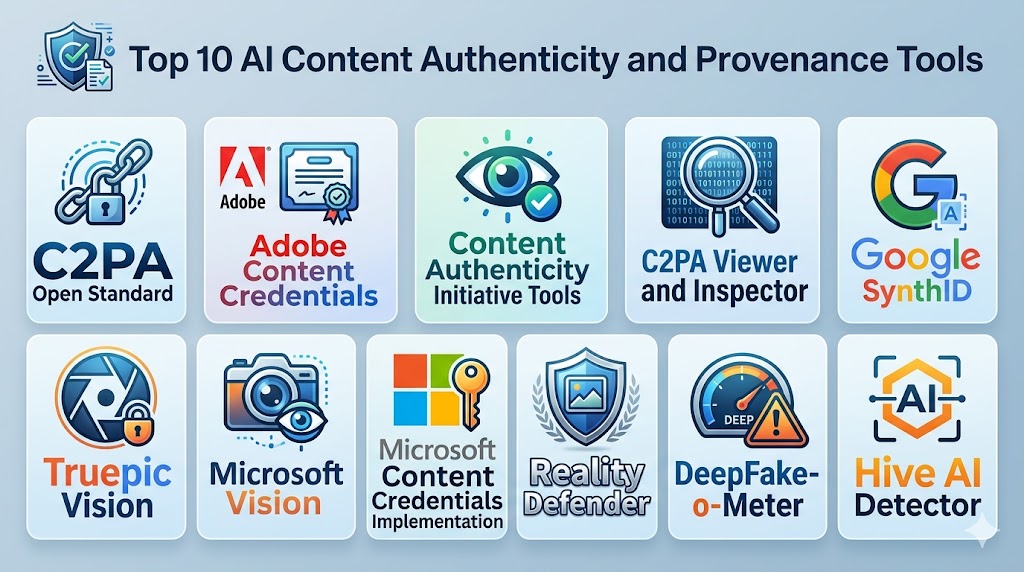
Top 10 AI Content Authenticity and Provenance Tools
1. C2PA Open Standard and Tooling
Short description:
C2PA is the leading open standard for embedding verifiable provenance metadata into digital content. It enables tracking of origin, edits, and AI generation. It is widely adopted across industries. It is the foundation for most authenticity tools.
Key Features
- Provenance metadata embedding
- Cryptographic signatures
- Content history tracking
- Offline verification support
- Standardized manifest format
- Cross-platform compatibility
- Industry-wide adoption
Pros
- Open and widely supported
- Strong trust model
- Interoperable
Cons
- Requires ecosystem adoption
- Metadata can be stripped in some workflows
- Implementation complexity
Platforms / Deployment
Cross-platform
Deployment: Standard and SDKs
Security & Compliance
Cryptographic verification and tamper detection supported
Integrations & Ecosystem
C2PA integrates with cameras, editing tools, and AI platforms.
- Media tools
- AI platforms
- Publishing systems
- APIs
- SDKs
- Verification tools
Support & Community
Backed by major tech and media organizations
2. Adobe Content Credentials
Short description:
Adobe Content Credentials is a practical implementation of C2PA that displays content origin and edit history. It provides a visible trust indicator for users. It is widely used in creative workflows. It is ideal for media and design professionals.
Key Features
- Provenance display
- Edit history tracking
- AI usage labeling
- Visual trust indicators
- Integration with creative tools
- Metadata embedding
- Verification tools
Pros
- User-friendly
- Strong adoption
- Integrated with creative workflows
Cons
- Requires Adobe ecosystem
- Limited outside supported platforms
- Metadata visibility depends on platform
Platforms / Deployment
Cloud / Desktop
Deployment: SaaS
Security & Compliance
Based on C2PA cryptographic metadata
Integrations & Ecosystem
Integrates with creative and publishing tools.
- Adobe tools
- Media platforms
- APIs
- AI tools
- Publishing systems
- Verification apps
Support & Community
Strong enterprise and creative community
3. Content Authenticity Initiative CAI Tools
Short description:
CAI provides open-source tools and SDKs for implementing content provenance systems. It focuses on transparency and trust in digital media. It supports AI-generated content tracking. It is ideal for developers and organizations.
Key Features
- Open-source SDKs
- Provenance tracking
- Metadata standards
- AI content labeling
- Developer tools
- Cross-platform support
- Integration frameworks
Pros
- Open ecosystem
- Developer-friendly
- Strong backing
Cons
- Requires implementation
- Not a standalone product
- Learning curve
Platforms / Deployment
Cross-platform
Deployment: SDK
Security & Compliance
Supports C2PA-based verification
Integrations & Ecosystem
Integrates with media and AI tools.
- APIs
- SDKs
- Media systems
- AI platforms
- Publishing tools
- Dev workflows
Support & Community
Large global community
4. C2PA Viewer and Inspector
Short description:
C2PA Viewer is a tool for inspecting and verifying content credentials. It allows users to see metadata and provenance details. It works directly in the browser. It is ideal for verification workflows.
Key Features
- Metadata inspection
- Provenance verification
- JSON manifest display
- AI content detection indicators
- Browser-based processing
- Privacy-focused
- Real-time validation
Pros
- Easy to use
- No installation needed
- Transparent verification
Cons
- Limited to verification
- No content creation features
- Dependent on C2PA adoption
Platforms / Deployment
Web
Deployment: Browser-based
Security & Compliance
Client-side verification ensures privacy
Integrations & Ecosystem
Works with C2PA-enabled systems.
- Media tools
- AI platforms
- APIs
- Verification workflows
- Browser tools
- Dev systems
Support & Community
Growing ecosystem
5. Google SynthID
Short description:
SynthID is a watermarking technology that embeds invisible identifiers into AI-generated content. It helps detect AI-generated media even after modifications. It is widely used in AI models. It is ideal for large-scale AI platforms.
Key Features
- Invisible watermarking
- AI content detection
- Robust to modifications
- Integration with AI models
- Scalable detection
- Cross-media support
- Automated verification
Pros
- Hard to remove
- Scalable
- Integrated with AI tools
Cons
- Limited public tooling
- Detection accuracy varies
- Proprietary approach
Platforms / Deployment
Cloud
Deployment: AI platform
Security & Compliance
Watermark-based verification
Integrations & Ecosystem
Integrates with AI generation systems.
- AI models
- Cloud platforms
- APIs
- Media tools
- Detection systems
- Dev workflows
Support & Community
Backed by major AI ecosystem
6. Truepic Vision
Short description:
Truepic Vision provides secure capture and verification of media authenticity. It uses cryptographic signing at capture time. It is widely used in enterprise and government sectors. It is ideal for trusted media capture.
Key Features
- Secure media capture
- Metadata signing
- Tamper detection
- Chain of custody tracking
- API integration
- Enterprise workflows
- Compliance features
Pros
- Strong authenticity guarantees
- Enterprise-ready
- Secure capture
Cons
- Paid solution
- Limited open ecosystem
- Requires adoption
Platforms / Deployment
Mobile / Cloud
Deployment: SaaS
Security & Compliance
Cryptographic verification supported
Integrations & Ecosystem
Integrates with enterprise systems.
- APIs
- Mobile apps
- Cloud platforms
- Media systems
- Compliance tools
- Dev workflows
Support & Community
Enterprise support
7. Microsoft Content Credentials Implementation
Short description:
Microsoft integrates content provenance features into its AI and media tools. It supports metadata-based verification. It aligns with industry standards. It is ideal for enterprise ecosystems.
Key Features
- Provenance metadata
- AI content labeling
- Integration with tools
- Security features
- Compliance support
- Cross-platform support
- Enterprise integration
Pros
- Strong enterprise adoption
- Integrated ecosystem
- Scalable
Cons
- Limited standalone tools
- Requires Microsoft ecosystem
- Less open visibility
Platforms / Deployment
Cloud
Deployment: SaaS
Security & Compliance
Supports C2PA-based provenance
Integrations & Ecosystem
Integrates with enterprise tools.
- Cloud platforms
- AI tools
- APIs
- Dev systems
- Media tools
- Security systems
Support & Community
Enterprise support
8. Reality Defender
Short description:
Reality Defender is an AI-based detection platform that identifies synthetic content. It uses machine learning to detect deepfakes. It complements provenance tools. It is ideal for real-time detection.
Key Features
- Deepfake detection
- AI content analysis
- Real-time scanning
- Multi-media support
- API integration
- Security monitoring
- Enterprise tools
Pros
- Real-time detection
- Broad coverage
- Easy integration
Cons
- Detection is probabilistic
- Not provenance-based
- Requires ongoing updates
Platforms / Deployment
Cloud
Deployment: SaaS
Security & Compliance
Detection-based security
Integrations & Ecosystem
Integrates with security systems.
- APIs
- Media platforms
- DevOps tools
- Monitoring systems
- AI tools
- Enterprise systems
Support & Community
Growing adoption
9. DeepFake-o-Meter
Short description:
DeepFake-o-Meter is a tool for analyzing and detecting AI-generated media. It aggregates multiple detection models. It is used for research and analysis. It is ideal for evaluation workflows.
Key Features
- Multi-model detection
- Media analysis
- AI detection
- Research tools
- API support
- Visualization
- Benchmarking
Pros
- Research-focused
- Multi-model insights
- Flexible
Cons
- Not production-ready
- Limited enterprise use
- Requires expertise
Platforms / Deployment
Web / Research
Deployment: Tool
Security & Compliance
Detection-based
Integrations & Ecosystem
Integrates with research tools.
- AI models
- APIs
- Dev tools
- Research systems
- Analytics tools
- Data pipelines
Support & Community
Academic community
10. Hive AI Detector
Short description:
Hive AI Detector is a commercial tool for detecting AI-generated content. It supports multiple media types. It is widely used in moderation workflows. It is ideal for platforms and enterprises.
Key Features
- AI content detection
- Multi-format support
- API integration
- Real-time analysis
- Moderation tools
- Scalability
- Cloud deployment
Pros
- Easy to integrate
- Scalable
- Good detection accuracy
Cons
- Detection-based
- Paid solution
- False positives possible
Platforms / Deployment
Cloud
Deployment: SaaS
Security & Compliance
Detection-based verification
Integrations & Ecosystem
Integrates with content platforms.
- APIs
- Media systems
- Moderation tools
- DevOps tools
- Cloud platforms
- AI workflows
Support & Community
Enterprise support
Comparison Table
| Tool Name | Best For | Platform(s) Supported | Deployment | Standout Feature | Public Rating |
|---|---|---|---|---|---|
| C2PA | Standard | Cross-platform | Standard | Provenance metadata | N/A |
| Adobe Credentials | Media | Multi-platform | SaaS | Visual trust indicator | N/A |
| CAI Tools | Developers | Cross-platform | SDK | Open ecosystem | N/A |
| C2PA Viewer | Verification | Web | Browser | Metadata inspection | N/A |
| SynthID | AI platforms | Cloud | SaaS | Invisible watermarking | N/A |
| Truepic | Capture | Mobile | SaaS | Secure capture | N/A |
| Microsoft | Enterprise | Cloud | SaaS | Integration | N/A |
| Reality Defender | Detection | Cloud | SaaS | Deepfake detection | N/A |
| DeepFake-o-Meter | Research | Web | Tool | Multi-model analysis | N/A |
| Hive AI | Moderation | Cloud | SaaS | Real-time detection | N/A |
Evaluation & Scoring of AI Content Authenticity Tools
| Tool Name | Core | Ease | Integrations | Security | Performance | Support | Value | Weighted Total |
|---|---|---|---|---|---|---|---|---|
| C2PA | 10 | 7 | 10 | 10 | 9 | 9 | 9 | 9.4 |
| Adobe | 9 | 9 | 9 | 9 | 9 | 9 | 8 | 9.0 |
| CAI | 9 | 7 | 9 | 10 | 8 | 9 | 9 | 9.0 |
| Viewer | 7 | 10 | 7 | 9 | 8 | 8 | 9 | 8.4 |
| SynthID | 9 | 8 | 8 | 9 | 9 | 8 | 8 | 8.6 |
| Truepic | 9 | 8 | 8 | 10 | 9 | 9 | 7 | 8.8 |
| Microsoft | 8 | 8 | 9 | 9 | 9 | 9 | 8 | 8.7 |
| Reality Defender | 7 | 9 | 8 | 7 | 8 | 8 | 8 | 7.9 |
| DeepFake-o-Meter | 6 | 7 | 7 | 6 | 7 | 7 | 8 | 6.9 |
| Hive AI | 8 | 9 | 8 | 7 | 8 | 8 | 7 | 8.0 |
These scores are comparative and reflect overall capabilities. Provenance-based tools generally score higher for trust, while detection tools complement them.
Which AI Content Authenticity Tool Is Right for You
Solo / Freelancer
Use C2PA Viewer and basic watermark tools for simple verification.
SMB
Adopt Adobe Content Credentials and Hive AI for usability and moderation.
Mid-Market
Combine C2PA with SynthID for balanced provenance and detection.
Enterprise
Use C2PA, Truepic, and Microsoft tools for full-scale authenticity frameworks.
Budget vs Premium
Open standards like C2PA are free, while enterprise tools offer advanced features.
Feature Depth vs Ease of Use
Adobe tools are easier, while C2PA offers deeper control.
Integrations & Scalability
C2PA and CAI tools integrate well across ecosystems.
Security & Compliance Needs
Choose cryptographic provenance tools for highest trust.
Frequently Asked Questions
1. What is AI content provenance
AI content provenance refers to tracking the origin and history of digital content. It includes creation, edits, and transformations. It helps verify authenticity and trust.
2. How do these tools work
They attach metadata or watermarks to content. This data is cryptographically secured. It allows verification of authenticity and history.
3. What is C2PA
C2PA is an open standard for embedding provenance data into media. It allows verification of origin and edits. It is widely adopted across industries.
4. Are watermarking tools reliable
They are useful but not perfect. Some watermarks can be removed. They work best with other methods.
5. Can these tools prevent deepfakes
They help detect and verify authenticity. They do not fully prevent deepfakes. They are part of a broader solution.
6. Are these tools mandatory
Not yet, but regulations are emerging. Adoption is increasing across industries.
7. Do they work for all content types
Most tools support images, video, and audio. Some also support text. Coverage varies.
8. Can users verify content easily
Some tools provide simple interfaces. Others require technical knowledge. Ease of use varies.
9. Are these tools secure
Provenance tools use cryptographic methods. Detection tools rely on AI. Security depends on implementation.
10. How do I choose the right tool
Identify your use case and scale. Combine provenance and detection tools. Test solutions before adoption.
Conclusion
AI content authenticity and provenance tools are becoming essential in a world where synthetic media is increasingly indistinguishable from real content. These tools provide the foundation for trust by enabling verification of origin, tracking edits, and identifying AI involvement. Standards like C2PA are leading the way by embedding secure metadata directly into content, creating a transparent and verifiable chain of custody. The ecosystem is evolving with two main approaches: provenance-based systems that track content history and detection-based tools that analyze media for AI generation. Both approaches are complementary and often used together for stronger protection. Enterprises and platforms are increasingly adopting these tools to combat misinformation, ensure compliance, and maintain user trust. There is no single solution that fits all use cases. Organizations should start by identifying their needs, whether it is media verification, compliance, or AI transparency. Shortlist a few tools, run pilot implementations, and evaluate how well they integrate with existing workflows. A combined strategy using provenance, watermarking, and detection will provide the most robust defense in the evolving AI landscape.
This article clearly explains AI content authenticity tools, their verification capabilities, and importance in preventing misinformation and improving digital trust.