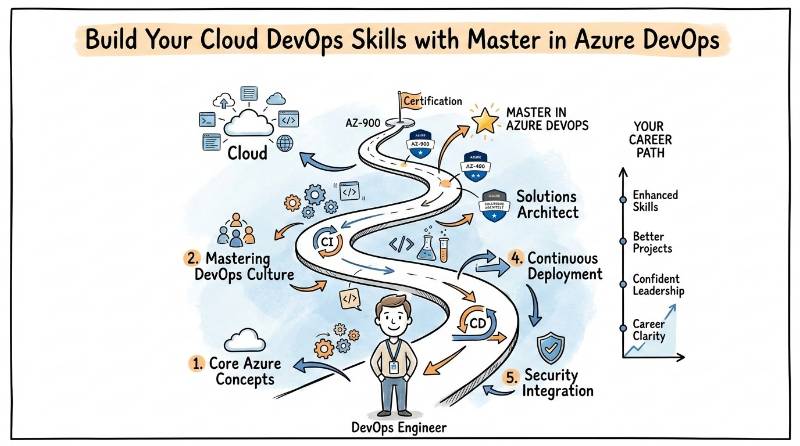
Introduction
The Master in Azure DevOps is a comprehensive training and certification track that is focused on teaching the tools, practices, and cultural shifts needed to bridge the gap between development and operations. By using the Azure platform, the entire software lifecycle—from planning and coding to testing and deployment—is managed under one roof. It is considered a master-level program because it goes beyond simple task automation; it explores the architectural decisions that must be made to keep a global application running smoothly.
Why It Matters Today
Today’s software ecosystem is driven by automation. Manual processes are being replaced by “Infrastructure as Code” and continuous integration pipelines. Because businesses require faster updates without downtime, expertise in Azure DevOps is considered a top-tier skill. It is not just about knowing a tool; it is about understanding how to build a reliable, scalable system that can support millions of users. When a pipeline is built correctly, human error is reduced, and the time taken to fix bugs is cut in half.
The Importance of Certification
For engineers and managers alike, certifications serve as a benchmark of competence. They are used by hiring managers to verify that a candidate possesses a specific set of skills. For the individual, the process of earning a certification ensures that all corners of the platform are explored, not just the parts used in daily tasks. A structured learning path ensures that no gaps in knowledge are left, which is vital when managing production-level environments where even a small mistake can lead to a significant outage.
Certification Overview Table
| Track | Level | Who it’s for | Prerequisites | Skills Covered | Recommended Order |
| Azure DevOps | Master | Software & Cloud Engineers | Basic Cloud Knowledge | CI/CD, Boards, Repo, Artifacts | 1st |
Provider: DevOpsSchool
Why Choose DevOpsSchool?
DevOpsSchool is chosen by many because of its deep focus on practical, hands-on learning. The programs are crafted by industry veterans who bring decades of experience to the table. Students are provided with lifetime access to course materials and are supported by a community of technical experts. It is often preferred because the training is not just theoretical; it is based on real-world scenarios that engineers face every day. Support is provided even after the course is finished, ensuring that any challenges faced at work can be resolved with expert guidance.
Certification Deep-Dive
Master in Azure DevOps
What is this certification?
This certification is a professional validation of an individual’s ability to design and implement DevOps practices on the Azure platform. It covers everything from version control to automated release management and cloud security.
Who should take this certification?
- Software Developers who want their code to be deployed faster and safer.
- System Administrators who are transitioning into modern Cloud Architect roles.
- Project Managers who wish to understand how technical teams deliver value.
Skills you will gain
- Azure Boards: Work items are tracked and managed using Agile and Scrum methodologies.
- Azure Pipelines: Build and release processes are fully automated using YAML and classic editors.
- Azure Repos: Source code is managed with Git and private repositories for better collaboration.
- Azure Artifacts: Packages and dependencies are shared across teams securely.
- Security Integration: Security scans are integrated directly into the automated workflow to catch vulnerabilities early.
Real-world projects after certification
- Zero-Downtime Deployment: A pipeline is built where new versions of an app are rolled out without the users ever noticing a glitch.
- Environment as Code: Entire servers and databases are created and deleted using simple script files.
- Auto-Scaling Systems: Rules are set up so that the application automatically grows when traffic is high and shrinks when traffic is low.
Preparation Plan
- 7–14 Days Plan: A foundation is built by learning the interface. Small, simple websites are deployed to Azure to understand the basic flow.
- 30 Days Plan: The focus is shifted to complex YAML pipelines. Tasks like unit testing, linting, and multi-stage deployments are practiced daily.
- 60 Days Plan: Advanced topics like Docker containers and Kubernetes orchestration are mastered. Real-world troubleshooting is performed to prepare for the exam.
Common Mistakes to Avoid
- Tool Obsession: Tools are learned but the underlying DevOps culture is ignored.
- Neglecting Security: Security is treated as a final step rather than being included from the very first day of coding.
- Avoiding Labs: Theory is read but no hands-on practice is done, leading to failure when real issues arise in a project.
Best Next Certification
- Same Track: Azure Solutions Architect Expert for a deeper cloud perspective.
- Cross-Track: AWS Certified DevOps Engineer to become a multi-cloud expert.
- Leadership: Certified Kubernetes Administrator (CKA) for deep infrastructure management.
Choose Your Learning Path
- DevOps Path: This is the most popular route. It is chosen by those who want to be the bridge between developers and the IT team, ensuring that code flows smoothly from a laptop to the live server.
- DevSecOps Path: This path is followed by engineers who are passionate about security. Here, the focus is placed on making sure that every piece of code is scanned for bugs and threats before it is ever allowed to run.
- Site Reliability Engineering (SRE) Path: This is recommended for those who love high-scale systems. The focus is on keeping websites up 99.99% of the time by using monitoring and automation to fix problems before they happen.
- AIOps / MLOps Path: This is a newer field where AI models are managed like software. It is ideal for data professionals who want to automate the training and deployment of machine learning models.
- DataOps Path: This is designed for data engineers. It teaches how to manage data pipelines and big data warehouses with the same speed and reliability as a software application.
- FinOps Path: This path is perfect for those interested in the business side. It involves managing cloud costs and making sure that no money is wasted on unused cloud resources.
Role → Recommended Certifications Mapping
- DevOps Engineer: The Master in Azure DevOps is the foundation, followed by Docker and Kubernetes certifications.
- SRE: Monitoring tools like Prometheus and Grafana are mastered alongside Azure DevOps practices.
- Platform Engineer: A heavy focus is placed on Terraform and Infrastructure as Code to build consistent cloud platforms.
- Cloud Engineer: Azure Administrator and Azure DevOps certifications are combined to manage complex cloud environments.
- Security Engineer: The DevSecOps Master program is taken to learn how to defend automated systems.
- Data Engineer: Azure Data Factory and DataOps certifications are prioritized for managing large-scale data sets.
- FinOps Practitioner: Training in cloud financial management is added to technical Azure skills.
- Engineering Manager: DevOps for Managers is taken to lead technical teams effectively without getting lost in the code.
Next Certifications to Take
Based on the latest data for software engineers, the following recommendations are made:
- Same-track: Azure Solutions Architect Expert. This is seen as the natural next step for those who want to design high-level systems.
- Cross-track: HashiCorp Certified: Terraform Associate. This is recommended because cloud-neutral tools are becoming highly valuable.
- Leadership: Certified Scrum Master (CSM). This is chosen by those moving into leadership roles to better manage team dynamics and agile delivery.
Training & Certification Support Institutions
- DevOpsSchool: This institution is widely known for its hands-on labs. A huge library of real-world projects is provided so that students can practice until they are experts.
- Cotocus: Specialization is offered here for corporate teams. The focus is placed on helping large companies migrate their legacy systems to the modern cloud.
- ScmGalaxy: This is a great place for technical resources. Thousands of tutorials and articles are available for those who want to learn on their own.
- BestDevOps: A very simple approach to learning is taken here. Complex topics are broken down into easy-to-understand lessons for those just starting out.
- devsecopsschool.com: Everything related to secure automation is taught here. It is the go-to place for learning how to keep hackers away from your deployment pipelines.
- sreschool.com: The art of keeping systems alive is the main focus. Students are taught how to handle heavy traffic and prevent website crashes.
- aiopsschool.com: The future of operations is explored here. Lessons are provided on how to use artificial intelligence to manage IT systems automatically.
- dataopsschool.com: This site is dedicated to data professionals. It bridges the gap between traditional data management and modern DevOps speed.
- finopsschool.com: Financial cloud management is the core subject here. It is where engineers learn how to keep the cloud bill as low as possible.
FAQs Section
General Career FAQs
- Is Azure DevOps difficult to learn?
A logical mindset is required, but it is manageable for anyone with basic IT knowledge. - How much time is needed for the Master program?
Usually, 2 to 3 months are needed for a full understanding and preparation. - Are there prerequisites?
A basic understanding of the software development life cycle is helpful for context. - What is the sequence of learning?
It is recommended that basic Azure cloud concepts are mastered before moving to DevOps. - What is the career value of this certification?
It is seen as a major career booster that can lead to higher-paying and more stable roles. - Which job roles can I apply for?
Roles such as DevOps Engineer, Cloud Architect, and Release Manager can be targeted. - Is coding required?
Basic scripting knowledge is expected, though deep programming is not always mandatory for every role. - Does this certification expire?
Periodic updates are usually required as the Azure platform is updated with new features. - How is Azure DevOps different from AWS?
While the tools have different names, the core principles of automation remain identical. - Is there global demand?
Yes, the skills are highly recognized in India, the US, Europe, and the Middle East. - Can a manager benefit from this?
Yes, a much better understanding of how technical teams operate is gained through this training. - Is hands-on practice included?
Most reputable training programs emphasize practical lab work over just reading slides.
Master in Azure DevOps Specific FAQs
- What is included in the Master in Azure DevOps curriculum?
Boards, Repos, Pipelines, Test Plans, and Artifacts are all covered in detail. - How is the exam structured?
It is typically a mix of multiple-choice questions and scenario-based technical problems. - Is open-source integration taught?
Yes, integration with popular tools like GitHub, Jenkins, and SonarQube is often included. - Is containerization covered?
Yes, working with Docker and Kubernetes within the Azure ecosystem is a core part of the program. - Can I learn this part-time?
Many working professionals complete this through flexible weekend or evening sessions. - Are there practice exams available?
Yes, these are usually provided by training institutions to help students get comfortable with the format. - What industries use Azure DevOps?
It is used heavily in finance, healthcare, retail, and the tech service sector. - Is there a community for support??
Large forums and alumni groups are available where questions can be asked and answered.
Testimonials
- “The way my workflow was organized changed completely after the course. A lot of clarity was gained regarding how code moves from my laptop to the server securely.” — Arjun
- “System reliability is no longer a mystery to me. The practical labs helped me build a level of confidence that simply wasn’t there before the training.” — Saritha
- “The transition from a standard developer role to a cloud-focused role was made much smoother. My career path is now very clear and rewarding.” — Vikram
- “Security was always an afterthought for our team. Now, it is integrated into everything we do, and the results are much better and faster.” — Aditi
- “As a manager, I can now speak the same language as my engineers. The project timelines have become much more predictable and manageable.” — Rajesh
Conclusion
The importance of the Master in Azure DevOps certification cannot be overstated in today’s market. Long-term career benefits include not just job security, but the ability to lead high-impact projects in any industry across the globe. Strategic learning and careful certification planning are encouraged for anyone who wants to stay relevant in the coming years. By following this guide, a strong foundation for a future in cloud automation can be built.