Introduction
Deploying a single robot in a controlled laboratory environment is a rewarding technical achievement. You write code, test it on the physical hardware, fix bugs, and watch the machine navigate a room or manipulate an object. However, moving from one robot in a lab to a fleet of fifty or five hundred robots in a live commercial warehouse changes the engineering challenge entirely.
Suddenly, you are not just writing control algorithms; you are managing a distributed system spread across physical space. Hardware parts degrade, wireless networks drop packets, batteries lose capacity, and software updates can cause unexpected navigation failures miles away from the developer’s desk.
To solve these scaling challenges, the industry has adopted RobotOps. By combining software engineering discipline with robotics, engineering teams can safely monitor, update, and scale robotic systems in production.
What Is RobotOps?
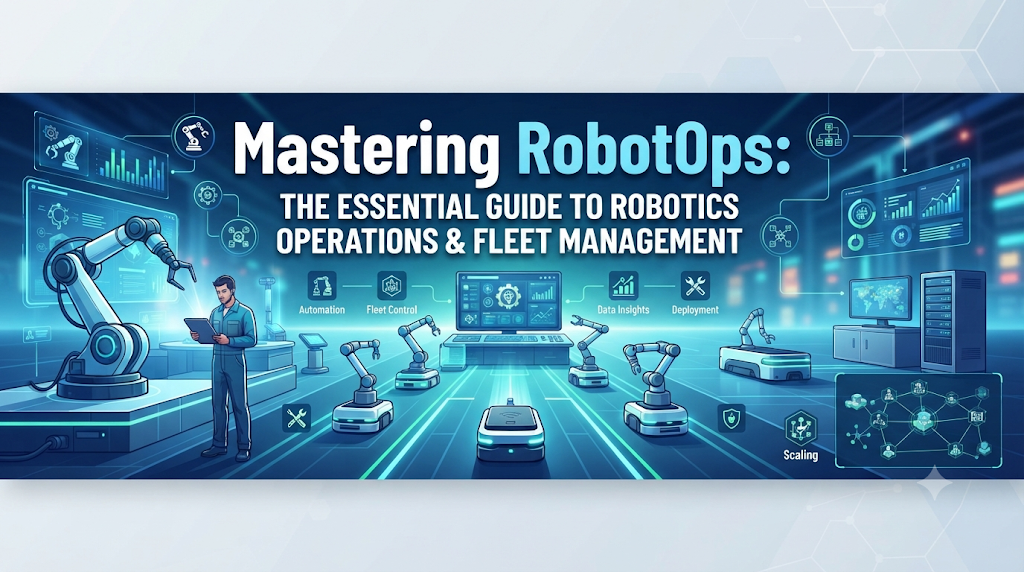
At its core, RobotOps (Robotics Operations) is the practice of applying modern software operations, automation, observability, and lifecycle management to robotic systems.
A traditional software application runs on stable cloud servers where you can instantly restart a container or push a patch. A robot is fundamentally different. A robot is a physical machine that combines:
- Hardware and Actuators: Motors, wheels, and mechanical linkages that interact with the physical world.
- Sensors: LiDAR, cameras, IMUs, and depth sensors that generate massive streams of environmental data.
- Embedded Software and Operating Systems: Real-time kernels and drivers that manage low-level hardware communication.
- Middleware and Frameworks: Communication layers like ROS 2 (Robot Operating System 2) that let different software nodes talk to each other.
- Edge and Cloud Systems: Local onboard computers paired with centralized cloud infrastructure for data storage and coordination.
When these systems scale, managing them manually becomes impossible. RobotOps bridges the gap between building a robot and keeping it reliably running in the real world.
Core Pillars of Robotics Operations
Running a reliable robotics program requires looking at the entire lifecycle of the machine—from design and simulation to active deployment and eventual retirement.
1. Robot Fleet Management
Managing a single robot requires tracking battery levels and software versions. Managing a fleet requires Robot Fleet Management platforms that act as the central nervous system for all active units.
A fleet management tool coordinates task allocation, traffic control in narrow aisles, and priority routing. If Robot A encounters a blocked path, the fleet system dynamically reroutes Robot B and alerts operators if human intervention is required.
2. Telemetry and Observability
You cannot fix a problem you cannot see. Robots operate in dynamic environments where network connectivity fluctuates. Effective Robotics Operations rely on continuous telemetry streaming.
Instead of pulling gigabytes of raw camera footage, efficient systems stream vital health metrics:
- CPU and memory usage of onboard computers
- Battery state of health and charge cycles
- Wheel slip and localization confidence scores
- Current sensor status and error codes
3. Robotics Software and Middleware (ROS 2)
Modern robots rely heavily on modular software architectures. ROS 2 has become the industry standard middleware, using nodes, topics, services, and actions to distribute tasks across the robot’s computer.
In a production RobotOps workflow, managing these software packages requires robust containerization, version control, and reproducible builds so that code running in simulation behaves identically on the physical robot.
The Role of Robot Simulation in Production
Before pushing code to physical hardware, engineering teams rely heavily on Robot Simulation. Virtual environments allow developers to test navigation, obstacle avoidance, and sensor calibration in physics-based digital twins.
- Scenario Testing: You can simulate edge cases, such as sudden pedestrian crossings or flickering lighting, that are dangerous or difficult to replicate in a real warehouse.
- Faster Iteration: Developers can run hundreds of automated tests in parallel overnight without draining physical batteries or risking hardware collisions.
The Reality Gap
Simulation is powerful, but it is never 100% perfect. Friction coefficients, wheel wear, and wireless latency in the real world always differ slightly from virtual models. A successful RobotOps pipeline uses simulation for rapid validation, followed by staged canary deployments on a small subset of physical robots.
Autonomous Mobile Robots in Action
Consider an Autonomous Mobile Robot (AMR) operating in a busy e-commerce fulfillment center. The AMR relies on simultaneous localization and mapping (SLAM) to understand its surroundings, detect obstacles, and plan safe paths.
When hundreds of these robots share the same floor, operational challenges multiply:
- Localization Failures: If a dynamic obstacle blocks visual landmarks, a robot might momentarily lose its position on the map.
- Traffic Deadlocks: Two robots meeting in a narrow corridor must negotiate right-of-way without human intervention.
- Battery Management: Robots must autonomously navigate to charging stations before power drops to critical levels, factoring in queue times at the chargers.
The Robotics Operations Center (ROC)
To oversee large-scale deployments, organizations often establish a Robotics Operations Center. Similar to an IT network operations center (NOC), an ROC provides centralized visibility into the entire fleet.
Operators inside an ROC monitor real-time dashboards showing active robot states, geofenced zones, active alerts, and incident logs. If an AMR experiences a fatal error—such as a persistent motor fault or a severe localization drift—the ROC receives an immediate alert, allowing a remote operator to review diagnostic logs or teleoperate the robot to a safe zone.
Common RobotOps Mistakes to Avoid
Building a scalable robotics operation requires avoiding several frequent pitfalls:
- Treating Robots Only as Hardware: Focusing entirely on mechanical design while ignoring software deployment pipelines and remote monitoring tools.
- Skipping Staged Rollouts: Pushing a new navigation algorithm to the entire fleet simultaneously instead of rolling it out gradually.
- Ignoring Network Reliability: Assuming constant, high-speed Wi-Fi or 5G coverage in every corner of a facility. Systems must be designed to gracefully handle intermittent connectivity.
- Neglecting Security Controls: Leaving ROS 2 communication unencrypted or using default credentials on onboard edge computers, exposing the fleet to potential interference.
Learning Path for RobotOps Professionals
For engineers and developers looking to master this emerging field, a structured learning path is essential:
- Robotics Fundamentals: Understand kinematics, sensors, and basic control theory.
- Software Engineering & Linux: Master command-line tools, networking basics, and Docker containerization.
- Robotics Middleware (ROS 2): Learn how to build nodes, publish topics, and manage services.
- Robot Simulation: Gain experience with physics simulators and digital twin environments.
- Deployment & CI/CD: Learn automated testing, fleet monitoring, and remote software delivery.
Educational Resources at RobotsOps.com
For engineers, students, and automation professionals looking to deepen their expertise, platforms like RobotsOps.com provide technical tutorials, architectural guides, and learning resources covering RobotOps, Robot Fleet Management, and ROS 2. These materials focus on bridging the gap between theoretical robotics algorithms and reliable production operations.
Frequently Asked Questions
What is RobotOps?
RobotOps is the practice of applying software engineering, DevOps, automation, and lifecycle management principles to robotic systems to ensure reliable performance at scale.
How is RobotOps different from traditional DevOps?
While DevOps manages software running on cloud servers or virtual machines, RobotOps must account for physical hardware, mechanical wear, sensors, wireless network fluctuations, and real-world safety constraints.
Why is ROS 2 important for Robotics Operations?
ROS 2 provides a robust, secure, and distributed communication middleware that allows modular robotic software components to share data reliably across different nodes and systems.
What is the purpose of a Robotics Operations Center (ROC)?
An ROC serves as a centralized hub where operators monitor fleet telemetry, track robot health, review active incidents, and manage remote interventions or software updates.
Can robot simulation completely replace physical testing?
No. While simulation is essential for rapid testing and edge-case validation, physical-to-virtual discrepancies mean real-world testing and staged deployments remain necessary.
Conclusion
Managing robotic systems in production requires far more than writing clever control algorithms or designing durable mechanical hardware. As organizations scale from a single experimental unit to fleets of hundreds of autonomous machines, the complexity shifts from local performance to large-scale coordination, observability, and lifecycle maintenance.
By embracing RobotOps, engineering teams can bridge the gap between software engineering and physical robotics. Implementing robust telemetry, leveraging ROS 2 middleware, utilizing physics-based robot simulation, and establishing a centralized Robotics Operations Center ensure that fleets remain reliable, secure, and adaptable in dynamic environments. Ultimately, treating robotics operations with the same rigor as modern cloud infrastructure is the key to unlocking the true potential of industrial automation and Autonomous Mobile Robots.