Introduction
Marketplace platforms are online ecosystems where multiple sellers list products or services and customers purchase from a shared digital storefront. In simple terms, instead of building your own e-commerce store from scratch, you sell through a platform that already has traffic, trust, and infrastructure. These platforms handle core elements like listings, payments, logistics support, and customer acquisition.
Marketplace platforms matter because they provide instant access to large audiences, reduce go-to-market time, and enable global selling without heavy upfront investment. They are widely used for B2C retail, B2B commerce, handmade goods, cross-border trade, and digital products. Common use cases include launching new brands, scaling product reach, testing new markets, and running multi-channel commerce strategies.
Buyers (sellers) should evaluate platform fees, audience reach, competition level, fulfillment options, brand control, analytics, international capabilities, seller tools, and integration support.
Best for: D2C brands, retailers, wholesalers, startups, artisans, and enterprises looking to expand sales channels.
Not ideal for: businesses needing full brand control, custom customer experiences, or those wanting to avoid platform commissions.
Key Trends in Marketplace Platforms
- Rapid growth of cross-border and global selling
- AI-driven product recommendations and personalization
- Integration with logistics and fulfillment networks
- Rise of niche and vertical marketplaces
- Strong focus on seller analytics and performance tracking
- Expansion of B2B marketplaces alongside B2C
- Omnichannel strategies combining marketplaces and own stores
- Mobile-first shopping experiences dominating usage
- Subscription and service-based marketplace models
- Increased focus on trust, reviews, and fraud prevention
How We Selected These Tools (Methodology)
- Evaluated global popularity and user base
- Assessed seller tools and marketplace features
- Reviewed scalability and international reach
- Analyzed fee structures and monetization models
- Considered integration and API capabilities
- Evaluated logistics and fulfillment support
- Reviewed analytics and reporting features
- Considered ease of onboarding for sellers
- Assessed trust, security, and buyer protection
- Ensured coverage across different regions and industries
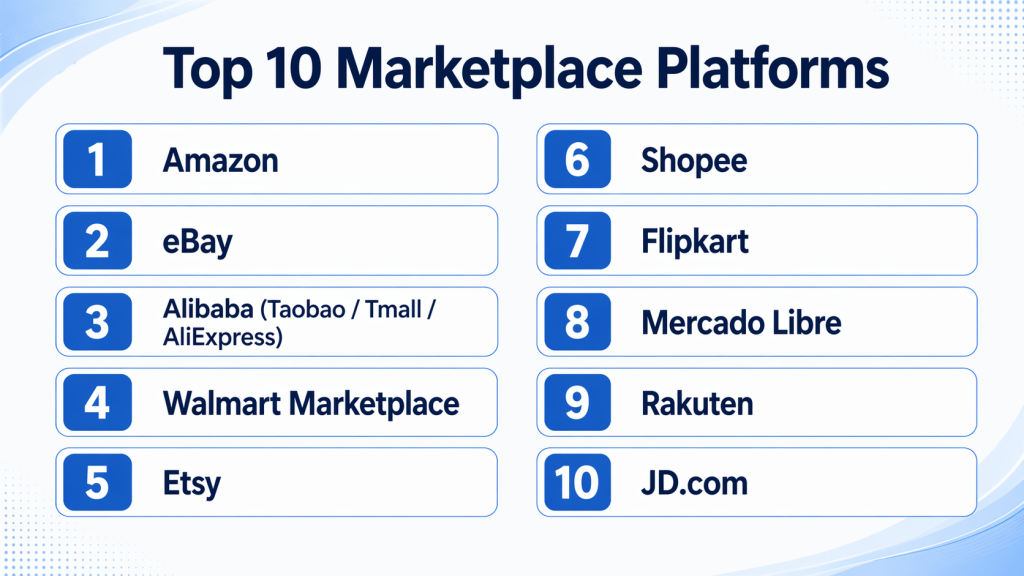
Top 10 Marketplace Platforms
#1 — Amazon
Short description : Amazon is the largest global marketplace, enabling millions of sellers to reach customers worldwide with strong logistics and fulfillment support.
Key Features
- Global customer reach
- Fulfillment by Amazon (FBA)
- Advanced seller analytics
- Advertising tools
- Secure payment processing
Pros
- Massive audience
- Strong logistics network
Cons
- High competition
- Fees can be significant
Platforms / Deployment
- Web / Mobile / Cloud
Security & Compliance
- Strong buyer and seller protection systems
Integrations & Ecosystem
Amazon offers a vast ecosystem connecting sellers with logistics, advertising, and analytics tools.
- Shipping integrations
- Advertising tools
- Seller APIs
Support & Community
Extensive documentation and seller support programs.
#2 — eBay
Short description : eBay is a global marketplace known for auctions and fixed-price listings, supporting both new and used goods.
Key Features
- Auction and fixed pricing
- Global selling
- Seller analytics
- Buyer protection
- Payment processing
Pros
- Flexible selling models
- Global audience
Cons
- Less brand control
- Competitive pricing pressure
Platforms / Deployment
- Web / Mobile / Cloud
Security & Compliance
- Buyer protection programs
Integrations & Ecosystem
- Payment systems
- Shipping integrations
- APIs
Support & Community
Seller community and support resources.
#3 — Alibaba (Taobao / Tmall / AliExpress)
Short description : Alibaba operates multiple marketplaces focused on B2B and B2C commerce, connecting global buyers and suppliers.
Key Features
- B2B and B2C platforms
- Global supplier network
- Bulk ordering support
- Payment systems
- Analytics tools
Pros
- Strong manufacturing connections
- Global reach
Cons
- Complex ecosystem
- Quality variation
Platforms / Deployment
- Web / Mobile / Cloud
Security & Compliance
- Escrow payment systems
Integrations & Ecosystem
- Logistics providers
- Payment gateways
- APIs
Support & Community
Vendor support and documentation.
#4 — Walmart Marketplace
Short description : Walmart Marketplace allows third-party sellers to reach a large U.S.-based audience with trusted retail backing.
Key Features
- Trusted brand
- Fulfillment services
- Seller analytics
- Product listing tools
- Secure payments
Pros
- Lower competition than Amazon
- Strong brand trust
Cons
- Strict onboarding
- Limited global reach
Platforms / Deployment
- Web / Cloud
Security & Compliance
- Secure payment processing
Integrations & Ecosystem
- Shipping tools
- APIs
- Retail integrations
Support & Community
Seller support programs.
#5 — Etsy
Short description : Etsy is a niche marketplace focused on handmade, vintage, and creative goods.
Key Features
- Handmade and custom products
- Seller storefronts
- Marketing tools
- Payment processing
- Analytics
Pros
- Targeted audience
- Strong brand identity
Cons
- Limited product categories
- Fees
Platforms / Deployment
- Web / Mobile / Cloud
Security & Compliance
- Secure transactions
Integrations & Ecosystem
- Payment tools
- Marketing integrations
Support & Community
Active seller community.
#6 — Shopee
Short description : Shopee is a fast-growing marketplace in Southeast Asia, offering mobile-first shopping and integrated logistics.
Key Features
- Mobile-first design
- Logistics support
- Seller tools
- Promotions
- Payment integration
Pros
- Strong regional presence
- User-friendly
Cons
- Limited global reach
- Competitive environment
Platforms / Deployment
- Web / Mobile / Cloud
Security & Compliance
- Payment protection systems
Integrations & Ecosystem
- Logistics partners
- Payment systems
Support & Community
Regional support and resources.
#7 — Flipkart
Short description : Flipkart is a major marketplace in India, offering a wide range of products and strong logistics support.
Key Features
- Large customer base
- Seller tools
- Logistics integration
- Payment systems
- Analytics
Pros
- Strong local presence
- Growing ecosystem
Cons
- Limited global reach
- Competitive pricing
Platforms / Deployment
- Web / Mobile / Cloud
Security & Compliance
- Secure payment systems
Integrations & Ecosystem
- Logistics
- Payment tools
Support & Community
Seller support programs.
#8 — Mercado Libre
Short description : Mercado Libre is a leading marketplace in Latin America, providing e-commerce and fintech services.
Key Features
- Regional dominance
- Payment integration
- Logistics support
- Seller analytics
- Advertising tools
Pros
- Strong regional reach
- Integrated payments
Cons
- Limited outside region
- Competition
Platforms / Deployment
- Web / Mobile / Cloud
Security & Compliance
- Secure transactions
Integrations & Ecosystem
- Payment tools
- Logistics
Support & Community
Vendor support.
#9 — Rakuten
Short description : Rakuten is a Japanese marketplace offering a loyalty-driven shopping experience.
Key Features
- Loyalty programs
- Seller storefronts
- Analytics tools
- Payment integration
- Marketing tools
Pros
- Strong loyalty system
- Established brand
Cons
- Limited global reach
- Complex onboarding
Platforms / Deployment
- Web / Mobile / Cloud
Security & Compliance
- Secure payments
Integrations & Ecosystem
- Marketing tools
- APIs
Support & Community
Seller support and resources.
#10 — JD.com
Short description : JD.com is a major Chinese marketplace known for logistics efficiency and product authenticity.
Key Features
- Fast logistics
- Inventory management
- Seller tools
- Analytics
- Secure payments
Pros
- Strong logistics
- Trusted platform
Cons
- Regional focus
- High competition
Platforms / Deployment
- Web / Mobile / Cloud
Security & Compliance
- Secure payment systems
Integrations & Ecosystem
- Logistics
- Payment tools
Support & Community
Vendor support.
Comparison Table (Top 10)
| Tool | Best For | Platform | Deployment | Standout Feature | Public Rating |
|---|---|---|---|---|---|
| Amazon | Global sellers | Web/Mobile | Cloud | Massive reach | N/A |
| eBay | Flexible selling | Web/Mobile | Cloud | Auctions | N/A |
| Alibaba | B2B/B2C | Web/Mobile | Cloud | Supplier network | N/A |
| Walmart | U.S. sellers | Web | Cloud | Retail trust | N/A |
| Etsy | Creators | Web/Mobile | Cloud | Niche focus | N/A |
| Shopee | SEA market | Web/Mobile | Cloud | Mobile-first | N/A |
| Flipkart | India | Web/Mobile | Cloud | Local reach | N/A |
| Mercado Libre | LATAM | Web/Mobile | Cloud | Regional dominance | N/A |
| Rakuten | Japan | Web/Mobile | Cloud | Loyalty system | N/A |
| JD.com | China | Web/Mobile | Cloud | Logistics | N/A |
Evaluation & Scoring of Marketplace Platforms
| Tool | Core | Ease | Integrations | Security | Performance | Support | Value | Total |
|---|---|---|---|---|---|---|---|---|
| Amazon | 10 | 8 | 9 | 9 | 10 | 9 | 7 | 8.9 |
| eBay | 8 | 9 | 8 | 8 | 8 | 8 | 8 | 8.1 |
| Alibaba | 9 | 7 | 8 | 8 | 9 | 8 | 7 | 8.0 |
| Walmart | 8 | 7 | 7 | 8 | 8 | 7 | 7 | 7.6 |
| Etsy | 7 | 9 | 7 | 8 | 7 | 8 | 8 | 7.7 |
| Shopee | 8 | 8 | 7 | 7 | 8 | 7 | 8 | 7.6 |
| Flipkart | 8 | 7 | 7 | 7 | 8 | 7 | 8 | 7.5 |
| Mercado Libre | 8 | 7 | 7 | 7 | 8 | 7 | 8 | 7.5 |
| Rakuten | 7 | 7 | 7 | 7 | 7 | 7 | 7 | 7.0 |
| JD.com | 9 | 7 | 7 | 8 | 9 | 7 | 7 | 7.7 |
Which Marketplace Platform Is Right for You?
Solo / Freelancer
- Etsy or eBay for niche and flexible selling.
SMB
- Amazon, Flipkart, or Shopee for growth and reach.
Mid-Market
- Walmart Marketplace or Mercado Libre.
Enterprise
- Amazon, Alibaba, JD.com for scale.
Budget vs Premium
- Low cost → eBay, Etsy
- Premium → Amazon, Alibaba
Feature Depth vs Ease of Use
- Easy → Etsy, eBay
- Advanced → Amazon, Alibaba
Integrations & Scalability
- Choose platforms with strong APIs.
Security & Compliance Needs
- Enterprise platforms offer better protection.
Frequently Asked Questions (FAQs)
1. What is a marketplace platform?
It connects multiple sellers with buyers on one platform.
2. How do they make money?
Through commissions and listing fees.
3. Can I sell globally?
Yes, most platforms support global selling.
4. Do I need inventory?
Not always; dropshipping is possible.
5. Are they secure?
Yes, most include buyer protection.
6. Can I build my own brand?
Limited compared to own website.
7. Are fees high?
Depends on platform and category.
8. Can I integrate tools?
Yes, APIs are available.
9. Is competition high?
Yes, especially on large platforms.
10. What is the biggest benefit?
Access to large audiences.
Conclusion
Marketplace platforms are one of the fastest ways to enter and scale in e-commerce, offering access to massive customer bases, built-in trust, and streamlined operations. While platforms like Amazon and Alibaba dominate globally, regional players like Flipkart, Shopee, and Mercado Libre provide strong local opportunities. The right choice depends on your target market, product category, and growth strategy. Businesses should start by testing multiple platforms, optimizing listings, and gradually expanding into a multi-channel approach to maximize revenue and long-term success.