Introduction
E-commerce platforms are software solutions that allow businesses to create, manage, and scale online stores. In simple terms, they provide everything needed to sell online — from website design and product catalog management to payment processing, order fulfillment, and customer analytics. These platforms act as the backbone of digital commerce, enabling businesses to sell across websites, marketplaces, and social channels.
E-commerce platforms matter more than ever because online retail continues to grow rapidly, with businesses needing scalable, flexible, and integrated solutions to compete effectively. Modern platforms now include AI-driven recommendations, omnichannel selling, SEO tools, and automation features to improve conversions and customer experience .
Common use cases include launching online stores, managing inventory, handling payments, running marketing campaigns, and selling across multiple channels like Amazon, Instagram, and websites. Buyers should evaluate ease of use, scalability, customization, integrations, pricing model, performance, security, and omnichannel capabilities.
Best for: entrepreneurs, startups, SMBs, D2C brands, and enterprise retailers looking to build or scale online sales channels.
Not ideal for: businesses that don’t sell online or those needing only simple landing pages without full commerce functionality.
Key Trends in E-commerce Platforms
- AI-powered product recommendations and personalization
- Omnichannel selling across marketplaces and social media
- Headless commerce for flexible front-end customization
- Mobile-first shopping experiences
- Built-in SEO and marketing automation
- Subscription and digital product selling support
- Real-time analytics and customer insights
- Integration with payment gateways and logistics providers
- Cloud-based SaaS platforms dominating the market
- Focus on scalability and global selling (multi-currency, multi-language)
How We Selected These Tools (Methodology)
- Evaluated global adoption and popularity among businesses
- Assessed feature completeness (store design, payments, inventory, analytics)
- Reviewed scalability for growing businesses
- Considered ease of use for non-technical users
- Analyzed integration capabilities with third-party tools
- Evaluated customization and flexibility
- Reviewed performance and reliability
- Considered pricing models and hidden costs
- Assessed support and community ecosystem
- Ensured coverage across SMB and enterprise use cases
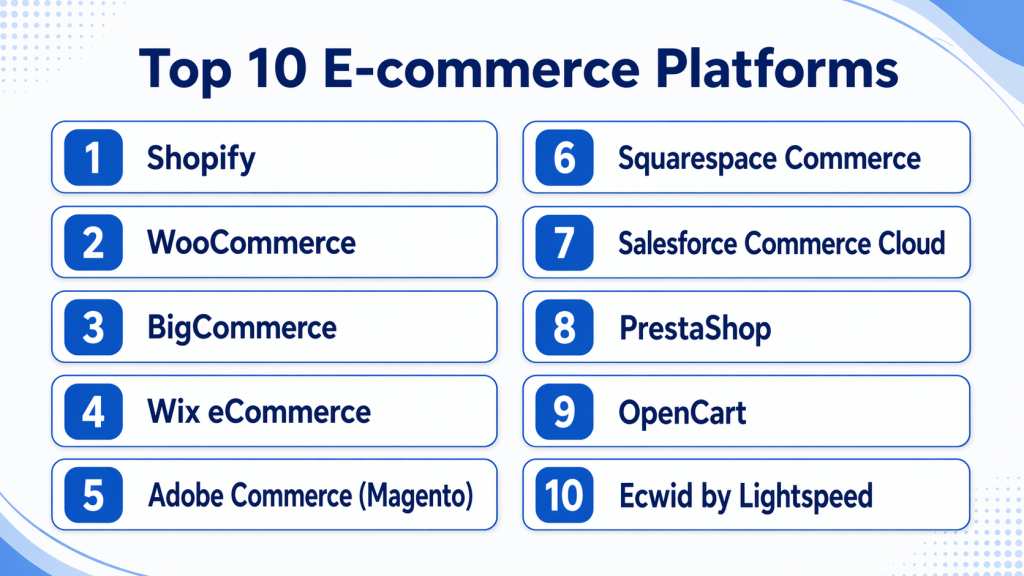
Top 10 E-commerce Platforms
#1 — Shopify
Short description : Shopify is one of the most widely used e-commerce platforms globally, designed for businesses of all sizes. It offers a fully hosted solution that allows users to quickly build, launch, and scale online stores without technical expertise.
Key Features
- Drag-and-drop store builder
- Payment processing integration
- Inventory management
- App marketplace
- Multichannel selling
Pros
- Easy to use
- Highly scalable
Cons
- Transaction fees
- Customization limits without apps
Platforms / Deployment
- Web / Mobile
- Cloud
Security & Compliance
- SSL, PCI compliance (commonly supported)
Integrations & Ecosystem
- Payment gateways
- Marketing tools
- Marketplace integrations
Support & Community
- 24/7 support and large community
#2 — WooCommerce
Short description : WooCommerce is an open-source e-commerce platform built on WordPress, offering flexibility and customization for businesses with technical resources.
Key Features
- Open-source flexibility
- Plugin ecosystem
- Customizable design
- SEO-friendly
- Large community
Pros
- Highly customizable
- Cost-effective base
Cons
- Requires hosting
- Technical setup needed
Platforms / Deployment
- Web
- Self-hosted
Security & Compliance
- Varies / depends on hosting
Integrations & Ecosystem
- WordPress plugins
- Payment gateways
- CRM tools
Support & Community
- Large developer community
#3 — BigCommerce
Short description : BigCommerce is a powerful SaaS platform designed for scaling businesses, offering advanced features like multi-storefront management and omnichannel selling.
Key Features
- Multi-storefront support
- Built-in SEO tools
- Omnichannel selling
- Analytics dashboards
- B2B features
Pros
- No transaction fees
- Strong scalability
Cons
- Learning curve
- Limited design flexibility
Platforms / Deployment
- Web
- Cloud
Security & Compliance
- PCI DSS, SSL
Integrations & Ecosystem
- APIs
- Payment providers
- Marketing tools
Support & Community
- 24/7 support
#4 — Wix eCommerce
Short description : Wix offers an easy-to-use website builder with integrated e-commerce features, ideal for beginners and small businesses.
Key Features
- Drag-and-drop builder
- AI website creation
- Templates
- Payment integration
- Multichannel selling
Pros
- Very beginner-friendly
- Fast setup
Cons
- Limited scalability
- Less advanced features
Platforms / Deployment
- Web
- Cloud
Security & Compliance
- SSL, 2FA
Integrations & Ecosystem
- App marketplace
- Social commerce
- Payment gateways
Support & Community
- Help center and support
#5 — Adobe Commerce (Magento)
Short description : Adobe Commerce is an enterprise-level e-commerce platform offering deep customization and scalability for large businesses.
Key Features
- Advanced customization
- Multi-store support
- B2B features
- Scalability
- Analytics
Pros
- Highly flexible
- Enterprise-ready
Cons
- Expensive
- Requires developers
Platforms / Deployment
- Cloud / Self-hosted
Security & Compliance
- Enterprise-grade security
Integrations & Ecosystem
- Adobe ecosystem
- APIs
- Third-party tools
Support & Community
- Enterprise support
#6 — Squarespace Commerce
Short description : Squarespace combines beautiful design templates with e-commerce functionality, making it ideal for creators and small businesses.
Key Features
- Design-focused templates
- Product management
- Payment integration
- Marketing tools
- Analytics
Pros
- Attractive designs
- Easy setup
Cons
- Limited advanced features
- Less scalable
Platforms / Deployment
- Web
- Cloud
Security & Compliance
- SSL
Integrations & Ecosystem
- Payment tools
- Marketing integrations
Support & Community
- Support and documentation
#7 — Salesforce Commerce Cloud
Short description : Salesforce Commerce Cloud is an enterprise solution focused on large-scale digital commerce with advanced AI and personalization.
Key Features
- AI-driven recommendations
- Omnichannel commerce
- Personalization
- Analytics
- Enterprise scalability
Pros
- Powerful enterprise features
- Strong ecosystem
Cons
- Expensive
- Complex implementation
Platforms / Deployment
- Web
- Cloud
Security & Compliance
- Enterprise-grade
Integrations & Ecosystem
- Salesforce ecosystem
- APIs
Support & Community
- Enterprise support
#8 — OpenCart
Short description : OpenCart is a lightweight open-source e-commerce platform suitable for small to mid-sized businesses.
Key Features
- Open-source
- Extensions marketplace
- Multi-store support
- Payment integrations
- Reporting
Pros
- Free core
- Flexible
Cons
- Requires technical setup
- Limited support
Platforms / Deployment
- Web
- Self-hosted
Security & Compliance
- Varies
Integrations & Ecosystem
- Extensions
- Payment gateways
Support & Community
- Community support
#9 — Square Online
Short description : Square Online is a simple e-commerce platform integrated with Square POS, ideal for small retailers.
Key Features
- POS integration
- Online store builder
- Payment processing
- Inventory sync
- Mobile-friendly
Pros
- Easy integration with POS
- Free plan available
Cons
- Limited customization
- Basic features
Platforms / Deployment
- Web
- Cloud
Security & Compliance
- PCI compliant
Integrations & Ecosystem
- Square ecosystem
- Payment tools
Support & Community
- Customer support
#10 — Shift4Shop
Short description : Shift4Shop offers a full-featured e-commerce platform with built-in tools for SEO, marketing, and product management.
Key Features
- Store builder
- SEO tools
- Payment integration
- Inventory management
- Analytics
Pros
- Feature-rich
- Free plan available
Cons
- Limited design flexibility
- Learning curve
Platforms / Deployment
- Web
- Cloud
Security & Compliance
- Not publicly stated
Integrations & Ecosystem
- Payment systems
- APIs
Support & Community
- Documentation and support
Comparison Table (Top 10)
| Tool Name | Best For | Platform | Deployment | Standout Feature | Public Rating |
|---|---|---|---|---|---|
| Shopify | All businesses | Web/Mobile | Cloud | Ease of use | N/A |
| WooCommerce | Developers | Web | Self-hosted | Flexibility | N/A |
| BigCommerce | Scaling businesses | Web | Cloud | Omnichannel | N/A |
| Wix | Beginners | Web | Cloud | Drag-and-drop builder | N/A |
| Adobe Commerce | Enterprise | Web | Cloud/Hybrid | Customization | N/A |
| Squarespace | Creators | Web | Cloud | Design templates | N/A |
| Salesforce Commerce | Enterprise | Web | Cloud | AI personalization | N/A |
| OpenCart | SMB | Web | Self-hosted | Open-source | N/A |
| Square Online | Small retailers | Web | Cloud | POS integration | N/A |
| Shift4Shop | SMB | Web | Cloud | Built-in tools | N/A |
Evaluation & Scoring of E-commerce Platforms
| Tool | Core | Ease | Integrations | Security | Performance | Support | Value | Total |
|---|---|---|---|---|---|---|---|---|
| Shopify | 9 | 9 | 8 | 8 | 9 | 9 | 8 | 8.7 |
| WooCommerce | 8 | 6 | 9 | 7 | 8 | 7 | 9 | 7.9 |
| BigCommerce | 9 | 7 | 8 | 8 | 9 | 8 | 7 | 8.2 |
| Wix | 7 | 9 | 7 | 7 | 7 | 7 | 8 | 7.6 |
| Adobe Commerce | 10 | 5 | 9 | 9 | 9 | 8 | 6 | 8.1 |
| Squarespace | 7 | 9 | 6 | 7 | 7 | 7 | 8 | 7.4 |
| Salesforce | 10 | 5 | 9 | 9 | 9 | 8 | 6 | 8.1 |
| OpenCart | 7 | 6 | 7 | 6 | 7 | 6 | 8 | 6.8 |
| Square Online | 7 | 9 | 7 | 7 | 7 | 7 | 9 | 7.6 |
| Shift4Shop | 8 | 7 | 7 | 7 | 7 | 7 | 8 | 7.4 |
Which E-commerce Platform Is Right for You?
Solo / Freelancer
- Wix, Squarespace, or Square Online for simplicity.
SMB
- Shopify or WooCommerce for flexibility and scalability.
Mid-Market
- BigCommerce or Shopify Plus for growth.
Enterprise
- Adobe Commerce or Salesforce Commerce Cloud.
Budget vs Premium
- Budget → WooCommerce, Square
- Premium → Shopify Plus, Salesforce
Feature Depth vs Ease of Use
- Easy → Shopify, Wix
- Advanced → Magento, Salesforce
Integrations & Scalability
- Choose platforms with strong API ecosystems.
Security & Compliance Needs
- Enterprise platforms offer better compliance support.
Frequently Asked Questions (FAQs)
1. What is an e-commerce platform?
It is software that allows businesses to sell products online.
2. Which platform is best for beginners?
Shopify and Wix are the easiest to use.
3. Is WooCommerce free?
Yes, but hosting and plugins cost extra.
4. Can I scale my store?
Yes, most platforms support scaling.
5. Do I need coding skills?
Not for SaaS platforms like Shopify.
6. What is headless commerce?
It separates front-end and back-end systems.
7. Can I sell globally?
Yes, most platforms support global selling.
8. Are these platforms secure?
Most include SSL and payment security.
9. How much do they cost?
Pricing varies from free to enterprise-level.
10. What is the biggest benefit?
Easy setup and scalable online selling.
Conclusion
E-commerce platforms are the foundation of modern online businesses, enabling companies to build, manage, and scale digital stores efficiently. From beginner-friendly tools like Wix and Shopify to enterprise solutions like Adobe Commerce and Salesforce Commerce Cloud, the right platform depends on your business size, technical expertise, and growth goals. SMBs benefit from simplicity and affordability, while larger enterprises require scalability and advanced features. The best approach is to evaluate your requirements, test shortlisted platforms, and ensure they align with your long-term strategy before making a final decision.