Introduction
Compensation Management Tools help organizations design, manage, and optimize employee compensation, including salaries, bonuses, incentives, and equity. In simple terms, these platforms replace spreadsheets with structured workflows to ensure fair, competitive, and data-driven pay decisions.
As businesses scale and talent competition increases, managing compensation manually becomes inefficient and inconsistent. Modern tools provide automation, pay equity analysis, performance-linked compensation planning, and real-time analytics, enabling HR and finance teams to align compensation with business goals.
Common use cases include:
- Salary planning and benchmarking
- Bonus and incentive management
- Commission planning and tracking
- Pay equity and compliance analysis
- Performance-based compensation reviews
Key evaluation criteria:
- Compensation planning and modeling capabilities
- Pay equity and benchmarking tools
- Integration with HR and payroll systems
- Automation of compensation cycles
- Reporting and analytics
- Scalability for growing organizations
- Security and compliance features
- Pricing and ROI
Best for: HR leaders, finance teams, enterprises, mid-market companies, and organizations managing structured compensation programs.
Not ideal for: Very small businesses with simple salary structures or companies not requiring formal compensation planning processes.
Key Trends in Compensation Management Tools
- AI-driven compensation benchmarking and recommendations
- Pay equity analysis and compliance tracking
- Integration with performance management systems
- Real-time analytics and reporting dashboards
- Cloud-based compensation platforms
- Automation of compensation review cycles
- Global compensation planning for distributed teams
- Equity and stock-based compensation management
- Data-driven salary adjustments and forecasting
- Focus on transparency and employee experience
How We Selected These Tools
- Market adoption and recognition
- Coverage of compensation management features
- Integration ecosystem
- Automation and analytics capabilities
- Ease of use and implementation
- Scalability for different business sizes
- Security and compliance readiness
- Customer support and reliability
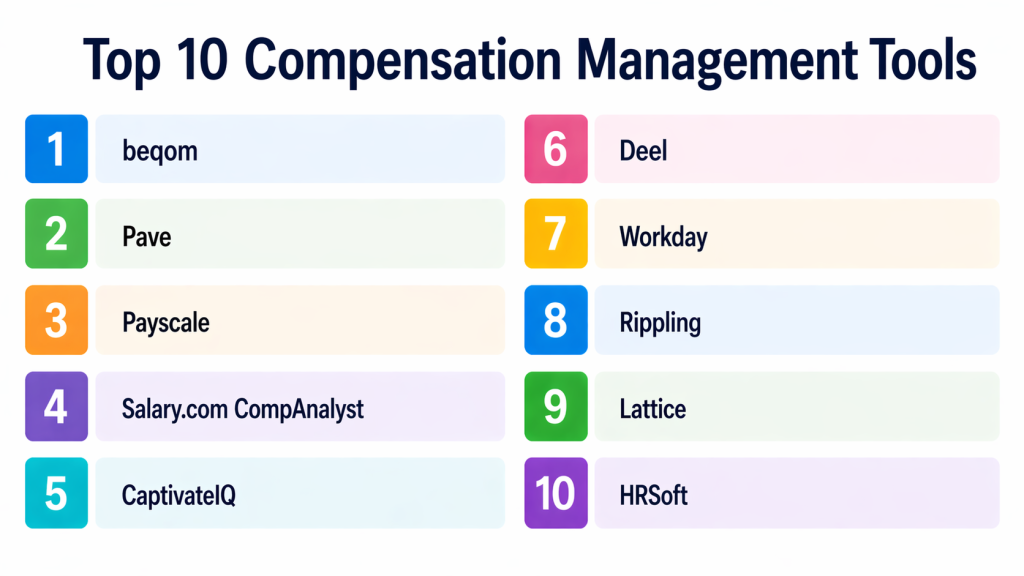
Top 10 Compensation Management Tools
1 — beqom
Short description:
beqom is an enterprise compensation management platform offering advanced planning, analytics, and automation. It supports global compensation strategies and complex pay structures. It is designed for large organizations. It provides strong scalability.
Key Features
- Compensation planning
- Pay equity analysis
- Bonus management
- Analytics
- Automation
Pros
- Enterprise-grade
- Highly scalable
Cons
- Complex implementation
- Expensive
Platforms / Deployment
Web
Cloud
Security & Compliance
Encryption, access control
Integrations & Ecosystem
- HR systems
- ERP platforms
Support & Community
Enterprise support.
2 — Pave
Short description:
Pave is a modern compensation platform focused on real-time benchmarking and transparency. It helps companies design competitive compensation packages. It is widely used by startups and tech companies. It provides strong analytics.
Key Features
- Compensation benchmarking
- Salary planning
- Analytics
- Equity tracking
- Reporting
Pros
- Modern interface
- Real-time data
Cons
- Limited enterprise depth
- Pricing varies
Platforms / Deployment
Web
Cloud
Security & Compliance
Encryption, access control
Integrations & Ecosystem
- HR tools
- APIs
Support & Community
Growing support.
3 — Payscale
Short description:
Payscale provides compensation data and benchmarking tools to help businesses set competitive salaries. It is widely used across industries. It offers strong analytics and reporting. It is suitable for SMBs and enterprises.
Key Features
- Salary benchmarking
- Compensation planning
- Reporting
- Analytics
- Market data
Pros
- Strong data insights
- Easy to use
Cons
- Limited automation
- Subscription cost
Platforms / Deployment
Web
Cloud
Security & Compliance
Encryption, access control
Integrations & Ecosystem
- HR systems
- Data tools
Support & Community
Good support.
4 — Salary.com CompAnalyst
Short description:
CompAnalyst by Salary.com is a compensation management tool focused on salary benchmarking and analytics. It provides market data and planning tools. It is suitable for mid-market and enterprise organizations. It offers detailed insights.
Key Features
- Salary benchmarking
- Compensation planning
- Reporting
- Analytics
- Market data
Pros
- Detailed insights
- Strong benchmarking
Cons
- Complex interface
- Pricing varies
Platforms / Deployment
Web
Cloud
Security & Compliance
Encryption, access control
Integrations & Ecosystem
- HR systems
- Data platforms
Support & Community
Good support.
5 — CaptivateIQ
Short description:
CaptivateIQ is a commission and incentive management platform. It helps businesses manage sales compensation. It offers automation and analytics. It is ideal for sales-driven organizations.
Key Features
- Commission tracking
- Incentive management
- Reporting
- Analytics
- Automation
Pros
- Strong commission tools
- Flexible
Cons
- Limited general compensation features
- Learning curve
Platforms / Deployment
Web
Cloud
Security & Compliance
Encryption, access control
Integrations & Ecosystem
- CRM systems
- Sales tools
Support & Community
Good support.
6 — Deel
Short description:
Deel offers global payroll and compensation management for distributed teams. It supports international hiring and payments. It is suitable for remote-first companies. It provides compliance features.
Key Features
- Global payroll
- Compensation management
- Compliance
- Reporting
- Automation
Pros
- Global capabilities
- Easy to use
Cons
- Pricing varies
- Limited advanced planning
Platforms / Deployment
Web
Cloud
Security & Compliance
Encryption, compliance
Integrations & Ecosystem
- HR tools
- Payment systems
Support & Community
Strong support.
7 — Workday
Short description:
Workday provides enterprise-level compensation management integrated with HR systems. It supports complex compensation structures and global operations. It offers analytics and automation. It is ideal for large organizations.
Key Features
- Compensation planning
- Analytics
- Reporting
- Automation
- Global support
Pros
- Enterprise-grade
- Scalable
Cons
- Expensive
- Complex implementation
Platforms / Deployment
Web
Cloud
Security & Compliance
Encryption, compliance
Integrations & Ecosystem
- ERP systems
- HR tools
Support & Community
Enterprise support.
8 — Rippling
Short description:
Rippling combines HR, payroll, and compensation management in one platform. It offers automation and integration. It is suitable for growing businesses. It provides flexibility.
Key Features
- Compensation management
- Payroll
- HR automation
- Reporting
- Integration
Pros
- All-in-one
- Strong integrations
Cons
- Pricing complexity
- Learning curve
Platforms / Deployment
Web
Cloud
Security & Compliance
Encryption, access control
Integrations & Ecosystem
- HR systems
- IT tools
Support & Community
Good support.
9 — Lattice
Short description:
Lattice is a performance management platform with compensation planning features. It helps align compensation with performance. It is suitable for mid-market companies. It offers analytics.
Key Features
- Compensation planning
- Performance management
- Reporting
- Analytics
- Reviews
Pros
- Performance integration
- Easy to use
Cons
- Limited advanced compensation
- Pricing varies
Platforms / Deployment
Web
Cloud
Security & Compliance
Encryption, access control
Integrations & Ecosystem
- HR tools
- Performance systems
Support & Community
Good support.
10 — HRSoft
Short description:
HRSoft provides compensation management solutions for enterprises. It supports salary planning, bonus management, and analytics. It offers automation and compliance features. It is suitable for large organizations.
Key Features
- Compensation planning
- Bonus management
- Reporting
- Analytics
- Automation
Pros
- Strong enterprise features
- Good automation
Cons
- Complex setup
- Limited SMB features
Platforms / Deployment
Web
Cloud
Security & Compliance
Encryption, compliance
Integrations & Ecosystem
- HR systems
- ERP
Support & Community
Enterprise support.
Comparison Table
| Tool Name | Best For | Platforms Supported | Deployment | Standout Feature | Public Rating |
|---|---|---|---|---|---|
| beqom | Enterprise | Web | Cloud | Advanced planning | N/A |
| Pave | Startups | Web | Cloud | Real-time benchmarking | N/A |
| Payscale | SMB | Web | Cloud | Market data | N/A |
| CompAnalyst | Mid-market | Web | Cloud | Salary insights | N/A |
| CaptivateIQ | Sales teams | Web | Cloud | Commission mgmt | N/A |
| Deel | Global teams | Web | Cloud | Global payroll | N/A |
| Workday | Enterprise | Web | Cloud | Scalability | N/A |
| Rippling | SMB | Web | Cloud | All-in-one | N/A |
| Lattice | Mid-market | Web | Cloud | Performance link | N/A |
| HRSoft | Enterprise | Web | Cloud | Automation | N/A |
Evaluation and Scoring of Compensation Management Tools
| Tool Name | Core 25% | Ease 15% | Integrations 15% | Security 10% | Performance 10% | Support 10% | Value 15% | Weighted Total |
|---|---|---|---|---|---|---|---|---|
| beqom | 9 | 6 | 9 | 9 | 9 | 8 | 6 | 8.2 |
| Pave | 8 | 9 | 8 | 8 | 8 | 8 | 8 | 8.2 |
| Payscale | 8 | 9 | 7 | 8 | 8 | 8 | 8 | 8.1 |
| CompAnalyst | 8 | 7 | 7 | 8 | 8 | 8 | 7 | 7.7 |
| CaptivateIQ | 8 | 8 | 8 | 8 | 8 | 8 | 7 | 7.9 |
| Deel | 8 | 9 | 8 | 8 | 8 | 8 | 8 | 8.2 |
| Workday | 9 | 6 | 9 | 9 | 9 | 8 | 6 | 8.2 |
| Rippling | 8 | 8 | 9 | 8 | 8 | 8 | 8 | 8.2 |
| Lattice | 7 | 9 | 7 | 8 | 8 | 8 | 8 | 7.9 |
| HRSoft | 8 | 7 | 8 | 8 | 8 | 8 | 7 | 7.9 |
These scores are comparative and help evaluate tools based on features and usability.
Which Compensation Management Tool Is Right for You
Solo / Freelancer
Not required; basic payroll tools are sufficient.
SMB
Pave, Payscale, and Rippling are ideal.
Mid-Market
Lattice and CompAnalyst provide balance.
Enterprise
beqom, Workday, and HRSoft are best.
Budget vs Premium
Pave is budget-friendly, beqom is premium.
Feature Depth vs Ease of Use
Pave is easy, Workday is advanced.
Integrations and Scalability
Rippling and Workday excel.
Security and Compliance Needs
beqom and HRSoft are strong.
Frequently Asked Questions
1. What are compensation management tools?
These tools help manage salaries, bonuses, and incentives. They automate compensation planning. They improve decision-making.
2. Why do businesses need them?
They ensure fair and competitive pay. They improve transparency. They reduce manual work.
3. Do these tools support pay equity?
Yes, many tools provide pay equity analysis. They help ensure compliance. They reduce bias.
4. Are they suitable for small businesses?
Some tools are designed for SMBs. Others are enterprise-focused. Choose based on needs.
5. Can they integrate with HR systems?
Yes, integration is common. It ensures smooth workflows. It improves accuracy.
6. Do they support automation?
Yes, automation is a key feature. It includes compensation cycles. It saves time.
7. Are they secure?
Most tools offer encryption and compliance features. Security depends on provider. Businesses should evaluate.
8. What are common challenges?
Implementation complexity and pricing are common. Data accuracy is also important. Planning helps.
9. Can startups use them?
Yes, tools like Pave are ideal. They offer flexibility. They support growth.
10. Which tool is best?
No single tool is best. It depends on needs. Testing tools is recommended.
Conclusion
Compensation Management Tools play a critical role in helping organizations design fair, competitive, and data-driven compensation strategies. These platforms replace manual processes with structured workflows, improving accuracy, transparency, and efficiency in compensation planning.
Enterprise solutions like beqom, Workday, and HRSoft provide advanced capabilities for managing complex global compensation structures. Mid-market tools such as Lattice and CompAnalyst offer a strong balance between usability and functionality. For startups and growing companies, Pave and Payscale provide modern, easy-to-use solutions with strong benchmarking features. The right tool depends on your organization’s size, compensation complexity, and integration requirements.
It is important to evaluate analytics, automation, and scalability before selecting a platform.
Running a pilot can help validate usability and real-world performance. A well-implemented compensation system improves employee satisfaction and retention.